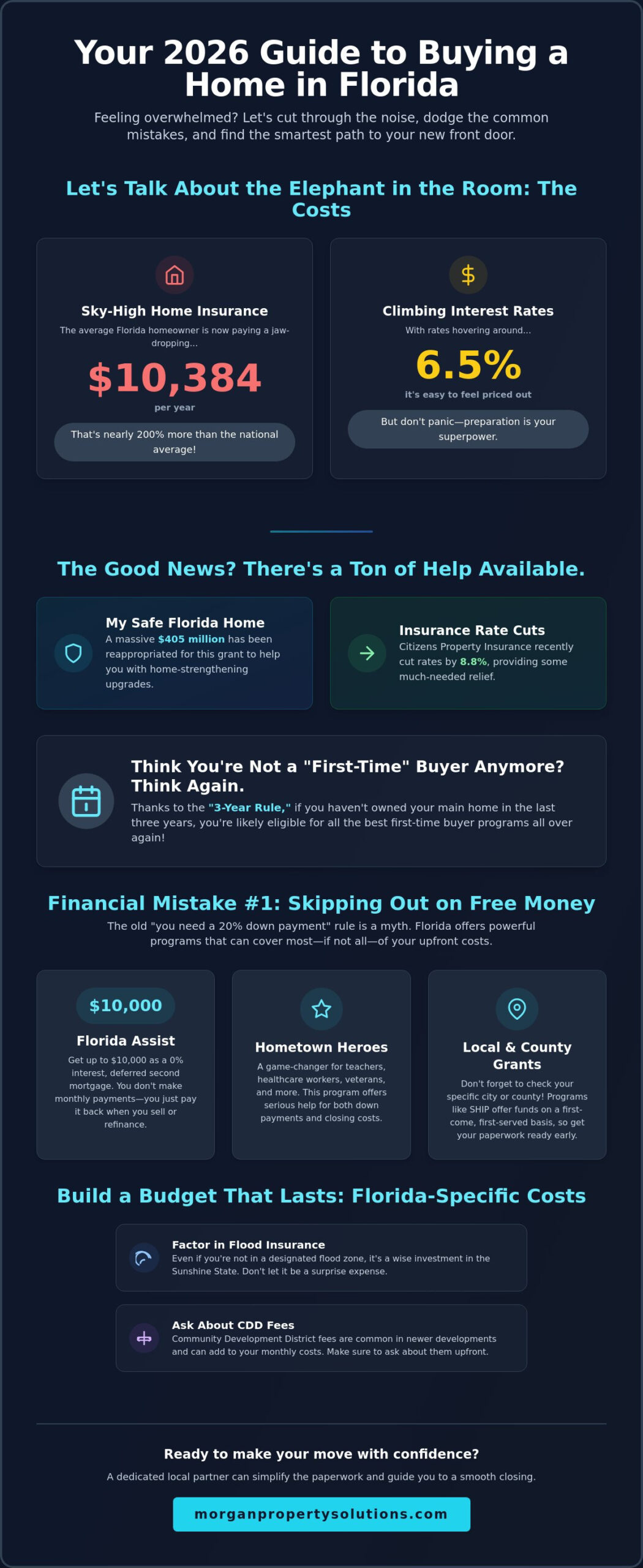
Did you know that the average Florida homeowner is now paying roughly $10,384 a year for property insurance? That is nearly 200% more than the national average, and it is a massive shock for anyone trying to budget for their first house. If you feel like the dream of owning a home is slipping away because of rising costs, you aren’t alone. It is easy to get overwhelmed by interest rates sitting near 6.5% or the confusing jargon found in a standard contract. Avoiding common first time home buyer mistakes florida residents often fall into is the first step toward securing your future.
We understand that this transition feels complex, but there is plenty of good news to help balance the scales. This article provides a clear roadmap to help you dodge expensive financial traps while taking advantage of the latest 2026 assistance programs. You will learn how to leverage the $405 million reappropriated for the My Safe Florida Home grant and how to navigate the recent 8.8% rate cuts from Citizens Property Insurance. We have distilled the process into manageable steps so you can stop worrying about hidden fees and start focusing on your new front door with confidence.
Key Takeaways
- Learn how to access 2026 state grants and the Florida Assist program to lower your upfront costs without needing a 20% down payment.
- Discover how to avoid the most expensive first time home buyer mistakes florida residents face, including the critical difference between pre-qualification and pre-approval.
- Find out if you qualify for the “3-year rule,” which could label you as a first-time buyer even if you’ve owned a home before.
- Understand the reality of Florida-specific expenses like flood insurance and CDD fees so you can build a budget that actually lasts.
- See how a dedicated local partner in Central Florida can simplify complex paperwork and guide you through a smooth closing process.
Navigating the Emotional Rollercoaster of Buying Your First Florida Home
Buying your first home in the Sunshine State is a massive milestone, but it is also completely normal to feel like you are on a rollercoaster of excitement and anxiety. In 2026, the Central Florida market presents a unique set of challenges and opportunities. One of the most common first time home buyer mistakes florida residents make is letting the fear of a complex process stall their progress entirely. Whether you are tired of rising rents in Orlando or just want a place to call your own in Lake Nona, moving from a rental mindset to an owner mindset requires a shift in how you view long-term stability. While renting is often about temporary convenience, owning is about building an asset that grows with you over time.
Setting realistic expectations is vital in a market as competitive as ours. You might not find a “perfect” house on your first tour, but finding a solid home that fits your current needs is a powerful step toward wealth building. The key is to stay calm and focused on facts rather than scary headlines. Success in 2026 is about being prepared and having a clear plan before you even start looking at listings. By understanding the local landscape, you can approach the journey with a sense of partnership and ease.
Defining the 2026 First-Time Home Buyer
You might be surprised to learn that you don’t actually have to be buying a home for the very first time to qualify for special programs. According to HUD guidelines, a first-time homebuyer is anyone who hasn’t owned a principal residence in the last three years. This “3-year rule” is a game-changer for many. It means if you sold a home years ago and have been renting since, you are likely eligible for 2026 state grants and down payment assistance again. Before you start touring houses in Clermont or Winter Garden, check your eligibility status. Knowing exactly where you stand helps you avoid predatory lending practices that often target those who feel they have limited financing options.
Why Central Florida is Still a Hotspot
Growth in areas like Wedgefield and Winter Garden isn’t slowing down. While some people are waiting for a market “crash” to find a bargain, history shows that waiting often leads to higher prices and missed equity. In 2026, we see a healthy balance of inventory and demand in suburbs like Clermont and Lake Nona. Local expertise is your best defense against market shifts. Having a partner like Morgan Property Solutions Inc. by your side ensures you have a tactical advisor who understands these local neighborhoods. You can learn more about our team and our approach to supportive guidance on our About page. We focus on distilling the complex parts of the journey into manageable steps so you can move forward with confidence.
Financial Mistake #1: Ignoring Florida’s 2026 Assistance Programs
Thinking you need a 20% down payment is a major hurdle that keeps many qualified people from entering the market. In reality, most buyers use significantly less, often as little as 3.5% for FHA loans. Overlooking the financial aid available is one of the most common first-time homebuyer mistakes that can cost you thousands in the long run. When you analyze first time home buyer mistakes florida residents often make, failing to research state-specific assistance is at the top of the list.
Florida offers several robust programs in 2026 designed to bridge the gap between your savings and the purchase price. The key is understanding how to “stack” these options. You can often combine state-level loans with local city or county grants to cover nearly all your upfront costs. This tactical approach turns a stressful financial burden into a manageable series of steps. We focus on making these complex financial tools easy to understand so you can move forward with confidence.
Statewide Heavyweights: Florida Assist and Hometown Heroes
The Florida Assist program is a powerful tool for 2026. It provides up to $10,000 as a deferred second mortgage to help with your down payment. This isn’t a traditional loan; it carries 0% interest and requires no monthly payments. You only repay it when you sell the home, refinance, or move. It is a great way to keep your monthly budget stable while securing a property.
The Hometown Heroes program is another game-changer. It was specifically expanded to support those who serve our communities, such as teachers, healthcare workers, and veterans. This program offers even more substantial assistance, often helping with both down payments and closing costs. Understanding the difference between a grant, which you don’t pay back, and a deferred loan, which you pay back later, helps you make the best choice for your financial future.
Local Gems: Orlando and Orange County Grants
Don’t stop at the state level. Local programs like the SHIP (State Housing Initiatives Partnership) program provide funding that is specific to your county. These funds are usually distributed in cycles and are strictly first-come, first-served. To get in line, you need your paperwork ready before the funding window opens. The 2026 income limits for a family of four in Orange County are determined by the area’s median income and were recently updated in June 2026 to reflect current economic conditions. If you want to stay ahead of these deadlines, reading our latest market updates can give you the edge you need.
Mortgage and Credit Slip-Ups That Can Derail Your Closing
Many people think getting a pre-qualification letter is the finish line for their financial prep. It isn’t. A pre-qualification is essentially a “maybe” from a lender based on unverified info you provide over the phone. A pre-approval is the real deal. It involves a deep dive into your tax returns, bank statements, and credit history. If you want to avoid common first time home buyer mistakes florida buyers encounter, get that pre-approval early. It gives you the confidence to make an offer that actually sticks in a fast-moving market like Orlando or Lake Nona.
You don’t need a perfect 800 credit score, but 2026 program eligibility often hinges on specific tiers. Most state programs look for a middle score around 640. While you are waiting for the right house, avoid the temptation to buy a new car or open a big credit line for furniture. A new car payment can slash your home buying power by tens of thousands of dollars because of your Debt-to-Income (DTI) ratio. Think of DTI as the percentage of your monthly pre-tax income that goes toward paying debts. Lenders generally want to see this number stay below 43% to 45% for most conventional loans.
While you work on your local mortgage plans, it is always helpful to maintain a high-level view of your overall financial strategy. If you are looking for professional consultancy to optimize your long-term fiscal health, check out Engage Financial Solutions.
Getting Your Financial House in Order
Improving your score doesn’t have to take years. Paying down credit card balances to under 30% of their limit can often bump your score by 20 to 30 points in just a few months. It’s also smart to look at screening criteria to understand how professionals evaluate risk. This helps you see your finances through a lender’s eyes before you apply. Start gathering your “paper trail” now. You’ll need tax returns from the last two years and your most recent pay stubs to satisfy 2026 underwriting requirements. Being organized early prevents the last-minute scramble that often delays closings.
The Mandatory Education Requirement
Most Florida assistance programs, including Florida Assist, require you to take a certified homebuyer education class. Don’t view this as a chore. It is actually a helpful way to learn about the closing process and how to manage your home after you move in. More importantly, that certificate is the key that unlocks thousands of dollars in state aid. Most courses are available online and can be finished in a single Saturday. It is one of the easiest steps you can take to ensure you remain eligible for the 2026 grants we discussed earlier. Taking this class early in the process is a smart way to dodge first time home buyer mistakes florida residents often face when trying to secure funding at the last minute.
Sunshine State Specifics: Don’t Overlook Florida-Only Property Traps
Florida living is beautiful, but it comes with unique fine print that can catch you off guard. One of the biggest first time home buyer mistakes florida residents make is assuming a “Zone X” flood designation means they are completely safe from water damage. In 2026, we’ve seen that heavy summer rains can affect almost any neighborhood, regardless of what the federal maps say. Don’t let a flood zone fumble ruin your first year of ownership. It’s always better to get a quote for flood insurance early so you know exactly what your “all-in” monthly payment looks like.
Another local trap involves the difference between HOA and CDD fees. While most people expect a Homeowners Association fee, many newer developments in Central Florida also have a Community Development District (CDD) fee. These fees pay for the infrastructure of the neighborhood, like the roads and streetlights. They are often included in your property tax bill, which can lead to a nasty surprise if you only looked at the base tax rate. We help our clients distill these complex costs into manageable numbers so there are no shocks at the closing table.
Inspections and Insurance in 2026
A standard home inspection is a great start, but it isn’t enough for a Florida house. You absolutely need a Wind Mitigation report and a 4-Point inspection. These documents are vital for securing homeowners insurance, which currently averages between $5,500 and $11,000 annually across the state. A strong Wind Mitigation report proves your roof and windows can handle high winds, which can significantly lower your premiums. If you’re looking at a home as a long-term investment or considering Orlando property management for a future rental, these inspections protect your bottom line. You can also look into the My Safe Florida Home program, which has $405 million available for the 2026-2027 cycle to provide grants up to $10,000 for hurricane-hardening improvements.
Neighborhood Nuance: From Winter Park to Windermere
Property taxes can vary wildly depending on which side of a county line you buy on. Under the new SB 4F law that took effect on June 24, 2026, local governments now need a two-thirds vote to raise tax rates above the “rolled-back” rate. This provides some helpful stability for your budget. However, forgetting to file for your Homestead Exemption by the March 1st deadline is a mistake that can cost you thousands. You should also keep an eye on the November 2026 ballot for a proposed increase to this exemption. Whether you are looking in Winter Park or Windermere, local knowledge prevents “buyer remorse” after your first hurricane season. Our team at Morgan Property Solutions Inc. provides expert Real Estate Buyer Representation to ensure you navigate these Florida-specific hurdles with total confidence.
How a Local Central Florida Partner Simplifies Your Journey
Finding the right house is just the beginning of your journey. The real work happens between that initial offer and the day you finally get your keys. Many first time home buyer mistakes florida residents encounter stem from treating a Realtor like a tour guide rather than a tactical advisor. You need someone who can spot a problematic roof from the street or explain why a particular neighborhood’s fees are structured a certain way. Morgan Property Solutions Inc. bridges the gap between searching and closing by providing a steady, experienced presence. We help you move from being a tenant to an owner with a clear, supportive plan that removes the mystery from the process.
Our team looks at every property with a dual perspective. We don’t just see a living space; we see a long-term investment. Even if you plan to stay in your new home for a decade, understanding how maintenance needs and market values will shift in Central Florida is vital. We focus on distilling the complex parts of the transaction into manageable steps so you can focus on the excitement of your new home. By having an ally who understands the local landscape in 2026, you avoid the anxiety that often comes with such a significant transition.
The Morgan Property Solutions Inc. Difference
With over 20 years of Central Florida history, we have a deep understanding of how this market evolves. We have a special focus on first-time buyers because we know how transformative that first purchase is for a family’s financial future. A key part of our approach is helping you “stack” the programs we discussed earlier, ensuring you don’t miss out on state or local aid. Because we understand both the buying and management sides of real estate, we help you choose a home that will be a stable asset for years. You can meet our 2026 support team on our About page to see how we prioritize reliable care and professional guidance.
Your Next Steps: The 6-Month Plan
We suggest starting your home-buying conversation at least six months before your current lease ends. This window gives us plenty of time to review your credit, organize your “paper trail” for underwriting, and ensure all your education requirements are met without any last-minute stress. We provide a custom list of properties in areas like Orlando, Lake Nona, and Clermont that actually align with your budget and goals. If you are ready to move past the common first time home buyer mistakes florida is known for, we invite you to a no-pressure 2026 planning consultation to start mapping out your path today.
Ready to Secure Your Piece of the Sunshine State?
Owning a home in Florida is a journey that requires both heart and a solid strategy. By now, you know that the path to success isn’t just about finding a house you love. It’s about avoiding the first time home buyer mistakes florida residents often make, like skipping local grants or ignoring the nuances of flood zones and property tax exemptions. Whether you are “stacking” state aid like Florida Assist or preparing your finances for a 2026 pre-approval, being proactive is your greatest advantage.
With over 20 years of combined Central Florida experience, we pride ourselves on being more than just a service provider. We are your steady allies in neighborhoods like Orlando, Lake Nona, and Clermont. Our team has the deep expertise needed to navigate complex Florida Housing grants and the local property traps that can stall your progress. We are here to simplify every step of the transition for you.
Start your Central Florida home search with a team that knows the programs. You have the tools and the knowledge to move forward with total confidence; now it’s time to find the front door that belongs to you.
Frequently Asked Questions
What is the minimum credit score for Florida first-time home buyer programs in 2026?
You generally need a middle credit score of at least 640 to qualify for most Florida Housing Finance Corporation programs in 2026. While some FHA loans might allow for lower scores, the 640 threshold is the standard for accessing down payment assistance grants and deferred loans. It is a good idea to check your score early so you have time to make adjustments if you are just below that mark.
Can I get down payment assistance if I have owned a home in another state before?
Yes, you can still qualify as a first-time buyer if it has been more than three years since you last owned a principal residence. This rule applies regardless of whether your previous home was in Florida or another state. This flexibility is one of the ways the state helps people re-enter the market after a period of renting. It is a common way to avoid first time home buyer mistakes florida residents make by assuming they are ineligible.
How much money do I actually need to save for a house in Orlando if I use grants?
Even with grants, you should aim to have at least 1% to 3% of the purchase price saved for items that assistance doesn’t always cover. In Orlando, where the median price is around $388,000, this means having about $4,000 to $11,000 in the bank. While programs like Florida Assist cover down payments, you will still need cash for things like earnest money deposits, home inspections, and initial appraisal fees before you get to the closing table.
Are there specific programs for teachers or first responders in Central Florida?
The Hometown Heroes program is specifically designed for frontline workers, including teachers, police officers, and healthcare professionals. In 2026, this program continues to offer substantial assistance for down payments and closing costs to those who serve the Central Florida community. It is a powerful tool that helps local heroes afford homes in the very neighborhoods where they work. This program is often the best way to bridge the affordability gap in a competitive market.
Do I have to pay back the Florida Assist down payment loan?
You do have to pay back the Florida Assist loan, but the terms are very buyer-friendly. It is a 0% interest, non-amortizing second mortgage, which means you don’t make monthly payments on it. The full balance is only due when you sell the home, refinance your primary mortgage, or no longer live in the property as your main residence. This structure helps keep your monthly housing costs as low as possible during your years of ownership.
How long does the approval process take for Florida Housing programs?
The approval for Florida Housing programs usually runs parallel to your standard mortgage timeline, which typically takes between 30 and 45 days. However, because these programs require extra documentation and a specific education certificate, it is smart to start the process as early as possible. Being organized with your tax returns and pay stubs will help prevent delays. Working with a lender who is already familiar with these state-specific requirements can also speed things up.
Can I use these programs for a condo or townhouse in Winter Park or Lake Nona?
You can definitely use these programs for condos and townhouses in areas like Winter Park or Lake Nona, provided the property meets specific FHA or conventional guidelines. Not every condo complex is approved for every type of loan, so it is important to verify the building’s status early in your search. Townhouses are often easier to qualify for because they are frequently treated like single-family homes in the eyes of many lenders and assistance programs.
What is the biggest mistake people make during the Florida home inspection?
The biggest mistake is skipping the Wind Mitigation and 4-Point inspections in favor of just a standard home inspection. In Florida, these two specific reports are what determine your insurance eligibility and your final premium costs. Without them, you might find yourself with an uninsurable home or a monthly bill that is double what you expected. Getting these done during your due diligence period is the best way to avoid expensive first time home buyer mistakes florida buyers often regret.

Article by
Oliver Overton-Morgan
Oliver Overton-Morgan is a full-time Real Estate Broker since 2003, with years of experience helping thousands of people purchase and sell real estate throughout Central Florida. He holds a Graduate Realtor Institute designation, LCAM, and has held licenses in good standing as a Florida Mortgage Broker and a Notary Public. Oliver immigrated to central Florida in 2001, and within 5 years Oliver built a successful Real Estate brokerage in central Florida, where he recruited over 75 Sales Associates with 25+ million in sales production.