
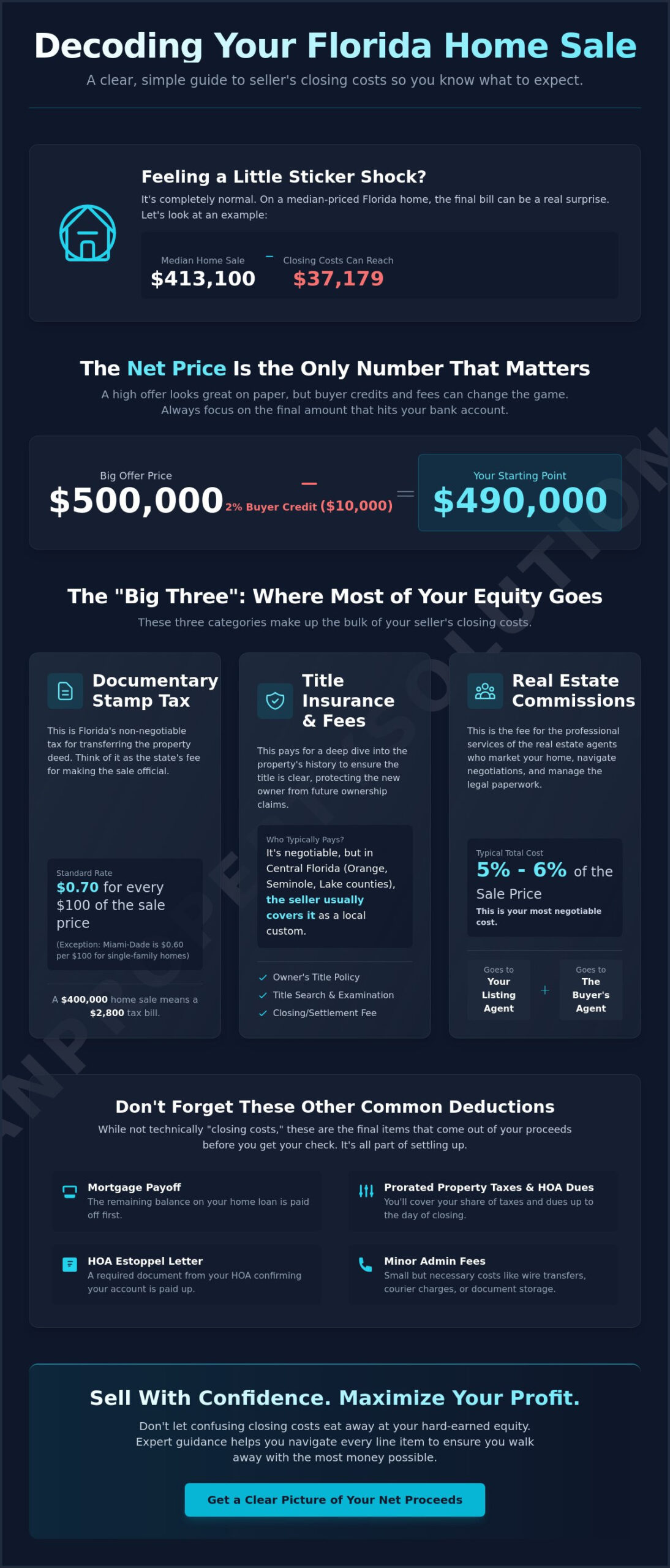
Did you know that on a median-priced home of $413,100, your final bill at the closing table could reach as high as $37,179? It’s a staggering figure that catches many homeowners off guard. Selling a home is a major milestone, but the excitement often fades when you see the final settlement statement for the first time. Feeling a bit of sticker shock or confusion when looking at the breakdown of seller’s closing costs in Florida is completely normal. You’ve worked hard to build equity, and seeing it chipped away by taxes and fees can feel overwhelming.
We’re here to help you replace that uncertainty with total confidence. You’ll learn exactly how much you’ll walk away with after the sale is final, from Doc Stamps to commission splits. This guide provides a clear, line-item breakdown of Florida-specific expenses and offers strategies to help you maximize your net profit. We’ll walk through the process together so you can ensure you aren’t being overcharged and that every dollar of your equity is protected.
Key Takeaways
- Understand exactly how Florida’s Documentary Stamp Tax and other mandatory state fees impact your bottom line based on the latest 2026 rates.
- Get a transparent look at seller’s closing costs in florida, including how title insurance and commission structures are negotiated in today’s market.
- Identify specific Central Florida customs in counties like Orange County that determine whether you or the buyer should pay for certain closing line items.
- Learn the step-by-step math to calculate your true net proceeds by accurately accounting for mortgage payoffs, HOA estoppels, and tax prorations.
- Discover how expert guidance can help you avoid common administrative hurdles and maximize the final check you receive at the end of the sale.
Understanding Seller’s Closing Costs in Florida: What to Expect in 2026
Closing costs are the final hurdle between you and your payday. They represent a mix of taxes, administrative fees, and professional commissions that get settled when the property officially changes hands. In the Sunshine State, the way these costs are divided isn’t set in stone. It often comes down to local county customs and how well you negotiate your contract. As we move through 2026, the market has shifted toward much higher transparency, especially regarding how title insurance and agent commissions are handled. Understanding your seller’s closing costs in florida is the first step toward a stress-free exit from your property.
Many sellers feel a sense of dread when they see the list of line items on a settlement statement. It’s helpful to remember that these aren’t just random fees. They are the essential payments that ensure the title is clear and the transfer is legally binding. By knowing what to expect, you can plan your next move with a clear financial picture. You can find more details in our real estate articles to help you prepare. You won’t have to guess if you have enough for your next down payment or your moving expenses. Instead, you’ll have a roadmap for your equity.
Why the Net Price is the Only Number That Matters
Common Misconceptions: Commissions vs. Closing Costs
It’s common for sellers to lump everything into one bucket, but there’s a distinction between real estate commissions and settlement fees. Commissions are usually the largest expense, but they’re technically separate from the seller’s closing costs in florida like documentary stamps or recording fees. Even if you were to sell your home without an agent, you’d still face significant expenses due to state taxes and title requirements. The good news is that you rarely have to bring cash to the table. These expenses are simply deducted from your sale proceeds at the very end. You won’t be writing a check; you’ll just be receiving one that is slightly smaller than the sale price.
The Big Three: Taxes, Title Fees, and Commissions
While every closing statement looks a little different, three main categories usually make up the bulk of your expenses. Understanding these helps you see exactly where your equity is going. These aren’t just arbitrary numbers; they are the essential costs of legally and safely transferring your property. When you calculate your seller’s closing costs in florida, you’ll find that these “big three” account for nearly all of the deductions from your final check.
Florida Documentary Stamp Taxes (The Deed Tax)
Documentary Stamp Tax is a state excise tax on the transfer of real property. In most of Florida, the rate is $0.70 for every $100 of the sale price. If you’re selling in Miami-Dade, you get a slight break at $0.60 per $100 for single-family homes. A quick way to estimate this is to drop two zeros from your sale price and multiply by 0.7. For a $400,000 home, that’s $2,800. It’s a mandatory cost, so there’s no negotiating this one with the state.
Title Insurance and Search Fees: Who Pays?
In Central Florida counties like Orange, Seminole, and Lake, custom dictates that the seller pays for the owner’s title insurance policy. This policy protects the buyer if someone else claims they own the house later. The title company also performs a “Title Search” to find old liens or unpaid taxes. You’ll also see a “Closing Fee” on the statement. This covers the title agent’s time spent coordinating with lenders and recording the deed. Using a Florida Seller Closing Costs Calculator can give you a more precise estimate based on your specific county’s requirements.
Real Estate Commissions: The Largest Expense
This is usually the largest part of your seller’s closing costs in florida. While the total often lands between 5% and 6%, it’s important to remember that this fee is split between the listing agent and the buyer’s agent. This money pays for professional photography, yard signs, and the legal liability your agent carries to keep the deal on track. Since this is a service fee rather than a tax, it’s often the most negotiable part of your closing statement. If you’re feeling overwhelmed by these numbers, reaching out for Real Estate Seller Representation can help you navigate the fine print and ensure you’re getting the best possible terms.
Administrative and “Junk” Fees
Lastly, watch out for smaller administrative fees. These might include wire fees, courier charges, or electronic storage fees. Most of these are legitimate costs of doing business, but they should be reasonable. If you see a fee that isn’t clearly explained, don’t be afraid to ask for a breakdown. Most title companies are happy to clarify why a specific charge is on your statement. Keeping a close eye on these smaller items ensures you aren’t paying more than you strictly need to at the closing table.
Central Florida Nuances: Local Customs and Negotiables
Florida is a massive state, and real estate “rules” often change the moment you cross a county line. What’s standard in Miami might be unheard of in Orlando. If you’re selling a home in a community like Lake Nona or Winter Park, you need to understand the specific local customs that dictate who pays for what. These traditions have a direct impact on your seller’s closing costs in florida, and knowing them ahead of time prevents last-minute surprises at the closing table.
County Rules: Why Orlando Differs from Miami
In Central Florida counties like Orange and Seminole, the seller traditionally picks the title company and pays for the owner’s title insurance policy. This is a major contrast to South Florida, where the buyer often makes that choice. Because you are the one selecting the provider in the Orlando area, you have more control over the administrative fees associated with the search. Choosing a reputable, local title company can sometimes lead to smoother communication and fewer delays, which keeps your transition on schedule. It’s a subtle difference, but it’s one of the most important regional nuances to keep in mind.
HOA Prorations and Estoppel Fees
Most neighborhoods in our region are governed by a Homeowners Association. When you sell, the HOA charges an “Estoppel Fee” to certify that your account is current and there are no outstanding violations. These fees typically range from $100 to $500. Beyond the certificate, your dues are prorated to the exact day of closing. If you’ve already paid your $400 monthly fee but close on the 15th, you’ll see a $200 credit coming back to you. However, you should also look out for “Capital Contribution” fees. Some associations charge these one-time fees to new owners, but buyers often try to negotiate for the seller to cover them. This is a common point where you can stand your ground to protect your profit.
What Can You Actually Negotiate with the Buyer?
Most residential deals in the Sunshine State use the “As-Is” contract. While this technically means you aren’t required to make repairs, buyers in the 2026 market still frequently ask for “Seller Credits” after a home inspection. If a roof is nearing the end of its life, a buyer might ask for $10,000 off the price. One smart way to handle this without losing your shirt is by offering a one-year home warranty instead. It’s a relatively low-cost tool that provides the buyer with peace of mind without a massive deduction from your equity. Remember, almost every line item in your seller’s closing costs in florida is negotiable, provided you understand the leverage you have in the current market.
Property taxes also require careful attention. Since Florida taxes are paid in arrears, you’ll owe the buyer a credit for the portion of the year you lived in the home. If you close in July, you’ll be giving the buyer a credit for roughly seven months of taxes because they will receive the full bill in November. This isn’t “lost” money, it’s just settling your portion of the annual bill early. Keeping these details in mind ensures you’re looking at your net proceeds with total clarity.
Calculating Your Net Proceeds: The Math of the Sale
Calculating your final check shouldn’t feel like a guessing game. It’s about starting with the big number on the contract and methodically peeling away the layers of financial responsibility. While earlier sections covered the “why” behind specific fees, this is where we look at the actual arithmetic of your seller’s closing costs in florida. To get an accurate picture, you have to look past the sale price and focus on the math of the transfer.
Let’s look at a real-world example for a home in Winter Garden selling for $450,000. After you subtract a standard commission, you’ll need to account for state documentary stamps and the owner’s title insurance policy based on the current rates. If you add in an HOA estoppel fee and a settlement fee, your costs before the mortgage payoff can easily approach $33,000. This is why we emphasize looking at the net proceeds rather than the gross offer. If you want a team to walk you through these numbers personally, the experts at Morgan Property Solutions Inc. provide professional Real Estate Seller Representation to ensure you have a clear financial roadmap from day one.
The 2% to 5% Rule of Thumb (Beyond Commissions)
While commissions are a significant part of the deal, you should budget an additional 2% to 5% of the sale price for taxes and administrative fees. This “rule of thumb” helps you avoid sticker shock when the title company sends over the preliminary settlement statement. You’ll likely see these five common line items on your Closing Disclosure:
- State Documentary Stamp Taxes on the deed.
- Owner’s Title Insurance Policy premium.
- Title search and municipal lien search fees.
- HOA estoppel fees and prorated dues.
- Recording fees for the satisfaction of your current mortgage.
It’s also smart to keep a small “buffer” of about $500 to $1,000. This covers last-minute utility finalizations or minor repair credits that might pop up during the final walkthrough.
Handling Mortgage Payoffs and Interest
Your mortgage payoff is almost always higher than the balance shown on your last monthly statement. This happens because mortgage interest is paid in arrears. If you close on the 15th of the month, you owe interest for those 15 days that hasn’t been billed yet. The title company will request a formal payoff letter from your lender that includes this “per diem” interest to ensure the loan is fully satisfied. You’ll also pay a small recording fee to officially show the county that the mortgage has been discharged. If you have a tax escrow account, those funds usually aren’t part of the closing math. Instead, your lender will mail you a refund check for that balance a few weeks after the sale is complete.
Don’t forget to account for any outstanding liens or back taxes. If you have a pending municipal assessment for a new sidewalk or a sewer connection, that balance must be settled at the table. By accounting for these details early, you can walk into your closing with the confidence that the number on your check is exactly what you expected.
Maximizing Your Profit with Morgan Property Solutions Inc.
Selling your home is a major transition, but you don’t have to navigate the final steps alone. While we’ve already covered the specific seller’s closing costs in florida, the real secret to a successful sale is having an advocate who understands how to protect your equity. Professional representation does more than just list your home; it acts as a shield against expensive delays and unnecessary concessions that can drain your profit at the last minute. We focus on procedural ease, ensuring every detail is handled with precision so you can move forward with confidence.
How Management Expertise Prepares a Home for Top Dollar
One of our greatest advantages is our deep background in both sales and property management. If you’ve been renting out your property, the transition to selling can be tricky. We understand the specific nuances of Orlando property management, which means we know how to handle security deposit transfers and tenant-occupied closing requirements that often trip up other agents. This expertise helps prevent “inspection surprises” that lead to buyers asking for massive credits. By performing a professional pre-listing walk-through, Morgan Property Solutions Inc. identifies small repairs that could turn into major negotiation points. A well-maintained home with clear maintenance records justifies a higher asking price, which effectively helps offset your closing expenses.
Navigating the Closing Table Without the Stress
The finish line is finally here. Once you’ve moved past the inspections and appraisals, the lender issues the “Clear to Close.” This is when the title company finalizes the settlement statement and prepares the deed for signature. For many of our clients, a “Remote Closing” is the preferred option. You don’t necessarily have to sit in a title office for hours. We can coordinate a mobile notary to come to you, allowing you to sign the paperwork on your own schedule. This flexibility is just one way we aim to be a steady ally throughout your entire professional journey.
Once the papers are signed and the buyer’s lender funds the loan, the title company initiates the wire transfer to your account. It’s a rewarding moment that marks the successful end of one chapter. If you’re looking for more ways to prepare for this transition, feel free to explore our library of real estate articles. We’re committed to simplifying the complex and ensuring you feel supported. Understanding the seller’s closing costs in florida is just the beginning of what we can achieve together.
Ready to see what your home is worth and get a clear picture of your potential earnings? Contact Morgan Property Solutions Inc. for a free home valuation and net sheet today. We’ll provide a methodical breakdown of your property’s value and a thorough estimate of your proceeds so you can plan your next move with total certainty.
Ready to Secure Your Equity?
Selling your home is a major life transition, and you deserve to go into it with total clarity. You’ve seen how regional customs in Orlando and the “Big Three” expenses shape your final proceeds. By focusing on the math of the sale rather than just the gross offer, you’re already ahead of most sellers in the 2026 market. It’s about protecting the investment you’ve spent years building.
Successfully managing seller’s closing costs in florida requires a methodical approach and a team that understands the local landscape. As top-rated Orlando real estate experts with over 20 years of experience, Morgan Property Solutions Inc. takes pride in simplifying the complex for our clients. We offer comprehensive support from your first valuation until the moment the funds hit your account, acting as your steady ally every step of the way.
If you’re ready to see exactly what your move looks like, we’re here to help. Get Your Free Home Valuation and Estimated Net Sheet today. We look forward to partnering with you on a smooth and profitable closing.
Frequently Asked Questions
Do I have to pay taxes on the profit from my home sale in Florida?
Florida does not have a state income tax, so you won’t owe the state anything on your capital gains. However, you might still face federal capital gains taxes if your profit exceeds $250,000 for an individual or $500,000 for a married couple. If the home was your primary residence for at least two of the last five years, you likely qualify for an exclusion. It’s a significant financial advantage for Florida homeowners.
Can I avoid paying the Documentary Stamp Tax?
No, this is a mandatory state excise tax that must be paid to record the transfer of your deed. In almost every county, the rate is $0.70 for every $100 of the sales price. This tax is a standard part of the seller’s closing costs in florida and is paid directly to the Department of Revenue. Since it is a state requirement, it isn’t something you can negotiate away with the buyer.
Who pays for the title insurance in Orange County, Florida?
In Orange County, the seller traditionally pays for the owner’s title insurance policy. This is a local custom that also applies to surrounding areas like Seminole and Lake counties. While you can technically negotiate for the buyer to pay this in your contract, most Orlando-area sellers expect to cover this cost. It’s one of those regional nuances that differs from South Florida, where the buyer often picks up the tab.
What is an “Estoppel Fee” and why am I being charged for it?
An estoppel fee is an administrative charge from your Homeowners Association to provide a legal document showing your account status. This certificate confirms to the buyer and the title company that you don’t owe any back dues, late fees, or active fines. It protects the new owner from inheriting your debt. Most HOAs charge between $100 and $500 for the time it takes to verify these records and issue the formal statement.
How long after closing will I receive my money?
You will typically receive your proceeds via wire transfer on the same day as the closing. Once the buyer’s lender funds the loan and the title company confirms all documents are signed, they initiate the transfer to your bank. If your closing takes place late in the afternoon or on a holiday, the funds might not hit your account until the next business morning. Always double-check your wiring instructions with the title agent early.
Are seller closing costs tax-deductible in Florida?
Most closing costs aren’t directly deductible as an annual expense, but they do reduce your tax burden by increasing your “cost basis.” Fees like real estate commissions, title insurance, and state transfer taxes are subtracted from your sale price when calculating your profit. This lowers the capital gains you report to the IRS. Keeping an accurate record of these seller’s closing costs in florida can save you a lot of money when tax season arrives.
What happens to my property tax escrow account after I sell?
Your lender will close your escrow account and mail you a refund check for the remaining balance. This usually happens within 30 days after your mortgage is officially paid off. This money isn’t part of the closing table math because the lender handles it separately. It’s basically your own money coming back to you, so make sure your lender has your new forwarding address to avoid any delays in receiving the check.
Can I negotiate the real estate commission in 2026?
Yes, real estate commissions are fully negotiable and there is no set “standard” rate. In the 2026 market, you have the right to discuss the fee and the specific services included, such as professional photography or staging. Since this is often the largest line item on your settlement statement, it’s worth having an open conversation with your agent. You should find a balance between a fair rate and the level of expertise you need to protect your equity.

Article by
Oliver Overton-Morgan
Oliver Overton-Morgan is a full-time Real Estate Broker since 2003, with years of experience helping thousands of people purchase and sell real estate throughout Central Florida. He holds a Graduate Realtor Institute designation, LCAM, and has held licenses in good standing as a Florida Mortgage Broker and a Notary Public. Oliver immigrated to central Florida in 2001, and within 5 years Oliver built a successful Real Estate brokerage in central Florida, where he recruited over 75 Sales Associates with 25+ million in sales production.