Did you know that the “sticker price” on a home listing in Central Florida might only represent about two-thirds of your actual monthly commitment? Many buyers start their journey by asking, “how much house can i afford in orlando,” but they quickly realize that the math here is a bit unique compared to other markets. With the median single-family home price sitting around $443,000 and mortgage rates hovering near 6.5 percent in mid-2026, the numbers can feel a bit daunting at first glance.
It’s perfectly natural to feel some anxiety about rising homeowners insurance costs or those mysterious CDD fees that can add up to $3,500 to your annual bill in areas like Horizon West. We believe you deserve a clear path forward without the stress of being house-poor. We’ve put together this guide to help you navigate the local landscape with confidence. You’ll discover the real math behind Orlando homeownership, including how to calculate property taxes correctly and which neighborhoods best fit your financial goals. We’ll break down these complex processes into manageable steps so you can focus on finding a place to call home.
Key Takeaways
- Learn to apply the 28/36 rule to your gross income so you can set a baseline budget that keeps you financially comfortable.
- Get the facts on the “Florida Factor,” including how to estimate property taxes without relying on the seller’s old “Save Our Homes” rate.
- See how your credit score directly impacts your monthly PMI and learn the trade-offs between a large down payment and keeping cash for renovations.
- Compare neighborhood price points to see how much house can i afford in orlando when looking at luxury spots versus high-growth suburbs like Clermont.
- Understand why a desktop-underwritten pre-approval is your best tool for standing out to sellers in today’s balanced market.
The Orlando Affordability Equation: Starting with Your Debt-to-Income Ratio
Figuring out your budget starts with a simple reality check. Most lenders use the 28/36 rule to decide your borrowing power, but in a market like Orlando, those numbers need a bit of local context. When you ask how much house can i afford in orlando, you’re really asking how much of your paycheck can disappear before you feel the pinch. With 2026 mortgage rates hovering around 6.5 percent, your interest payment will likely be a larger chunk of that math than it was a few years ago.
It’s vital to remember that what a bank says you can afford and what you can actually manage are two different things. Lenders often approve buyers for a debt-to-income (DTI) ratio as high as 43 or 45 percent. While that looks good on paper, it can leave you “house poor” in a city where the cost of living is rising. We always recommend sticking closer to the traditional 28/36 guidelines to ensure you still have money left for savings and leisure.
Calculating Your Gross Monthly Income
Your gross income is your total earnings before taxes or health insurance are taken out. For traditional employees, this is straightforward. However, Orlando has a huge population of 1099 contractors working in the tech and tourism sectors. If you’re self-employed, lenders usually require a two-year average of your income after business expenses. As Orlando’s economic growth continues to diversify, many residents are also seeing consistent bonuses or commissions. You can often include these in your math if you have a two-year history of receiving them. For dual-income households, combining your totals gives you a much clearer picture of your collective buying power.
Understanding the Front-End vs. Back-End Ratio
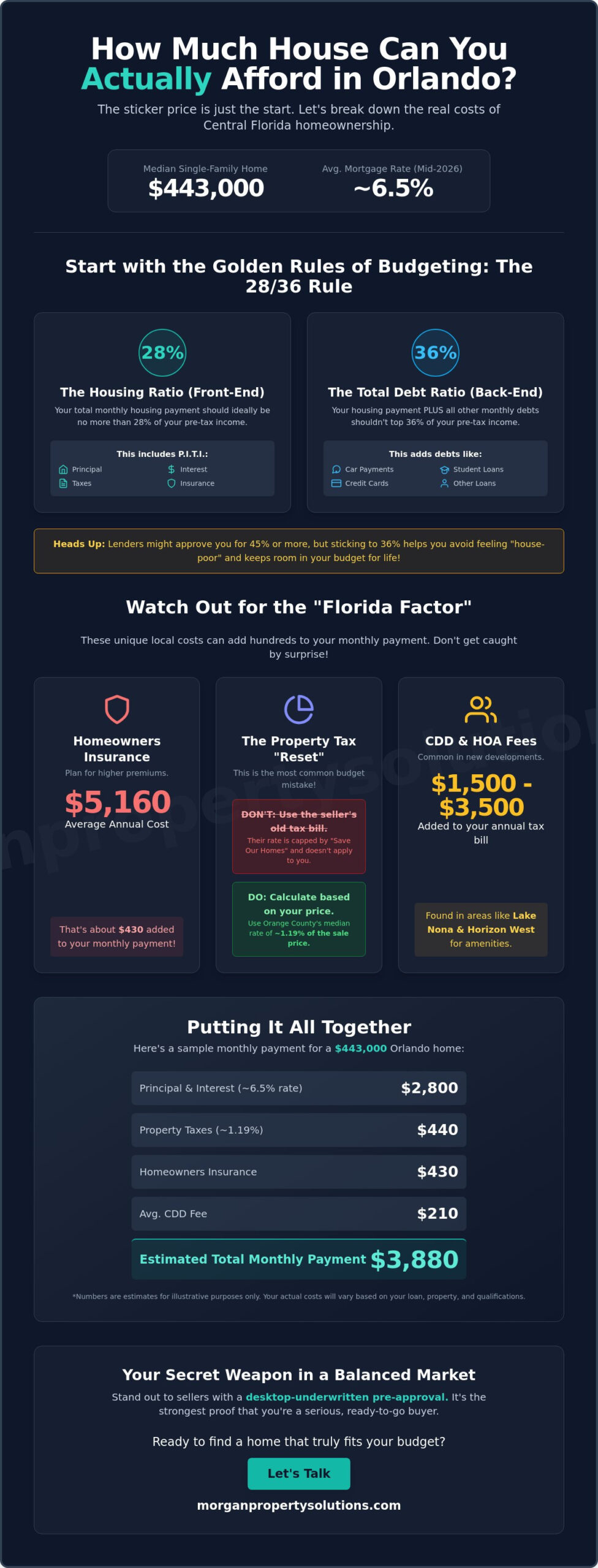
The “28” in the 28/36 rule refers to your front-end ratio. This means your total housing payment, including mortgage principal, interest, property taxes, and insurance, shouldn’t exceed 28 percent of your gross monthly income. In Orlando, where the median home price for a single-family home is roughly $443,000, this percentage fills up quickly.
The “36” represents your back-end ratio. This is the “hard limit” for most traditional loans. It includes your housing payment plus all other monthly debts like:
- Car loans and lease payments
- Student loan installments
- Minimum credit card payments
- Personal loans or child support
If you have a $500 monthly car payment, it directly reduces the amount a lender will let you put toward a mortgage. We suggest leaving some extra “breathing room” in your budget. Orlando summers mean high air conditioning bills, and you’ll want to keep some cash free for the lifestyle that brought you to Central Florida in the first place—and if that lifestyle includes visiting the world-famous theme parks, you can click here to find authorized deals through My Park Tickets.
Factoring in “The Florida Factor”: Insurance, Taxes, and CDDs
Orlando living comes with specific costs that don’t always show up on a standard mortgage calculator. When you’re trying to figure out how much house can i afford in orlando, you have to look at “The Florida Factor.” This includes insurance, taxes, and unique community fees that often catch out-of-state buyers off guard. For instance, homeowners insurance in Orlando now averages around $5,160 annually for a typical single-family home. You also need to plan for those July electric bills. Cooling a 2,000-square-foot home during a Florida summer can easily add $300 or more to your monthly expenses compared to the winter months.
Property Taxes: The Orange County Reset
Many buyers look at the current owner’s tax bill and assume they’ll pay the same amount. This is a common and expensive mistake. Florida’s “Save Our Homes” cap limits how much an assessed value can rise each year for current residents, but that protection vanishes the moment the home changes hands. Your new tax bill will be based on the 2026 purchase price, not what the previous owner paid years ago. In Orange County, the median tax rate is roughly 1.19 percent. We recommend visiting the local property appraiser’s website to use their tax estimator tool. You should also research Florida’s property tax exemptions to see if you qualify for the Homestead exemption, which can provide a much-needed break on your annual bill.
HOA and CDD Fees in Newer Developments
If you’re looking at newer developments in Lake Nona, Winter Garden, or Horizon West, you’ll likely run into CDD fees. A Community Development District (CDD) is a special-purpose government unit created to fund infrastructure like roads, utilities, and amenities. Unlike a standard HOA fee that you pay monthly to a neighborhood association, a CDD fee is usually rolled directly into your annual property tax bill. In areas like Horizon West, these fees can range from $1,500 to $3,500 per year. It’s important to decide if the resort-style pools and manicured parks justify the added cost. Some communities have both an HOA and a CDD, so always ask for a full breakdown of these recurring fees. Partnering with an expert who provides real estate buyer representation can help you identify these hidden costs early in your search so there are no surprises at the closing table.
How Your Down Payment and Credit Score Impact Your Buying Power
While the taxes and insurance we discussed earlier set your monthly baseline, your financial profile determines the “deal” you get from the bank. Your credit score and down payment amount are the biggest levers you can pull to change the answer to how much house can i afford in orlando. A higher credit score doesn’t just lower your interest rate; it also slashes your monthly Private Mortgage Insurance (PMI) if you’re putting down less than 20 percent. In the 2026 market, where mortgage rates are hovering near 6.5 percent, even a small reduction in your interest rate can save you hundreds of dollars every single month.
There’s a common myth that you need a massive 20 percent down payment to buy in Central Florida. While that’s the “gold standard” to avoid PMI, it isn’t always the smartest move for every family. If spending every penny of your savings on a down payment leaves you with no cash for a new roof or a higher-than-expected A/C bill in August, you’re putting yourself at risk. Many buyers find that a 3.5 or 5 percent down payment provides a better balance. This strategy allows you to keep a “maintenance fund” for your new home while still taking advantage of 2026’s stabilizing home prices.
Loan Types for Every Budget
Finding the right loan depends on your specific debt profile and career path. Conventional loans are excellent if you have a 620+ score and want more flexibility. FHA loans remain a popular choice for those with slightly lower scores, requiring only 3.5 percent down. For the veteran community near the VA Medical Center in Lake Nona or other Central Florida hubs, VA loans offer a zero-down option with no monthly PMI. We also suggest looking into Florida-specific down payment assistance programs. Programs like “Hometown Heroes” often provide significant support for qualifying workers, helping you bridge the gap to homeownership without draining your life savings.
The Real Cost of a Low Credit Score
A score of 740 or higher is the current “sweet spot” for securing the best interest rates. If your score sits at 690, you might pay an interest rate that’s 0.5 percent higher than someone in the 740+ club. Over the life of a loan on a median-priced $443,000 home, that small gap can cost you over $40,000 in extra interest. Before you start touring homes, try to pay down credit card balances to below 30 percent of their limits. Most importantly, don’t open any new credit lines. Buying a new car or financing furniture right before you apply for a mortgage can tank your buying power instantly. We’re here to help you navigate these choices so you feel confident in your final decision.
Strategic Neighborhood Searching: Where Your Budget Goes Further
Once you’ve done the math on how much house can i afford in orlando, the fun part begins: choosing where to live. Orlando isn’t just one market; it’s a collection of very different suburbs, each with its own financial personality. We find that many buyers start their search with a specific price in mind but quickly realize that a dollar in Windermere doesn’t buy the same lifestyle as a dollar in Clermont. Understanding these local nuances is the key to finding a home that fits your budget without sacrificing your quality of life.
High-end havens like Windermere and Winter Park are the gold standards for many. In these areas, you’re paying for mature oak trees, historic charm, and proximity to upscale dining. Home prices here often start well above the city’s median, and competition can be stiff. If you want more square footage for your money, growth zones like Clermont and Apopka are fantastic alternatives. Clermont is famous for its rolling hills and “Chain of Lakes,” making it a favorite for active families who want a larger backyard. Apopka is seeing a surge in new construction, providing modern layouts that are often hard to find in older, more central neighborhoods.
Lake Nona remains a massive draw for healthcare and tech professionals due to its “Medical City” status. It’s a beautiful, master-planned community, but it comes with premium pricing and those CDD fees we discussed earlier. If you prefer a quieter, more established vibe, Oviedo is a hidden gem known for its excellent schools and community feel. For those who truly want to escape the city noise, Wedgefield offers larger lots and a rural atmosphere while keeping you within a reasonable drive of the Space Coast or downtown Orlando.
Mapping Price Points to Suburbs
In 2026, if your budget is under $450,000, you’ll find the most options in areas like Apopka, Kissimmee, or even parts of Ocoee. Mid-range buyers looking between $500,000 and $750,000 often gravitate toward Winter Garden or Lake Mary. These suburbs offer a great balance of amenities, shopping, and community events. For luxury seekers, affordability in the $800,000 plus range usually means looking for custom builds in Windermere or historic estates in the heart of Winter Park.
Commute Costs vs. Housing Costs
Don’t forget to factor in the “hidden” cost of your daily drive. Saving $50,000 on a house by moving further out might seem like a win, but it can backfire if you’re spending two hours a day on I-4 or the 408. When you calculate how much house can i afford in orlando, you must include gas, tolls, and the extra wear on your vehicle. Sometimes, buying a slightly more expensive home closer to work actually saves you more money every month. We’ve done several deep dives into these specific area dynamics in our Orlando real estate articles.
Choosing the right neighborhood is a major financial decision, and having an expert by your side makes the process much smoother. Our team provides dedicated real estate buyer representation to help you find the perfect match for your budget and your lifestyle.
Taking the Next Step: Getting Pre-Approved and Finding Your Ally
Now that you’ve explored the neighborhoods and understand the local taxes, it’s time to solidify your plan. You might still be wondering how much house can i afford in orlando after seeing the various price points in Lake Nona or Apopka. The answer becomes much clearer once you move from general research to the pre-approval phase. This is the moment where your budget meets reality, and having the right team by your side makes all the difference. It’s about more than just a number; it’s about finding a home that supports your long term financial health.
Many buyers confuse pre-qualification with pre-approval. A pre-qualification is essentially a casual conversation where a lender gives you a ballpark figure based on what you tell them. In the 2026 Orlando market, that isn’t enough to win a bid. You need a true “desktop-underwritten” pre-approval. This means a lender has actually verified your income, assets, and credit. When you submit an offer with this letter, the seller knows you’re a serious buyer who can actually close the deal. It gives you a massive advantage in a balanced market where sellers are looking for certainty.
As you start viewing homes, it’s easy to get distracted by beautiful finishes or resort style pools. We recommend creating a “must-have” list versus a “nice-to-have” list before you step foot in a property. Your must-have list should include non-negotiables like the number of bedrooms, proximity to work, or a specific school district. Your nice-to-have list can include things like granite countertops or a screened-in lanai. Staying disciplined with these lists is the best way to ensure you don’t overextend your budget for features that could be added later.
The Pre-Approval Process
Why Partnership Matters
Navigating the complex Orlando market is much easier when you have a steady ally. With over 20 years of experience, our team at Morgan Property Solutions Inc. understands the local trends that calculators simply can’t capture. Whether you’re transitioning from renting to owning or moving from out of state, we provide the methodical guidance you need to feel confident. We don’t just show you houses; we help you find a community that fits your life. If you’re ready to take the first step toward homeownership, learn more about our team and approach to see how we can help you reach your goals.
Ready to Turn Your Orlando Homeownership Goals into Reality?
You’ve now seen that the answer to how much house can i afford in orlando involves more than just a simple mortgage calculator. It’s about understanding the “Florida Factor,” from the property tax reset to those specific CDD fees found in growth zones like Lake Nona and Winter Garden. By focusing on your total monthly commitment and choosing a neighborhood that truly aligns with your lifestyle, you can move forward with confidence instead of worry. We believe that homeownership should be a source of joy, not financial stress.
With over 20 years of Central Florida real estate experience and high industry ratings for client satisfaction, our team is here to simplify the process for you. We are local experts who know the nuances of every suburb; we’re committed to being your steady ally through every step of the journey. Find your perfect Orlando home with Morgan Property Solutions Inc. today. We look forward to helping you find a place where you can truly thrive in Central Florida.
Frequently Asked Questions
Is 2026 a good year to buy a house in Orlando?
Yes, 2026 is a great time to buy because the market has shifted from an aggressive seller’s market to a more balanced one. You now have more negotiating power and choices than in previous years. Homes are currently taking an average of 48 to 59 days to sell, which gives you the time needed to perform thorough inspections and make a calm, informed decision.
How much do I need for a down payment on a $500,000 house in Florida?
Your down payment could range from $0 to $100,000 depending on your loan type. A VA loan for veterans often requires zero down. Many buyers opt for an FHA loan at 3.5 percent, which would be $17,500. If you want to avoid private mortgage insurance entirely, you will need a 20 percent down payment of $100,000.
What is the average homeowners insurance cost in Orlando right now?
The average cost for homeowners insurance in Orlando is approximately $5,160 per year for a home with $300,000 in dwelling coverage. While state legislative reforms have started to slow premium growth, Florida rates remain higher than the national average. We suggest getting quotes early in your search to ensure these costs fit your monthly budget.
Can I buy a house in Orlando with a 600 credit score?
You can certainly qualify for a home with a 600 credit score, typically through an FHA loan which requires a minimum of 580. However, your score directly affects how much house can i afford in orlando because it determines your interest rate. A lower score leads to higher monthly payments, so even a small improvement before you apply can save you thousands.
What are CDD fees, and are they permanent?
CDD fees pay for a community’s infrastructure like roads, streetlights, and amenities. They are split into two parts. The bond portion usually disappears after 20 to 30 years once the construction debt is paid off. The operations and maintenance portion is permanent and covers the ongoing upkeep of the neighborhood. These are common in newer areas like Lake Nona.
How much are closing costs typically in Central Florida?
You should budget between 2 percent and 5 percent of the purchase price for closing costs. For a home at the median Orlando price of $443,000, this means having roughly $8,860 to $22,150 ready at the closing table. These fees cover your appraisal, title insurance, and lender charges, and they are separate from your down payment.
Should I buy a home or continue renting in Orlando?
If you plan to stay in the area for at least five years, buying is usually the better financial move. While renting offers flexibility, homeownership allows you to build equity and protects you from annual rent hikes. When calculating how much house can i afford in orlando, consider that your mortgage principal and interest stay the same, while rent almost always goes up.
Does Orlando have a first-time homebuyer program?
Yes, there are several programs available, including the Hometown Heroes Housing Program which helps frontline workers with down payments. Florida Housing also offers statewide programs that provide 30-year fixed-rate mortgages and down payment assistance for those who meet specific income and purchase price requirements. These resources can make the leap into homeownership much more manageable.

Article by
Oliver Overton-Morgan
Oliver Overton-Morgan is a full-time Real Estate Broker since 2003, with years of experience helping thousands of people purchase and sell real estate throughout Central Florida. He holds a Graduate Realtor Institute designation, LCAM, and has held licenses in good standing as a Florida Mortgage Broker and a Notary Public. Oliver immigrated to central Florida in 2001, and within 5 years Oliver built a successful Real Estate brokerage in central Florida, where he recruited over 75 Sales Associates with 25+ million in sales production.