
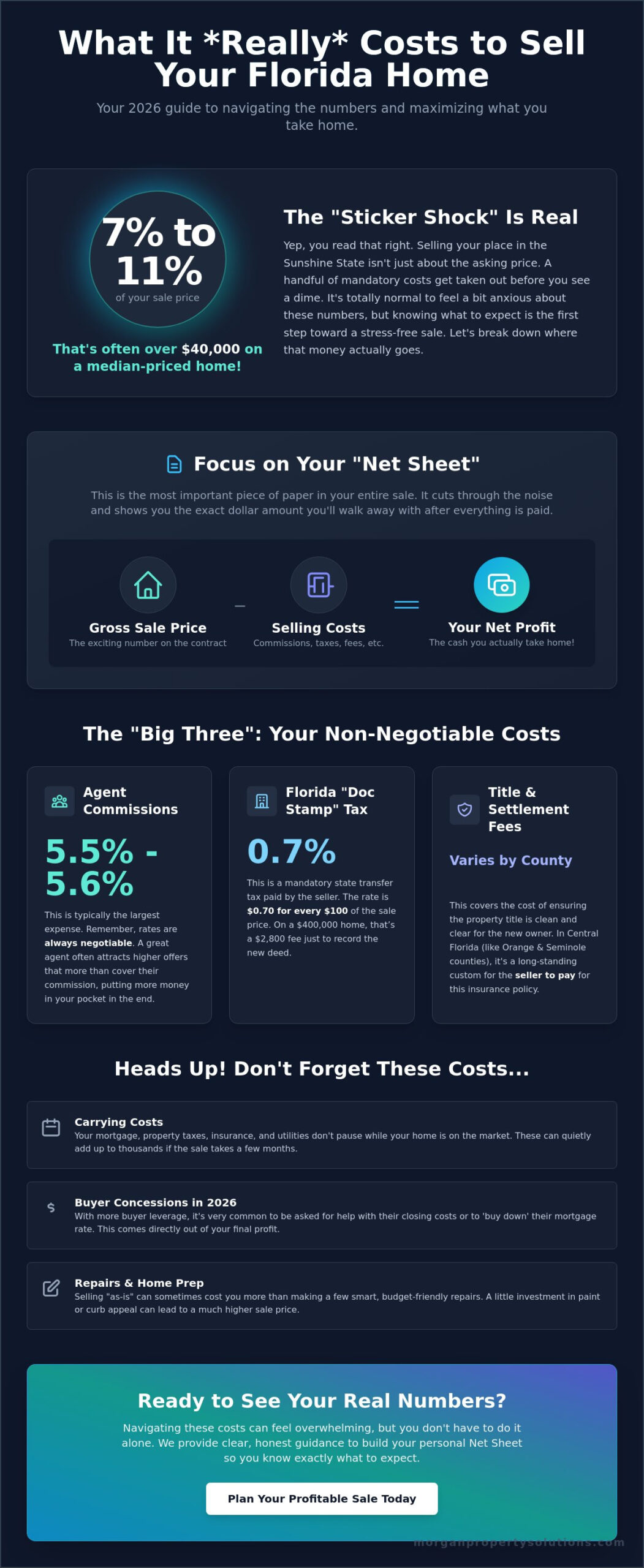
Did you know that selling your home in the Sunshine State could cost you up to 11% of your final sale price? For a median-priced home, that often means over $40,000 disappears before you ever see your final check. It’s a staggering figure that leaves many homeowners asking, how much does it cost to sell a house in florida, and how much will I actually walk away with? It’s completely natural to feel a bit anxious about these numbers, especially with recent shifts in commission structures and local customs regarding title insurance. You’ve worked hard to build equity in your property, and the last thing you want is for hidden fees or unexpected taxes to quietly eat away at your profit.
We understand that navigating these financial details can feel overwhelming, but it doesn’t have to be. Our goal is to provide the steady guidance you need to move forward with total confidence. In this guide, we’ll break down every expense you’ll encounter, from documentary stamps to pre-sale preparation costs. We’ll also explore smart strategies to minimize your expenses so you can maximize your net return. By the time you’re finished reading, you’ll have a clear, dollar-for-dollar roadmap of the 2026 selling landscape and the tools to choose the right path for your unique situation.
Key Takeaways
- Learn why your “Net Sheet” is the most important document for tracking your actual walk-away profit.
- Understand how much does it cost to sell a house in florida by breaking down the “Big Three” expenses, including the state’s documentary stamp tax.
- Find out why selling “as-is” can sometimes be more expensive than making a few smart, budget-friendly repairs.
- Get a clear view of Florida-specific costs like property taxes paid in arrears and the local HOA or CDD fees that often surprise sellers.
- Discover how a dedicated advisor helps you navigate 2026’s changing commission rules to keep more of your equity in your pocket.
The “Sticker Shock” of Selling a Florida Home
Selling a home is a major life event that carries significant emotional and financial weight. It’s often the culmination of years of memories and a massive financial investment. When you decide to list, it’s easy to get caught up in the excitement of a high asking price, but the headline number on your contract isn’t what you’ll actually take to the bank. Many homeowners ask how much does it cost to sell a house in florida and are surprised to find that mandatory costs typically range from 7% to 10% of the final sale price. This isn’t just one big fee; it’s a collection of smaller expenses that add up quickly.
Why 2026 is Different for Florida Sellers
The 2026 market presents a unique set of challenges and opportunities for homeowners. While Florida remains a top destination for relocation, inventory levels have stabilized, giving buyers more leverage than they had a few years ago. Current interest rates are also playing a huge role in negotiations. It’s very common for buyers to request concessions, such as closing cost assistance or mortgage rate buy-downs, to make a purchase more affordable. Additionally, the real estate transaction process has evolved significantly following the 2024 NAR settlement. Commissions are now a more transparent and negotiable part of the deal, meaning you need a strategic partner who knows how to navigate these conversations to protect your equity.
The Difference Between Gross and Net Profit
The “sold” price you see on public real estate sites is rarely the full story. Between the moment you list and the day you hand over the keys, you’ll deal with carrying costs. These include property taxes, insurance premiums, and utility bills that you must continue paying while the home is on the market. If a home sits for several months, these expenses can quietly drain thousands of dollars from your potential profit. At Morgan Property Solutions, we prioritize maximizing that final net number. We believe in providing clear, honest guidance so you aren’t caught off guard by hidden fees. Our focus is on simplifying the complex steps of the sale, ensuring you feel supported and confident from the first walkthrough to the final signature at the closing table.
The Big Three: Commissions, Closing Costs, and Florida Taxes
While preparing your home for the market is often a choice, the “Big Three” expenses are the non-negotiable hurdles of every closing. To find out how much does it cost to sell a house in florida, you have to separate optional staging from the mandatory financial obligations. These costs are usually deducted directly from your proceeds at the closing table. Understanding them early helps you avoid any last-minute surprises that could dampen the excitement of a successful sale. While some costs are negotiable, others are set by state law and must be paid regardless of your strategy.
Agent Commissions in the Modern Market
The Florida Documentary Stamp Tax Explained
One cost that catches many homeowners off guard is the state’s transfer tax on deeds. In most of Florida, the rate for Florida’s documentary stamp taxes is $0.70 for every $100 of the sale price. For example, if you sell a home for $400,000, you’ll owe $2,800 to the state. This is a mandatory fee paid by the seller to record the new deed. While Miami-Dade has a slightly different rate, homeowners in Central Florida should plan for that 0.7% figure as a standard part of their net profit calculation.
Title Insurance and Settlement Fees
Title insurance is a major piece of the puzzle, and who pays for it often depends on where the house is located. In Central Florida counties like Orange and Seminole, it’s a long-standing custom for the seller to pay for the owner’s title policy. This ensures the buyer receives a clear title free of liens or disputes. You’ll also encounter smaller administrative fees that add up at the finish line. These include:
- Settlement or closing fees paid to the title company, typically ranging from $750 to $975.
- Recording fees for the new deed and mortgage satisfaction.
- Wire transfer and courier fees for moving funds and documents securely.
If you’re selling an investment property, checking out our landlord resources can help you understand how these costs impact your overall portfolio. Navigating how much does it cost to sell a house in florida is much easier when you have a steady ally by your side. If you’re ready to see what your specific numbers look like, our team at Morgan Property Solutions is here to provide the clarity you need.
Pre-Sale Prep: Why “As-Is” Might Cost You More
High-ROI Improvements vs. Money Pits
You don’t need to remodel the entire house to see a significant return on your investment. We recommend focusing on high-impact, low-cost tasks like fresh neutral paint, professional deep cleaning, and basic landscaping. A new set of modern cabinet handles or a clean, mulched flower bed can work wonders for a buyer’s perception. We generally advise against major overhauls like full roof replacements or complete kitchen guts unless they’re legally required or the home is otherwise unfinanceable. For more specific advice on which projects are worth your time, you can browse our real estate articles. These smaller, strategic investments often pay for themselves by attracting multiple competing offers.
The Cost of “As-Is” Selling
Selling “As-Is” might sound like a stress-free shortcut, but it often comes with a hidden price tag. In Florida, selling a home as-is doesn’t mean you can hide known defects; you’re still legally required to disclose them. Many buyers view an as-is status as a signal to negotiate aggressively for deep price cuts to cover potential “unknowns.” Think about the simple math of a transaction. A $500 repair for a minor electrical issue or a leaky fixture might prevent a buyer from asking for a $5,000 price reduction during the inspection period. When you review the typical seller closing costs in Florida, you’ll see that many fees are fixed, but your repair strategy is one area where you have real control. While calculating how much does it cost to sell a house in florida is a smart first step, deciding whether to fix or fold is what truly determines your final check. Having a steady partner to help you weigh these costs against your potential gain is essential for protecting your equity.
Central Florida Market Nuances: Orlando to Tampa
HOA Estoppel Fees and CDDs
In communities across Orlando and Tampa, the Homeowners Association is a major player in the closing process. Before you can hand over the keys, the title company must request an “estoppel certificate.” This document confirms you’re up to date on your dues and don’t have any outstanding violations. These certificates usually cost between $200 and $500, and it’s a seller expense that often gets overlooked until the final week of the transaction. You also need to be aware of Community Development Districts, or CDDs. These are very common in newer developments like Lake Nona or Horizon West. A CDD is a fee for community infrastructure that appears on your property tax bill. Having your HOA and CDD documents ready early prevents stressful delays and keeps your closing on track.
Prorated Property Taxes
One of the biggest regional nuances is how we handle property taxes. In Florida, taxes are paid in arrears. This means the bill that comes out in November covers the calendar year you’re currently finishing. Because of this, the seller must give the buyer a credit at closing for the portion of the year they owned the home. For example, if you sell your house on June 30, you’ll owe exactly half of the estimated tax bill for that year. It’s not a check you have to write out of your pocket, but it’s a significant deduction from your proceeds that can feel like a surprise if you haven’t planned for it.
In high-demand pockets like Doctor Phillips, the competition is often fierce enough that sellers can avoid paying for buyer concessions. However, even in 2026, the timing of your sale matters. The “snowbird” season from January to April still brings a surge of out-of-state buyers to the Orlando market. This increased demand can help you secure a higher price, which helps offset the various costs we’ve discussed. If you want to see how these regional factors play into your specific neighborhood, our team of Orlando real estate experts can provide the local insight you need to maximize your return.
Simplifying Your Sale: Why Partnership Beats a Transaction
After looking at the numbers, it’s easy to feel like you’re just a line item in a massive financial transaction. When you’re totaling up how much does it cost to sell a house in florida, it’s tempting to look for the lowest possible commission rate or skip professional staging to save a few dollars. However, the “cheapest” route often leads to a lower final sale price and more stress during the process. A discount broker might save you 1% on fees, but if they lack the negotiation skills to secure an offer that’s 5% higher, you’ve actually lost money. True profit isn’t found in cutting corners; it’s found in expert strategy and a steady partner who knows how to protect your equity from start to finish.
The Morgan Property Solutions Advantage
With over 20 years of experience in the Central Florida market, we’ve seen every type of market shift and closing hurdle imaginable. Our approach is built on the idea of distilling complex processes into manageable steps. We don’t just list your home; we act as your steady ally throughout the entire journey. This local expertise is especially valuable if you’re selling a property that currently has tenants. We understand the nuances of screening criteria and tenant rights, which allows us to bridge the gap between property management and a successful real estate sale without disrupting your cash flow or the closing timeline.
Next Steps: Getting Your Free Valuation
We invite you to reach out for a no-pressure consultation to discuss your goals. We’ll provide you with a personalized net sheet estimate so you can see exactly what your walk-away profit might look like in today’s market. Our commitment is to a genuine, person-to-person interaction where your questions are answered with honesty and clarity. You’ve worked hard for your home’s equity, and you deserve a partner who is as committed to your success as you are. Let’s talk about your Florida home sale today and start planning your strategic exit with confidence. We look forward to helping you move forward with ease.
Secure Your Strategic Exit with Confidence
With over 20 years of expertise from Orlando to Tampa, our team is here to provide the steady guidance you need. We believe in a supportive, client-first partnership that simplifies every complex detail. Whether you’re navigating 2026 commission structures or managing a tenant-occupied property, we’ll help you find the most profitable path forward. Ready to see your true numbers? Get a Professional Home Valuation and Net Profit Estimate today. You’ve worked hard for your home, and we’re here to help you cross the finish line with confidence.
Common Questions About Selling a Florida Home
Who typically pays for closing costs in Florida, the buyer or the seller?
Both parties share the responsibility for closing costs, but the seller usually pays the larger portion. As a seller, you’ll typically cover the real estate commissions, the state’s documentary stamp taxes, and the owner’s title insurance policy in most Central Florida counties. Buyers are generally responsible for their own loan-related fees, home inspections, and appraisal costs. This arrangement can be negotiated, but these are the standard local customs you’ll encounter at the closing table.
How much is the real estate commission in Florida in 2026?
The average total commission in Florida currently ranges between 5.5% and 5.6% of the home’s final sale price. This fee is typically split between the listing agent and the buyer’s agent. It’s important to remember that these rates are not set by law and are always negotiable. While some sellers explore discount models, a full-service advisor provides the marketing and negotiation expertise needed to help you walk away with the highest possible net profit.
What is the Florida Documentary Stamp Tax, and how is it calculated?
The documentary stamp tax is a mandatory state transfer tax paid when a property changes hands. In most Florida counties, it’s calculated at a rate of $0.70 for every $100 of the sale price. If you sell your home for $450,000, you’ll owe $3,150 to the state. The only major exception is Miami-Dade County, where the rate for single-family homes is slightly lower at $0.60 per $100. This fee is almost always paid by the seller.
Do I need a real estate attorney to sell my house in Florida?
What are HOA estoppel fees, and why do I have to pay them?
An estoppel fee is a charge from your Homeowners Association to provide a certificate showing your current account status. This document proves to the buyer and the title company that you don’t owe any back dues or have active property violations. These fees typically cost between $200 and $500 per association. It’s a necessary step because it protects the buyer from inheriting any of your unpaid financial obligations to the community.
How does property tax proration work when selling a home in Orlando?
Florida property taxes are paid in arrears, meaning the bill you pay in November covers the current year. When you sell, you’ll give the buyer a credit for the months you lived in the house before the closing date. For example, if you sell in July, you’ll owe roughly seven months of taxes. This credit is a significant factor when calculating how much does it cost to sell a house in florida and is deducted from your final proceeds.
Can I sell my Florida house “As-Is” to avoid repair costs?
Are there capital gains taxes on selling a primary residence in Florida?
Most Florida homeowners won’t owe federal capital gains tax on their primary residence. If you’ve lived in the home for at least two of the last five years, you can usually exclude up to $250,000 in profit if you’re single, or $500,000 if you’re married. Since Florida doesn’t have a state income tax, there are no additional state-level capital gains taxes to pay. It’s a major financial perk of selling a home in the Sunshine State.

Article by
Oliver Overton-Morgan
Oliver Overton-Morgan is a full-time Real Estate Broker since 2003, with years of experience helping thousands of people purchase and sell real estate throughout Central Florida. He holds a Graduate Realtor Institute designation, LCAM, and has held licenses in good standing as a Florida Mortgage Broker and a Notary Public. Oliver immigrated to central Florida in 2001, and within 5 years Oliver built a successful Real Estate brokerage in central Florida, where he recruited over 75 Sales Associates with 25+ million in sales production.