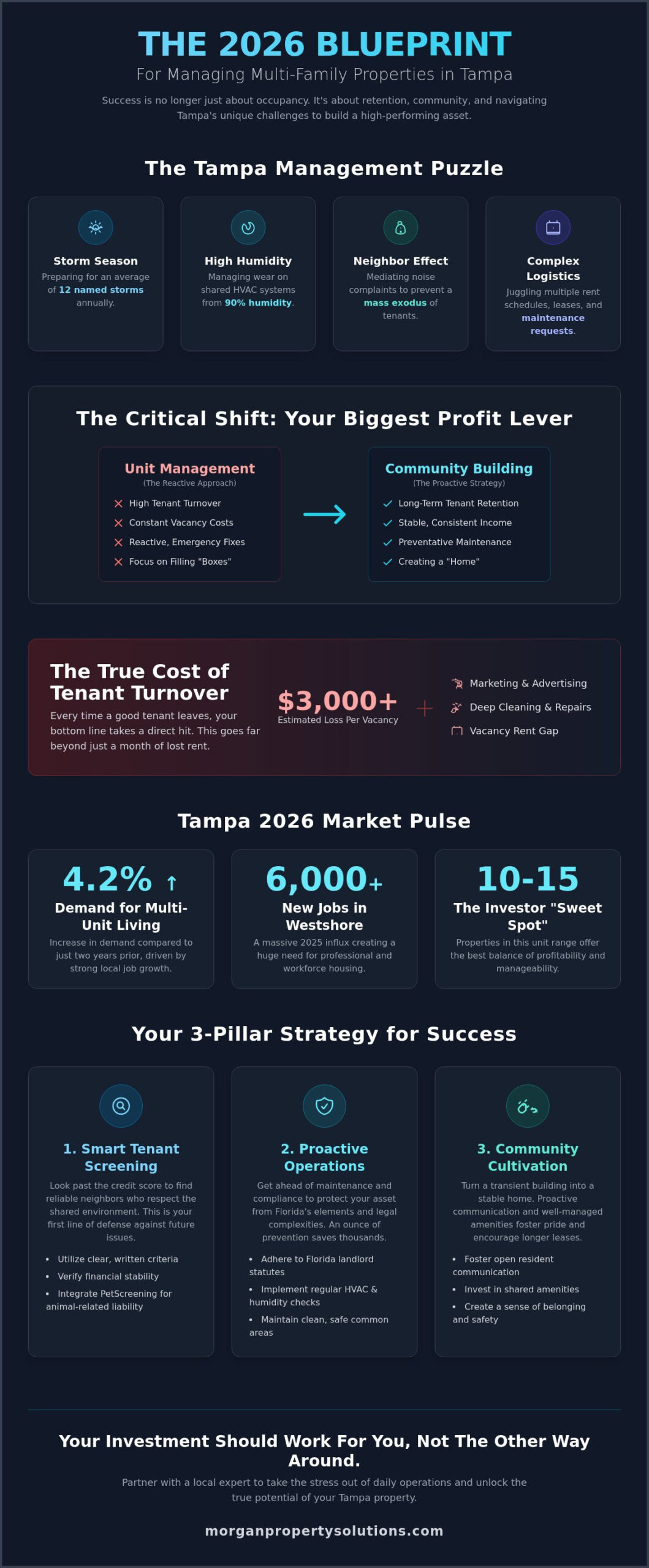
By 2026, the real measure of success for Florida investors won’t be the number of units they own, but how many tenants choose to renew their leases for a third consecutive year. It’s no secret that managing a multi-family property in tampa can quickly turn from a passive income dream into a 24/7 logistical puzzle. You’re likely already juggling the unique challenges of our local climate, like preparing for a storm season that sees an average of 12 named systems or handling the wear and tear that 90% humidity causes on shared HVAC systems. It’s a lot to handle, especially when you’re also mediating noise complaints between neighbors or trying to track three different rent schedules at once.
We believe that your investment should work for you, not the other way around. You deserve a management strategy that simplifies the complex stuff and lets you focus on the big picture. In this guide, we’ll show you how to streamline your maintenance and improve tenant satisfaction so you can enjoy consistent returns without the midnight phone calls. We’re going to walk through the exact steps to organize your leases, protect your property from the elements, and create a community that tenants are proud to call home.
Key Takeaways
- Learn why shifting your focus from just filling units to building a real community is the secret to keeping your best tenants long-term.
- Get ahead of Florida’s unique 2026 regulations and discover how to protect your building from the harsh effects of Tampa’s humidity and salt air.
- Master the art of managing a multi-family property in tampa by using smart financial tools and local market data to boost your monthly cash flow.
- Find out how simple upgrades to your payment systems and regular rent reviews can stop you from leaving money on the table.
- See how partnering with a local expert can take the stress out of daily operations, making your investment journey truly simple and worry-free.
The Reality of Managing a Multi-Family Property in Tampa
Success in real estate often comes down to scale, but that scale brings a new set of rules. When you start managing a multi-family property in tampa, you’re looking at residential buildings with more than one unit, ranging from a simple duplex in Riverside Heights to a 50-unit complex near the University of South Florida. By 2026, the local market has evolved beyond simple landlording. It’s now about professional asset management. You aren’t just a rent collector; you’re the steward of a complex ecosystem that requires constant attention to maintain its value.
Tampa’s growth hasn’t slowed down. With the city’s population hitting a new peak in early 2026, the pressure on high-density areas like Ybor City and Seminole Heights is intense. Investors who try to self-manage in these neighborhoods often run into walls. Between strict historic district codes and the logistical nightmare of limited street parking, the “do-it-yourself” approach usually leads to burnout. Managing a multi-family property in tampa requires a local perspective to stay ahead of these urban challenges.
Why Multi-Family is Different from Single-Family
Managing a single-family home is relatively linear. When you move into the multi-family space, you’re managing shared amenities like courtyards, laundry rooms, and roofs that cover multiple families. There’s also the “neighbor effect” to consider. If one tenant is disruptive, it doesn’t just affect your peace of mind; it can cause a mass exodus of your other paying residents, dropping your occupancy rate overnight. The multiplier effect of multi-family maintenance means that a single pipe burst on the third floor can quickly become a four-unit insurance claim.
The Tampa Advantage: 2026 Market Trends
The 2026 market shows a 4.2% increase in demand for multi-unit living compared to just two years ago. This shift is driven by the 6,000 new jobs added to the Tampa Westshore district in 2025, creating a massive need for workforce housing. Your rental rate strategy has to reflect this growth. We’ve found that the “sweet spot” for many Central Florida investors right now is the 10 to 15 unit range. These properties offer enough scale to boost profits while remaining manageable enough to maintain a sense of community. We want to help you simplify these complexities so you can focus on growing your portfolio.
Shifting from Unit Management to Community Building
Managing a multi-family property in tampa isn’t just about collecting rent checks and fixing leaky faucets. It’s about managing a micro-neighborhood. In 2026, the most successful investors are the ones who realize that tenant retention is their biggest profit lever. Every time a tenant moves out, you’re looking at costs that can easily hit $3,000 when you factor in marketing, deep cleaning, and the vacancy gap. When people feel like they belong to a community rather than just renting a box, they stay longer. This sense of place turns a transient building into a stable, high-performing asset.
Communication is your best tool for keeping the peace and protecting your bottom line. When you’re proactive about talking to residents, you reduce the friction that naturally happens when people live in close quarters. A human-first approach isn’t just about being nice; it’s a smart business strategy. When tenants feel respected, they’re more likely to pay on time and take better care of the property. Most legal headaches start with a breakdown in communication, not a breakdown in the plumbing. Successfully managing a multi-family property in tampa requires a balance between firm rules and genuine empathy.
Effective Tenant Screening for Shared Living
You need to look past the credit score. While financial stability is a must, you’re looking for neighbors, not just numbers. Having clear, written screening criteria ensures you’re being fair while finding people who will respect the shared environment. Since many Tampa residents have four-legged roommates, using PetScreening helps you manage the risks and liabilities that come with animals in common areas. This keeps the courtyard safe and clean for everyone while reducing your liability.
Managing Common Spaces and Shared Amenities
Your common areas are the heart of the community. Whether it’s a shared laundry room or a BBQ area, these spots need clear boundaries to prevent conflict. You have to stay on top of things like lighting, pest control, and functional locks, as required by the Florida Statutes on landlord maintenance, to keep the property compliant and safe. When the hallways are clean and the amenities are well-maintained, tenants take more pride in where they live. This pride leads to fewer maintenance calls because residents actually want to keep the place nice. If you want to see how we handle these details, you can explore our landlord resources for more tips on community management.
Navigating Florida Compliance and Maintenance Logistics
Managing a multi-family property in tampa is a full-time commitment because the local environment is relentless. Between the 90% humidity in August and the salt air drifting off Old Tampa Bay, buildings here age faster than in almost any other part of the country. If you wait for a tenant to call about a leak or a broken AC, you’re already losing money. Data shows that reactive repairs typically cost 30% more than scheduled preventative care. By 2026, building standards and insurance requirements have tightened, making it essential to catch small issues before they become structural failures.
Staying ahead of the curve means understanding that your property is a living system. Florida’s weather patterns can shift in an afternoon, and your maintenance strategy needs to be just as dynamic. We’ve seen how deferred maintenance can lead to mold issues that spiral into five-figure remediation bills. Professional inspections aren’t just a good idea; they’re a legal necessity for multi-unit properties to ensure every unit meets the state’s habitability standards. Keeping your building in top shape protects your investment and keeps your tenants happy and paying on time.
The Tampa Maintenance Checklist
- HVAC systems: In the Florida heat, an AC unit isn’t a luxury; it’s a necessity. We recommend bi-annual checks in March and October to prevent mid-summer breakdowns when repair crews are backed up for weeks.
- Hurricane preparedness: Your 2026 plan must include clear communication with tenants about evacuation zones and shutter deployment. Managing a multi-unit protection plan requires coordinating with dozens of people at once.
- Exterior care: Tropical pests and sun damage can ruin a building’s curb appeal. Regular pressure washing and pest barriers are vital for protecting your stucco and roofing from the elements.
Legal Compliance and Risk Management
Florida’s legal landscape is constantly shifting. You need to be intimately familiar with Florida Statute 83, which dictates how you handle security deposits and habitability. For a clear breakdown of your local obligations, you can review Hillsborough County landlord responsibilities to ensure you’re meeting every requirement. Missing a single notice deadline can lead to costly legal disputes that eat into your monthly cash flow.
Risk management also involves protecting yourself from Fair Housing lawsuits. Even an accidental mistake in your screening process or a slow response to a repair request can lead to a legal headache. We’ve found that using professional landlord resources helps owners stay updated on local ordinances that change from year to year. A professional management team acts as a shield, ensuring every interaction with a tenant follows the letter of the law while keeping your property profitable and compliant.
Optimizing Financials for Multi-Unit ROI
Managing a multi-family property in tampa successfully requires a sharp eye on the numbers every single month. By 2026, the Tampa rental market is projected to see a 4.2% increase in average rental rates, according to local economic forecasts. This means you can’t afford to guess what your units are worth. Conducting a local market rent analysis every six months ensures you aren’t leaving cash on the table while your competitors adjust their prices. We’ve found that owners who track the “Total Cost of Ownership” per unit, rather than just looking at the building as a whole, are far more successful. If Unit 4 is consistently costing 15% more in repairs than Unit 2, you need to know why so you can fix the root cause.
Streamlining Rent Collection and Accounting
Paper checks are a liability for multi-family owners. They get lost in the mail, they’re slow to clear, and they require manual data entry that leads to mistakes. We recommend moving to a centralized online payment system to keep your cash flow consistent. To attract the best tenants in 2026, you might offer modern solutions like deposit-free renting. This lowers the barrier to entry for great renters while still protecting your investment. When a payment is late, an automated system handles the notifications without the personal drama, keeping your professional relationship with the tenant intact.
Calculating the Real Value of Your Time
The hidden cost of self-managing is the opportunity cost. If you’re spending 10 hours a week chasing rent or managing repairs, you aren’t spending that time finding your next investment deal. When you compare management fees against the cost of a single month of vacancy or a botched eviction, the value becomes clear. Professional management often pays for itself through reduced turnover and more efficient vendor pricing. We’ve seen that investors who step back from the daily grind often see a 10% to 12% improvement in their overall portfolio performance within the first year. We’re here to help you get that time back so you can focus on growing your wealth.
Ready to see how much more your Tampa units could be earning? Get a professional rental analysis today and start maximizing your ROI.
Simplifying Your Tampa Investment with a Trusted Partner
Real estate shouldn’t feel like a second full-time job. Since we opened our doors over 20 years ago, we’ve focused on one main goal: making the lives of property owners easier. We know that managing a multi-family property in tampa involves a massive checklist of daily tasks. Between handling maintenance in Ybor City and tracking lease renewals in Westchase, it’s easy for an investor to feel overwhelmed. We’re here to take that weight off your shoulders so you can actually enjoy the rewards of your hard work.
Our approach blends high-tech tools with high-touch service. While we use advanced online portals for rent collection and financial reporting, we don’t believe in managing from behind a desk. Our team maintains a “boots on the ground” presence across Central Florida. We’re out in the field, performing regular inspections and meeting with tenants. This proactive style helps us catch a small leak before it turns into a massive repair bill. It’s about being present and being prepared.
The Morgan Property Solutions Difference
We don’t just act as a service provider; we view ourselves as your dedicated partner. This means we’re looking out for your long-term ROI, not just checking boxes. We handle the heavy lifting, from rigorous tenant screening to 2 a.m. emergency calls, so you don’t have to. Our deep roots in the local market give us the data needed to price your units competitively and keep vacancies low. If you’re looking for more tips on maximizing your returns, feel free to browse our real estate articles for expert advice on the Florida market.
Getting Started: Your Next Move
Transitioning from self-management to professional care is a straightforward process. We’ve refined our onboarding to be as stress-free as possible. During your first 90 days with us, we perform a deep-dive audit of your current leases, safety standards, and maintenance history. We’ll set up your owner portal so you can see real-time updates on your portfolio at any time. Managing a multi-family property in tampa is much more sustainable when you have a team that knows the 813 area code inside and out. Ready to simplify? Contact Morgan Property Solutions today to discuss how we can support your Tampa multi-family portfolio.
Take the Next Step Toward a Stress-Free Portfolio
Success in the 2026 market isn’t just about collecting rent checks. It’s about building a community where residents actually want to stay for the long haul. When you focus on high retention rates and stay ahead of Florida’s strict maintenance codes, your ROI naturally follows. managing a multi-family property in tampa doesn’t have to be a source of constant stress or midnight phone calls. You’ve seen how shifting your focus from individual units to overall community health can significantly boost your bottom line.
We’ve spent over 20 years helping local investors navigate these exact challenges with confidence. With our A+ BBB rating and a comprehensive online portal that gives you 24/7 transparency, you’re never left in the dark about your investment status. We handle the complex logistics and compliance hurdles so you can focus on growing your portfolio. It’s about time you had a partner who cares about your success as much as you do.
Let’s make your Tampa investment simple; contact us for a free consultation.
We’re excited to help you reach your goals and make 2026 your most profitable year yet!
Frequently Asked Questions
Is managing a multi-family property harder than a single-family home?
Yes, it’s generally more demanding because you’re juggling multiple tenant relationships and shared infrastructure simultaneously. When managing a multi-family property in tampa, you have to oversee common areas and resolve neighbor conflicts that simply don’t exist in single-family rentals. While the workload is higher, the ability to spread your financial risk across several units often leads to more stable monthly income for your investment portfolio.
What are the specific laws for multi-family properties in Tampa, Florida?
You must follow the Florida Residential Landlord and Tenant Act under Chapter 83 and stick to Tampa’s local building codes. In 2024, Florida passed HB 1417, which gave the state more control over landlord-tenant laws and ended local rent control efforts. You’ll need to ensure every unit meets specific safety standards, such as having working smoke detectors and two ways to exit the building in an emergency.
How much do property management companies in Tampa charge for multi-family units?
Most local management firms charge a monthly fee between 8% and 12% of the total rent collected from the building. You’ll also find that some companies offer a flat rate per door, which typically falls between $100 and $200 for larger apartment complexes. It’s important to ask about potential extra costs like marketing fees or lease renewal charges so you can accurately calculate your expected return on investment.
Can I manage a duplex or triplex myself while working a full-time job?
You can manage a small building yourself, but it’s a significant commitment that often leads to burnout for busy professionals. Most owners spend about 5 to 10 hours a month per unit on administrative tasks, tenant screenings, and coordinating repairs. If an emergency pipe bursts at 2 PM on a Tuesday while you’re in a meeting, you’ll need a reliable team of contractors ready to jump in immediately.
What happens if two tenants in the same building have a major dispute?
You should step in as a calm mediator and rely on the specific language in your lease regarding noise and neighborly conduct. It’s vital to document every complaint and your response in writing to keep your records organized. If the issues continue after you issue a formal warning, you may need to consult a legal expert to discuss lease termination for the tenant who is violating the building’s community rules.
How do I handle maintenance for shared areas like parking lots or hallways?
Set up a recurring schedule for professional cleaning and safety inspections to prevent small issues from becoming expensive repairs. For example, pressure washing walkways every 6 months prevents slip hazards and keeps the property looking fresh for current residents. Factoring these recurring costs into your annual budget ensures the building stays safe and attractive for everyone, which helps you maintain a high occupancy rate year-round.
Is Tampa a good place for multi-family investments in 2026?
Tampa remains a strong market for investors because the population grew by over 1.2% annually leading up to 2025. With more people moving to the Sun Belt for jobs in tech and healthcare, the demand for rental housing stays consistently high. Managing a multi-family property in tampa allows you to tap into this steady growth while building long-term equity in one of Florida’s most stable metropolitan areas.
How do I attract long-term tenants to an older multi-family building?
Focus on high-impact upgrades like modern lighting, smart locks, or refreshed landscaping to make the building feel current. A 2023 study by Rent.com showed that 60% of renters prioritize high-speed internet and updated kitchens over other luxury amenities. Clean, well-lit common areas make a great first impression and show prospective tenants that you’re a dependable owner who truly cares about the property’s condition and their comfort.

Article by
Oliver Overton-Morgan
Oliver Overton-Morgan is a full-time Real Estate Broker since 2003, with years of experience helping thousands of people purchase and sell real estate throughout Central Florida. He holds a Graduate Realtor Institute designation, LCAM, and has held licenses in good standing as a Florida Mortgage Broker and a Notary Public. Oliver immigrated to central Florida in 2001, and within 5 years Oliver built a successful Real Estate brokerage in central Florida, where he recruited over 75 Sales Associates with 25+ million in sales production.