
Owning a rental property in Florida should be a rewarding investment, not a source of constant legal anxiety. The landscape of regulations can feel complex and ever-changing, leaving even the most diligent landlords worried about accidental non-compliance or the financial risk of a dispute. That’s why we’ve created this clear and helpful florida landlord tenant law summary 2026. We’re here to help you navigate these crucial rules with confidence, making the complex simple so you can focus on what matters most-protecting your investment.
In this guide, you will find a straightforward breakdown of your rights and obligations, from lease agreements and security deposits to the eviction process and key 2026 updates. Our goal is to provide the clarity you need to manage your property legally, avoid costly mistakes, and foster positive tenant relationships. Consider this your essential resource for stress-free, compliant property management, brought to you by a partner you can trust to guide you every step of the way.
Key Takeaways
- This florida landlord tenant law summary 2026 provides a clear roadmap to help you stay compliant, protect your rights, and manage your properties with confidence.
- Learn the key legislative updates for 2026 that directly impact your rental operations, from notice periods to landlord obligations.
- Discover why a generic lease agreement can put your investment at risk and what essential clauses you must include to be protected under Florida law.
- Understand the strict legal procedures for handling security deposits and navigating the eviction process to avoid common and costly mistakes.
Key Legislative Updates for Florida Landlords in 2026
Staying current with evolving legislation is one of the most important responsibilities of a successful landlord. This florida landlord tenant law summary 2026 focuses on key updates to Florida Statutes, Chapter 83, Part II, which governs residential tenancies. Understanding these changes is essential for ensuring your lease agreements and operational procedures remain compliant, protecting both you and your investment. While the legal framework can seem complex, a general Landlord-Tenant Law Overview provides a helpful foundation. We’re here to help you navigate what’s new.
New Rules for Written Notices via Email
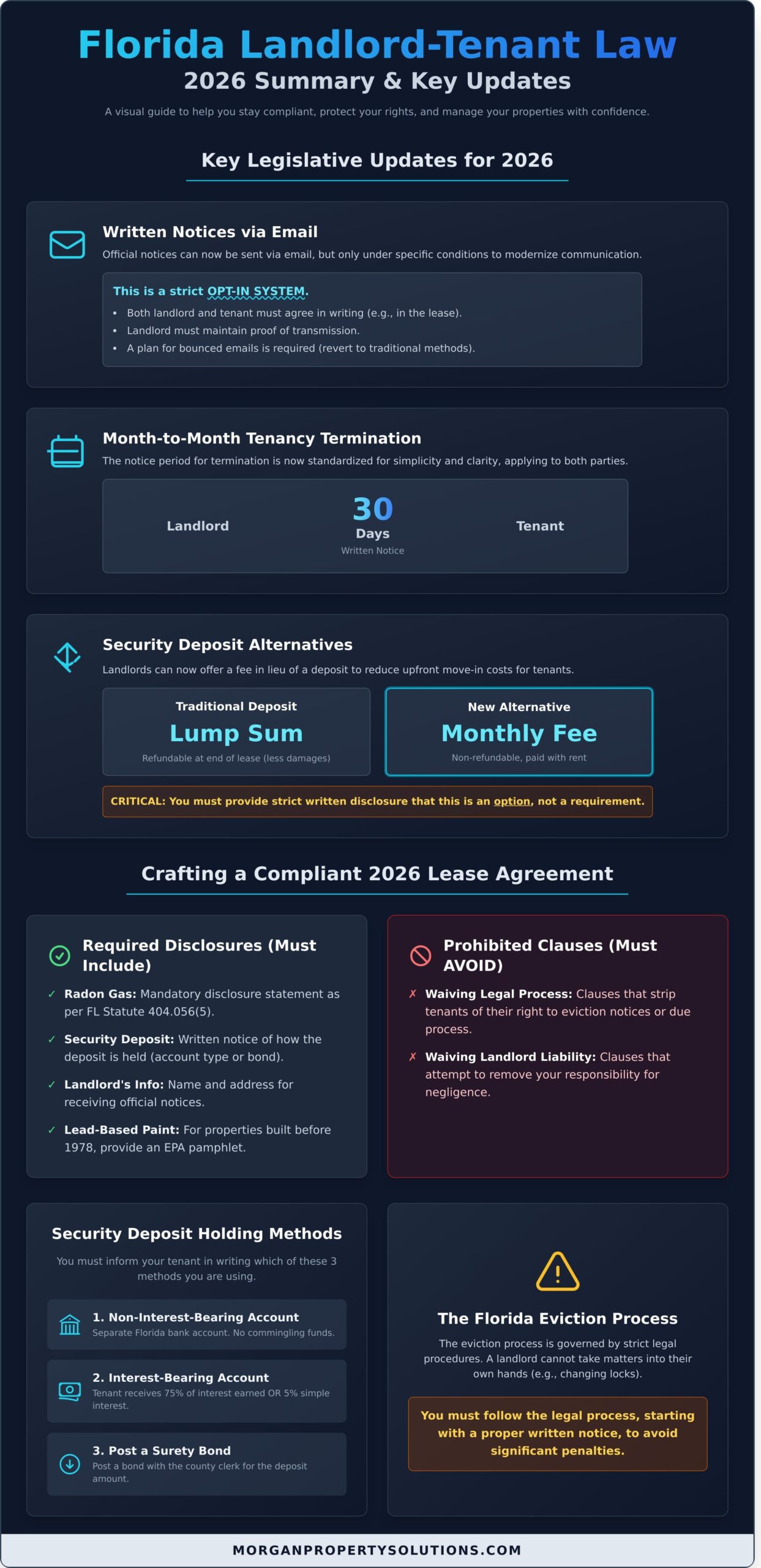
In a move to modernize communication, Florida law now officially permits certain written notices to be sent via email. However, this is strictly an opt-in system. Both you and your tenant must agree in writing-typically within the lease agreement-to use email for official correspondence like claims on a security deposit. You are responsible for maintaining proof of transmission and must have a clear procedure for handling bounced emails, which would require you to revert to traditional delivery methods to remain compliant.
Changes to Month-to-Month Tenancy Termination
Simplicity is a welcome change in the 2026 updates. The notice period for terminating a month-to-month tenancy has been standardized to a clear 30-day written notice. This rule applies equally to both landlords and tenants, eliminating previous confusion. Your notice must be in writing and served according to the terms of your lease. This contrasts with fixed-term leases, which automatically terminate at the end of the agreed-upon period without requiring a separate notice, unless the lease specifies an automatic renewal clause.
Security Deposit Alternatives: Fees in Lieu of Deposits
To make properties more accessible, landlords now have the option to offer tenants a fee in lieu of a traditional security deposit. This involves the tenant paying a smaller, non-refundable monthly fee. While this can attract a wider pool of applicants by reducing upfront move-in costs, the law requires strict written disclosure. You must clearly state that this is an option, not a requirement, and present the alternative of a standard refundable deposit. This flexibility can be a powerful marketing tool, but it’s important to weigh the benefits against the risk of not having a lump-sum deposit to cover potential damages.
Crafting a Compliant 2026 Florida Lease Agreement
Your lease agreement is the foundation of your entire landlord-tenant relationship. It’s a legally binding contract that outlines the rights and responsibilities of both parties, serving as your primary tool for managing expectations and resolving disputes. While a generic online template may seem like a quick fix, it can expose you to significant legal and financial risks by omitting state-specific requirements. A thorough understanding of the florida landlord tenant law summary 2026 is essential to creating an ironclad agreement that protects your investment.
In Florida, while an oral lease for a term of less than one year can be legally binding, it is never recommended. A written lease provides clarity and irrefutable proof of the terms, preventing “he said, she said” conflicts down the road. It is the professional standard and your best protection.
Required Disclosures for Florida Landlords
To be compliant, every Florida lease must contain specific disclosures. Omitting these can lead to penalties and legal challenges. Key required notices include:
- Radon Gas: A mandatory statement disclosing what radon gas is, as required by Florida Statute 404.056(5).
- Security Deposit: You must state in writing which method you are using to hold the tenant’s security deposit-a separate non-interest-bearing account, an interest-bearing account, or a surety bond.
- Landlord’s Name and Address: The lease must include the landlord’s name and address (or that of their authorized representative) for receiving notices.
- Lead-Based Paint: For any property built before 1978, federal law requires you to provide an EPA-approved pamphlet and disclose any known lead-based paint hazards.
Prohibited Clauses in a Rental Agreement
Just as important as what you include is what you must leave out. Florida law makes it illegal to include clauses that attempt to strip tenants of their fundamental rights. Including such a clause can render it unenforceable. For a detailed overview of tenant protections, you can reference Florida’s Official Landlord/Tenant Law Guide from the Department of Agriculture and Consumer Services. Prohibited clauses often include:
- Waiving a tenant’s right to eviction notices or other legal processes.
- Limiting the landlord’s liability for negligence or failure to maintain the property.
- Forcing a tenant to agree to pay the landlord’s attorney fees in all situations, regardless of the court’s ruling.
The Importance of Thorough Tenant Screening
A strong lease is only as effective as the tenant who signs it. Thorough tenant screening is your first and most critical line of defense against future problems like late rent, property damage, and costly evictions. This process must always adhere strictly to federal and state Fair Housing laws to avoid discrimination claims. By checking credit history, criminal backgrounds, and past rental references, you gain a clear picture of an applicant’s reliability. We have refined our process over many years to be both effective and compliant; you can review our detailed tenant screening criteria for expert guidance.
Landlord Rights and Responsibilities During Tenancy
Once a tenant moves in, a landlord’s duties shift from finding a renter to managing a tenancy. This phase involves more than just collecting rent; it’s about upholding your end of the lease agreement and navigating the day-to-day realities of property ownership. Understanding your obligations is the key to avoiding costly disputes and maintaining a positive landlord-tenant relationship. This florida landlord tenant law summary 2026 focuses on balancing your rights as a property owner with the tenant’s right to quiet enjoyment, a crucial aspect of a successful rental experience.
Landlord’s Right to Enter the Property
While you own the property, your tenant has a right to privacy. Florida law requires you to provide ‘reasonable notice’ before entering a rental unit, which is typically interpreted as at least 12 hours. Entry should also occur at ‘reasonable times,’ generally between 7:30 a.m. and 8:00 p.m. The only exception is for emergencies, such as a fire or a major water leak, where you can enter without prior notice to protect the property. Violating these rules can lead to legal disputes and damage your credibility as a landlord.
Maintenance and Repair Obligations
One of your most significant legal duties is to maintain a habitable property. This means ensuring essential systems and structures are in safe, working order. According to The Florida Bar’s Rights and Duties of Landlords, this includes things like functioning plumbing, heating, and structural components. You must respond to tenant repair requests in a timely manner. If a landlord fails to make necessary repairs, a tenant may have the right to withhold rent under specific legal procedures. Managing maintenance can be stressful and time-consuming, but our expert Orlando property management team can handle all tenant requests and vendor coordination for you, making it simple and stress-free.
Rules for Rent Collection, Late Fees, and Grace Periods
A clear rent collection policy is foundational to your business. It’s important to note that the florida landlord tenant law summary 2026 does not require landlords to offer a grace period for rent payments. If you choose to charge a late fee, it must be a ‘reasonable’ amount and must be explicitly stated in the signed lease agreement. When rent is late, you must follow the proper legal procedure for notifying the tenant, which typically begins with a formal Three-Day Notice to Pay or Vacate. Establishing a firm but fair policy from the start helps prevent confusion and ensures consistent cash flow.
Handling Security Deposits and End-of-Lease Procedures
Security deposit disputes are one of the most common sources of friction between landlords and tenants. To protect your investment and avoid costly legal issues, it is essential to handle these funds with care from move-in to move-out. Florida law is very specific about these procedures, and a clear understanding is a cornerstone of any effective florida landlord tenant law summary 2026.
Following the correct process not only ensures compliance but also builds trust and simplifies the end-of-lease transition for everyone involved. Getting this right from the start can save you significant time and stress down the road.
Properly Holding a Tenant’s Security Deposit
As a landlord in Florida, you cannot simply deposit security funds into your personal checking account. The law provides three distinct options for holding a tenant’s security deposit and advance rent. You must choose one and notify your tenant in writing which method you are using within 30 days of receiving the funds.
- Option 1: Non-Interest-Bearing Account. Hold the money in a separate, non-interest-bearing bank account in a Florida banking institution. You may not commingle these funds with any other money.
- Option 2: Interest-Bearing Account. Hold the funds in a separate, interest-bearing bank account in Florida. You must pay the tenant the interest earned, either annually or at the end of the lease (at least 75% of the annualized average interest rate or 5% simple interest per year, at your discretion).
- Option 3: Surety Bond. Post a surety bond with the clerk of the circuit court in the county where the property is located. The bond must be for the total amount of deposits you hold or $50,000, whichever is less.
Making a Claim on the Security Deposit
If you need to make a claim for damages beyond normal wear and tear or for unpaid rent, you must follow a strict timeline. Within 30 days of the tenant vacating the property, you must send a written “Notice of Intent to Impose Claim on Security Deposit” via certified mail. This notice must clearly itemize the deductions you intend to make. The tenant then has 15 days from receiving the notice to object in writing.
Deadlines for Returning the Deposit
The timelines for returning the deposit are non-negotiable under the florida landlord tenant law summary 2026.
- If you are not making a claim, you have 15 days after the tenant moves out to return the full security deposit.
- If you are making a claim and the tenant does not object, you have 30 days to deduct the claimed amount and return the remainder of the deposit.
Failure to adhere to these deadlines can result in you forfeiting your right to make any claim on the deposit. Meticulous record-keeping and prompt action are your best protection. If navigating these rules feels overwhelming, the team at Morgan Property Solutions Inc. can help manage the entire process, ensuring you stay compliant and your property stays protected.
The Florida Eviction Process: A Legal Overview
Navigating an eviction can be one of the most stressful aspects of being a landlord. In Florida, eviction is a formal legal process governed by strict rules, and any misstep can result in costly delays or even a lawsuit against you. It’s crucial to understand that “self-help” evictions, such as changing the locks or shutting off utilities, are illegal. A comprehensive florida landlord tenant law summary 2026 must emphasize that following the correct legal procedure is not just recommended-it’s required.
Valid Grounds for Eviction
Before you can begin the eviction process, you must have a legally valid reason, or “grounds.” While every situation is unique, the most common grounds for eviction in Florida include:
- Non-payment of rent: This is the most frequent reason for eviction.
- Lease violations: This can include having an unauthorized pet, causing significant property damage, or creating a nuisance.
- Illegal activity: Conducting illegal acts on the property is a serious violation.
- Holding over: This occurs when a tenant remains on the property after their lease term has officially ended without the landlord’s permission.
The 3-Day Notice to Pay Rent or Quit
For non-payment of rent, the first official step is to serve the tenant with a 3-Day Notice to Pay Rent or Quit. This document must be in writing and state the exact amount of rent owed. It must be properly delivered to the tenant, either by hand, by mail, or by posting it in a conspicuous place like the front door. If the tenant pays the full amount due within the three business days (excluding weekends and holidays), you must accept the payment, and the eviction process stops.
Filing an Unlawful Detainer Lawsuit
If the tenant fails to pay rent or vacate the property after the 3-day notice expires, your next step is to file an eviction lawsuit, known as an Unlawful Detainer action, with the county court. After you file the complaint, the tenant will be served and will have five business days to respond. Navigating the court system requires precision and a deep understanding of legal requirements. For helpful guides and forms, see our landlord resources. Protecting your investment means handling this process correctly from the start. For expert support that simplifies property management, trust the team at morganpropertysolutions.com.
Simplify Your Role as a Florida Landlord in 2026
Staying compliant with Florida’s landlord-tenant laws is crucial for protecting your investment and maintaining positive tenant relationships. As we’ve covered, this means diligently updating your lease agreements for 2026, understanding your responsibilities during tenancy, and correctly handling procedures from security deposits to evictions. Mastering this florida landlord tenant law summary 2026 is the foundation for a successful rental business, but you don’t have to navigate it alone.
At Morgan Property Solutions, we specialize in making real estate simple and stress-free for owners. With over 20 years of combined experience in Central Florida and a consistent A+ Rating with the Better Business Bureau, our expert team is here to be your trusted partner. We handle the day-to-day complexities of property management so you can focus on what matters most.
Let us simplify your landlord duties. Learn more about our property management services.
Let our experts guide you toward a profitable and stress-free year of property ownership.
Frequently Asked Questions About Florida Landlord-Tenant Law
Can a landlord enter a property without permission in Florida?
In most situations, a landlord must provide “reasonable notice,” which is generally interpreted as at least 12 hours before entry. This applies to showings, inspections, and non-emergency repairs. However, a landlord can enter without notice in an emergency, such as a fire or serious water leak. Understanding these rules is a key part of maintaining a professional and legal landlord-tenant relationship, ensuring tenant privacy is respected while protecting your investment.
How much can a landlord legally raise the rent in Florida in 2026?
Florida does not have statewide rent control, meaning there is no legal cap on how much a landlord can raise the rent. However, you cannot raise the rent during the term of a fixed lease unless the agreement allows for it. For month-to-month tenancies, you must provide at least 15 days’ written notice before the end of the monthly period. Proper communication and adherence to notice periods are essential for a smooth and stress-free process for everyone involved.
What is considered ‘normal wear and tear’ vs. ‘damage’ in Florida?
This distinction is crucial for security deposit deductions. Normal wear and tear is the natural deterioration that occurs over time, such as faded paint, minor scuff marks on walls, or worn carpet from regular use. Damage, on the other hand, is caused by negligence or abuse. Examples include large holes in the wall, broken windows, pet stains on the carpet, or a broken appliance due to misuse. Documenting the property’s condition is your best tool to avoid disputes.
What happens if a landlord doesn’t return the security deposit on time?
Florida law has strict deadlines for security deposits. You have 15 days to return the full deposit or 30 days to send a written notice of your intent to make a claim against it. If you fail to meet these deadlines, you may lose your right to claim any portion of the deposit. This can be a costly mistake, so it’s vital to act promptly and follow the correct legal procedure to protect your interests and maintain trust.
Is Florida a landlord-friendly state?
Florida is often considered landlord-friendly due to its lack of rent control and a relatively streamlined eviction process. However, the laws also provide clear protections for tenants, particularly regarding notice for entry and security deposit handling. A comprehensive florida landlord tenant law summary 2026 reveals that while landlords have significant rights, they must strictly follow all statutory procedures to avoid legal trouble. It’s a balanced system that rewards diligent and professional landlords.
How long does the eviction process take in Florida?
The timeline for an eviction in Florida can vary significantly. An uncontested eviction for non-payment of rent might be resolved in as little as two to three weeks. However, if a tenant contests the action or if there are procedural delays, the process could take several months. Following the legal steps precisely is the best way to ensure the process is as efficient as possible and avoids unnecessary complications in regaining possession of your property.

Article by
Oliver Overton-Morgan
Oliver Overton-Morgan is a full-time Real Estate Broker since 2003, with years of experience helping thousands of people purchase and sell real estate throughout Central Florida. He holds a Graduate Realtor Institute designation, LCAM, and has held licenses in good standing as a Florida Mortgage Broker and a Notary Public. Oliver immigrated to central Florida in 2001, and within 5 years Oliver built a successful Real Estate brokerage in central Florida, where he recruited over 75 Sales Associates with 25+ million in sales production.