
Imagine walking into your rental property on a Tuesday morning to find a set of keys on the counter and a short note saying the tenant moved out early. It’s a scenario that can leave any property owner feeling blindsided. Understanding breaking a lease in florida landlord rights is the only way to turn this stressful moment into a manageable situation. We know that an unexpected vacancy feels like a direct hit to your bank account. It’s completely normal to feel anxious about lost rental income or the legal complexities found in the 2023 Florida Statutes.
You don’t have to handle this alone. We’re here to help you learn exactly what your rights are when a tenant leaves early so you can protect your investment without the unnecessary stress. Our goal is to help you retain as much income as possible while staying 100% compliant with the law. This guide covers everything from the 2-month rent liquidated damages rule to the specific steps for finding a new tenant quickly while following every requirement of Florida Chapter 83.
Key Takeaways
- Get a clear handle on breaking a lease in florida landlord rights under Chapter 83 so you can navigate tenant departures with total confidence.
- Discover why the “Liquidated Damages” addendum is your best defense for protecting your rental income when a tenant needs to move out early.
- Learn to spot the specific legal reasons, such as active military service, that allow a tenant to walk away without being in breach of contract.
- Find out what your “duty to mitigate” really means and how to effectively handle an unjustified lease break without the extra stress.
- See how professional property management helps you avoid these headaches entirely through expert screening and proactive lease oversight.
Understanding Florida Lease Termination Laws (Chapter 83)
Dealing with a tenant who wants to leave early can feel like a major headache, but it doesn’t have to be. Florida Statutes Chapter 83 Part II is the rulebook that keeps everyone on the same page. Think of it as the legal foundation for every residential rental in the Sunshine State. While a lease is a binding contract, Florida law builds in specific exit ramps for both you and your tenant. Understanding breaking a lease in florida landlord rights is the first step to staying protected and keeping your investment profitable. At Morgan Property Solutions Inc., we believe “Making Real Estate Simple” starts with knowing these basic statutory requirements so you don’t get caught off guard by a sudden vacancy.
Understanding the broader context of Landlord-tenant law helps you see why these statutes exist. They balance the scales between the property owner and the person living there. These exit ramps might include military orders, an uninhabitable property, or even a specific early termination clause you’ve included in your document. Landlord rights are protected as long as the agreement was drafted correctly from day one. If you skip a step or use vague language, you might find yourself stuck with a vacant property and no legal recourse to collect what you’re owed.
Written Notice Requirements for Florida Landlords
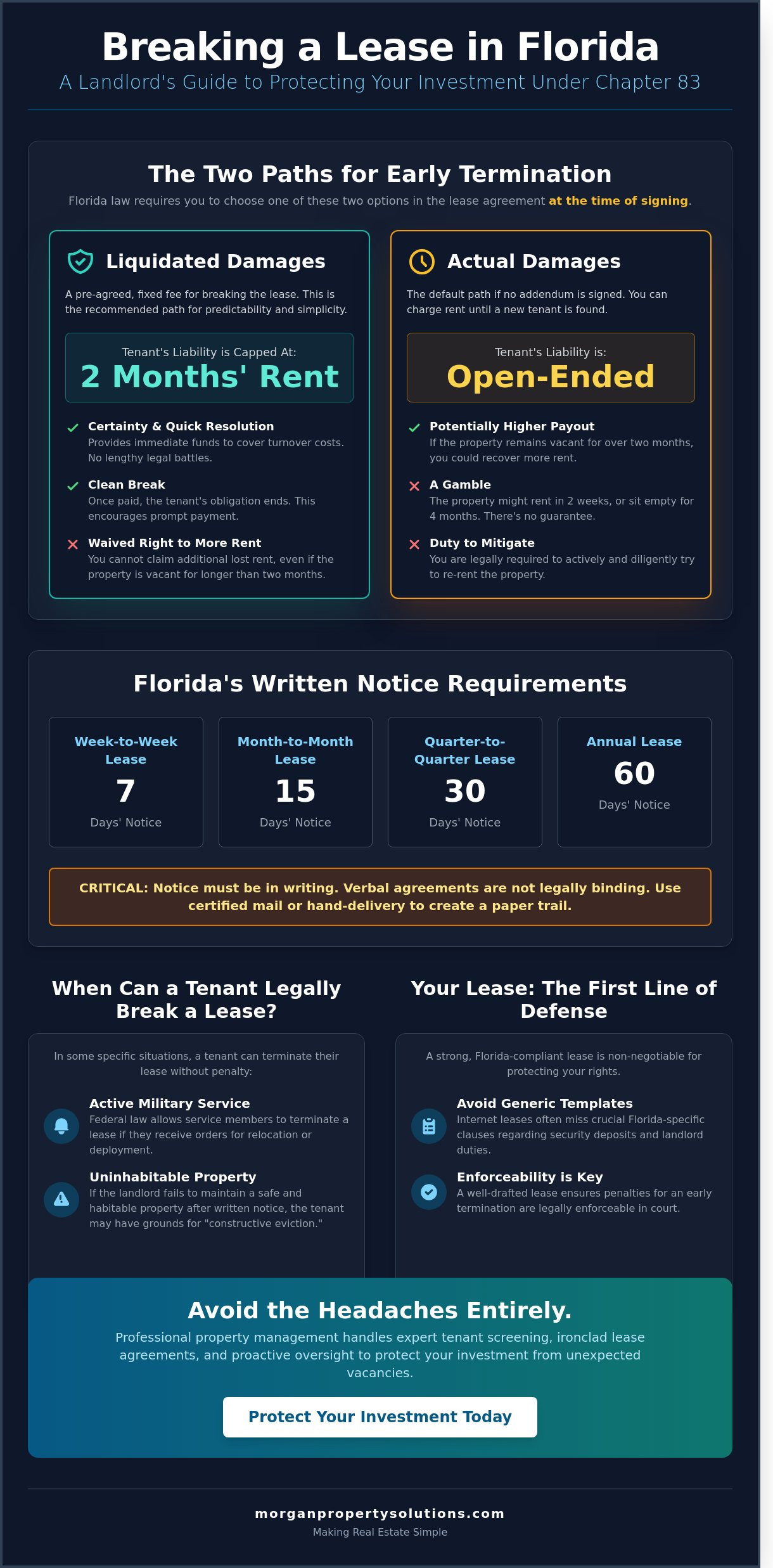
Florida is very specific about timing. If you’re dealing with a week-to-week lease, the law only requires 7 days’ notice. For quarter-to-quarter, it’s 30 days. Most people we work with have month-to-month or annual leases. In those cases, you’re looking at 15 or 60 days respectively. Don’t rely on a quick phone call or a text message. Verbal agreements are a recipe for disaster. If it isn’t in writing, it basically didn’t happen in the eyes of a judge. A formal, written notice delivered via certified mail or hand delivery is the gold standard. This creates a clear timeline that no one can argue with later, providing a paper trail that protects your interests during disputes.
The Role of the Lease Agreement
Your lease is your first line of defense. While state laws provide a baseline, your specific contract language can often add extra layers of protection or clarify how you handle early departures. A generic internet lease is often more trouble than it’s worth. Florida has unique requirements about where security deposits are held and how interest is handled. If your lease doesn’t follow these rules, your ability to enforce lease termination penalties might vanish. You can check out our landlord resources to stay updated on how these laws shift over time. A well-drafted lease ensures that when breaking a lease in florida landlord rights come into play, you have a clear path forward that minimizes your financial loss and keeps your rental business running smoothly.
The ‘Liquidated Damages’ Choice: Your Best Defense
Florida law offers a specific tool that most other states simply don’t provide. It is called a Liquidated Damages addendum. Understanding this specific document is the first step to mastering the process of breaking a lease in florida landlord rights while protecting your investment. This addendum allows you to set a fixed price for an early move-out right at the start of the tenancy. At Morgan Property Solutions, we find this to be the most reliable way to handle a tenant who needs to leave before their term is up. By choosing this option, you limit the tenant’s liability to a maximum of two months of rent. It creates a clean break that protects your monthly cash flow without the need for a long, expensive legal battle.
Liquidated Damages vs. Actual Damages
Liquidated damages are a pre-agreed penalty for an early exit from a rental agreement. If you choose this path, you receive a guaranteed two months of rent, but you must waive your right to seek more money for lost rent. The alternative is the Actual Damages path. This allows you to charge rent every month until you find a new tenant. While that sounds better on paper, it is often a gamble. A home might sit empty for 3 or 4 months during a slow winter season, or it could be filled in 14 days. According to Florida Statutes Chapter 83, you have to pick one of these two directions when the lease is signed. Most experienced Orlando property managers prefer the certainty of the two-month payout because it provides immediate funds to cover marketing and turnover costs.
Why the Addendum Must Be Signed at Lease Inception
You cannot wait until a tenant is already packing their boxes to ask them to sign a Liquidated Damages addendum. Florida law is very strict about this timing. If the specific box isn’t checked or the separate addendum is missing from the original lease, the court will default your case to the Actual Damages path. This often leads to frustration for owners who just want a quick, simple resolution.
There is also a significant psychological benefit to this approach. Tenants are much more likely to pay a fixed, two-month fee they agreed to upfront than they are to pay an open-ended debt that grows every day the house stays vacant. It makes the reality of breaking a lease in florida landlord rights much smoother for everyone involved. If you want to see how we structure these agreements to keep your life stress-free, you can explore our landlord resources for more expert guidance. This proactive strategy ensures that you aren’t left chasing a former tenant for months of unpaid rent while your property sits empty.
When is a Tenant Legally Allowed to Walk Away?
It’s a common worry for property owners, but sometimes a tenant leaving early isn’t actually a lease violation. Understanding breaking a lease in florida landlord rights starts with knowing which situations are legally protected by state or federal statutes. Federal and state laws create specific safety valves for tenants. If your tenant falls into one of these specific categories, they can walk away without the usual penalties you might expect.
The SCRA and Military Orders
The Servicemembers Civil Relief Act (SCRA) is a federal law that protects those in uniform. If a tenant enters active duty or receives a permanent change of station (PCS) order, they’re allowed to break their lease. They can’t just pack up and leave in the middle of the night, though. The tenant must provide you with a written notice and a copy of their official military orders. As a landlord, you’re entitled to see these documents before you release them from their obligations. The timeline is also specific. The lease doesn’t end immediately; it terminates 30 days after the next rent payment is due. If they pay rent on the 1st and give notice on the 10th, the lease ends 30 days after the following 1st of the month.
Habitability and the ‘Right to Repair’
Florida law is very clear about what makes a home livable. If a property becomes uninhabitable, the tenant might have a legal path out. According to the Landlord/Tenant Law in Florida, owners must keep the building up to code. This includes basic necessities like working heat, clean water, and a sound structure. If you fail to fix a major issue, like a broken AC during a 95-degree July in Orlando, the tenant can issue a 7-Day Notice of Noncompliance. If the repair isn’t made within those seven days, they can legally terminate the lease. This is why breaking a lease in florida landlord rights can be tricky if maintenance is neglected. Staying on top of preventative care is the best way to protect your legal standing.
Landlord Harassment and Constructive Eviction
You have to be careful not to accidentally evict your tenant through your own actions. This is known as constructive eviction. If a landlord tries to force a tenant out by changing the locks, shutting off the water, or removing windows, the law sees that as a lease breach by the landlord. Even if the tenant is months behind on rent, these self-help tactics give them the legal right to walk away and potentially sue for damages. It’s always better to follow the official eviction process than to take matters into your own hands. We always recommend keeping all interactions professional to avoid any claims of harassment that could void your lease agreement.
Handling an Unjustified Lease Break without the Stress
It happens more often than you might expect. A tenant gets a dream job offer in another state or simply decides to “skip” in the middle of the night, leaving you with a set of keys and an empty unit. When you’re dealing with breaking a lease in florida landlord rights, your first instinct might be to worry about the lost income. Take a breath. You have a clear path forward that protects your investment while keeping your stress levels low.
Florida law is very specific about your responsibilities in this scenario. Under Florida Statutes Section 83.595, you have what’s known as a duty to mitigate damages. This means you can’t just leave the unit empty for the next 10 months and expect the former tenant to pay for every day it sits vacant. You’re required to make a genuine, good faith effort to find a new, qualified renter. If you find a replacement in 45 days, the original tenant is typically only responsible for the rent during that gap and your re-leasing costs. For more tips on managing these shifts, check out our real estate articles.
The Step-by-Step Action Plan
- Step 1: Send a written acknowledgement immediately. Even if they just texted you, reply with a formal letter or email. Acknowledge they’ve vacated the property and remind them of the specific lease terms regarding early termination.
- Step 2: Get inside the unit right away. Conduct a move-out inspection within 24 to 48 hours to document any physical damage beyond normal wear and tear. Use photos and video for proof.
- Step 3: Market the property at a competitive rate. If you try to list the home for $300 more than the previous rent, a court might rule that you didn’t truly try to mitigate damages.
Security Deposit Pitfalls
Florida gives you a strict 15 day window to return a deposit in full or a 30 day window to send a certified letter claiming a portion of it. If you miss these deadlines, you could lose your legal right to keep any of that money, regardless of the lease break. Don’t fall into the trap of using the deposit as a “penalty” fee. Unless your lease includes a specific liquidated damages clause that the tenant signed, you can only deduct actual lost rent and documented repair costs. Always provide a line-item accounting statement to the tenant’s last known address to avoid a messy small claims lawsuit. Understanding the nuances of breaking a lease in florida landlord rights ensures you stay compliant while protecting your cash flow.
How Professional Management Simplifies the Process
Dealing with a tenant who wants to leave early is often the most stressful part of being a landlord. This is exactly where professional Orlando property management pays for itself. Instead of you spending your weekends worrying about legal notices or missed rent, we step in to make the transition smooth. We handle the awkward conversations and all the complex legal paperwork so you don’t have to. When you’re managing the specifics of breaking a lease in florida landlord rights, you realize that having a professional team means you aren’t just reacting to a crisis; you’re following a proven plan. A simple real estate experience comes down to letting experts manage the turnover while you focus on your own life. We’ve been doing this for over 20 years, so we know how to protect your investment and keep things moving forward.
Prevention Through Better Screening
Everything starts with who you let into your home. Our detailed screening criteria filter for reliable, long-term tenants from day one. There’s a direct correlation between a solid credit history and lease-breaking behavior. Industry data shows that tenants with a credit score above 670 are significantly less likely to default or skip out on their obligations. High-quality tenants are your best insurance policy against vacancy. Our process helps eliminate the risk of a “skip” before it ever happens. By looking at past rental history and stable income, we find people who value their credit and their commitments. This proactive step saves you thousands of dollars in potential lost rent and legal fees down the road.
Rapid Re-Renting and Marketing
- We handle all tenant communications to reduce your stress.
- Our marketing reach ensures your property is seen by thousands of potential renters.
- We ensure all security deposit claims follow Florida statutes perfectly.
- Our goal is to make your rental income as passive as possible.
Protect Your Investment and Move Forward with Confidence
Handling a tenant who walks away early can feel like a major setback, but it’s really just a hurdle you can clear with the right plan. Remember that Florida Chapter 83 gives you specific protections, especially if you’ve already set up a solid liquidated damages strategy in your lease agreement. This one choice often makes the difference between a long legal battle and a quick, clean transition to a new tenant. Understanding the nuances of breaking a lease in florida landlord rights is essential for keeping your rental business profitable and your stress levels low.
You don’t have to navigate these complex laws on your own or worry about the financial impact of an empty property. With over 20 years of Central Florida experience and a consistent A+ BBB rating, we’ve seen every possible scenario. We use proven strategies to protect your income and keep your properties running smoothly. Let us make your property management simple and stress-free. Contact Morgan Property Solutions today!
You’ve worked hard to build your real estate portfolio, and we’re here to help you keep it secure and successful for the long haul. Just as you plan for your financial future, you can also explore Life Celebration Services to ensure every aspect of your legacy is handled with care and professionalism.
Frequently Asked Questions
Can a landlord keep the security deposit if a tenant breaks the lease in Florida?
Yes, you can often use the security deposit to cover unpaid rent or physical damages if a tenant leaves before the lease ends. Florida Statute 83.49 requires you to notify the tenant within 30 days if you intend to claim any part of the deposit. If your lease includes a liquidated damages clause, you might apply the deposit toward that agreed fee. We’re here to help you track these expenses to keep the process simple and stress-free.
How much notice does a tenant have to give to break a lease in Florida?
The required notice period depends entirely on the type of rental agreement you’ve signed with the tenant. For month-to-month tenancies, Florida Statute 83.57 dictates that tenants must provide at least 15 days’ notice before the end of the monthly period. Yearly leases usually require 30 or 60 days of notice. Our team finds that clear communication helps eliminate vacancy and keeps your rental income steady during these transitions.
What is the ‘Early Termination Fee’ addendum in Florida?
This addendum is a specific agreement where the tenant pays a set fee to end the lease early, which is capped at two months’ rent. Florida Statute 83.595 gives landlords the choice to offer this option right when the lease starts. It’s a smart way to simplify the process because it provides a clear financial exit strategy for everyone. By using this, you avoid the headache of trying to collect rent while the unit sits empty.
Is a job transfer a legal reason to break a lease in Florida?
No, a job transfer isn’t a legally protected reason to break a lease under Florida state law. While active military members have specific protections under the Servicemembers Civil Relief Act, standard employees don’t have the same automatic rights. Understanding breaking a lease in florida landlord rights helps you navigate these requests fairly. You can choose to be flexible and work with the tenant, but you aren’t legally required to let them walk away without penalty.
Can I sue my tenant for the remaining rent if they move out early?
You can sue for the remaining rent, but your legal options depend on how you handle the property after the tenant vacates. Florida Statute 83.595 allows you to stand by and hold the tenant liable for rent as it comes due, or you can retake possession to re-rent the unit. If you choose to re-rent it, you can only sue for the time the home was actually vacant. Most of our clients prefer finding a new tenant quickly to boost profits.
Does breaking a lease hurt a tenant’s credit score in Florida?
Breaking a lease doesn’t show up on a credit report immediately, but the resulting financial debt certainly can. If a tenant leaves with unpaid rent and you send that debt to a collection agency, their score will likely drop. A 2023 report from FICO shows that collection accounts can stay on a credit report for seven years. We’ll guide you through handling these collections professionally so you can stay focused on your next move.
What happens if a tenant leaves without notice in Florida?
When a tenant disappears without a word, it’s legally considered abandonment if they’re gone for at least 15 days without paying their rent. Florida Statute 83.59 outlines the exact steps you must take to regain possession of your property safely. It’s a frustrating situation, but following the legal path protects you from future claims. We’ve guided many owners through this process to ensure their investment stays secure and ready for the next occupant.
Can a landlord break a lease early to sell the property in Florida?
You generally can’t break a lease just to sell the property unless your contract includes a specific “sale of premises” clause. In Florida, the lease typically stays with the property, meaning the new owner simply becomes the new landlord. If you need to sell a vacant home, you might offer the tenant a “cash for keys” settlement. Mastering breaking a lease in florida landlord rights ensures you handle these sales without legal hiccups or unhappy tenants.

Article by
Oliver Overton-Morgan
Oliver Overton-Morgan is a full-time Real Estate Broker since 2003, with years of experience helping thousands of people purchase and sell real estate throughout Central Florida. He holds a Graduate Realtor Institute designation, LCAM, and has held licenses in good standing as a Florida Mortgage Broker and a Notary Public. Oliver immigrated to central Florida in 2001, and within 5 years Oliver built a successful Real Estate brokerage in central Florida, where he recruited over 75 Sales Associates with 25+ million in sales production.