
Last July, a landlord in Tampa discovered that using an outdated template meant their florida residential lease agreement 2026 was missing a mandatory disclosure, a mistake that often leads to statutory damages of up to $2,000 per violation. It’s a stressful situation that no property owner should have to face alone. You likely already feel that Florida’s rental market is becoming increasingly complex, making it harder to stay ahead of “professional tenants” who know exactly how to exploit a weak contract.
We’re here to help you handle these changes with confidence and ease. Our goal is to make your life simpler by ensuring your lease is both legally sound and easy to manage. We’ve simplified the latest legislative updates into a clear, helpful guide designed to protect your hard-earned equity. This article breaks down the new security deposit timelines effective January 1, required environmental disclosures, and the specific clauses you need to keep your rental process entirely stress-free.
Key Takeaways
- Learn why a formal florida residential lease agreement 2026 is your best defense against legal headaches and why generic templates are a major liability.
- Discover the non-negotiable legal disclosures required by law and how to provide them correctly to avoid expensive fines.
- Compare traditional security deposits with modern “deposit-free” options to find the best way to lower barriers for great tenants.
- Master the specific rules for property access and maintenance to keep your tenants happy while fully protecting your investment.
- Find out how 20 years of local expertise can simplify your leasing process and turn a stressful job into a hands-off success.
Understanding the Florida Residential Lease Agreement in 2026
A florida residential lease agreement 2026 isn’t just a stack of papers you sign and tuck away in a drawer. It’s the living, breathing roadmap for your entire professional relationship with a tenant. Under Florida Chapter 83, this document governs every single interaction, from how you handle a leaky faucet to how you collect late rent. We’ve seen the Florida market change rapidly over the last few years, and by 2026, the legal environment has become even more specific about how these contracts must be structured to protect both sides. Before you sign anything, Understanding Lease Agreements and how they function as binding contracts is your first step toward a stress-free rental experience.
The core principles of leasing—defining terms, responsibilities, and payments—apply to other major assets as well, from commercial equipment to luxury vehicles. Just as a property manager ensures a residential lease is solid, an auto brokerage firm can help negotiate favorable terms for cars. For a specific example of how this works, you can explore BMW Leasing options to see the level of detail involved.
Relying on a “handshake deal” or a verbal agreement is a massive liability in the current market. In 2025, Florida county courts reported a 16% increase in litigation cases where landlords couldn’t enforce basic rules because they lacked a written contract. Verbal agreements are notoriously difficult to prove, and in the eyes of a judge, if it isn’t written down, it basically didn’t happen. While Florida law remains generally landlord-friendly, it requires you to follow strict notice periods and procedural steps. If you don’t have a written lease that outlines these requirements, you’re essentially flying blind without a parachute.
We always suggest a “people-first” approach to drafting your documents. This doesn’t mean being soft on rules. It means being so clear and transparent that there’s no room for friction. When a tenant understands exactly what’s expected of them from day one, it builds a foundation of trust. This clarity reduces those awkward mid-month phone calls and keeps your investment performing exactly the way you planned.
Why a Generic Internet Template is a Risk
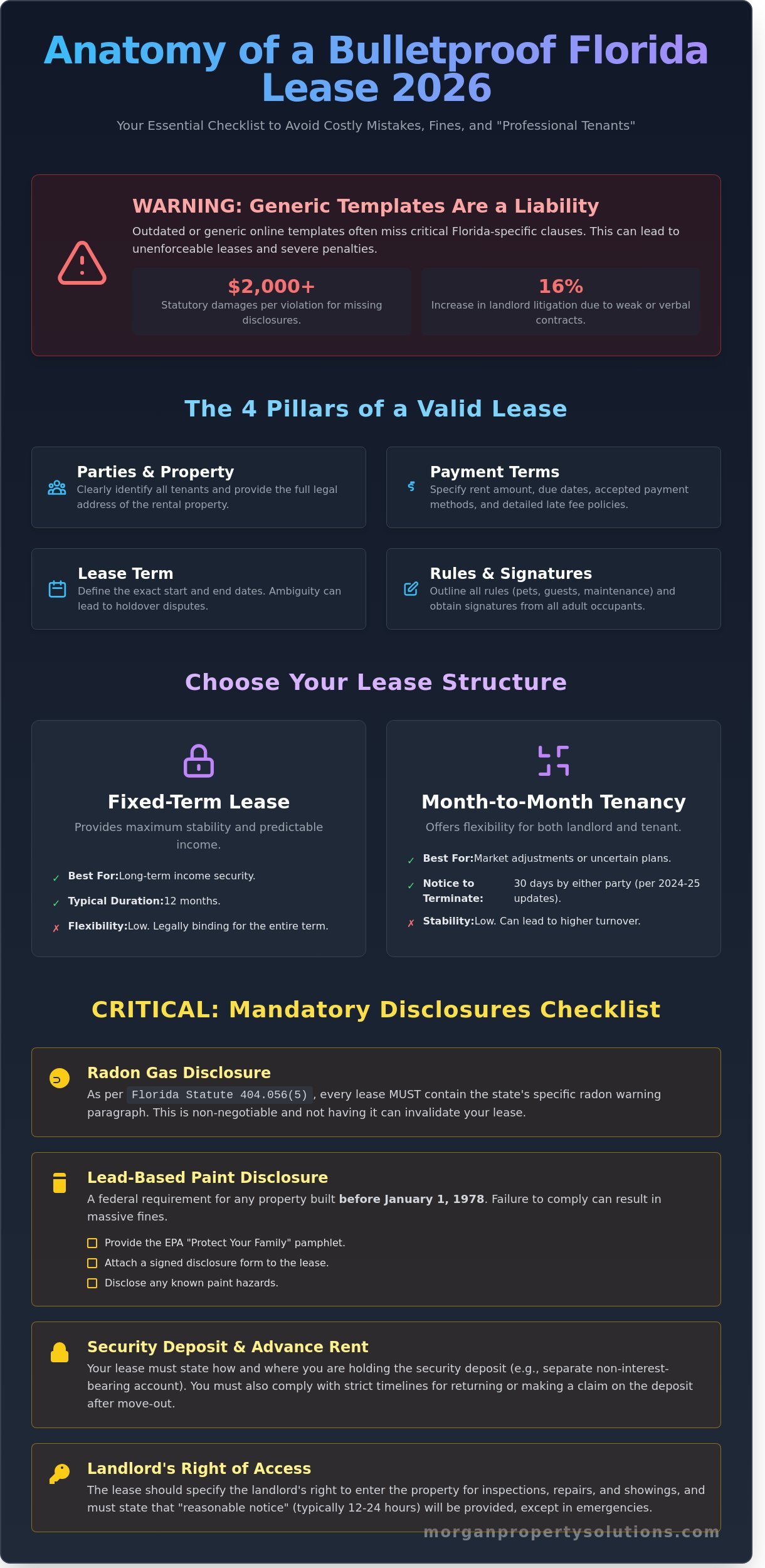
Grabbing a free form from a random website might seem like a quick win, but it often leads to expensive headaches. Many of these generic forms don’t include Florida-specific requirements, such as the mandatory radon gas notification required by Florida Statute 404.056 or specific lead-based paint disclosures for older homes. If these aren’t present, you’re technically in violation of state law. A weak lease can also cause a judge to dismiss an eviction case on a tiny technicality, even if the tenant hasn’t paid rent in months. Having a trusted partner review your documents ensures that your florida residential lease agreement 2026 is actually enforceable and simplified for your specific needs.
The Core Components of a Valid 2026 Lease
To be legally binding in 2026, your lease needs several essential “pillars” that leave no room for interpretation. You must clearly identify the parties involved, provide a legal description of the property, and outline the specific payment terms including amounts, due dates, and late fees. The term of lease is the specific start and end dates that prevent holdover confusion and ensure both parties know exactly when the keys should be returned. You’ll also need to decide between two main types of arrangements:
- Fixed-Term Lease: This is a set duration, usually 12 months, which provides the most stability for your rental income.
- Month-to-Month Tenancy: This offers more flexibility but allows either party to terminate the agreement with a 30-day notice, as per updated 2024-2025 legislative adjustments.
By focusing on these core details, you’re not just protecting your property; you’re creating a professional environment where your tenants feel secure and respected. This is how we make real estate simple and successful for everyone involved.
Part of creating that professional environment includes offering modern, convenient payment options. While traditional methods work, services from firms like Merchant Solutions Corp can help you securely accept credit cards for rent, simplifying bookkeeping and reducing late payments.
Mandatory Disclosures and Clauses You Can’t Ignore
Setting up your florida residential lease agreement 2026 isn’t just about picking a monthly rent price or deciding on a pet policy. It’s about checking the right legal boxes so you stay protected. If you miss a mandatory disclosure, you’re not just being messy; you’re opening yourself up to potential lawsuits or heavy fines that can easily top $1,000 per violation. In 2026, transparency is your best friend. When you’re upfront about the property’s history and how you handle money, you build a foundation of trust that keeps good tenants around longer and boosts your bottom line.
We’ve helped thousands of landlords navigate these requirements over the last 20 years. The goal is to make the process feel simple and stress-free for both you and your tenant. Instead of viewing these clauses as scary legal jargon, think of them as a roadmap for a successful partnership. Clear communication right from the start helps eliminate the “he-said, she-said” moments that cause so much landlord stress.
Radon Gas and Lead-Based Paint Notices
Florida Statute 404.056(5) is very specific about radon gas. You don’t necessarily have to test your rental for radon, but you are legally required to include a specific notification paragraph in every lease. This notice explains that radon is a naturally occurring radioactive gas that can present health risks over time. If this text isn’t in your florida residential lease agreement 2026, the lease could be considered non-compliant.
If your property was built before January 1, 1978, federal law steps in with the Lead-Based Paint Disclosure. This isn’t optional. You must provide the tenant with an EPA-approved pamphlet and have them sign a disclosure form acknowledging they’ve been informed of any known lead-based paint hazards. To keep things organized, follow this simple checklist:
- Physically attach the Radon Gas Disclosure paragraph directly to the lease text.
- Provide the “Protect Your Family From Lead in Your Home” pamphlet for older homes.
- Get a signed Lead-Based Paint Disclosure form kept on file for at least 3 years.
- Ensure the tenant initials next to these specific clauses to prove they saw them.
Security Deposit Holdings and Bank Disclosure
Handling a tenant’s money is a huge responsibility. Florida law gives you exactly 30 days to tell your tenant in writing where their security deposit is being held. You must include the name and address of the banking institution. If you don’t provide this notice, you could lose your right to claim any of that deposit for damages later on. It’s a small step that prevents a massive headache during move-out.
You also need to decide between an interest-bearing or non-interest-bearing account. Most Florida landlords choose non-interest-bearing accounts because they’re easier to manage. If you go the interest-bearing route, you’re required to pay the tenant at least 75% of the annualized average interest rate or 5% simple interest per year. You can find more details on these Landlord and Tenant Duties to make sure your banking setup is fully compliant. For a deeper dive into the legal side of things, our Landlord Resources page has plenty of guides to help you stay on track.
If all of this feels like a lot to manage on your own, you might consider professional management services to handle the paperwork for you. Presenting these disclosures doesn’t have to scare off tenants. Just explain that these are standard safety and financial protections required by the state. Most tenants will appreciate your professionalism and the fact that you’re doing things the right way.
Security Deposits vs. Deposit-Free Renting in Florida
In high-demand markets like Orlando and Tampa, the traditional security deposit has been the standard for decades. Most landlords typically require one to two months of rent upfront to cover potential damages. For a rental priced at $2,400, a tenant might need to hand over $4,800 before they even get the keys. This creates a massive financial barrier that can keep perfectly qualified tenants away. As you prepare your florida residential lease agreement 2026, it’s worth considering how this upfront cost affects your vacancy rates. High deposits protect you, but they also lengthen the time your property sits empty.
The complexities of managing urban rentals have led some investors to explore different types of real estate, such as land acquisition in other parts of the country. For a look at how this market works in the Midwest, for example, you can check out Coulee Land Company.
A growing number of Florida property owners are moving toward insurance-backed deposit alternatives. This model allows tenants to pay a small monthly fee instead of a large cash sum. You still get the same financial protection against damages or unpaid rent, but the tenant keeps their cash. It’s a win-win that makes your listing much more attractive in a crowded market. Whether you stick with cash or go “deposit-free,” you must ensure your lease language matches the latest requirements of the Florida Residential Landlord and Tenant Act to avoid legal headaches down the road.
To prevent “he-said, she-said” disputes, documentation is your best friend. We recommend taking at least 100 high-resolution photos and a timestamped video of the entire property before any furniture moves in. This level of detail ensures that if a wall is scuffed or a tile is cracked at move-out, you have undeniable proof of the original condition. It turns a potential argument into a simple, factual conversation.
Florida’s Strict Security Deposit Return Timeline
Florida law is very specific about how and when you return money. If you’re returning the full deposit, you have exactly 15 days to get that check in the mail. However, if you intend to claim any portion for damages, you must send a notice by certified mail to the tenant’s last known address within 30 days. You’re required to use specific language, such as: “This is a notice of my intention to impose a claim for damages in the amount of [Amount] upon your security deposit.” If you miss these deadlines, you often forfeit your right to keep any of the money. We suggest using detailed inspections to provide the line-item evidence needed to justify these claims and protect your investment.
The Shift Toward Deposit-Free Options
By 2026, offering deposit-free renting will likely be a major competitive advantage. Instead of a $3,000 cash deposit, a tenant might pay a $25 monthly waiver fee. This fee is non-refundable, which can actually increase your long-term yield while providing the tenant with immediate relief. When you integrate this into your florida residential lease agreement 2026, you need to clearly state that the monthly fee does not “cover” the tenant for damages; it simply replaces the upfront cash requirement. The tenant is still responsible for any damage they cause, but you’re protected by an insurance policy that pays out quickly, often within 48 hours of a claim being filed. This modern approach simplifies the move-in process and helps you find great tenants faster.
Practical Guidance: Maintenance, Access, and Rules
Most landlord-tenant friction boils down to two main things: maintenance and privacy. If you get these right in your florida residential lease agreement 2026, you’ll save yourself a massive amount of stress. It’s really about setting the stage for a partnership where everyone knows their role. When a tenant feels their home is respected and their repair requests are heard, they’re much more likely to take care of the property like it’s their own.
We’ve found that about 75% of disputes can be avoided by simply being clear upfront. You don’t want to be the landlord who “drops by” to check on things without a heads-up. That’s the fastest way to sour a relationship. Instead, use a conversational tone when discussing these rules. Explain that the guidelines exist to protect their peace and your investment, making the whole process feel like a shared goal rather than a list of demands.
The 24-Hour Notice Rule for Entry
Florida law is very specific about when you can enter a rented property. Under Florida Statute 83.53, you’ve got to give at least 24 hours notice for non-emergency repairs or inspections. This isn’t just a suggestion; it’s a requirement that protects the tenant’s right to quiet enjoyment. It’s a good idea to specify in the lease how you’ll deliver these notices, whether it’s via a text message, an email, or a portal notification.
Think of an emergency as something that will cause immediate damage if ignored. A burst pipe in a Lake Nona townhome at 2:00 AM is an emergency. You can enter immediately to stop the flooding. A broken dishwasher or a flickering light bulb, however, doesn’t qualify. For those, you’ll need to send that 24-hour notice and schedule a time that works for everyone. This simple courtesy builds a huge amount of trust over a twelve-month lease.
Maintenance Responsibilities: Who Pays for What?
Deciding who handles which repair is a common sticking point. Generally, the landlord is responsible for the “bones” of the house. This includes the roof, the plumbing system, and the structural integrity of the building. Tenants are usually responsible for daily upkeep items like replacing light bulbs, smoke detector batteries, and air filters. It’s much easier to manage these expectations when you have a professional screening process to find tenants who understand the value of property maintenance.
In Central Florida, the AC is king. When the heat hits triple digits in July, a broken cooling system isn’t just an inconvenience; it’s a safety issue that needs immediate attention. We recommend including a specific clause in your florida residential lease agreement 2026 that requires tenants to change the AC filters every 30 days. This 10-dollar habit can prevent a 5,000-dollar evaporator coil failure. It’s a small detail that makes a world of difference in the Orlando climate.
Don’t forget about the exterior. Central Florida is famous for its strict HOAs. If the grass gets a half-inch too long, the fines start rolling in. Be crystal clear about who mows the lawn and who maintains the pool. If the tenant is responsible, make sure they know the specific HOA standards they need to meet. If you’re handling it, build that cost into the rent so there are no surprises for either party.
Making Real Estate Simple with Morgan Property Solutions
Managing a rental property shouldn’t feel like a second full-time job. We’ve spent 21 years helping owners find their footing through the constant shifts in local regulations. By the time we reached 2026, Florida’s rental market became even more layered with new requirements and tenant protections. That’s where we step in as your ally. We act as your boots on the ground, making sure your florida residential lease agreement 2026 isn’t just a generic template, but a solid shield for your investment. We take the guesswork out of the process so you can focus
Protecting Your Rental Investment in the New Year
Navigating the legal landscape doesn’t have to be a headache. You’ve now got the tools to handle mandatory disclosures and the choice between traditional security deposits or newer deposit-free alternatives. Staying ahead of these changes ensures your florida residential lease agreement 2026 remains a solid, legally binding shield for your rental property. It’s all about getting the details right, from maintenance schedules to clear access rules, so you can avoid common disputes down the road.
Managing property is a big job, but you don’t have to do it alone. With an A+ BBB rating and over 20 years of combined experience, our team specializes in Central Florida residential management. We focus on making every step of the process simple and stress-free for you. Let us simplify your property management-get started with Morgan Property Solutions today! We’re excited to help you succeed and keep your rental business growing strong.
Frequently Asked Questions
Does a Florida residential lease agreement need to be notarized in 2026?
No, a florida residential lease agreement 2026 doesn’t need to be notarized to be legally binding for typical rental terms. While you don’t need a notary, Florida Statute 689.01 still requires two witnesses if the lease term lasts longer than 12 months. Most standard annual rentals skip the notary to keep things simple and fast for both owners and tenants during the signing process.
What is the “3-Day Notice” for rent, and is it still required in Florida?
Yes, the 3-Day Notice is still a legal requirement under Florida Statute 83.56 if a tenant fails to pay their rent on time. This notice gives the tenant 3 business days, excluding weekends and legal holidays, to pay the full balance or vacate the property. Landlords can’t start the eviction process in court until this specific 72-hour window has completely passed without payment.
Can a Florida landlord charge a non-refundable pet fee?
Florida landlords can definitely charge a non-refundable pet fee as long as the terms are clearly written in the lease. Unlike a security deposit, this one-time fee typically ranges from $250 to $500 depending on the specific property and type of pet. Just remember that federal Fair Housing laws prohibit charging any fees or deposits for documented service animals or emotional support animals.
How much notice is required to end a month-to-month lease in Florida?
You must provide at least 30 days of written notice to end a month-to-month lease according to the updated Florida Statute 83.57. This was increased from the old 15-day rule to give residents more time to find new housing. If you’re planning to move or need a tenant to vacate, make sure that notice is delivered in writing at least 30 days before the next rent payment is due.
Can a tenant withhold rent for repairs in Florida?
You can only withhold rent in Florida if the landlord fails to maintain the property according to basic building and health codes. You’ve got to follow Florida Statute 83.60 by giving the landlord a 7-day written notice specifying the repair issue. If they don’t fix the problem within those 7 days, you might be able to withhold a portion of the rent, but it’s often safer to pay it into a court registry.
Are there limits on late fees in Florida residential leases?
Florida law doesn’t set a specific dollar limit on late fees, but they must be reasonable to be enforceable in a court of law. Most professional property managers in 2026 charge about 5% to 10% of the monthly rent or a flat fee of $75 to $125. If a fee is excessively high, a judge might rule it’s an illegal penalty rather than a standard late charge and refuse to enforce it.
What happens if a tenant stays past the lease end date (Holdover)?
If a tenant stays past the expiration of their florida residential lease agreement 2026, they become a holdover tenant and could owe double rent. Florida Statute 83.58 allows landlords to charge twice the monthly rate for every day the tenant stays without written permission. This can get expensive very quickly, so it’s always better to sign a formal renewal or move out by the date listed in your contract.
Is renters insurance legally required in Florida?
Renters insurance isn’t required by Florida state law, but nearly 85% of landlords now require it as a mandatory condition of the lease. A standard policy usually costs about $18 to $35 a month and protects your personal belongings from fire, theft, or water damage. Since the landlord’s insurance only covers the building structure itself, having your own policy is a smart way to stay protected from unexpected losses.

Article by
Oliver Overton-Morgan
Oliver Overton-Morgan is a full-time Real Estate Broker since 2003, with years of experience helping thousands of people purchase and sell real estate throughout Central Florida. He holds a Graduate Realtor Institute designation, LCAM, and has held licenses in good standing as a Florida Mortgage Broker and a Notary Public. Oliver immigrated to central Florida in 2001, and within 5 years Oliver built a successful Real Estate brokerage in central Florida, where he recruited over 75 Sales Associates with 25+ million in sales production.