
Last Tuesday, a landlord in Orlando found himself staring at a $4,500 plumbing bill and a threatening letter from a tenant’s attorney. It’s a nightmare scenario that many property owners face when they aren’t 100% sure about the latest landlord responsibilities for repairs in Florida. You want to provide a safe home for your tenants, but you also don’t want to be taken advantage of by unreasonable demands or skyrocketing maintenance fees.
We know that keeping up with habitability standards in 2026 feels like trying to hit a moving target while your budget takes a hit. You deserve to feel confident that you’re protecting your investment without overpaying for every minor scratch or dent. This guide gives you a clear, human-friendly breakdown of what you legally must fix, what you can charge for, and how to stay compliant with Florida’s 2026 landlord-tenant laws. We’ll walk through a specific list of mandatory repairs and show you the legal way to structure your lease clauses so you can finally have some peace of mind.
Key Takeaways
- Understand how Florida Statute 83.51 sets specific maintenance standards that differ between single-family homes and multi-family units.
- Get a clear breakdown of landlord responsibilities for repairs in Florida, including the essential services like water and heat that must always be functional.
- Learn the truth about the $100 repair deductible myth and how to legally distinguish between tenant damage and normal wear and tear.
- Discover how to navigate the strict “7-Day Notice” timeline and the legal requirements for handling emergency versus non-emergency repairs.
- Find out how professional property management can simplify your maintenance process and protect you from common legal headaches.
Understanding Florida Statute 83.51: The Foundation of Repair Duties
Florida Statute 83.51 serves as the essential rulebook for every property owner in the state. It defines the legal baseline for what a home must provide to be considered habitable. If you’re managing a rental, you can’t treat maintenance as an optional task. This law creates a clear framework for landlord responsibilities for repairs in florida, ensuring that every tenant has access to a safe and functional living environment. At Morgan Property Solutions Inc., we’ve spent more than 20 years guiding owners through these requirements, making sure they stay compliant while protecting their investments.
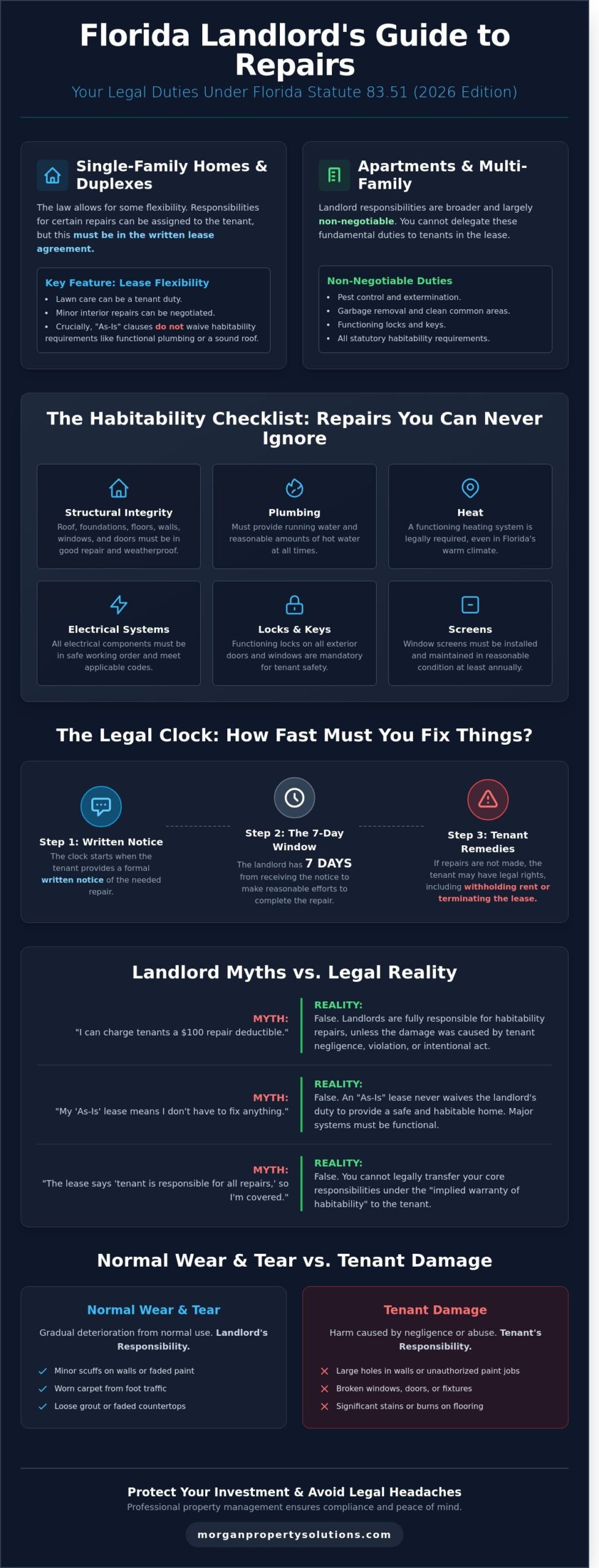
The law treats different types of properties with varying levels of strictness. If you own a single-family home or a duplex, the statute allows for some flexibility. You and your tenant can actually agree in writing that the tenant will handle certain repairs or maintenance tasks. However, if you’re renting out an apartment or a multi-family building, your duties are much broader and largely non-negotiable. You’re responsible for things like pest control, garbage disposal, and maintaining common areas. You can’t simply hand those tasks off to a tenant just because it’s convenient for your budget.
One of the biggest mistakes we see is the attempt to “contract away” these legal duties. You might think that adding a sentence to your lease saying “tenant is responsible for all repairs” protects you, but Florida law doesn’t work that way. Certain obligations are tied to the implied warranty of habitability, which means the home must meet basic health and safety standards regardless of what the lease says. Attempting to bypass these rules can lead to heavy fines or legal action. Our goal is to help you build a “stress-free” management plan that respects these boundaries while keeping your property in top shape.
The Default Statutory Duties
By default, Florida law requires you to comply with all applicable building, housing, and health codes. This isn’t just about aesthetics; it’s about structural integrity. You must maintain the roof, windows, doors, floors, and foundations in good repair. If a storm hits in 2026 and damages the exterior, the clock starts ticking on your duty to fix it. You’re also required to provide working plumbing and heating systems. While Florida doesn’t legally require air conditioning under this specific statute, the plumbing and heat must function properly to meet the state’s minimum standards for a livable home.
Lease Flexibility vs. Legal Requirements
While the law sets a high bar, there’s some room for negotiation in specific scenarios. In single-family rentals, you can shift the responsibility for things like lawn care or minor interior repairs to the tenant. But you must be careful with “As-Is” lease agreements. Even in 2026, an “As-Is” clause doesn’t excuse a landlord from fixing a broken water heater or a collapsing ceiling. These pitfalls often lead to disputes that could have been avoided with professional guidance. Utilizing expert landlord resources is the best way to ensure your lease clauses are both fair and legally binding. We lean on our A+ BBB rating and decades of experience to help you draft agreements that protect your interests without crossing legal lines. Understanding landlord responsibilities for repairs in florida is much simpler when you have a seasoned partner helping you manage the details.
For example, when defining “lawn care,” it’s wise to specify whether this includes basic mowing or more involved projects. If you’re looking to improve curb appeal with a new lawn, you might want to explore Sod Installation to see what’s involved; this Tennessee-based guide offers great insights applicable to any region.
The Habitability Checklist: Repairs You Can Never Ignore
Every lease in Florida includes an unwritten promise called the “Warranty of Habitability.” It’s a simple concept that means you’re providing a home that is safe, sanitary, and fit for human life. To stay on the right side of the law, you should familiarize yourself with Florida Statutes Chapter 83, specifically section 83.51. This section is the foundation for all landlord responsibilities for repairs in florida. It covers everything from the structural integrity of the roof to the screens on the windows.
Staying on top of landlord responsibilities for repairs in florida isn’t just about being a good neighbor; it’s about protecting your investment from legal claims. You’re legally required to provide essential services that keep the home functional. This includes:
- Working Plumbing: You must provide access to running water and hot water at all times.
- Electricity: All electrical components must meet local building codes and remain in safe working order.
- Heating: Even though we enjoy 80-degree days in December, Florida law requires landlords to provide functioning heat for those rare cold snaps.
- Structural Integrity: The foundation, walls, and roof must be weather-tight and capable of supporting the building’s load.
Given Florida’s intense weather, maintaining the roof is one of the most critical aspects of structural integrity. For landlords looking for reliable solutions for inspections, repairs, or replacements, you can discover Roof Top Experts to help protect your property.
When it comes to electrical systems, from faulty panels to ensuring everything is up to code, it’s essential to use a licensed and insured contractor. For landlords in Central Florida, a long-standing professional service like Sanford Electric, LLC can be a reliable partner in meeting these legal requirements.
Understanding your property’s electrical capacity is also a key part of preventative maintenance. As tenants use more high-powered devices, the risk of tripping breakers or creating fire hazards increases. To learn how to assess your system’s limits, check out Sanford Electric, LLC.
Florida Climate Specifics: AC and Mold
By 2026, the expectations for cooling have evolved. While Florida state law doesn’t explicitly mandate air conditioning in every rental, local Orlando codes often require that if an AC system was provided at move-in, it must be maintained. If a unit fails and the indoor humidity stays above 60% for several days, you’re inviting mold growth. You’ll likely be held liable for mold remediation costs, which can easily exceed $5,000, if the issue stems from a delayed repair. We recommend scheduling HVAC service every six months to prevent these expensive breakdowns and keep your profits steady.
Security and Safety Essentials
Safety starts with the basics like functioning locks and window screens. These aren’t just suggestions; they’re non-negotiable duties under Florida law. You must also ensure that smoke detectors are installed and tested before every new move-in. In 2026, fire safety compliance is a top priority for local inspectors, so don’t cut corners here. Beyond physical repairs, your first line of defense against property damage is choosing the right people. Using thorough screening criteria helps ensure you place tenants who are more likely to respect the property and report issues before they become disasters.
Managing these moving parts can feel like a full-time job because it often is. If you’re feeling overwhelmed by the maintenance schedule, it might be time to partner with a professional team who can handle the heavy lifting for you. We’ve spent over 20 years helping owners simplify their rental business while ensuring every repair is handled quickly and correctly. Taking care of these “habitability” items today prevents the stress of a lawsuit tomorrow.
Can You Make Tenants Pay? The $100 Deductible and Other Myths
You might have heard that charging a $100 deductible for every repair request is just “the way things are done” in the Sunshine State. It’s a common myth that can land even the most well intentioned property owner in hot water. While it sounds like a smart way to keep tenants from calling about every loose cabinet knob, Florida law doesn’t actually support shifting these costs for essential systems. If you try to pass off the cost of a broken water heater or a leaking roof to your tenant, you’re likely violating Florida Statute 83.51. This law explicitly places the burden of major system maintenance on the owner. When you understand the specific landlord responsibilities for repairs in florida, you can protect your investment without risking a lawsuit.
The reality is that 7 out of 10 self managed landlords in Florida currently use lease clauses that wouldn’t hold up in court. If a judge sees a “repair deductible” for a primary habitability item, they often throw the entire clause out. This leaves you responsible for the full bill plus potential legal fees. We believe in making property management simple and stress free, which starts with knowing exactly what you can and cannot charge for.
Damage vs. Normal Wear and Tear
In the 2026 Florida rental market, the line between damage and wear is where most disputes happen. Normal wear is the expected decline in a property’s condition over time. For example, a carpet has a typical life span of 5 years. If it’s slightly frayed after a long lease, that’s on you. However, if a tenant’s dog chews a hole in that same carpet, that’s damage. You can legally charge for things like broken windows, large holes in the drywall, or a kitchen counter scorched by a hot pan. To stay safe, we recommend using 4K video walkthroughs during every move in. This provides 100% clarity if a dispute ever reaches a mediator.
The Deductible Clause: Legal or Not?
Florida courts are increasingly skeptical of repair deductibles because they discourage tenants from reporting small issues. If a tenant has to pay $100 for a small pipe leak, they might wait until the floor is rotting to call you. This “self repair” culture often leads to massive repair bills later. According to this Florida Bar consumer pamphlet, landlords must maintain the plumbing and structural components in reasonable working condition regardless of what a custom lease says. Instead of deductibles, we suggest focusing on thorough tenant screening and slightly higher rent to cover a maintenance reserve. It’s a much safer way to manage your cash flow.
Charging for statutory maintenance is a legal risk you don’t need to take. Over the last 24 months, Florida Small Claims courts have seen a 15% rise in security deposit disputes related to repair charges. If the repair is needed to keep the home safe or functional, it’s almost always your responsibility. You can stay ahead of these issues by conducting bi-annual inspections. These 20 minute walk throughs catch small leaks before they become $5,000 mold remediation projects. Our team is here to guide you through these rules so you can enjoy being a landlord without the constant worry of legal pushback. We make it easy to follow the landlord responsibilities for repairs in florida while keeping your profits high.
The Legal Timeline: How Fast Do You Have to Fix Things?
Understanding the clock is vital for managing landlord responsibilities for repairs in florida effectively. When a tenant hands you a formal 7-Day Notice, it isn’t just a suggestion; it’s a legal countdown. Under Florida Statute 83.56, if you fail to address a major habitability issue within those seven days, the tenant may have the legal standing to break their lease or even withhold a portion of the rent. This 7-day window applies to “material non-compliance,” which includes things like failing to provide clean water, functioning heat during the winter, or a structurally sound roof.
Emergencies require even faster action. While the law doesn’t always provide a specific hour-by-hour deadline for every scenario, common legal standards suggest that life-safety issues should be addressed within 24 hours. If a pipe bursts or the electricity fails due to a faulty panel, having a trusted electrician Sanford FL on call is critical; waiting a full week is a recipe for a lawsuit. On the other hand, non-emergency items like a cracked floor tile or a squeaky door don’t carry the same legal weight. You should still fix them, but they won’t typically trigger the same statutory penalties as a lack of hot water.
Retaliation is another area where landlords often get into trouble. Florida Statute 83.64 protects tenants who exercise their rights. If you suddenly raise the rent or file for eviction shortly after a tenant submits a valid repair request, a judge may view this as “retaliatory conduct.” In Florida, there’s a rebuttable presumption of retaliation if the landlord acts within 6 months of the tenant’s complaint. It’s always better to keep the relationship professional and focus on the solution rather than the frustration.
If a tenant stops paying rent because something is broken, don’t panic, but don’t ignore it either. In Florida, tenants are generally required to pay rent into the court registry if they want to defend an eviction based on a lack of repairs. You have the right to protect your investment, but staying ahead of maintenance prevents these high-stress standoffs from happening in the first place.
The Proper Procedure for Repair Requests
To keep things simple, establish a written communication channel like an online portal or a dedicated email. This creates a paper trail that protects you. Assess the urgency immediately. If it’s a habitability issue, you have 7 days to cure the defect. Always document the process by taking “before and after” photos and saving every receipt from your licensed contractors. Following up with the tenant after the job is done ensures the issue is fully resolved and builds trust.
Tenant ‘Repair and Deduct’ Rules in Florida
Florida is not a “repair and deduct” state in the way many people think. Unlike other states, a tenant cannot simply fix a microwave and take $200 off the rent. They must follow a strict legal process involving a 7-day notice and, in most cases, a court order to legally withhold funds. If a tenant tries to unilaterally deduct costs, it often leads to a valid eviction case for non-payment. Clear communication can stop these disputes before they reach a courtroom.
Making Real Estate Simple: How Professional Management Solves the Repair Headache
For most property owners, the sound of a phone ringing at 2:00 AM is the ultimate nightmare. Maintenance isn’t just a minor chore; it’s the primary reason Florida landlords decide to sell their investments and walk away. Between the relentless humidity that wears down HVAC systems and the salt air that corrodes exterior fixtures, the physical demands on a rental property in this state are higher than almost anywhere else—a challenge that services like Warrens Power Washing help landlords address. When you’re managing things on your own, a single broken pipe can turn a relaxing weekend into a high-stakes crisis.
The real challenge isn’t just fixing the leak. It’s the legal trail that follows. Understanding your landlord responsibilities for repairs in florida means knowing that every second counts. If a tenant feels a repair isn’t handled quickly enough, they have the right to start a legal process that could lead to withheld rent. This is why we provide a 24/7 maintenance portal. Every request is timestamped, every communication is logged, and every photo of the completed work is stored in one place. This isn’t just for convenience; it’s your primary defense if a dispute ever reaches a courtroom. Having a digital paper trail ensures you can prove you met your legal obligations every single time.
Cost is the other major hurdle. Many DIY landlords end up paying “retail” prices for emergency repairs, which can eat a whole year of profit in one afternoon. At Morgan Property Solutions, we’ve spent more than 20 years building a vetted vendor network. Because we provide these contractors with a steady volume of work, our clients often benefit from rates that are 10% to 20% lower than the standard market price. You get professional, licensed work without the “emergency” price hike.
Smart investing is about the ROI of preventative maintenance. Spending $150 on an annual AC tune-up is a small price to pay compared to a $6,000 full system replacement in the middle of a July heatwave. When you stay ahead of the curve, you avoid the “emergency legal fixes” that happen when a property falls into disrepair. Keeping a home in top shape isn’t just about being a good landlord; it’s about protecting your bottom line and ensuring your landlord responsibilities for repairs in florida are always satisfied before they become a liability.
The Morgan Property Solutions Advantage
We’ve spent over 20 years navigating the unique challenges of the Orlando rental market. Our team understands that “simplifying the complex” is the best way to serve our owners. When a tenant serves a 7-day notice to repair, it can be a terrifying moment for an owner. We take that burden off your shoulders immediately. We handle the communication, coordinate the vendors, and ensure the work is completed to code so you don’t have to worry about the legal fallout.
Your Next Steps for a Stress-Free Rental
Taking the next step toward a passive income stream shouldn’t be difficult. We invite you to request a free rental analysis to see exactly how our professional management services fit into your specific budget. Our about page highlights our deep roots in the community and our commitment to being a partner rather than just a service provider. Remember, investing in professional management isn’t just an expense; it’s an investment in your own peace of mind and the long-term health of your property. We’re here to help you every step of the way.
Simplify Your Florida Property Management Journey
Navigating landlord responsibilities for repairs in florida doesn’t have to be a headache. You’ve learned that Florida Statute 83.51 isn’t just a suggestion; it’s the legal foundation that keeps your property habitable and your investment safe. You also know that shifting repair costs to tenants through “deductibles” is a risky myth that rarely holds up in court. Most importantly, you understand that the clock starts ticking fast. You typically have a strict 7-day window to address major issues once you’ve been notified by a tenant.
Staying compliant protects your bank account and your reputation. We’ve spent over 20 years mastering the Central Florida market to help owners stay ahead of these requirements. Our A+ BBB rating shows we’re a partner you can trust to do things right. Plus, our 24/7 online maintenance portal means you’ll never have to deal with an emergency plumbing call at 2:00 AM again. We make the complex parts of being a landlord simple and stress-free.
Let Morgan Property Solutions handle your repairs and reduce your stress today!
We’re ready to guide you toward a more peaceful and profitable rental experience.
Frequently Asked Questions
Is a landlord required to provide air conditioning in Florida?
Florida state law doesn’t actually require landlords to provide air conditioning. Under Florida Statute 83.51, owners must provide heat during the winter, but cooling isn’t a legal mandate for habitability. If your lease agreement includes AC as an amenity, then you’re required to keep it in good working order. We find that providing AC is essential in the Florida heat to protect your property from mold and humidity issues.
How many days does a landlord have to make a repair in Florida?
Landlords generally have 7 days to address major repairs after receiving a formal written notice from the tenant. This timeline is strictly defined by Florida Statute 83.56 for issues that make the home unlivable. If the problem is an emergency like a burst pipe, we recommend acting within 24 hours. Staying on top of landlord responsibilities for repairs in florida helps prevent small leaks from becoming $5,000 restoration projects later on.
Can a tenant withhold rent for repairs in Florida?
You can withhold rent in Florida, but you’ve got to follow a very specific legal process first. You must give your landlord a written 7-day notice stating you’ll withhold rent if the repair isn’t finished. If the repair isn’t done by day 8, you can legally withhold a portion of the rent. We always suggest talking to a professional first, as skipping these steps can lead to an eviction filing for non-payment.
Can I charge my tenant a deductible for every repair call?
Charging a repair deductible or service fee is technically allowed if it’s written into your lease, but it’s often a bad idea. Florida judges often rule that landlords cannot charge tenants for basic habitability repairs, like fixing a broken water heater. In our 20 years of experience, we’ve found that these fees often discourage tenants from reporting small leaks. This eventually leads to much higher costs for the property owner when the damage spreads.
What happens if a landlord doesn’t fix something within 7 days?
If a landlord fails to fix a major issue within 7 days of receiving a written notice, the tenant has the right to terminate the lease agreement. This is known as a 7-day notice with intent to terminate. The tenant can move out without further rent obligations if the home remains non-compliant with building codes. It’s a serious step that usually involves the local health department or building inspectors to verify the property’s condition.
Who is responsible for pest control in a Florida rental property?
For apartments and multi-family units, Florida Statute 83.51 explicitly requires the landlord to handle pest control for rats, mice, and bed bugs. If you’re renting out a single-family home, the responsibility depends entirely on what your lease says. We typically advise landlords to cover quarterly pest treatments. This protects your investment from Florida’s common pests like subterranean termites and wood-destroying organisms that can cause $10,000 in structural damage.
Is the landlord responsible for light bulbs and AC filters?
Tenants are almost always responsible for replacing light bulbs and AC filters during their stay. These are considered basic maintenance tasks that fall under the tenant’s duty to keep the premises clean and sanitary. We recommend that landlords provide a fresh 3-month pleated filter at move-in. This simple $15 investment helps ensure the tenant knows exactly which size to buy and keeps the HVAC system running efficiently throughout the year.
Can a landlord enter a property to make repairs without notice?
No, you can’t just walk in whenever you want. Florida law requires you to give at least 24 hours of notice before entering for repairs, and you must visit between 7:30 a.m. and 8:00 p.m. The only exception is a genuine emergency, like a fire or a major flood that threatens the property. Understanding landlord responsibilities for repairs in florida ensures you respect your tenant’s privacy while keeping the home in great shape.

Article by
Oliver Overton-Morgan
Oliver Overton-Morgan is a full-time Real Estate Broker since 2003, with years of experience helping thousands of people purchase and sell real estate throughout Central Florida. He holds a Graduate Realtor Institute designation, LCAM, and has held licenses in good standing as a Florida Mortgage Broker and a Notary Public. Oliver immigrated to central Florida in 2001, and within 5 years Oliver built a successful Real Estate brokerage in central Florida, where he recruited over 75 Sales Associates with 25+ million in sales production.