
Last Tuesday, a landlord named David discovered that a simple miscalculation in his security deposit return window could cost him three times the original amount in penalties. It’s a frustrating reality, but the legal risks for landlords in florida can turn a small clerical error into a very expensive problem. You’ve put a lot of heart and capital into your rentals, so it’s natural to feel stressed when the rules seem to change every time the legislature meets in Tallahassee.
For those managing larger multifamily property portfolios, maintaining this level of compliance across hundreds of units requires a specialized approach to revenue protection; you can find out more about Compliance Gap Analysis to see how expert oversight can safeguard your extensive holdings and minimize risk.
You deserve to manage your properties with peace of mind rather than a constant fear of being sued. We’re here to take that weight off your shoulders with a plain-English guide designed to keep you protected through 2026 and beyond. This article provides a clear checklist of legal “must-dos” that will help you ensure your leases are ironclad and your tenant interactions stay professional and lawful. By the time you finish reading, you’ll have the confidence to handle disputes and protect your investment without the looming threat of a courtroom battle.
Key Takeaways
- Get to know Chapter 83, the legal “North Star” that helps you stay protected even when Florida’s laws seem to shift in 2026.
- Discover the specific rules for entering your property so you can handle maintenance and inspections without crossing any legal lines.
- Master the strict 15, 30, and 60-day timelines for security deposits to avoid the common financial traps that catch many DIY owners off guard.
- Understand how to navigate the formal eviction process correctly to minimize legal risks for landlords in florida and avoid the costly mistakes of “self-help” methods.
- Learn how a professional property manager acts as your legal buffer, simplifying your role and protecting your investment from day one.
Understanding the Florida Residential Landlord Tenant Act (Chapter 83)
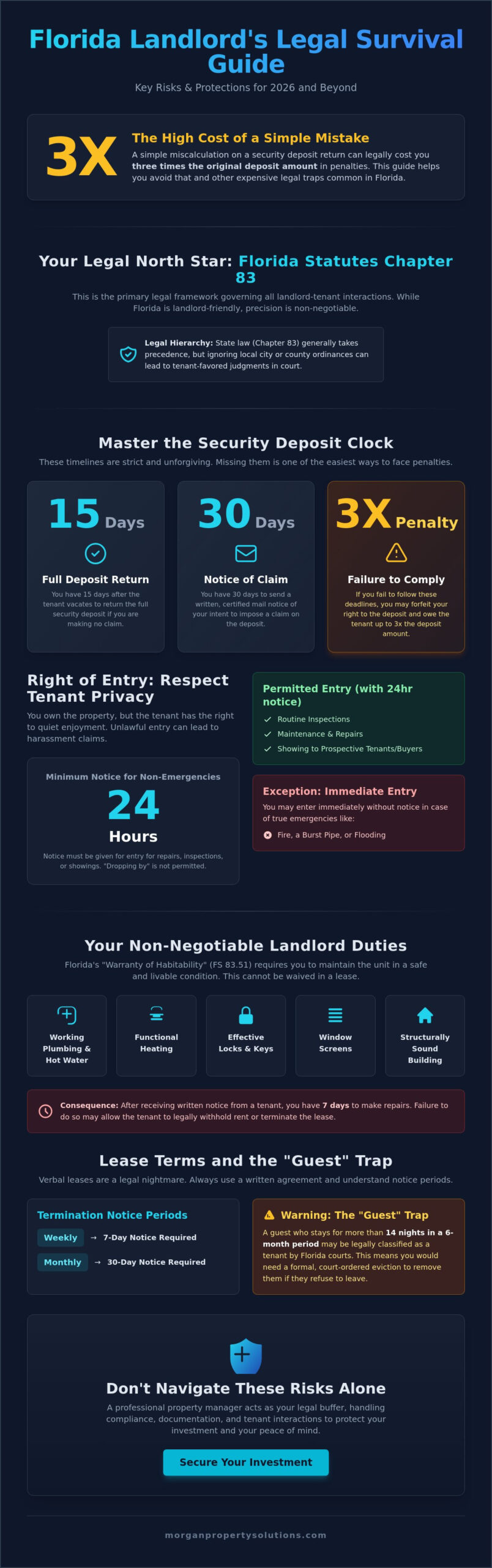
Florida Statutes Chapter 83, Part II, serves as the primary legal framework governing the rights and responsibilities of both parties in a residential lease agreement. Think of this Act as your North Star. It guides every interaction from the moment a tenant views your property until they hand back the keys. While Florida is often called a landlord-friendly state, the legal landscape in 2026 requires a high level of precision. Following the rules isn’t just about being a good neighbor; it’s about avoiding the legal risks for landlords in florida that can lead to expensive lawsuits or stalled evictions. If you find your business embroiled in a complex dispute, you can explore Business Litigation Services with Matthew Fornaro, P.A. to protect your interests.
The hierarchy of laws in the Sunshine State can be tricky. While Chapter 83 sets the baseline, local ordinances in cities like Orlando or Tampa have become more common following the legislative shifts seen in 2023 and 2024. These local rules might require additional notices or specific disclosures. When you’re Understanding Landlord-Tenant Law, you have to remember that state law generally takes precedence, but local courts often favor tenants if a landlord ignores municipal requirements. We’re here to help you stay on the right side of these overlapping rules so your investment remains a source of income rather than a source of stress.
The Legal Definition of a Tenancy
In Florida, a tenancy is created the moment you allow someone to occupy your property in exchange for rent. While verbal leases for terms under one year are technically legal, they’re a nightmare for owners. Without a written document, you’re stuck with “he-said, she-said” arguments in front of a judge. The law treats different periods with specific rules:
- Weekly rentals: These require a 7-day notice for termination.
- Monthly rentals: Following changes in recent years, these typically require a 30-day notice to terminate.
- The “Guest” Trap: If a guest stays longer than 14 nights in a six-month period, many Florida courts may classify them as a tenant, meaning you’ll need a formal eviction to get them out.
Your Fundamental Duties as a Landlord
Every Florida lease includes an implied “Warranty of Habitability.” This means you’re legally obligated to keep the unit in a condition that’s fit for human life. You can’t waive this responsibility. Even if a tenant signs a lease saying they accept the property “as-is,” Florida Statute 83.51 requires you to provide:
- Working plumbing and hot water.
- Functional heating during winter months.
- Effective locks and window screens.
- A structurally sound roof and exterior walls.
To meet these legal obligations, it is often wise to consult with professional contractors; you can learn more about Roof Top Experts to find assistance with maintaining a sound roof and exterior.
Failing to meet these basics is one of the biggest legal risks for landlords in florida. If you don’t make repairs within seven days of a written notice, a tenant might have the right to withhold rent or terminate the lease entirely. You can find more guidance on maintaining these standards in our landlord resources section. Staying proactive with maintenance doesn’t just protect your property; it protects your legal standing in court.
Privacy and Maintenance: Where Most DIY Landlords Trip Up
Owning a rental property feels like a personal investment, but the moment a tenant signs a lease, the legal dynamic shifts. You have to remember that tenant privacy is a protected right, not a landlord privilege. One of the most common legal risks for landlords in florida involves overstepping these boundaries, often with the best intentions. Under Florida’s Landlord-Tenant Statutes, you’re required to give at least 24 hours of notice before entering for repairs. You can’t just drop by because you’re in the neighborhood.
The rules change during emergencies. If a pipe bursts or there’s a fire, you can use your key immediately. For everything else, like routine inspections or showing the unit to a potential buyer, you need that 24-hour buffer. If you ignore this, you’re opening yourself up to harassment claims. Even worse is the risk of constructive eviction. This happens when a landlord ignores essential repairs so long that the home becomes unlivable. If the AC fails in the middle of a Florida July and you take three weeks to respond, a judge might decide you’ve effectively forced the tenant out, leading to heavy fines and legal fees.
Modern Privacy Risks in 2026
By 2026, smart home tech has become the standard, but it’s a legal minefield. You can’t use internal cameras or monitor a tenant’s private internet usage. Even smart doorbells need clear disclosure in the lease to avoid privacy violations. When it comes to communication, Florida courts are increasingly seeing text messages as legal notice, but it’s risky to rely on them alone. Always follow up with an email or a physical letter to stay safe. Protecting sensitive info is also vital. When you’re reviewing screening criteria, ensure you’re storing social security numbers and bank statements on encrypted drives to avoid data breach liabilities.
The Maintenance Paper Trail
A verbal “I’ll be there tomorrow” won’t hold up in court. You need a digital or physical paper trail for every work order. Since 2023, Florida has seen a 12% increase in retaliatory maintenance lawsuits. These happen when a landlord delays a repair because a tenant complained about a separate issue. To protect yourself, document when the request came in, when you responded, and when the contractor finished the job. Staying organized keeps things simple and keeps you out of the courtroom. If managing these details feels overwhelming, you can find more guidance through our landlord resources to help you stay compliant without the stress. This proactive approach is the best way to mitigate the legal risks for landlords in florida while keeping your tenants happy.
The Financial Minefield: Security Deposits and Rent Hikes
Managing money in a rental business often feels like walking a tightrope. One small slip with a security deposit or a poorly timed rent increase can lead to a costly lawsuit. Florida law is incredibly specific about how you handle a tenant’s cash. You can’t simply toss a deposit into your personal savings account. State law requires these funds to be held in a separate, Florida-based banking institution. Whether the account is interest-bearing or not, that money belongs to the tenant until you have a legal right to claim it. Mixing these funds with your personal operating cash is one of the fastest ways to trigger legal risks for landlords in florida.
The timeline for returning these funds is unforgiving. If you intend to return the full deposit, you have exactly 15 days to do so after the tenant moves out. If you plan to keep any portion of it for damages, you must notify the tenant via certified mail within 30 days. Missing this window by even a single day usually means you forfeit your right to the claim, even if the tenant caused thousands of dollars in damage. To help you stay on the right side of the law, The Florida Bar’s Guide to Landlord-Tenant Rights provides a clear roadmap for these interactions. If you want to avoid this administrative burden entirely, you might consider deposit-free renting, which simplifies the move-in process and reduces your liability.
Rent increases also require a careful approach. While Florida generally prevents local governments from imposing rent control, you still have to follow strict notice periods. For month-to-month tenancies, you’re now required to provide at least 60 days’ notice before an increase or termination. Springing a surprise price hike on a tenant isn’t just bad for the relationship; it can be used as evidence of a retaliatory eviction if other disputes are ongoing.
Common Deposit Deduction Mistakes
The biggest point of contention is usually the difference between “normal wear and tear” and actual damage. You cannot charge a tenant for faded paint, carpet that shows signs of walking paths, or a few small nail holes from pictures. These are considered part of the cost of doing business. However, you can charge for things like large holes in the drywall, deep carpet stains, or broken appliances. When you send your “Notice of Intention to Impose Claim on Security Deposit,” you must use the exact statutory language required by Florida law. If your letter doesn’t include the specific paragraph informing the tenant of their right to object, your claim could be thrown out in court.
Fair Housing and Financial Discrimination
Your screening process must be consistent for every single person who applies. If you require a specific income-to-rent ratio for one applicant but give a “pass” to another because they seem more reliable, you’re opening yourself up to a fair housing complaint. Having a written set of criteria that you apply to everyone is your best protection. This consistency also applies to animals. You cannot charge a pet deposit or monthly pet rent for a documented service animal or emotional support animal. To make this process easier and more legally sound, using a tool like pet screening can help you verify documentation while staying compliant with federal and state regulations.
Navigating the Legal Eviction Process Without Getting Sued
Eviction is easily the most stressful part of being a property owner. It’s also the moment when legal risks for landlords in florida are at their absolute highest. If a tenant stops paying, your first instinct might be to take matters into your own hands. You might want to change the locks or shut off the water to “nudge” them out. Don’t do it. Florida Statute 83.67 strictly prohibits these “self-help” evictions. If you’re caught doing this, a judge can order you to pay the tenant three times their monthly rent in damages, plus their attorney fees. It’s a mistake that can turn a simple non-payment issue into a financial disaster; you can learn more about Matthew Fornaro, P.A. to understand how to proceed legally and avoid these costly penalties.
You have to follow the rules of the court to the letter. This means understanding the difference between a 3-day notice for non-payment and a 7-day notice for lease violations. If you calculate the dates wrong or include a weekend as part of that 3-day window, your entire case could be dismissed. You also need to be wary of retaliatory eviction claims under Florida Statute 83.64. If a tenant complained about a broken water heater or called code enforcement in the last six months, trying to evict them right after can look like illegal revenge in the eyes of the law. Always remember that eviction is a legal process, not a physical one.
The Step-by-Step Florida Eviction Timeline
The process starts with serving the correct legal notice. For rent, it’s a 3-day notice; for lease breaches like unauthorized pets, it’s a 7-day notice. Once that period ends, you file a formal complaint with the county court. The tenant then has five business days to respond. If the case is about unpaid rent, Florida Statute 83.60(2) requires the tenant to deposit the disputed money into the court registry. If they don’t, you can often move for a default judgment. Finally, once the judge signs the order, the Clerk issues a Writ of Possession. Only the Sheriff can physically remove the tenant and their belongings after giving a 24-hour warning.
Common Landlord Defenses That Fail
We often see landlords try to justify skipping steps because a tenant is months behind on rent. The court doesn’t care how much is owed; the procedure remains the same. Another common trap is accepting a partial payment. If you take $200 toward a $1,500 balance after serving a notice, you may accidentally reset the entire eviction clock under Florida Statute 83.56(5). You’d have to start over from day one. It’s also vital to use professional process servers for court documents. If a tenant claims they were never served, and you don’t have a professional’s signature to prove it, you’ll lose weeks of progress and your filing fees.
How Professional Management Eliminates Your Legal Exposure
Most owners start their journey as a DIY landlord. You’re the one taking the calls, fixing the sinks, and collecting the checks. But as your portfolio grows, you need to think like a property investor. This transition is all about delegation. When you hire Orlando Property Management, you create a vital legal buffer between yourself and your tenants. You aren’t the one who has to handle a 2:00 AM emergency or interpret a confusing new statute on the fly. We manage those direct interactions so your personal life stays private and your legal exposure remains as low as possible.
A professional manager provides a framework of safety that’s hard to build on your own. We use leases that are pre-vetted by legal experts to ensure they align with the latest Florida statutes. These documents are updated regularly to reflect current court rulings, which is essential for managing legal risks for landlords in florida. Our automated notice systems also take the guesswork out of compliance. If rent is late or a lease term is violated, the correct legal paperwork goes out immediately. This precision helps you avoid the simple clerical errors that often lead to expensive delays in court. To support these digital operations, businesses can benefit from the managed services of Mytech Partners, providing the strategic IT consulting necessary to keep your data secure and your systems running smoothly.
Staying Ahead of 2026 Legislative Changes
Florida’s rental laws are constantly shifting. As we move through 2026, we expect to see new developments in how the Florida Bar interprets habitability standards and security deposit disputes. Our team monitors these rulings daily so you don’t have to. As an A+ BBB rated partner, we provide the landlord resources you need to stay informed without the headache of constant research. We focus on eliminating the “stress tax” that many owners pay. This is the mental toll and financial cost of worrying about a potential lawsuit. Your time is your most valuable asset. We keep your investment compliant so you can focus on your next acquisition instead of worrying about a courtroom appearance.
The Morgan Property Solutions Approach
Our philosophy is built on “Making Real Estate Simple.” We take the “tough stuff” off your plate and handle it with the care it deserves. This includes:
- Conducting thorough, documented property inspections to prevent damage disputes.
- Screening tenants with a proven, rigorous process.
- Handling the eviction process professionally if it ever becomes necessary.
With over 20 years of experience, we’ve seen almost every scenario a landlord can face. We’re here to guide you and protect your interests every step of the way. If you’re ready to secure your future and reduce your legal risks for landlords in florida, contact us to protect your investment today.
Take Control of Your Florida Rental Property Today
You don’t have to carry that burden alone. With over 20 years of experience in the Central Florida market, our team understands the local landscape better than anyone. We maintain an A+ rating with the Better Business Bureau and our leadership is NARPM-certified. We’re here to simplify your life and make sure your investment stays protected while you focus on what matters most. Let us handle the legal headaches; explore our Orlando property management services. We’re excited to help you succeed as a landlord without the stress.
Frequently Asked Questions
Can a landlord enter a property without notice in Florida for an emergency?
Yes, you can enter the property without notice if there is a genuine emergency like a fire, a major water leak, or a gas odor. Florida Statute 83.53 allows this to protect the property and ensure everyone’s safety. For any other reason, you’ll need to give at least 24 hours’ notice before showing up. We’re here to help you manage these situations so you can stay confident and keep things running smoothly.
How many days does a landlord have to return a security deposit in Florida?
You have 15 days to return a full security deposit or 30 days if you’re making a claim for damages. If you keep any of the money, you must send a notice to the tenant via certified mail to their last known address. Managing these timelines is a big part of avoiding legal risks for landlords in florida. We’ll guide you through the process to make sure every deadline is met without any stress.
Is it illegal to change the locks on a tenant who hasn’t paid rent?
It’s completely illegal to change the locks or shut off utilities to force a tenant out, even if they owe you money. Florida Statute 83.67 prohibits these “self-help” evictions, and doing this could cost you three months’ rent in penalties. The only legal way to remove someone is through a formal court-ordered eviction. We make this simple by helping you follow the right steps so you don’t end up in hot water.
Does Florida law require a written lease for a rental over a year?
Yes, Florida law requires any lease agreement that lasts longer than one year to be in writing and signed by both parties. This is part of the Statute of Frauds, which ensures that long-term commitments are clear and enforceable for everyone. Even for shorter rentals, we always recommend having a written contract in place. It’s the best way to build a foundation of trust and keep your investment safe from the start.
Can I evict a tenant for complaining about a broken AC unit?
No, you can’t evict a tenant for reporting a broken AC because that’s legally considered a retaliatory eviction. Florida Statute 83.64 protects residents who exercise their right to request repairs for essential services. If you try to remove them just for speaking up, a judge will likely rule against you. We focus on keeping your properties in great shape so you can avoid these kinds of disputes and keep your residents happy.
What is the maximum a landlord can charge for a late fee in Florida?
Florida law doesn’t set a specific dollar limit on late fees, but they must be reasonable and clearly written in your lease agreement. Most experts suggest a fee between 5% and 10% of the monthly rent to stay within fair territory. It’s important to be transparent about these costs to minimize legal risks for landlords in florida. We can help you structure your lease so it’s fair, clear, and protects your bottom line.
Are landlords required to provide pest control in Florida rentals?
Landlords are usually responsible for pest control in multi-family units like apartments or duplexes under Florida Statute 83.51. If you’re renting out a single-family home, the lease can actually state that the tenant is responsible for extermination. It’s a good idea to clarify this in your contract so there’s no confusion later on. We’re here to help you set clear expectations so your property stays pest-free and your tenants feel well cared for.
How do I legally handle mail for a tenant who has moved out?
You should mark the mail as “Refused” or “Return to Sender” and put it back in the mailbox for the postal service to handle. You should never open or throw away mail that isn’t yours, as that’s actually a federal offense. If the former resident left a forwarding address, you can provide that to the post office. We’ll show you how to handle these small details so the transition between tenants is always easy and professional.

Article by
Oliver Overton-Morgan
Oliver Overton-Morgan is a full-time Real Estate Broker since 2003, with years of experience helping thousands of people purchase and sell real estate throughout Central Florida. He holds a Graduate Realtor Institute designation, LCAM, and has held licenses in good standing as a Florida Mortgage Broker and a Notary Public. Oliver immigrated to central Florida in 2001, and within 5 years Oliver built a successful Real Estate brokerage in central Florida, where he recruited over 75 Sales Associates with 25+ million in sales production.