
Last July, an Orlando landlord realized that while his property value climbed 12%, his insurance premium jumped by a staggering $2,400, nearly wiping out his annual profit. It’s no secret that owning property in the Sunshine State feels more expensive than ever. Between those rising premiums and the constant worry about whether a $5,000 roof patch counts as a repair or a capital improvement, it’s easy to feel like the IRS is just waiting for you to make one wrong move. Understanding the rental property tax deductions florida laws allow is the only way to stay ahead of these rising costs. You shouldn’t have to lose sleep over an audit or leave money on the table because the tax code seems too complex.
We’re here to help you maximize your profits by claiming every legal federal deduction and managing local tax nuances with ease. Our team believes in making real estate simple, so we’ve taken the guesswork out of your 2026 filings. This guide provides a clear checklist of deductible items and explains exactly how to handle those high Florida insurance costs to lower your taxable income and protect your investment for the long haul.
Key Takeaways
- Understand why Florida’s lack of state income tax means you can focus entirely on federal rules to boost your bottom line.
- Learn how to correctly claim your rental property tax deductions florida by identifying the “Big Three” expenses that most investors overlook.
- Stop guessing the difference between a repair and an improvement with a clear guide that helps you save thousands during tax season.
- Discover how professional management and legal fees are fully deductible, making it easier than ever to build a stress-free investment.
- Master the digital record-keeping habits that will keep you organized and ready for any audit without the usual headaches.
The Florida Advantage: Why Local Landlords Only Worry About Federal Taxes
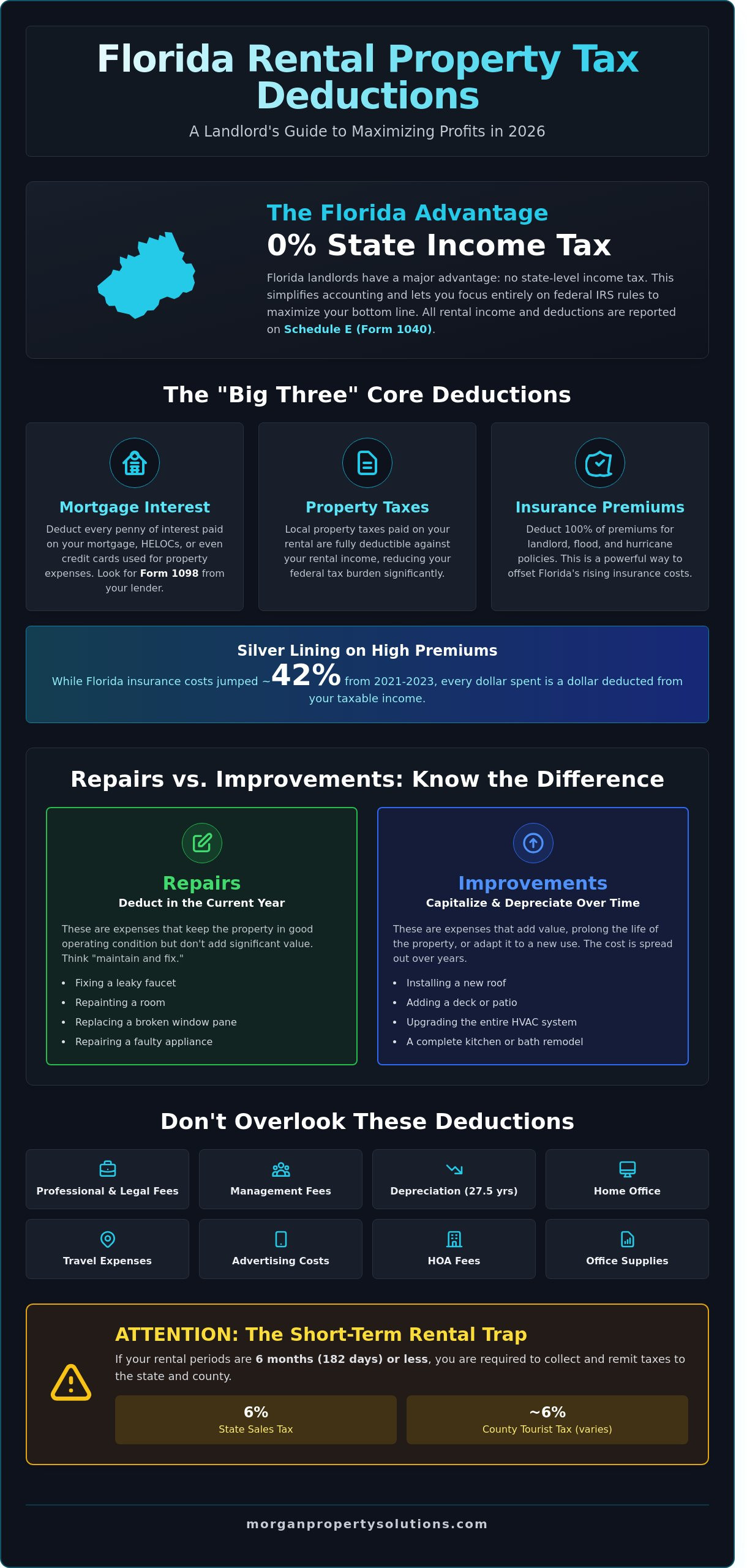
Florida is a true sanctuary for property owners. In 2026, the state still doesn’t charge an individual income tax, which is a huge relief when you compare it to the high-tax burdens in states like Hawaii or New Jersey. This lack of a state tax bill is one of the biggest reasons why people flock to the Sunshine State to build their portfolios. It makes your accounting life much easier, but it doesn’t mean you can ignore the tax man entirely. You’re still working within the federal system, and that’s where the real strategy happens.
When you’re looking for rental property tax deductions florida landlords can use, you have to look at the IRS guidelines. Every cent of rent you collect needs to be reported on Schedule E of your Form 1040. The federal government treats your rental business like any other income-generating venture. You’ll want to be meticulous about tracking every expense. This includes understanding depreciation and how it acts as a non-cash expense to lower your taxable income. At Morgan Property Solutions Inc., we’ve seen owners save thousands just by being organized from day one. It’s about making the complex feel simple so you can focus on growing your wealth.
Federal vs. State: What You Need to Know
Living in Florida means you avoid the “double dip” where both the state and the feds take a cut of your hard-earned rent. This simplicity is a breath of fresh air. However, a common mistake we at Morgan Property Solutions Inc. see is the belief that no state tax means record-keeping isn’t vital. That’s a dangerous path. The IRS is just as active in Florida as anywhere else. Your income from a duplex in Downtown Orlando or a suburban home in Lake Mary is taxed at federal brackets. These brackets currently range from 10% to 37% for the 2026 tax year. Because your rental profit is added to your other income, it can easily push you into a higher bracket if you don’t maximize your rental property tax deductions florida allowances.
The Short-Term Rental Trap
Short-term rentals are a different beast in the eyes of the Florida Department of Revenue. If you rent your property for periods of six months or less, specifically 182 days or fewer, you’re essentially running a hotel in the eyes of the law. You’re required to collect a 6% state sales tax. On top of that, you have to deal with county-specific surtaxes. For instance, in Orange County, the tourist development tax is an additional 6%. If you’re in Osceola, it’s also 6% as of early 2024. You have to register with the state and your local county to remit these funds. The good news is that these taxes don’t count as part of your gross income. You’re simply collecting them from the guest and handing them over to the government. Keeping these funds in a separate account makes your life much simpler when it’s time to report. We at Morgan Property Solutions Inc. are here to help you navigate these local rules so you don’t get hit with unexpected penalties.
This level of complexity is why many investors in the short-term rental market opt for professional management. While the tax laws are local, the strategies for maximizing profit are universal. To see how a specialized service handles high-yield holiday properties, you can learn more about Bnb Hub, an Australian-based leader in the field.
The Big Three: Mortgage Interest, Insurance, and Property Taxes
For most Florida investors, mortgage interest is the king of write-offs. If you own a rental in Orlando or Tampa, that monthly payment likely eats a huge chunk of your cash flow. The good news is that you can write off every penny of that interest. This applies to the interest on your primary mortgage, but it also covers interest on credit cards or personal loans used for property improvements. You don’t get to deduct the principal portion of the payment because that’s essentially paying yourself back in equity. It’s a simple distinction that keeps your books clean. If you put down less than 20% and pay Private Mortgage Insurance (PMI), those premiums are typically deductible as well. This is a vital part of maximizing your rental property tax deductions florida so you can keep more of your hard-earned rent.
To stay on the right side of the law, you should follow the IRS guidelines on rental property deductions to ensure you’re tracking these payments correctly. Most lenders send Form 1098 by January 31 each year. This document is your best friend during tax season. It clearly breaks down the interest and points paid during the previous year. If you paid points to get a lower rate on your 30-year fixed loan, you usually have to deduct those over the life of the loan rather than all at once. It’s these small details that help you manage these complex expenses without the usual headache.
Florida Insurance: Silver Linings on High Premiums
Insurance costs in the Sunshine State rose by roughly 42% between 2021 and 2023. While those high premiums hurt your monthly bottom line, they’re fully deductible. This includes your standard landlord liability policy, flood insurance, and specialized hurricane coverage. If your policy includes a loss-of-income rider, which pays you if the unit becomes uninhabitable after a storm, that premium is also a write-off. Looking toward 2026, keep every digital receipt and policy declaration page. Precise records help you claim every dollar as costs continue to shift. You can also deduct premiums for workers’ compensation if you have employees, or even health insurance for those staff members. Because Florida is a high-risk zone for wind damage, these deductions often represent a significant portion of your total operating expenses.
Given the complexity and cost, partnering with a knowledgeable local agent is a smart move. An agency like SI Insurance can help you find comprehensive coverage tailored to Florida’s unique risks, ensuring your investment is protected and your premiums are fully accounted for as deductions.
Just as managing property insurance is key to protecting your investment, managing personal health insurance is vital for your financial security. Many Florida landlords, especially those who are self-employed or nearing retirement, also need to navigate their healthcare coverage. To [learn more] about local Medicare options for 2026, this can be a helpful resource.
Beyond personal financial security, many investors also plan for their legacy. Life insurance is a key tool for ensuring your property portfolio can be passed on smoothly without forcing a sale to cover final expenses or taxes. For landlords looking into this aspect of long-term planning, McBango Insurance Services specializes in life insurance and final expense planning.
Local Property Tax Assessments
Florida property owners receive their tax bills every November. Whether your rental is in Orange County or Hillsborough County, you can deduct the entire property tax amount on your federal return. Florida offers a 4% discount if you pay the bill early in November. Even if you take this discount, the amount you actually pay is what you’ll deduct. Your bill will also include non-ad valorem assessments. These are specific charges for services like trash collection, street lighting, or drainage districts. You can deduct these as well because they’re necessary for the operation of the rental. You might feel tempted to hire a professional to appeal a high assessment if your property value jumps 15% in a single year. Just remember that while the tax itself is deductible, the legal or consulting fees you pay to fight the assessment are not. They’re considered a personal expense or a capital cost depending on the situation. Staying organized with your rental property tax deductions florida ensures you don’t leave money on the table when November rolls around.
Repairs vs. Improvements: The Difference That Saves Thousands
The IRS has a very specific line in the sand between a repair and an improvement. A repair is basically anything that keeps your rental in its current, functional state. If a faucet leaks or a door handle breaks, fixing it is a repair. On the other hand, an improvement is something that adds value, adapts the property to a new use, or extends its life. This distinction is vital for your 2024 tax strategy because it dictates how quickly you get your money back.
Immediate deductions are almost always better for your current cash flow. Why? Because you get to subtract the full cost from your income right now, rather than waiting decades to see the full benefit. If you spend $2,000 on repairs this year, that’s $2,000 less of your income that the government can touch. It’s a simple way to keep more of your hard-earned rent in your pocket today.
What Qualifies as an Immediate Repair?
Think of repairs as the “staying even” expenses. In Florida, we deal with intense humidity and sudden tropical storms. If a 45 mph wind gust rips a few shingles off your roof, patching that hole is a repair. It doesn’t make the roof new; it just stops the rain from ruining your ceiling. Pest control is another big one here. Paying $65 a month for a local exterminator to keep palmetto bugs at bay is a recurring cost you can deduct immediately. Even painting the walls between tenants or fixing a window cracked by a stray golf ball counts because you’re just maintaining the home’s appeal. These immediate tax advantages for landlords help keep your bank account healthy during the year.
Capital Improvements and Depreciation
Improvements are different because they are capitalized. This means you don’t get the whole deduction this year. Instead, you spread it out over 27.5 years, which is the standard IRS timeline for residential buildings. If you decide to install a $15,000 screened-in pool to attract higher-paying tenants, that is a capital improvement. It adds real value to the home. You add that $15,000 to your cost basis, which can also help reduce your capital gains taxes when you eventually sell the property. Other examples include:
- Installing a new permanent fence around the perimeter.
- Replacing all the old carpet with luxury vinyl plank flooring throughout the house.
- Adding a new bedroom or bathroom to the existing layout.
Florida landlords face a unique challenge with HVAC systems. If your technician replaces a $200 capacitor to get the air blowing cold again, that’s a repair. You deduct the full $200 on your next return. However, if the entire 3-ton unit dies and you spend $8,200 on a brand-new high-efficiency system, the IRS considers that an improvement. One helpful tip: the IRS has a de minimis safe harbor rule. For the 2024 tax year, you can often deduct items that cost $2,500 or less as an expense rather than depreciating them, even if they technically qualify as an improvement. Understanding these rental property tax deductions florida owners can claim helps you plan for major expenses without getting blindsided by the tax bill. We’re here to help you make these decisions so your investment stays profitable year after year.
Deducting Professional Services and Management Fees
Managing a rental property is a full-time job. While the workload can feel heavy, the IRS actually rewards you for hiring help to handle the heavy lifting. Every dollar you spend on professional services to keep your investment running is a dollar you can likely subtract from your taxable income. When you’re looking for ways to maximize your rental property tax deductions florida, your “team” of experts is your greatest asset. This includes the people who find your tenants, the experts who fix your leases, and the professionals who keep your books balanced. Understanding how this investment fits into your overall financial strategy is just as crucial; you can find out more about assessing your personal risk tolerance.
Beyond hiring a team, empowering yourself with the right knowledge and tools is equally important. For investors looking to deepen their expertise and find specialized resources for growing a real estate portfolio, you can visit Multifamily Intelligence.
Operating expenses are the heartbeat of your tax return. You can deduct 100% of the fees you pay for advertising your vacant units on sites like Zillow or local Orlando listing boards. If you spend $150 on professional photography to make your Lake Nona condo stand out, that’s a deduction. If you pay $50 for a background and credit check on a prospective tenant, that’s a deduction too. Legal fees are also fair game. Whether you’re paying an attorney $300 to review a complex lease or $500 for help with a difficult eviction, these costs are fully deductible business expenses that lower your overall tax burden.
- CPA and Accounting Fees: Fees paid for tax preparation and year-round bookkeeping.
- Legal Consultations: Costs for lease drafting, legal advice, or court appearances.
- Marketing Costs: Signage, online listings, and professional staging.
- Tenant Screening: Credit reports and criminal background check fees.
The ROI of Professional Management
Hiring a pro shouldn’t feel like an added cost. Fees paid to Morgan Property Solutions are 100% deductible as a primary operating expense. If you’re paying a standard management fee on a property that rents for $2,800 a month, that entire expense reduces your taxable income. We bring over 20 years of experience to the table, helping you avoid the costly mistakes that often lead to IRS audits. Our management portal tracks every single repair invoice and utility payment automatically. This level of organization is a gift for your CPA; it often reduces the hours they spend on your return, which saves you even more money on accounting fees at the end of the year.
Travel and Home Office Deductions
Do you drive your own car to check on your properties? You’re sitting on a significant deduction. For the 2024 tax year, the IRS allows you to deduct 67 cents for every mile driven for business purposes. If you live in downtown Orlando and drive to your rental in Kissimmee once a week, those miles add up quickly. Just keep a simple log of your odometer readings and the purpose of the trip to satisfy any potential questions from the IRS.
For landlords who use their vehicle frequently for business, structuring the vehicle’s financing smartly is just as important as tracking mileage. Exploring lease options can often be a tax-efficient strategy, and for those interested in learning more, emporiumautolease.com offers a comprehensive guide on the topic.
Out-of-state investors have even more opportunities to save. If you fly into Florida specifically to inspect your properties or meet with your management team, your airfare and 50% of your meals are deductible. To keep things clean, avoid mixing these trips with a family vacation at the theme parks. For those who manage their portfolio from home, you can claim a home office deduction if you have a space used exclusively for business. If your home office takes up 10% of your house’s square footage, you might be able to deduct 10% of your home’s utilities and insurance. It’s a great way to turn a portion of your personal living costs into a rental property tax deductions florida benefit.
Broadening your investment horizons can also mean looking at different types of properties. For those interested in the luxury development market, for example, you can learn more about how high-end projects are structured.
As your portfolio grows, you might even consider international markets. While tax laws differ, the principles of professional management are universal. For those curious about expanding into European luxury real estate, you can learn more about King Estates to understand the market in Spain’s Costa del Sol.
Ready to simplify your record-keeping and boost your bottom line? Contact our team today to see how we can help you maximize your investment’s potential.
Record Keeping: Making Tax Season Stress-Free
Keeping a paper trail isn’t just about staying organized; it’s about protecting your investment from unnecessary scrutiny. When you’re claiming rental property tax deductions florida, the IRS expects you to back up every penny with verifiable proof. The “audit-proof” method involves digitizing every single document the moment it hits your hand. By 2026, digital records have become the absolute standard for Florida landlords. Scanned receipts don’t fade like thermal paper does, and they’re much harder to lose than a stray envelope in your glove box.
You should aim for a “zero-paper” office. Use your smartphone to snap photos of hardware store runs or appliance repairs immediately. This habit ensures that if an auditor asks about a $1,250 AC repair from three years ago, you can pull up the timestamped invoice in seconds. Beyond simple receipts, you must stay on top of 1099-NEC forms. If you’ve paid an independent contractor or service provider $600 or more during the 2026 tax year, you’re legally required to send them this form by January 31st. Failing to do this can lead to IRS penalties and might even disqualify the labor deduction entirely.
Professional reports are your best friend during filing season. Instead of handing your CPA a pile of loose papers, provide a year-end summary that categorizes every expense according to Schedule E categories. This level of detail reduces the hours your accountant spends on your file, which directly lowers your professional fees. Most successful investors find that this structured approach saves them roughly 15 hours of administrative work every April. It transforms a chaotic week of digging through files into a simple, afternoon task.
Streamlining how you collect rent can also make a huge difference in your record-keeping. To see how modern payment systems can automate income tracking for your rental business, you can check out Merchant Solutions Corp.
Organizing for Your CPA
Your accountant needs specific documents to maximize your returns. Gather your HUD-1 settlement statements for any properties bought or sold in 2026, along with 1098 forms showing the mortgage interest you’ve paid. Don’t forget to include receipts for every repair, from a $20 smoke detector battery to a $6,000 roof patch. You can find helpful templates and guides in our landlord resources to help you categorize these items correctly. One of the biggest mistakes we see is co-mingling funds. You must use separate bank accounts for your rental activities to keep your personal life and business life distinct. This simple step makes your financial trail 100% transparent and easy to follow.
Final Checklist for 2026
Before you finalize your filing, take one last look at your annual profit and loss statement. Check for small, recurring costs that are easy to overlook. For instance, did you deduct the $50 monthly pest control fee or the annual $300 HOA assessment? Even utility payments made during tenant turnovers are fully deductible and often add up to over $1,200 annually for a single property. These “minor” expenses often total thousands of dollars across a portfolio. Managing these details can feel overwhelming, but you don’t have to do it alone. Choosing a trusted partner to handle your property management makes the complex simple, ensuring your records are pristine and your deductions are maximized every single year.
Start Maximizing Your Florida Rental Returns Today
Navigating the 2026 tax season is much easier when you remember that Florida landlords don’t have to deal with state income tax. You just need to stay focused on the “Big Three” deductions: mortgage interest, insurance, and property taxes. Keeping a clear line between immediate repairs and long-term improvements is another move that keeps thousands of dollars in your pocket. When you focus on the specific rental property tax deductions florida allows, your bottom line looks much healthier at the end of the year.
Morgan Property Solutions has over 20 years of experience in the Central Florida market, and our A+ BBB rating shows how much we value our clients’ peace of mind. We make the process simple by including comprehensive monthly financial reporting with our services, so your books are always ready for your accountant. Stop spending your weekends worrying about receipts and spreadsheets. Let us handle the stress of your rental; get a free management quote today! You’ve worked hard for your investment, and we’re here to help you protect it every step of the way.
Frequently Asked Questions
Can I deduct the cost of a new roof on my Florida rental property?
You generally cannot deduct the full cost of a new roof in a single year because the IRS classifies it as a capital improvement. Instead, you’ll recover the cost through depreciation over 27.5 years. For instance, if you spend $16,500 on a new shingle roof in 2024, you would claim a deduction of $600 each year. We’re here to help you track these long-term investments so your records stay organized and accurate.
Are property management fees tax deductible in Florida?
Yes, any fees you pay to a professional management company are 100 percent deductible as a business expense. These costs are a core part of your rental property tax deductions florida and directly reduce your taxable income. If your manager charges an 8 percent monthly fee on a $2,500 rental, you’ll deduct $2,400 annually. It’s a simple way to boost your profits while letting experts handle the daily stress of landlording.
How does the lack of state income tax affect my rental property deductions?
Florida has not had a state income tax since 1924, which means you won’t have state-level income tax payments to deduct. Your focus will stay entirely on federal deductions and local costs like property taxes. Since you don’t pay state tax on your rental profits, your overall tax burden is often lower than in states like California. We’ll guide you through maximizing your federal Schedule E to ensure you keep more of your hard-earned money.
Can I deduct my travel expenses if I live outside of Florida?
You can deduct travel expenses for visiting your property if the primary purpose of the trip is for business. The IRS allows you to claim 67 cents per mile for business travel in 2024; you can also deduct airfare and lodging for overnight stays. If you spend 75 percent of your trip working on the rental, you can deduct that portion of your costs. Keep your flight receipts and a detailed log to make the process easy.
What is the difference between a repair and an improvement for tax purposes?
Repairs are small fixes that keep your property livable, while improvements add value or extend the building’s life. A $150 plumbing repair to fix a leaky faucet is fully deductible in the year you pay for it. However, a $5,000 kitchen remodel is an improvement that must be depreciated over 27.5 years. Understanding this distinction is a key part of managing your rental property tax deductions florida without any headaches from the IRS.
Are HOA fees deductible for my rental property?
HOA and condo association fees are fully deductible for any property you use as a rental. If your Florida association charges $350 per month for amenities and landscaping, you’ll deduct the full $4,200 on your annual tax return. These fees cover essential services that maintain your property’s value and appeal to tenants. Just make sure to save your monthly statements so we can help you document every dollar spent on your investment.
Do I need to issue 1099s to my Florida repair contractors?
You must issue a Form 1099-NEC to any individual or unincorporated business you pay $600 or more for services during the year. This includes the local handyman who handled your painting or the electrician who fixed your wiring. These forms are due to the contractor by January 31 each year to stay compliant with federal law. It’s a straightforward task that helps you maintain a professional and transparent relationship with your vendors and the government.
Can I deduct hurricane shutters or storm prep costs?
Permanent hurricane shutters are considered a capital improvement because they add lasting protection and value to your Florida home. If you install a $7,500 shutter system, you’ll depreciate that cost over the standard 27.5-year period. On the other hand, paying a worker $250 to put up plywood before a specific storm is a current-year maintenance expense you can deduct immediately. We’ll help you categorize these storm-related costs so you’re always prepared for hurricane season.

Article by
Oliver Overton-Morgan
Oliver Overton-Morgan is a full-time Real Estate Broker since 2003, with years of experience helping thousands of people purchase and sell real estate throughout Central Florida. He holds a Graduate Realtor Institute designation, LCAM, and has held licenses in good standing as a Florida Mortgage Broker and a Notary Public. Oliver immigrated to central Florida in 2001, and within 5 years Oliver built a successful Real Estate brokerage in central Florida, where he recruited over 75 Sales Associates with 25+ million in sales production.