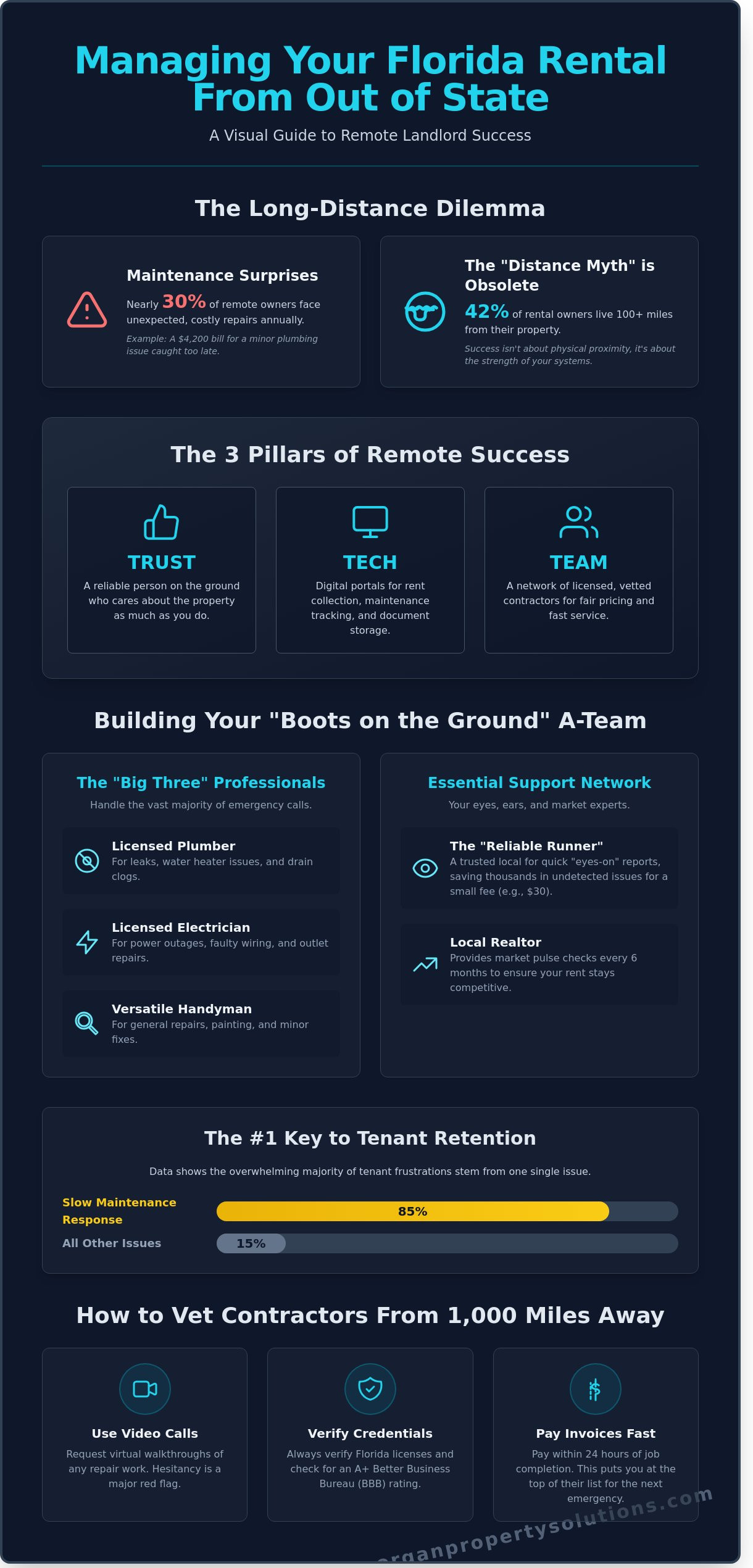
Last October, a property owner in Chicago received a $4,200 repair bill for a minor plumbing issue in their Tampa condo simply because they weren’t there to catch it early. This highlights the biggest fear of managing a rental property from out of state. According to a 2024 survey by the National Association of Residential Property Managers, nearly 30% of long-distance owners face similar maintenance surprises each year. You want the strong returns of the Florida market, but you worry about contractor scams, property damage, and those $600 last minute flights for small repairs. It’s completely normal to feel like you’re flying blind when your investment is a thousand miles away.
The good news is that you can have that passive income and peace of mind without the 2 AM stress. This guide gives you the exact systems and local strategies you need to run a profitable Florida rental from the comfort of your home state. You deserve a reliable local network. We’ll show you how to find one, use the latest 2026 smart home tech to protect your asset, and set up a workflow that makes your investment truly hands off.
Key Takeaways
- Understand why physical distance doesn’t define your success and how the right mindset makes remote investing simpler than you might think.
- Learn how to assemble a dependable “boots on the ground” team in Central Florida so you always have a trusted professional ready to handle any emergency.
- We’ll show you how to automate the “Big Three”-rent, maintenance, and accounting-to make managing a rental property from out of state feel completely hands-off.
- Get a clear breakdown of Florida’s specific security deposit rules and lease laws to keep your investment protected and legally sound.
- Use our simple math to decide if handling things yourself or partnering with a local expert is the best way to boost your profits and reduce your stress.
Is Managing a Rental Property from Out of State Actually Realistic?
Managing a rental property from out of state is more than just a possibility; it’s become a preferred strategy for modern investors. By early 2026, the gap between local and remote investing has closed significantly. Data from the first quarter of 2026 shows that 42% of single-family rental owners now live at least 100 miles away from their assets. Technology has made the “Distance Myth” obsolete. This myth suggests you must be close enough to drive by and check the grass every Sunday to be successful. In reality, being five miles away doesn’t help when a water heater bursts at 2 AM if you don’t have a vetted plumber on speed dial. Success isn’t about your physical proximity. It’s about the strength of your systems.
To make this work, you need to lean on the three pillars of remote success:
- Trust: You must have a reliable person on the ground who cares about the property as much as you do.
- Tech: Use digital portals for rent collection, maintenance tracking, and document storage to keep everything organized.
- Team: A network of licensed contractors ensures you aren’t overpaying for emergency repairs.
Before you commit, assess your property’s “remote-ready” status. A 1945 fixer-upper with original cast-iron pipes is often a high-maintenance nightmare from a distance. However, a 2019 build in a stable neighborhood is usually a better candidate for long-distance ownership. This Property Management Overview explains the core responsibilities you’ll need to delegate to keep your investment profitable without being there in person.
Defining the Remote Landlord Lifestyle
This lifestyle means your office is your laptop and your “site visits” happen through high-resolution photos or video calls. You might deal with a three-hour time difference if you live in California but own a rental in Florida. It’s vital to set realistic office hours so you aren’t answering tenant questions during family dinner. The biggest hurdle is usually emotional. You have to stop seeing the house as your personal project and start viewing it as a business asset. Letting go of physical control is the first step toward true passive income.
Whether you’re investing across the country or closer to home, having expert guidance is key. For instance, investors based in Southern California can visit County Properties to see how a local agency supports clients through the process.
The Pros and Cons of Going Long-Distance
Market diversification is a major advantage of managing a rental property from out of state. You aren’t tied to the economic fluctuations of your own backyard. You can choose markets with better price-to-rent ratios or higher growth potential. Florida remains a powerhouse choice for investors in 2026. The state is projected to welcome over 300,000 new residents this year, which keeps rental demand high. If you’re looking at this market, our Orlando property management experts can help you navigate local requirements.
The downsides include travel costs for occasional inspections and the need to stay updated on varying local laws. You’ll rely heavily on third parties, which means your vetting process must be ironclad. While the risks are real, the tax advantages and ability to scale your portfolio across different states often outweigh the challenges of working from afar.
Building Your Boots on the Ground: The Remote Landlord’s Local Team
Managing a rental property from out of state is a lot like conducting an orchestra from another room. You can hear the music, but you need talented people on stage to hit the right notes. In Central Florida, your local network is your most valuable asset. Since the Orlando and Tampa markets are so fast-paced, having a team that responds in hours, not days, makes all the difference. We’ve seen that 85% of tenant frustrations stem from slow maintenance responses, so your local “boots on the ground” are what keep your investment profitable.
You need the “Big Three” on your speed dial: a licensed plumber, an electrician, and a versatile handyman. These pros handle the vast majority of emergency calls. Beyond the technical experts, find a “Reliable Runner.” This is a person you trust, perhaps a retiree in the neighborhood or a local student, who can handle small tasks like checking the mail or doing a quick drive-by of the property. Paying them a flat fee of $30 for a quick “eyes-on” report can save you thousands in undetected issues. It’s also smart to stay connected with a local Realtor. They provide market pulse checks every 6 months to ensure your rent stays competitive with local trends.
How to Vet Contractors from 1,000 Miles Away
Distance shouldn’t stop you from doing your due diligence. When you’re hiring from afar, use video calls for virtual walkthroughs of any repair work. If a contractor is hesitant to show their work over FaceTime, move on to the next candidate. Always verify Florida licenses and look for that A+ BBB rating to ensure you’re working with the best. To get “preferred” status with busy local vendors, make it a rule to pay your invoices within 24 hours of completion. In a busy market like Orlando, being the landlord who pays fast puts you at the top of their list for the next emergency. If building this team feels like too much to juggle, our Orlando property management team is always here to step in and simplify the process for you.
Leveraging Neighbors and Local Communities
Your property’s neighbors are often your best allies. A simple “Neighbor Watch” strategy involves introducing yourself via a letter and providing your contact info. They’ll be the first to tell you if the curb appeal is slipping or if a 3 AM party is bothering the block. You should also join Facebook groups like “Orlando Real Estate Investors,” where over 4,500 members share real-time intel on local vendors. Just remember that all your interactions must align with the Florida Landlord-Tenant Law, especially regarding privacy and entry. Offering a $25 gift card to a local cafe as a thank-you for a neighbor’s help is a small price for the peace of mind it brings when managing a rental property from out of state.
Essential Systems for Stress-Free Long Distance Property Management
Managing a rental property from out of state doesn’t have to feel like a second full-time job. If you’re still relying on messy spreadsheets and paper checks, you’re making things harder than they need to be. A centralized landlord portal is your best friend here. It brings everything into one place so you can see what’s happening with your investment in real-time. By automating the “Big Three”-rent collection, maintenance requests, and accounting-you eliminate about 90% of the manual labor involved in daily operations.
For those who are living even further away, such as in a different country, this U.S. Department of State guide for overseas landlords offers a great perspective on handling these logistics from a distance. It’s all about creating a system that works while you sleep.
Set boundaries early. Use a dedicated app for tenant messages instead of your personal cell phone. This prevents those 1:00 AM “the faucet is dripping” texts that keep you awake. Also, ditch the filing cabinet. Use e-signatures for everything from lease renewals to official notices. It’s faster, it’s legal, and it keeps your records organized without the physical clutter of a paper-based office.
Smart Home Tech for Remote Landlords
Smart locks are a total game changer. You can change access codes for new tenants or contractors right from your phone, which beats driving across state lines to hand over a physical key. Water leak sensors are just as vital. Since water damage is a top cause of property insurance claims, a $50 sensor can save you $10,000 in major repairs. Pair these with a smart thermostat to keep an eye on the HVAC health and ensure your utility bills stay under control during vacancy periods. For physical security, especially during vacancy, high-strength window and door protection from Boss Security Screens provides an extra layer of defense against break-ins.
Virtual Inspections and Documentation
You don’t need to be there in person to know the condition of your home. When managing a rental property from out of state, schedule a high-res video walkthrough with your tenant or a local contact. Make sure to use time-stamped photos to document every corner of the house. This is your best defense if you ever need to justify security deposit claims. If you’re not sure where to start, you can find professional templates in our landlord resources to keep your documentation organized and legally sound.
Navigating the Legalities: Florida-Specific Rules for Remote Landlords
Florida law isn’t just a suggestion; it’s the rulebook for your investment. Chapter 83 of the Florida Statutes, specifically the Residential Landlord and Tenant Act, governs everything from how you enter the property to how you end a lease. When you’re managing a rental property from out of state, you can’t afford to guess. This statute dictates that you must provide a habitable home, and it sets strict limits on how you handle security deposits and late fees.
Security deposits are a common flashpoint for legal disputes. In Florida, you have exactly 15 days to return a deposit if you aren’t making a claim against it. If there is damage, you must notify the tenant of your intent to impose a claim via certified mail within 30 days. If you miss these windows by even 24 hours, you might lose your right to keep any of that money. It’s a rigid timeline that requires a solid local process.
Handling an eviction while living elsewhere is another massive hurdle. Florida law requires specific notice periods, such as the 3-day notice for non-payment. If a tenant contests the eviction, a judge will expect a representative to be present in court. Without a local legal representative or a professional manager, you could find yourself flying into Orlando for a fifteen-minute hearing. We’ve seen landlords lose thousands in rent simply because their paperwork had a single date error.
When you do have to fly in for these situations, having dependable ground transportation makes a stressful trip easier. For travel in the Orlando area, you can check out PDA Limo for a professional car service.
Tenant Screening from Afar
Professional screening is your first line of defense. You can’t just trust a friendly voice on the phone. You need to verify W2s, run comprehensive credit checks, and call previous landlords yourself. We recommend using our screening criteria as a benchmark to ensure you’re picking high-quality tenants who respect your property. This objective approach keeps you compliant with Fair Housing laws by ensuring every applicant is treated exactly the same.
Local Taxes and Licensing Requirements
Living out of state doesn’t exempt you from Florida taxes. You’ll likely need to file a Tangible Personal Property tax return (Form DR-405) by April 1st each year if your rental has furniture or appliances. Many Central Florida counties, like Orange and Seminole, also have specific registration requirements for rental units. Missing these filings can lead to stiff penalties and interest that eat into your monthly cash flow.
Staying compliant doesn’t have to be a headache if you have the right systems in place. If you’re feeling overwhelmed by these regulations, we’re here to help you every step of the way. You can explore our landlord resources to find more tools for staying on the right side of the law.
DIY Remote Management vs. Hiring a Pro: Which Path Wins?
You might think doing it yourself saves money. In reality, managing a rental property from out of state often carries hidden costs that eat your profits faster than a management fee ever would. Think about the last time you had to book a last-minute flight for $500 just to check on a repair. Add the 12 hours of phone calls and the stress of an emergency you can’t see with your own eyes. That’s the “true cost” of DIY.
The math usually shifts in favor of a professional when a property sits empty for more than 18 days. A professional team like Morgan Property Solutions Inc. focuses on “Making Real Estate Simple” by keeping your units full and your stress levels low. We’ve spent over 20 years perfecting this process, helping landlords transition from overwhelmed to organized. You can choose a hybrid approach by handling the high-level financial decisions while we take care of the heavy lifting on the ground.
The ROI of Professional Management
Vacancy is the biggest profit killer for any landlord. Professional marketing typically cuts vacancy time by 14 days or more because we have immediate access to high-traffic listing platforms. You also tap into our network of pre-vetted maintenance vendors who offer wholesale rates. This often saves owners 10% to 15% on routine repairs. Most importantly, you get the value of “sleeping through the night.” When a pipe bursts at 2 AM, your manager handles the call, the plumber, and the cleanup while you stay asleep. For an example of a team providing this peace of mind to owners in another competitive market, you can check out True Property Management and their work in Orange County, CA.
Making the Final Decision
Not sure if you’re ready to hand over the keys? Ask yourself these five simple questions. Can I visit the property within 4 hours if there’s an emergency? Do I have 5 hours a week for admin and tenant calls? Is my local vendor list fully vetted and reliable? Am I 100% confident in my knowledge of local laws? Does managing this property still feel like an investment rather than a second job? If you answered “no” to more than two, it’s time to bring in an expert.
For some property owners, the answer isn’t hiring help but exiting the investment entirely. If the stress of remote landlording outweighs the benefits, selling to a real estate investment firm can be a straightforward solution. For those considering this path, you can learn more about Peregrine REI to see how a cash home buyer can simplify the process.
Exploring how professional services operate can clarify the benefits they offer. For instance, even though they’re based in Australia, you can learn more about Bnb Hub to see how a dedicated team manages high-yield holiday rentals for remote owners.
Similarly, following market-specific blogs can provide valuable strategies, even if you’re investing elsewhere. The Corpus Christi Real Estate Blog is a great resource for understanding how a dedicated team communicates with and educates property owners in a competitive market.
Moving from DIY to professional management doesn’t have to upset your tenants. We handle the introduction, show them how to use the new payment portal, and ensure they feel supported. This transition usually improves tenant retention because they appreciate having a local point of contact. To learn more about boosting your bottom line, read our real estate articles for expert advice on maximizing your ROI.
Take the Next Step Toward Stress-Free Ownership
Success as a remote landlord in 2026 comes down to two things: smart systems and the right people on the ground. You’ve seen how digital tools and a solid local team can bridge the gap between your home and your Florida investment. Whether you’re navigating specific Florida statutes or coordinating a midnight repair, having a reliable partner makes all the difference. Managing a rental property from out of state works best when you aren’t trying to do everything yourself from a different time zone.
For many investors, planning for their property goes hand-in-hand with planning for their future in the state, which can include understanding healthcare options; you can learn more about plans available to Florida residents.
We’ve spent over 20 years helping owners navigate the Central Florida market with ease. Our team maintains an A+ rating with the Better Business Bureau because we prioritize transparency and results. You’ll always stay in the loop through our comprehensive online owner portal. This system gives you real-time access to your property’s performance and financial health. We’re here to handle the heavy lifting so you can enjoy the benefits of your investment without the daily stress.
Let us make your Florida rental simple, explore our Orlando property management services today!
You’ve got a great asset on your hands, and with the right support, your rental will thrive for years to come.
Frequently Asked Questions
Can I legally manage my Florida rental property if I live in another state?
Yes, you can legally manage your Florida home while living elsewhere. Florida Statutes Chapter 83 doesn’t demand that landlords live in the same zip code as their investment. You just have to give your tenant a written way to reach you. Managing a rental property from out of state works fine as long as you follow local codes and keep your contact info updated in the lease agreement.
How do I handle emergency repairs when I am out of state?
You handle emergencies by building a reliable network of local pros before a pipe bursts. It’s smart to have a 24/7 plumber and an electrician on speed dial who can arrive within 4 hours. Without a local partner, you’ll likely spend 3 times more on emergency dispatch fees when you’re calling from 1,000 miles away. We’re here to help you coordinate these vendors so you don’t have to worry.
Do I need a local bank account for my out-of-state rental property?
No, you don’t need a local bank account to run your business effectively. Most modern banks allow 95% of transactions to happen through mobile apps or online portals in 2024. Nearly all landlords use digital transfers to pay vendors and receive rent, so a physical branch in the same city isn’t necessary for your daily operations. It’s all about making the process simple and stress-free for you.
How often should I physically visit my rental property?
You should aim to visit your property at least 2 times every year. These 6-month check-ins let you look for small leaks or lease violations that a tenant might not report. If you can’t make the trip, hiring a pro to do a formal inspection twice a year protects your investment from $5,000 or more in deferred maintenance costs. Regular visits ensure your home stays in great shape.
What is the best way to collect rent from a tenant remotely?
The best way to get paid is through an automated online portal. Statistics from 2023 show that 78% of renters prefer paying online rather than mailing a paper check. Using a digital system makes managing a rental property from out of state much easier because it tracks late fees automatically and deposits funds directly into your account within 2 business days. It’s the most reliable way to boost your profits.
Is it worth hiring a property manager for just one out-of-state rental?
It’s definitely worth it because a manager usually costs between 8% and 12% of the monthly rent. For a single home renting at $2,000, that $200 fee buys you peace of mind and 24/7 emergency coverage. Most owners find that the time saved on tenant screening and maintenance calls is worth more than the small monthly cost. We’ve seen this approach reduce stress for hundreds of owners.
How do I find a trustworthy handyman in a city I don’t live in?
Start by checking local trade associations or apps that require background checks. You want someone with at least 20 verified local reviews from the past 12 months to ensure they’re currently active and reliable. Asking for a copy of their $1,000,000 liability insurance policy is a great way to filter out the amateurs quickly. Trust is earned through proven results and clear communication.
What happens if my remote tenant stops paying rent?
You need to follow the legal process immediately, starting with a 3-Day Notice to Pay in Florida. Don’t wait weeks for a promise that doesn’t come through. In Florida, the law allows you to start the eviction process after just 72 hours of non-payment. This keeps your vacancy time low and ensures you don’t lose $2,000 or more in monthly income while waiting for a solution.

Article by
Oliver Overton-Morgan
Oliver Overton-Morgan is a full-time Real Estate Broker since 2003, with years of experience helping thousands of people purchase and sell real estate throughout Central Florida. He holds a Graduate Realtor Institute designation, LCAM, and has held licenses in good standing as a Florida Mortgage Broker and a Notary Public. Oliver immigrated to central Florida in 2001, and within 5 years Oliver built a successful Real Estate brokerage in central Florida, where he recruited over 75 Sales Associates with 25+ million in sales production.