
Last week, a property owner in Orlando opened a renewal notice to find their insurance premium had jumped significantly, mirroring the 42% average increase Florida homeowners saw throughout 2023 and 2024. It’s a stressful situation to face when you want to keep your business profitable but worry that even a $50 monthly hike might send a great tenant looking for a new home. You’ve worked hard to find reliable people for your units, and the last thing you want is to trade a steady relationship for a vacant property and a “For Rent” sign.
At Morgan Property Solutions, we believe managing your investment should be simple and stress-free. This guide will show you exactly when to raise rent florida so you can protect your ROI while maintaining a positive connection with your renters. We’ll walk you through the legal notice periods required by Florida Statutes, how to time your increases with 2026 market shifts, and our proven steps for making the entire process feel professional and fair for everyone involved.
Key Takeaways
- Learn how to spot the right market signals in cities like Orlando and Tampa so you know exactly when to raise rent in Florida without pushing away good tenants.
- Get a clear breakdown of the 2026 notice requirements and why the state’s current laws give you more flexibility than you might think.
- Use our simple “break-even” calculation to make sure a rent hike actually puts more money in your pocket instead of costing you a month of vacancy.
- Discover how to talk to your tenants about price changes in a way that feels fair, transparent, and drama-free.
- Find out how professional management uses real-time data to take the guesswork out of your pricing strategy while keeping your relationship with tenants strong.
When is the right time to raise rent in Florida?
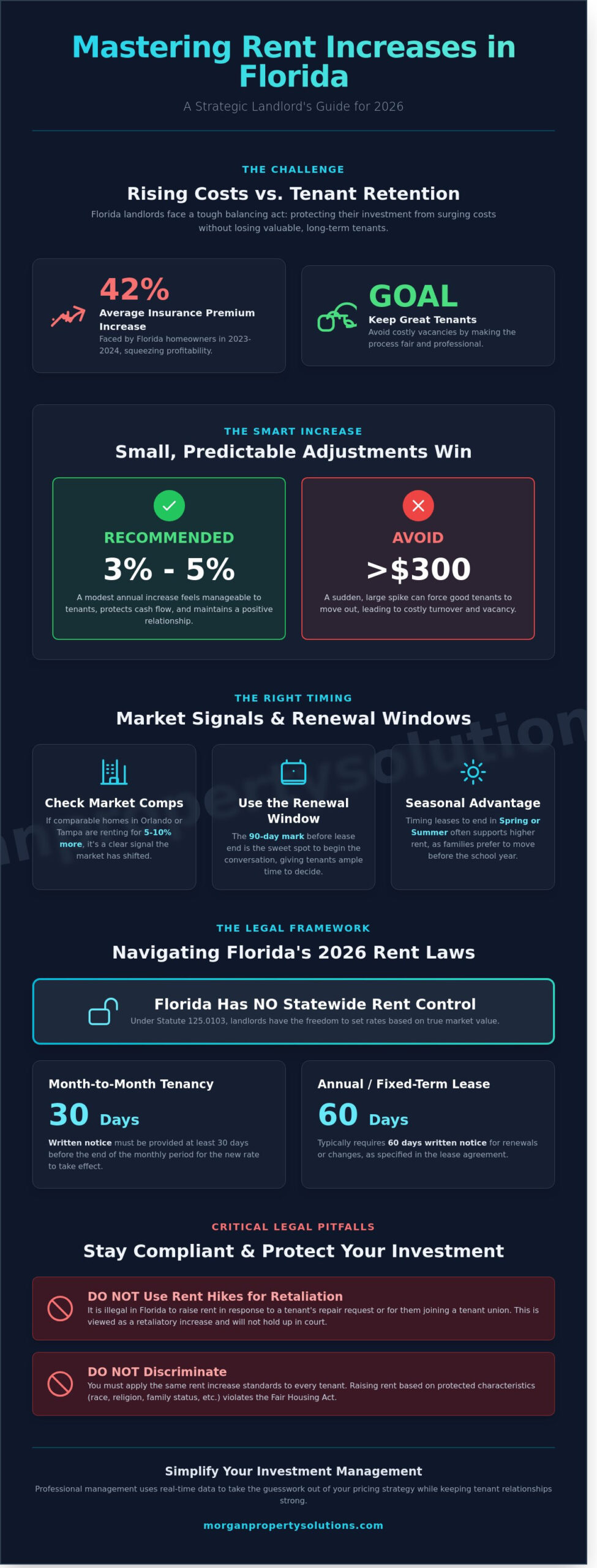
Deciding exactly when to raise rent florida can feel like a balancing act. You want to protect your investment, but you also want to keep good tenants in place. Generally, the best time to adjust your rates is at the end of a lease term or during the formal renewal window. At Morgan Property Solutions, we follow a simple philosophy. We believe making small, predictable adjustments is much better than hitting a tenant with a massive jump that forces them to move out. A modest 3% to 5% increase feels much more manageable for a family than a sudden $300 spike. It keeps your cash flow healthy without the high cost of an unexpected turnover.
External factors often dictate these decisions. If you see that comparable homes in Orlando or Tampa are renting for 5% to 10% more than your current rate, it’s a clear signal that the market has moved past you. You also have to look at your own overhead. With Florida property insurance premiums and property taxes expected to see another annual hike in 2026, your break-even point has likely shifted. Understanding Landlord-tenant law helps you navigate these changes while staying compliant and fair to your residents. Keeping your rent aligned with your rising expenses is simply a part of being a responsible property owner.
The Lease Renewal Window
The 90-day mark is the sweet spot for starting the conversation. It gives your tenant enough time to think, and it gives you enough time to find someone new if they decide to leave. Always check your current lease language for any automatic renewal or specific increase clauses you’ve already agreed to. Florida has no statewide rent control as of 2026. This allows you to set rates based on actual market value rather than arbitrary caps.
Market Comparables in Central Florida
Florida Rent Increase Laws: What’s legal in 2026?
Florida continues to be a landlord-friendly state as we move through 2026. Under Florida Statute 125.0103, local governments are still prohibited from imposing rent control or rent caps. This means you have the legal freedom to set your rates based on what the market will bear. However, this flexibility comes with a responsibility to follow specific procedures to avoid costly disputes. Staying “above board” is how we maintain our A+ BBB rating and how you protect your investment for the long haul.
While the state doesn’t tell you how much you can charge, it is very specific about how you communicate those changes. If you don’t follow the rules for notice, your rent increase could be thrown out in court. It’s all about keeping the relationship with your tenant transparent and professional.
Proper Notice for Different Lease Types
For month-to-month tenancies, the law is clear. You must provide at least 30 days of notice before the end of the monthly period. This gives the tenant enough time to decide if they’ll stay or look for a new place. If you wait until 15 days before the rent is due, you’ll likely have to wait another full month before the new rate can take effect.
Annual or fixed-term leases are a bit different. In these cases, the notice period is usually dictated by the language in your specific contract. Most standard Florida leases require a 60-day notice for renewals or changes in terms. Always deliver this notice in writing. While a text or a phone call might seem easier, they rarely hold up if a legal disagreement arises. You can find more specifics on these obligations in the Florida Bar’s guide on landlord-tenant rights to ensure you’re following the letter of the law.
Avoiding Legal Pitfalls
The biggest mistake a landlord can make is using a rent hike as a weapon. If a tenant asks for a repair or joins a tenant union, and you immediately respond with a massive price jump, that is considered a retaliatory increase. This is illegal in Florida. Judges don’t look kindly on landlords who use financial pressure to silence legitimate complaints.
You also need to stay mindful of the Fair Housing Act. When you’re deciding when to raise rent florida property owners must apply the same standards to every tenant. You can’t raise rent on one family but not another based on protected characteristics like race, religion, or familial status. Using consistent screening criteria from the very beginning helps you find high-quality tenants who understand the market and are more likely to accept reasonable, legal increases without a fuss.
Keeping your documentation organized makes the entire renewal process stress-free for both parties. If you’re feeling unsure about your current lease language, you can browse our landlord resources to find tools that help simplify your management tasks.
The Landlord’s Dilemma: Higher rent vs. a reliable tenant
Deciding when to raise rent in Florida involves more than just checking a spreadsheet of market averages. It is a delicate balancing act between maximizing your monthly income and keeping the “gold mine” of a reliable resident. While a $100 monthly increase adds $1,200 to your annual revenue, it can backfire if it triggers a move-out. We call this the Turnover Trap. If your property sits empty for 60 days while you search for a new tenant at a $2,100 rate, you lose $4,200 in immediate cash flow. It would take you three and a half years of that higher rent just to recover the cost of those two empty months.
Beyond the raw numbers, there is the human element of property management. A “2 AM call-free” tenant who treats your house like their own and pays like clockwork is often worth more than an extra $50 or $75 in the bank. These residents reduce your long-term maintenance costs and provide a level of predictability that is hard to price. At Morgan Property Solutions, we treat your investment like our own. This means we don’t just chase the highest possible number; we look for the “sweet spot” that ensures your property remains profitable and occupied by someone you can trust.
Maintaining that “sweet spot” often involves proactive property maintenance that benefits both the owner and the tenant. For instance, when you discover Fort Myers Insulation | A Goldstar Company, you’ll find expert ways to improve a home’s thermal performance, which keeps energy bills low for residents and protects the long-term value of your asset.
Doing the Math on Turnover
When a tenant leaves, the expenses start piling up immediately. You aren’t just losing rent; you are spending money to make the home “rent-ready” again. In the current Florida market, you can expect to spend at least $400 for a deep professional cleaning and $250 for minor wall repairs and touch-up paint. Professional photography to make your new listing stand out usually costs around $175. There is also the invisible cost of marketing time and the inherent risk of a “bad” new tenant replacing a “known” good one. Tenant Retention is the most effective way to boost long-term ROI.
- Cleaning and Prep: $400 to $800 depending on square footage.
- Marketing and Photos: $150 to $300 to attract high-quality leads.
- Vacancy Loss: The single biggest profit killer for independent landlords.
When to Hold Rent Flat
There are specific scenarios where keeping the rent exactly where it is becomes the most profitable move you can make. If a tenant has been in place for three or more years and handles minor repairs themselves, a “flat” year is a fantastic loyalty-building tool. It shows the resident you value their presence, which often encourages them to stay for another several years. During these years, you can still find ways to improve the lease without a base rent hike. For example, implementing a clear pet screening process allows you to manage risks and potentially collect pet rent or deposits while keeping the base rent stable. As you weigh these options, reading through Nolo’s overview of Florida landlord-tenant laws can help you understand the legal requirements for notice periods if you do eventually decide to adjust the terms. In a shifting economy, stability is often the smartest strategy for your bottom line.
For those looking to deepen their investment knowledge and access advanced financial planning resources, Multifamily Intelligence provides an all-in-one platform with specialized tools and a supportive investor community.
How to deliver a rent increase notice without the drama
Raising the rent is rarely a fun conversation, but it doesn’t have to be a battle. Most tenants understand that costs go up. In Florida, property insurance premiums rose by an average of 42 percent in 2023 alone, and those costs haven’t exactly plummeted since. When you’re deciding when to raise rent florida landlords should lead with transparency. If your property taxes or HOA fees jumped by 15 percent last year, tell your tenant. Being upfront about these “whys” helps them see the increase as a business necessity rather than a personal slight.
It’s also the perfect time to remind them of the value they’re getting. If you recently replaced an old dishwasher or upgraded the landscaping, mention it. Even smaller improvements like switching to a professional management team show that you’re reinvesting in their living experience. We focus on making real estate simple by handling these tough conversations for you, ensuring the relationship stays professional while your ROI stays on track.
The Professional Notice Template
A clear, written notice is your best friend. It should be sent at least 60 days before the lease ends to give everyone breathing room. Your notice needs to include the current rent, the new rent amount, the effective date, and a specific deadline for their response. To make the transition smoother, consider offering an incentive for an early renewal. A free professional carpet cleaning or a $50 gift card for a lease signed within 48 hours can work wonders. Many owners find that using Orlando property management acts as a helpful buffer, removing the emotional weight from the transaction while ensuring you stay compliant with Florida notice requirements.
Handling Tenant Objections
You might hear that a tenant simply can’t afford the new rate. Before you decide to move toward a vacancy, look for a middle ground. You could offer to lock in a slightly lower increase if they agree to a longer lease term, such as 18 or 24 months. This gives you the security of a long-term tenant and saves you the cost of a turnover. If cash flow is their main concern, we offer deposit-free renting options through our partners. This can free up their existing security deposit to cover the rent gap, creating a win-win. However, if market data shows you’re still below the local average for 2026, it’s okay to stand firm. Keeping your investment profitable is the only way to keep providing a quality home.
How professional management simplifies the rent increase process
Deciding when to raise rent florida landlords often find themselves balancing the need for profit with the desire to keep a reliable tenant. It’s a tough spot to be in. If you raise it too much, you risk a vacancy that costs thousands in lost income. If you wait too long, your expenses might outpace your revenue. Professional management takes the emotion out of the equation. We use real-time Central Florida market data from 2025 and 2026 to pinpoint the exact right number. We don’t guess. We look at actual signed leases in your specific neighborhood to ensure your property stays profitable and occupied. This data-driven approach helps you avoid the common mistake of overpricing and sitting on a vacant home for months.
Communication is often the most stressful part of owning a rental. Many owners dread sending that notice because they don’t want to be the “bad guy.” We act as the professional middleman, handling all the tough conversations so you don’t have to. Beyond just talking to tenants, we manage the legal paperwork. Florida laws regarding notice periods and tenant rights are precise. We make sure every document we send is 100% compliant with 2026 Florida statutes. This protects you from costly legal errors and ensures the process is smooth for everyone involved. Whether you are buying your first investment or selling a portion of your portfolio, we stay with you every step of the way to maximize your move. For investors looking to diversify their portfolio with high-yield short-term options, Bnb Hub provides specialized holiday rental management that focuses on maximizing returns through expert property positioning.
The Morgan Property Solutions Advantage
We bring over 20 years of experience in the Orlando and Tampa rental markets to the table. Our team has helped thousands of owners navigate shifting economies and local trends. We believe in making real estate simple. Our online portal gives you 24/7 access to financial reporting and rent adjustment history, so you’re always in the loop. You can learn more about us and see how our A+ BBB commitment translates into better service for your investment. We’re here to take good care of you.
Your Next Move
Take the Guesswork Out of Your Rental Strategy
Raising rent is about more than just the bottom line; it’s about finding a balance that keeps your investment profitable and your best tenants happy. Florida’s rental market is constantly evolving, and staying ahead of 2026 regulations helps you avoid legal headaches while maximizing your returns. You now have the tools to handle rent increases with professional communication and clear documentation, which keeps the process drama-free for everyone involved.
Deciding when to raise rent florida requires a careful look at local market trends and property performance. With over 20 years of experience in the Central Florida market and an A+ rating from the BBB, Morgan Property Solutions takes the guesswork out of the equation. We provide a comprehensive online owner portal that gives you total visibility into your portfolio, making property management simple and stress-free. Let us help you navigate these changes so you can focus on growing your wealth.
Get a Free Rental Analysis from Orlando’s Trusted Experts
We’re excited to help you make your next move a successful one.
Frequently Asked Questions
Can a landlord raise rent in Florida without notice?
No, you can’t raise the rent without giving your tenant proper written notice first. For a month-to-month agreement, Florida Statute 83.57 requires you to provide at least 30 days of notice before the next payment period starts. We always recommend sending this notice via certified mail so you have a clear paper trail. It keeps things professional and ensures everyone is on the same page.
Is there a limit on how much rent can be increased in Florida in 2026?
Florida doesn’t have a statewide limit on how much you can increase rent in 2026 because Statute 166.043 prohibits local governments from enacting rent control. While you have the freedom to set market rates, it’s smart to keep increases reasonable to avoid high turnover costs. Most landlords we work with aim for increases that reflect current market data rather than arbitrary numbers to keep their properties profitable.
How often can a landlord raise rent in Florida?
You can typically raise the rent whenever a lease term ends or with proper notice in a month-to-month arrangement. Most owners choose to evaluate when to raise rent florida properties once every 12 months during the renewal process. This annual rhythm helps you stay competitive with the local market while giving your tenants a sense of stability. Frequent changes can lead to frustration and unwanted vacancies for your business.
Can I raise the rent mid-lease if my property taxes go up?
You generally can’t raise the rent in the middle of a fixed-term lease just because your taxes or insurance costs increased. The lease is a binding contract that locks in the rate until the expiration date. You’ll need to wait until the current term ends to adjust the price. We suggest reviewing your tax assessments early so you can plan your next renewal offer and maintain your cash flow.
What happens if a tenant refuses to pay a rent increase in Florida?
If a tenant refuses to pay a legal rent increase, they’ll need to move out at the end of their current lease term. They don’t have a legal right to stay at the old rate once the notice period ends. If they stay without paying the new amount, it’s considered a holdover tenancy. In these cases, we’re here to help you navigate the transition and find a new qualified tenant quickly.
Does Florida have a 60-day notice requirement for rent increases?
Florida state law requires 30 days for month-to-month tenancies, but 2 counties like Miami-Dade and Broward have local ordinances requiring 60 days’ notice for increases over 5 percent. It’s vital to check your specific city or county rules to stay compliant. Even if the law only requires 30 days, giving 60 days is a helpful way to build trust and give your tenants enough time to plan their finances.

Article by
Oliver Overton-Morgan
Oliver Overton-Morgan is a full-time Real Estate Broker since 2003, with years of experience helping thousands of people purchase and sell real estate throughout Central Florida. He holds a Graduate Realtor Institute designation, LCAM, and has held licenses in good standing as a Florida Mortgage Broker and a Notary Public. Oliver immigrated to central Florida in 2001, and within 5 years Oliver built a successful Real Estate brokerage in central Florida, where he recruited over 75 Sales Associates with 25+ million in sales production.