
Last Tuesday, an Orlando property owner received a vague ESA letter from an anonymous online service and felt that familiar knot in his stomach. He wondered if a simple mistake regarding emotional support animal laws florida for landlords could lead to a $24,793 fine from the Department of Housing and Urban Development. It’s incredibly frustrating to feel like you’re losing control over your own rental property, especially when it’s hard to tell the difference between a legitimate medical need and a “certificate” someone bought for fifty dollars online. You want to be a fair housing provider, but you also need to protect your investment from unvetted animals and potential damage.
We’re here to help you understand exactly how these regulations work in 2026, so you can stay compliant without the constant headache of second-guessing every applicant. Our goal is to make these complex rules simple and stress-free for you. We’ll walk through the specific documentation you can legally require, the exact questions you’re allowed to ask, and the red flags that help you spot a fraudulent request from a mile away.
Key Takeaways
- Understand the vital distinctions between service animals and ESAs to ensure you’re applying the correct legal standards to every tenant request.
- Navigate the intersection of federal Fair Housing rules and emotional support animal laws florida for landlords to keep your investment safe and compliant.
- Learn how to professionally verify ESA requests for non-obvious disabilities by following a clear, step-by-step documentation process.
- Clarify your rights regarding pet fees, deposits, and breed restrictions so you can protect your property while respecting tenant protections.
- See how partnering with experts can take the stress out of complex regulations and help you standardize your screening for better results.
Understanding the Difference: Service Animals vs. Emotional Support Animals
Managing rental property in Florida during 2026 requires a clear head and a solid grasp of federal housing rules. One of the most frequent points of confusion for property owners involves the distinction between service animals and emotional support animals (ESAs). While both are protected under the law, they aren’t the same thing, and treating them identically can lead to unnecessary legal friction. Staying updated on emotional support animal laws florida for landlords helps you protect your investment while respecting the rights of your tenants. We’ve spent over 20 years helping owners navigate these rules, and we’ve found that education is the best way to make real estate simple and stress-free.
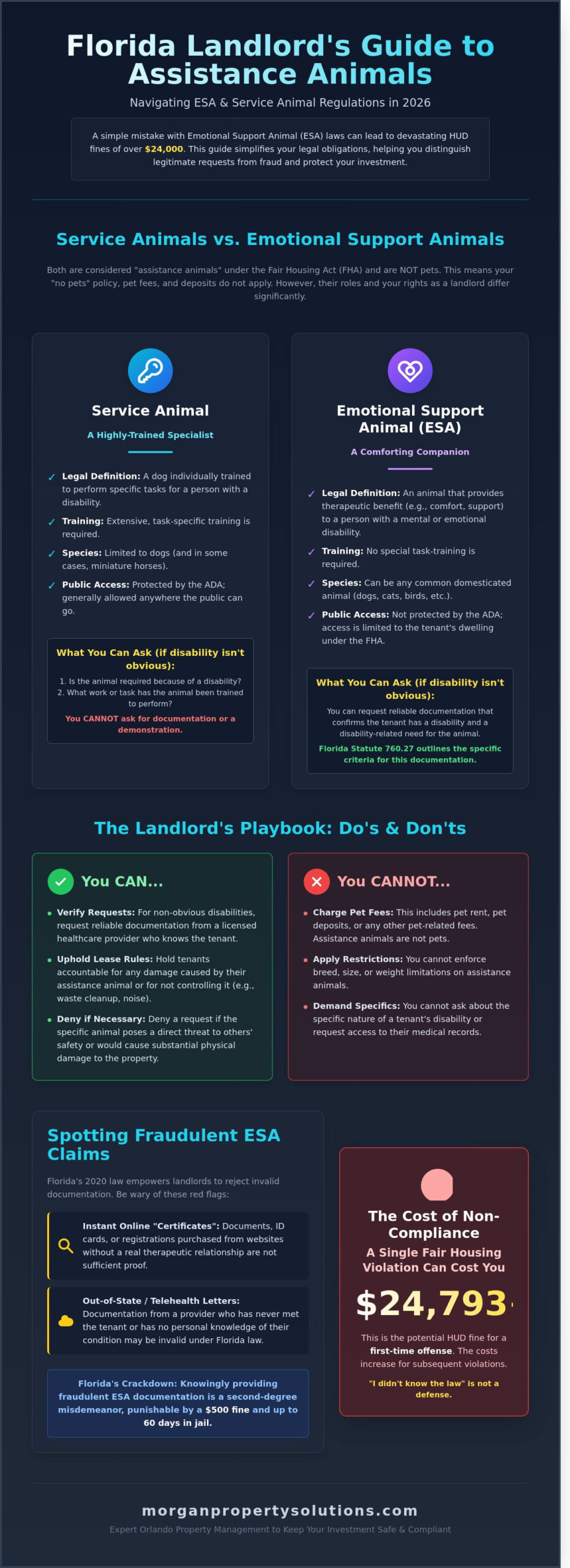
The legal “umbrella” that covers both types of animals is the Fair Housing Act (FHA). Under this federal law, neither service animals nor ESAs are considered pets. Instead, they are viewed as “assistance animals” that provide a necessary service or support to a person with a disability. This means that even if you have a strict “no-pets” policy, you are generally required to provide a reasonable accommodation for these animals. Understanding this distinction is a vital part of our landlord resources and helps ensure you stay compliant with HUD guidelines.
The Role of Service Animals in Housing
A service animal is a dog that is individually trained to do work or perform tasks for the benefit of an individual with a disability. These animals are highly trained professionals that assist with specific needs, such as guiding a person who is blind or alerting someone to an upcoming seizure. Because of their specialized training, you are limited in what you can ask. If the disability isn’t obvious, you can only ask if the dog is required because of a disability and what specific task it has been trained to perform. You cannot ask for medical records or a demonstration of the task. Standard “no-pet” policies and breed restrictions never apply to these legitimate working animals.
What Makes an Animal an ESA?
Emotional support animals are different because they provide comfort and support for mental or emotional disabilities without needing any specialized task training. The connection between the animal and the person’s well-being is what qualifies them under the FHA. While dogs and cats are the most common, ESAs can include various small, domesticated animals like rabbits, birds, or even hamsters. It’s important to remember that ESAs do not have the same “public access” rights as service dogs. While a service dog can go into a grocery store, an ESA is generally only permitted to stay in the home. Mastering emotional support animal laws florida for landlords ensures you know when to grant access and when to request proper documentation for these comfort animals.
Florida Statute 760.27 and the Fair Housing Act: Your Legal Obligations
Understanding the legal landscape is the first step to staying protected. At the federal level, the Fair Housing Act (FHA) prohibits discrimination against individuals with disabilities. This includes those who rely on emotional support animals. You’ve likely heard the term “reasonable accommodation.” In simple terms, this means you must adjust your rules to allow a person with a disability an equal opportunity to use and enjoy their home. You can’t charge pet deposits or monthly pet rent for these animals because they aren’t technically pets.
Florida Statute 760.27, which became effective on July 1, 2020, builds on these federal rules. It provides a clearer framework for how you should handle requests. It’s vital to remember that emotional support animal laws florida for landlords are designed to balance tenant rights with your rights as a property owner. If a tenant’s disability isn’t readily apparent, you’re allowed to ask for reliable documentation. This often comes from a licensed healthcare practitioner who has personal knowledge of the tenant’s condition.
The Consequences of Non-Compliance
Ignoring a valid request can lead to expensive headaches. The Department of Housing and Urban Development (HUD) handles these complaints, and they take them seriously. Fines for a first-time Fair Housing violation can reach over $23,000 as of 2024 updates. Florida courts don’t accept “I didn’t know the law” as a defense. If you feel overwhelmed by these regulations, partnering with an experienced team for Orlando property management can keep your investments safe and compliant.
Florida’s Crackdown on Fraudulent ESA Claims
The 2020 update brought some welcome news for landlords. It made providing fraudulent ESA documentation a second-degree misdemeanor. This means tenants can face up to 60 days in jail or a $500 fine for lying. The law also addresses those “ESA registration” websites that sell certificates without any real medical evaluation. Florida Statute 760.27 clarifies that a registration, ID card, or patch isn’t enough proof by itself. You have the right to stand your ground if the documentation doesn’t meet the state’s specific criteria. Staying informed helps you spot the difference between a legitimate need and someone just trying to bypass your pet policy. If you’re unsure about a specific request, our landlord resources offer more guidance on handling these daily challenges.
The Verification Process: How to Spot a Legitimate ESA Request
Handling a request for an accommodation doesn’t have to be a guessing game. Florida’s legal framework gives you a clear path to follow when a tenant asks to keep an animal in a no-pet property. Your first step is determining if the disability is “readily apparent.” If a tenant uses a wheelchair or a white cane, the need is obvious. In these cases, you shouldn’t ask for documentation because the disability and the need are clear to any observer.
However, many disabilities are invisible. When a condition isn’t obvious, you have the right to request reliable documentation. This is where emotional support animal laws florida for landlords provide much-needed structure. You’re looking for a “direct relationship” between the person’s disability and the support the animal provides. The animal must perform work, provide assistance, or offer emotional support that alleviates at least one identified symptom of the disability. If a tenant can’t show how the animal helps their specific condition, the request might not meet the legal threshold.
You’ll also want to keep an eye out for red flags. Florida Statute 760.27, which was updated in 2020, specifically addresses the issue of fraudulent ESA claims. An ID card, a vest, or a registration certificate bought from a random website isn’t sufficient proof of a disability. These “ESA mills” often sell documents without any real medical evaluation, and Florida law allows you to deny requests based solely on these unreliable sources.
What a Legitimate ESA Letter Actually Looks Like
Using Third-Party Screening for Peace of Mind
Reviewing medical letters can feel invasive and uncomfortable for many property owners. To make things easier, we suggest using a service like PetScreening to handle the verification. They act as a neutral expert to review documentation and ensure it meets the latest legal standards. This takes the guesswork out of the process and removes the awkwardness of discussing medical needs directly with your tenant. It’s a simple way to stay compliant with emotional support animal laws florida for landlords while keeping your professional relationship intact.
Common Landlord Questions: Fees, Breeds, and Property Damage
Getting a request for an ESA often brings up immediate worries about money and property safety. Under emotional support animal laws florida for landlords, these animals are legally viewed as “reasonable accommodations” rather than pets. This distinction is vital because it changes your financial rights. You can’t charge a pet deposit, monthly pet rent, or a one-time pet fee for an ESA. Even if your lease clearly states “no pets allowed,” you have to waive those specific costs because the law doesn’t see the animal as a pet.
Breed and weight limits don’t apply to these animals either. You can’t reject a 90-pound dog just because your building has a 25-pound limit. The only real exception involves your insurance policy. If your provider proves they will cancel your policy or significantly raise your premiums because of a specific breed, you might have a case for an “undue financial burden.” However, HUD and Florida’s 2020 SB 1084 guidelines usually require documented proof of this from the insurance company before you can deny the request on those grounds.
The Financial Side of ESAs
While you can’t charge up-front pet fees, you aren’t stuck with the bill if things get messy. Tenants are still liable for any actual damage the animal causes to the unit. If the ESA ruins the carpet or scratches the baseboards, you can deduct those repair costs from the standard security deposit at the end of the lease. We always recommend doing a detailed walkthrough before the tenant moves in to avoid disputes later. You can find helpful tools for this in our landlord resources to ensure you have the “before” photos you need to protect your investment.
Safety and Nuisance Concerns
You don’t have to tolerate a dangerous situation in your rental. A landlord can legally deny an ESA if the specific animal poses a “direct threat” to the safety of others. This can’t be based on a hunch or general fears about a breed. It has to be based on actual behavior, like a documented history of biting or aggressive lunging. If the animal shows these traits after moving in, you have the right to take action to protect your other residents.
Noise is another factor that impacts the community. If a dog barks constantly and disrupts the quiet enjoyment of other tenants, you can address it as a lease violation. The animal’s status as an ESA doesn’t give the owner a free pass to ignore local noise ordinances or community rules. You should treat these behavioral issues the same way you would any other problem. Following emotional support animal laws florida for landlords is much easier when you have a plan in place. Check out how we handle Orlando property management to keep your properties running smoothly and legally.
Why Professional Management Makes ESA Compliance Stress-Free
Managing a rental property in Florida involves more than just collecting checks. It requires staying on the right side of the law. Since the Florida Senate passed SB 1084 in 2020, the rules around ESAs have become much more specific. Handling these requirements alone can lead to expensive mistakes. We step in to take that weight off your shoulders.
We act as a professional buffer between you and the legal complexities of modern property management. Instead of you having to guess if a document is legitimate, we use our experience to verify everything correctly. By following standardized screening criteria, we ensure every applicant gets the same fair treatment. This consistency is your best defense against claims of discrimination or bias. It’s about protecting your reputation and your wallet at the same time.
Our team monitors every change to emotional support animal laws florida for landlords as they happen. We don’t just react to laws; we prepare for them. This proactive approach keeps your investment safe while you focus on your own life. We handle the difficult conversations and the paperwork with a human touch that keeps relationships positive. We make real estate simple by taking care of the details that usually cause the most headaches.
Our Approach to Tenant Relations
Communication is the heart of what we do. We believe in being professional, firm, and fair with every tenant. Our proven systems reduce the stress of self-management by setting clear expectations from day one. This keeps everyone happy and ensures that your property is respected. Morgan Property Solutions acts as your trusted partner in compliance, making sure every detail aligns with current Florida statutes so you don’t have to worry about a thing.
Ready to Simplify Your Rental Business?
A solid management strategy in Central Florida does more than just fill units. It protects your bottom line. We work to boost your profits by keeping vacancy rates low and minimizing legal risks that could cost you thousands in court fees. Our local expertise means we understand the specific needs of the Orlando market. We’ve seen how emotional support animal laws florida for landlords have evolved, and we know exactly how to apply them to keep your business running smoothly.
Ready to take the stress out of your investment? Contact Morgan Property Solutions to see how we can help you manage your investment with confidence and ease. We’re here to help you every step of the way.
Protect Your Investment and Stay Compliant
Navigating these rules doesn’t have to feel like a full-time job. By now, you understand how Florida Statute 760.27 protects both tenants and owners, and you know why distinguishing between a service animal and an ESA is vital for your daily operations. Following the Fair Housing Act isn’t just about avoiding legal trouble; it’s about running a professional rental business that respects legal boundaries while protecting your property. Staying on top of emotional support animal laws florida for landlords is much easier when you have the right systems in place to verify every request.
We’ve spent over 20 years helping owners in Central Florida manage these exact situations. Our team maintains an A+ rating with the Better Business Bureau because we focus on making the complex stuff feel simple. We even use a specialized PetScreening integration for all our rentals to ensure every request is legitimate and verified. You don’t need to stress over legal jargon when you have a partner who’s been doing this for two decades. Let us handle the complexities of Florida landlord law for you. We’re here to make sure your rental journey is as smooth and successful as possible.
Frequently Asked Questions
Can I deny a tenant with an ESA if my insurance doesn’t allow certain breeds?
You can’t automatically deny a breed just because of an insurance policy, but there’s a narrow exception if the provider actually threatens to cancel your coverage. Florida Statute 760.27 requires landlords to show that the specific animal poses a direct threat or creates an undue financial burden. If your 2026 insurance premium would skyrocket or be revoked, you’ll need written proof from the carrier to justify a denial.
Is a tenant required to tell me about their ESA before signing the lease?
No, a tenant isn’t legally obligated to disclose their need for an ESA during the application process or before signing. They can make a request for reasonable accommodation at any point during their tenancy. While it’s easier for everyone to plan ahead, the law protects their right to wait until they’ve secured the housing to bring it up. We always recommend staying flexible with these requests.
Can I charge a higher security deposit for an emotional support animal?
You cannot charge any extra pet fees, higher security deposits, or monthly pet rent for an emotional support animal. Under emotional support animal laws florida for landlords, these animals are viewed as medical tools rather than pets. However, you can still hold the tenant financially responsible for any physical damage the animal causes to the unit when they eventually move out.
What happens if I suspect an ESA letter is fake?
If you suspect a letter is fraudulent, you’re allowed to ask for documentation from a licensed healthcare professional who has personal knowledge of the tenant. Florida’s SB 1084, passed in 2020, actually makes it a second-degree misdemeanor to falsify ESA documents. You can’t ask for specific medical records, but you can verify the provider’s license is active and they’ve actually treated the person.
Does an ESA have to be a dog or a cat under Florida law?
Most ESAs are dogs or cats, but Florida law doesn’t strictly limit the species as long as it’s a common household animal. HUD’s 2020 guidance clarifies that unique animals like reptiles or barnyard creatures require much more detailed justification from a doctor. If a tenant wants to bring in a goat or a snake, they’ll have a much harder time proving it’s a reasonable accommodation.
How often can I ask for updated ESA documentation from a tenant?
You generally shouldn’t ask for updated paperwork if the tenant’s disability is permanent and the need for the animal is already established. Requesting new letters every few months can look like harassment or discrimination. If the documentation provided has an expiration date or the disability is temporary, you might have grounds to check in once a year, but it’s best to stay hands-off to avoid legal trouble.
Can I limit where an ESA goes on my multi-family property?
You can restrict an ESA from certain amenities like the swimming pool or the community gym, as they don’t have the same public access rights as service dogs. They’re primarily allowed in the dwelling unit and the paths needed to get outside. Just make sure you aren’t blocking their only way to get to the parking lot or the mailboxes, as that would be a violation of their rights.
What is the difference between an ESA and a psychiatric service dog?
The main difference is that a psychiatric service dog is trained to perform specific tasks, while an ESA provides comfort just by being there. Service dogs are protected under the Americans with Disabilities Act and can go almost anywhere. ESAs are only protected under housing laws, meaning they don’t have a legal right to enter restaurants or grocery stores with their owners in Florida.

Article by
Oliver Overton-Morgan
Oliver Overton-Morgan is a full-time Real Estate Broker since 2003, with years of experience helping thousands of people purchase and sell real estate throughout Central Florida. He holds a Graduate Realtor Institute designation, LCAM, and has held licenses in good standing as a Florida Mortgage Broker and a Notary Public. Oliver immigrated to central Florida in 2001, and within 5 years Oliver built a successful Real Estate brokerage in central Florida, where he recruited over 75 Sales Associates with 25+ million in sales production.