
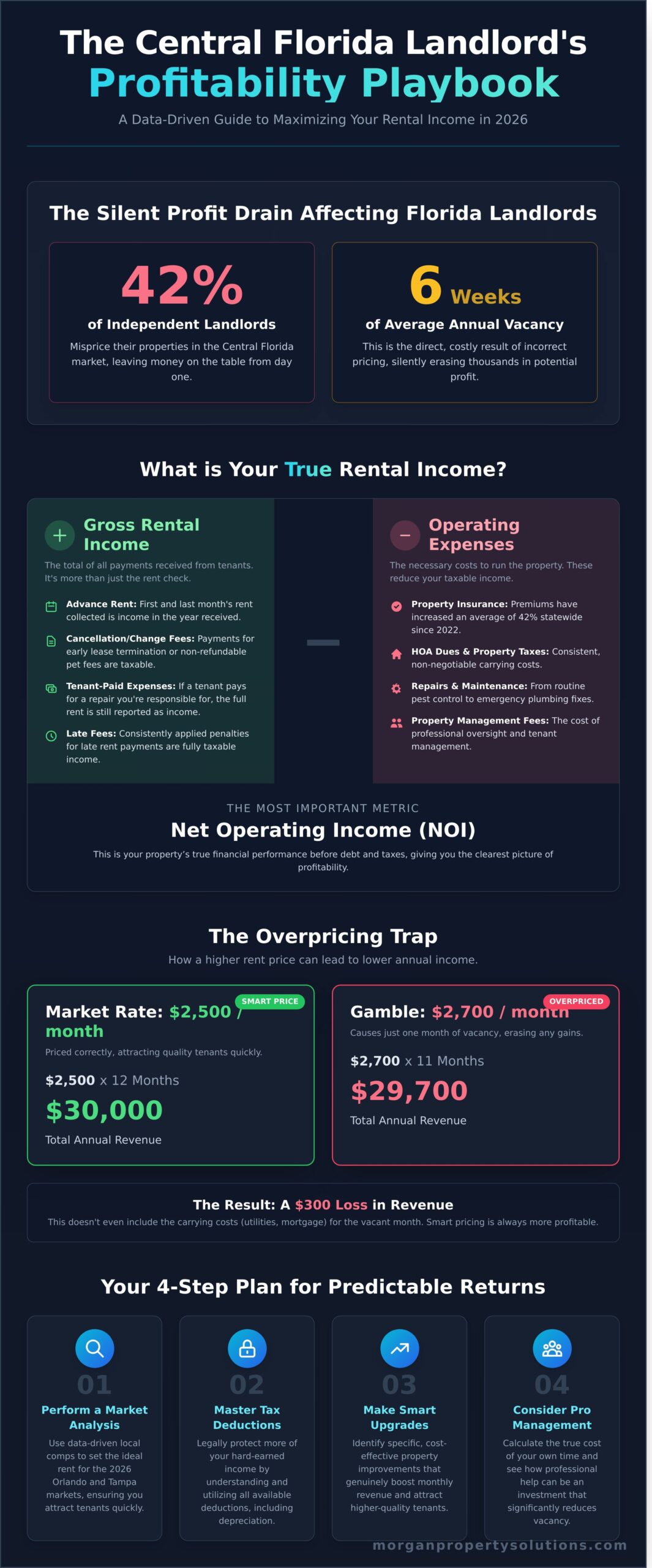
Did you know a recent analysis of the Central Florida market revealed that 42% of independent landlords misprice their properties? This single mistake leads to an average of six weeks of costly vacancy per year, silently draining their potential profits before they even see them.
It’s a frustrating cycle. You invested in a Florida property to build a secure financial future, but instead, you’re losing sleep over surprise maintenance bills and wondering if you’re leaving money on the table with the IRS come 2026. We believe managing your investment shouldn’t be a source of stress. This guide is your trusted partner, designed to give you complete control over your rental income. We’ll show you exactly how to calculate your true profitability, protect your investment with smart management, and grow your cash flow month after month.
Together, we’ll walk through proven local pricing strategies that attract quality tenants quickly, demystify the tax deductions specific to Florida property owners, and give you a clear, simple plan for predictable returns.
Key Takeaways
- Discover a straightforward method for performing a market analysis to set the ideal rent for the 2026 Orlando and Tampa markets.
- We’ll guide you through the most important tax deductions, including depreciation, to help you legally protect more of your hard-earned rental income.
- Identify the specific, cost-effective property upgrades that will genuinely boost your monthly revenue and attract high-quality tenants.
- Calculate the true cost of your own time and see how professional management can be an investment that significantly reduces vacancy periods.
What Exactly Counts as Rental Income in 2026?
As a Florida property owner, you know that maximizing profit starts with understanding every dollar that comes in. But your total rental income is much more than the monthly check your tenant sends. For 2026, a clear understanding is more critical than ever. The Florida Landlord Fairness Act, which took full effect in late 2025, changed how certain fees and security deposit claims are reported, making this the first full tax year under the new guidelines. Before we dive into the numbers, it’s helpful to remember the fundamentals of your role; the traditional definition of What is a Landlord? involves more than just collecting rent, and so does your income statement.
Many investors focus solely on the rent payment, leaving significant money on the table or, worse, misreporting their income to the IRS. To truly take control of your investment, you need a complete picture of your property’s earnings. Let’s make it simple and break down what really counts.
Common and Not-So-Common Income Sources
Your gross rental income is the sum of all payments you receive from a tenant. Some of these are obvious, but others are easy to overlook. According to IRS Topic No. 414, you must report all of these amounts as income:
- Advance Rent: If you collect the first and last month’s rent upon lease signing, both payments are considered income in the year you receive them, not when the last month occurs.
- Fees for Cancellation or Changes: Did a tenant pay a fee to break their lease early? That’s taxable income. The same applies to non-refundable pet fees or fees for adding a roommate.
- Tenant-Paid Owner Expenses: If a tenant pays for a necessary repair, such as a $300 plumbing fix that is your responsibility, and deducts it from their rent, you must still report the full original rent amount as income. You would then claim the $300 as a separate repair expense.
- Late Fees: Consistently applied late fees, such as a 5% penalty on rent paid after the fifth of the month, are a common and fully taxable source of income.
The “Net Income” Reality Check
Your bank account balance isn’t your true profit. That number simply shows cash flow, not the actual performance of your asset. To find your real profit, you must subtract your operating expenses from your gross income. For landlords in Central Florida, these “hidden” costs can add up quickly, from quarterly pest control services to higher property insurance premiums that have increased an average of 42% statewide since 2022. Don’t forget HOA dues, property management fees, and routine maintenance.
This brings us to the most important metric for your property. Net Operating Income is your property’s total income minus all operating expenses, giving you the clearest picture of its financial performance before debt service and taxes.
Grasping this distinction between what you collect and what you keep is the foundational first step to making your real estate investment simple and genuinely profitable.
How to Calculate Your Ideal Rent Price in Central Florida
Setting the right rent price is the single most important decision you’ll make to maximize your rental income. Price too high, and you risk costly vacancy. Price too low, and you leave money on the table every single month. While old rules of thumb like the “1% Rule” (monthly rent equals 1% of the purchase price) were once popular, they simply don’t apply to the high-value 2026 Central Florida market. A $450,000 home in Winter Garden won’t realistically rent for $4,500 per month. Instead, a data-driven approach is essential for success.
The biggest mistake new landlords make is overpricing their property. A single month of vacancy can completely erase any gains from a higher rent. For example, pricing a home at $2,700 instead of the market rate of $2,500 might seem like a $2,400 annual gain. But if that price causes just one month of vacancy, you lose $2,700 in revenue, plus you still have carrying costs for that month. These expenses can sometimes be deducted, but it’s vital to understand the official IRS rules on rental income to stay compliant. Suddenly, your effective annual revenue is lower than if you had priced it correctly from the start.
Researching Local Rental Comps
A Comparative Market Analysis (CMA) is your best tool, and you don’t need expensive software to perform a basic one. Start by searching sites like Zillow, Apartments.com, and Rentometer for currently available and recently rented properties in your immediate area (within a 1-mile radius). Don’t just look at the list price; look for properties that have gone off-market quickly. These are your true competitors. Go beyond square footage and the number of bedrooms to compare features that tenants truly value:
- Property Condition: Is the kitchen updated with stainless steel appliances? Does the property have fresh paint and modern flooring? A home built in 2022 will command a higher rent than a similar-sized home from 1995.
- Key Amenities: In Florida, a fenced-in yard, a community pool, or a private screened-in lanai can add significant value.
- Location & Schools: Being zoned for an A-rated school like those in Lake Nona or Dr. Phillips can add $150-$300 to your monthly rent potential compared to a similar home in a less-desirable school district.
Adjusting for neighborhood-specific features is also crucial. A property in Lake Nona benefits from its proximity to the Medical City and Orlando International Airport, attracting a specific tenant pool. Meanwhile, a rental in Dr. Phillips can demand a premium for its access to Restaurant Row and top-tier schools. Performing a detailed market analysis takes time, and if you’re unsure, a professional property assessment can provide the clarity needed to set the perfect price from day one.
Dynamic Pricing Strategies
Smart investors don’t just set a price and forget it. The Central Florida rental market has distinct seasonal demand. Peak leasing season typically runs from May through August, when more people are moving. You can often price a property 3-5% higher during this window. If your property becomes vacant in November, you may need to price it more competitively to avoid it sitting empty through the holidays.
If you’re facing a slower market, consider offering incentives instead of lowering the base rent. An offer like “one month free on a 13-month lease” or waiving a pet fee can be more attractive to a tenant than a small monthly discount. This strategy secures a great tenant without devaluing your property’s base rent for future renewals. To see how these different scenarios affect your annual profit and overall investment, using a rental income calculator can help you forecast your returns with confidence.
Taxes and Deductions: Keeping More of What You Earn
Generating profit from your Florida property is only half the battle; keeping it is what truly matters. The tax code can seem intimidating, but understanding its rules is one of the most powerful tools for maximizing your net return. All of your property’s financial activity is reported to the IRS on Schedule E, but don’t let a government form discourage you. With a clear strategy, you can transform tax season from a headache into an opportunity to boost your bottom line.
For most Florida landlords, the journey to lower taxes begins with three major deductions: mortgage interest, property taxes, and depreciation. While the first two are straightforward, the 2026 tax landscape introduces new considerations. Many of the Tax Cuts and Jobs Act (TCJA) provisions expired at the end of 2025, meaning 2026 returns will see shifts in individual income tax brackets and standard deduction amounts. This makes optimizing every available deduction on your rental property more critical than ever to protect your profits.
Maximizing Your Deductible Expenses
Beyond the big three, a host of other expenses can significantly lower your taxable rental income. It’s vital to distinguish between repairs, which are currently deductible, and improvements, which are capitalized and depreciated. For example, replacing a broken window pane is a repair, while replacing all the windows with new energy-efficient models is an improvement. Other key deductions include:
- Travel costs for managing the property
- Marketing and advertising fees to find new tenants
- Insurance premiums
- Professional service fees, including legal, accounting, and property management
Tracking these can feel overwhelming, which is why we’ve created simple tools to help. You can find our comprehensive tax-prep checklists on our landlord resources page to ensure you don’t miss a single opportunity.
The Power of Depreciation
Depreciation is the secret weapon of savvy real estate investors. It’s a “phantom expense” because it allows you to deduct a portion of your property’s cost basis each year without spending any actual cash. The IRS allows you to depreciate the value of a residential building (not the land) over a period of 27.5 years. For a property with a building value of $330,000, this translates to a $12,000 deduction each year, saving you thousands in taxes annually.
Finally, the best insurance against an IRS audit is meticulous, organized record-keeping. Every receipt, invoice, and mileage log serves as proof of your deductions. Using accounting software or a simple spreadsheet system from day one is non-negotiable. Meticulous records are not just for taxes; they’re essential for complying with all aspects of Florida landlord-tenant laws and proving the validity of your expenses if ever questioned. It’s the foundational habit that separates amateur landlords from professional investors.
Proven Ways to Boost Your Rental Income and ROI
Maximizing your return on a Florida rental property isn’t just about charging the highest possible rent. It’s about creating a desirable, stable asset that attracts and retains high-quality tenants. The most successful investors know that strategic improvements and ironclad processes yield far greater returns than simple rent hikes ever could. The goal is to build a reliable stream of rental income, and that starts with making smart, proactive decisions.
The cheapest way to increase your profit is to eliminate vacancy. A single month of lost rent can easily negate the gains from a 5% rent increase over an entire year. For a property renting at $2,800 per month, that’s a $2,800 loss, not including the costs of marketing, cleaning, and painting. Keeping a great tenant who pays on time and cares for your home is the single most effective financial strategy you can employ. This is achieved through responsive communication, prompt maintenance, and fair renewal terms.
Value-Add Improvements for Florida Homes
Tenants in 2026 are looking for more than just four walls and a roof. They prioritize convenience, efficiency, and lifestyle. Focus on upgrades that deliver tangible benefits, such as smart thermostats (which can reduce cooling costs by up to 15%) and keyless entry systems. In the Sunshine State, outdoor living is a massive draw. A clean, shaded patio, functional outdoor lighting, or a well-maintained garden can significantly boost perceived value without requiring a four-figure investment. These features, combined with a spotlessly clean interior, attract a better caliber of applicant from the start.
Maintaining a pristine exterior is equally crucial for making that strong first impression. Services like pressure washing for siding, roofs, and driveways can dramatically improve a property’s curb appeal with minimal investment. While they are based in the Philadelphia area, you can check out L&M Services LLP to see examples of how professional exterior cleaning can prepare a property for the market.
Protecting Income with Better Screening
Your cash flow is only as reliable as your tenant. A rigorous screening process is the ultimate defense against late payments and costly evictions, which averaged over $3,500 in costs for Florida landlords in 2024. Our comprehensive screening criteria examines credit history, verifies income, and checks past rental references to ensure we place only the most qualified residents. This diligence is directly connected to predictable income and peace of mind.
Furthermore, with nearly 70% of American households owning a pet, a “no pets” policy can severely limit your pool of potential renters. Instead of a blanket ban, a smarter approach is to manage the risk. We use professional pet screening services to verify animal records, assess behavior, and implement a strong pet addendum. This allows you to welcome responsible pet owners, fill vacancies faster, and protect your property all at once. Protecting your asset starts with implementing the right processes. Learn how our expert property management can secure your investment and boost your ROI.
Why Professional Property Management is an Investment, Not an Expense
Many Florida property owners view a management fee as a deduction from their profits. But that’s a limited perspective. A truly experienced property manager doesn’t cost you money; they make you money by optimizing your asset for peak performance. The real question isn’t “Can I afford a manager?” but rather, “Can I afford the time, risk, and lost revenue of not having one?”
Think about the real cost of self-management. What is your Saturday worth? Is it worth a 10 PM phone call about a running toilet? Or a full weekend spent showing the property, screening applicants, and running background checks? When you assign an hourly rate to your own time, the “savings” of DIY management disappear quickly. Your time is your most valuable asset, and professional management gives it back to you, turning your property into a genuinely passive income stream.
Beyond time, the financial benefits are concrete. A primary profit killer for landlords is vacancy. According to data from Buildium, a leading real estate technology platform, professional managers can reduce vacancy times by 30% or more. They achieve this through a proven system: high-quality marketing photos, broad advertising across dozens of platforms, and a streamlined application process that places qualified tenants faster. A single month of saved vacancy can often cover the management fee for an entire year.
Then there’s the “volume discount” on maintenance. As an individual landlord, you pay retail prices for every repair. We don’t. Our long-standing relationships with licensed and insured vendors in Central Florida mean you get access to preferred pricing and priority service. A plumbing emergency that might cost an individual $600 and a three-day wait could cost our client $450 and be fixed the same day. These savings directly boost your bottom line.
These principles of leveraging professional expertise apply globally. Successful agencies, such as Century 21 Aspire Group in Australia, build their reputation on providing comprehensive sales and management services that maximize returns for property owners, showcasing a model that works in any strong market.
The Math Behind the Management Fee
When you add up the savings from reduced vacancy, lower maintenance costs, and the elimination of costly legal mistakes, our service effectively pays for itself. A typical 8-10% management fee is a small price for maximizing your property’s performance and ensuring a consistent, stress-free rental income. Our expert Orlando property management services are designed to remove the hassle and boost your profits.
Partnering for Long-Term Success
The ultimate benefit is peace of mind. It’s knowing your investment is protected by 24/7 emergency maintenance response. It’s the confidence that comes from guaranteed compliance with Florida’s complex landlord-tenant laws. At Morgan Property Solutions, we don’t just manage properties; we build lasting partnerships. We are here to guide you through every step of your real estate journey, ensuring your investment is secure and profitable for years to come.
This long-term security extends beyond just your property. For many landlords planning for retirement, managing all aspects of their financial future is key. This includes navigating healthcare expenses, and you can learn more about The Modern Medicare Agency to understand how specialized guidance can help.
Ready to unlock your property’s full potential? Let us help you make real estate simple.
Turn Your Florida Property into a Profit Powerhouse
Navigating the Florida rental market in 2026 is about more than just finding a tenant; it’s about executing a smart strategy. By accurately calculating your ideal rent and leveraging every available tax deduction, you build the foundation for a successful investment. But the most significant lever you can pull to consistently increase your rental income and reduce your own stress is partnering with a dedicated property management team. Don’t leave your investment’s success to chance.
At Morgan Property Solutions, we make managing your property simple. With over 20 years of dedicated Central Florida experience and a consistent A+ rating from the BBB, we have a proven track record of reducing vacancies and boosting landlord profits. Our comprehensive online portal provides you with transparent financial reporting 24/7, so you’re always in control. Find out exactly what your property could be earning.
Get a Free Rental Analysis for Your Orlando Property and see the difference a trusted partner can make. Your 2026 investment goals are within reach, and we’re here to help you achieve them every step of the way.
Frequently Asked Questions About Rental Income
Is rental income considered earned or passive income for taxes?
Rental income is generally considered passive income by the IRS, which means it isn’t subject to self-employment taxes. However, your classification can change based on your level of involvement. If you meet the IRS criteria for “material participation,” such as spending over 500 hours per year on your rental activities, the rules may differ. We always guide our clients to consult a licensed tax professional to ensure they are compliant with all regulations.
What happens if my rental expenses are higher than my income?
If your expenses are higher than your income, you have a net rental loss which can often be deducted from other income. The IRS allows most property owners to deduct up to $25,000 in rental losses annually, provided their modified adjusted gross income is $100,000 or less. This valuable tax benefit can help offset a down year, but it requires meticulous record-keeping to claim correctly. We can help you keep your records organized.
How much should I set aside for maintenance and repairs each month?
A reliable guideline is to budget 1% of your property’s value for maintenance each year. For a $450,000 Florida home, that’s $4,500 annually, or $375 per month. Another trusted method is the 50% rule, which suggests half of your gross rent will go toward operating expenses, not including your mortgage. Setting these funds aside in a dedicated account ensures you’re prepared for any repair without financial stress.
Can I deduct property management fees from my rental income?
Yes, property management fees are fully deductible as a business expense on your tax return. These fees are considered an ordinary and necessary cost of managing your investment, just like advertising or insurance. This deduction directly reduces your taxable rental income, which helps boost your net profit. Our team provides clear, itemized statements to make tax time simple and straightforward for every property owner we partner with.
How often should I increase the rent on my Florida property?
Most landlords in Florida review and increase rent annually, timed with the lease renewal. While Florida law does not place a cap on rent increases, it does require proper notice. For an annual lease, you must give the tenant 60 days’ notice for any rent increase over 5%. A typical increase to keep pace with market rates and inflation is between 3% and 5% per year, but this can vary significantly by county.
Does a security deposit count as rental income?
No, a security deposit does not count as rental income at the time you receive it. It only becomes taxable income if you keep all or part of it to cover unpaid rent or pay for damages at the end of a lease. For example, if you use $400 of a deposit for repairs, you must report that $400 as income for that tax year. Otherwise, the deposit is a liability you owe back to the tenant.
What is the “fair market rent” and how is it determined?
Fair Market Rent (FMR) is an estimate of what a tenant would pay for a standard rental unit in a specific local market. The U.S. Department of Housing and Urban Development (HUD) calculates FMRs each year for every metropolitan area in Florida. They analyze recent rental data for properties, considering factors like location, size, and utilities. We use this data to help you set a competitive rent that attracts high-quality tenants quickly.
How do I report rental income if I only rent out part of my house?
You report income and expenses based on the percentage of your home used exclusively for the rental. For instance, if a rented room makes up 20% of your home’s total square footage, you can deduct 20% of shared expenses like mortgage interest, property taxes, and insurance. Any expense that is 100% for the rental space, like a new lock for that room’s door, is fully deductible. This requires careful tracking.

Article by
Oliver Overton-Morgan
Oliver Overton-Morgan is a full-time Real Estate Broker since 2003, with years of experience helping thousands of people purchase and sell real estate throughout Central Florida. He holds a Graduate Realtor Institute designation, LCAM, and has held licenses in good standing as a Florida Mortgage Broker and a Notary Public. Oliver immigrated to central Florida in 2001, and within 5 years Oliver built a successful Real Estate brokerage in central Florida, where he recruited over 75 Sales Associates with 25+ million in sales production.