
Imagine discovering that the “standard” lease you downloaded online is missing a mandatory disclosure required by a new 2025 county ordinance. For one landlord in Miami-Dade last month, this small oversight turned a simple eviction into a costly legal battle. It’s a scenario that plays out far too often across the state, and it’s a landlord’s worst nightmare.
It’s completely understandable to feel anxious about keeping up. Between evolving Florida Statutes and a patchwork of local rules, creating a truly protective florida residential lease agreement can feel like trying to hit a moving target. The fear of one missed detail undermining your entire investment is real, and you’re not alone in feeling that pressure.
That’s why we created this guide. We’re here to help you master the essentials of Florida rental contracts, from mandatory disclosures to protective clauses, making the entire process simple and stress-free. We promise you’ll walk away with a clear understanding of your rights and the peace of mind that comes from knowing your property is shielded. We’ll walk through the key components of a compliant lease, highlight common pitfalls, and provide actionable steps to secure your investment for 2026 and beyond.
Key Takeaways
- Learn the mandatory disclosures you must include in your lease to stay compliant and avoid costly legal issues.
- Discover specific clauses that go beyond the basics to protect your property from damage and unauthorized occupants.
- Understand why a well-crafted florida residential lease agreement is your most important tool for a stress-free tenancy.
- Find out the hidden risks of using generic online templates and how to ensure your contract is legally sound for 2026.
What is a Florida Residential Lease Agreement and Why is it Critical?
Think of a florida residential lease agreement as the foundational blueprint for a successful rental relationship. It’s not just a formality; it’s a legally binding contract that protects both the landlord and the tenant by clearly outlining every term of the tenancy. At its core, a lease is a document that grants a tenant the right to occupy a property for a specified time in exchange for rent. While you can find general information on What is a Lease Agreement? online, it’s crucial to understand that in our state, this document is governed by specific statutes that every landlord must follow.
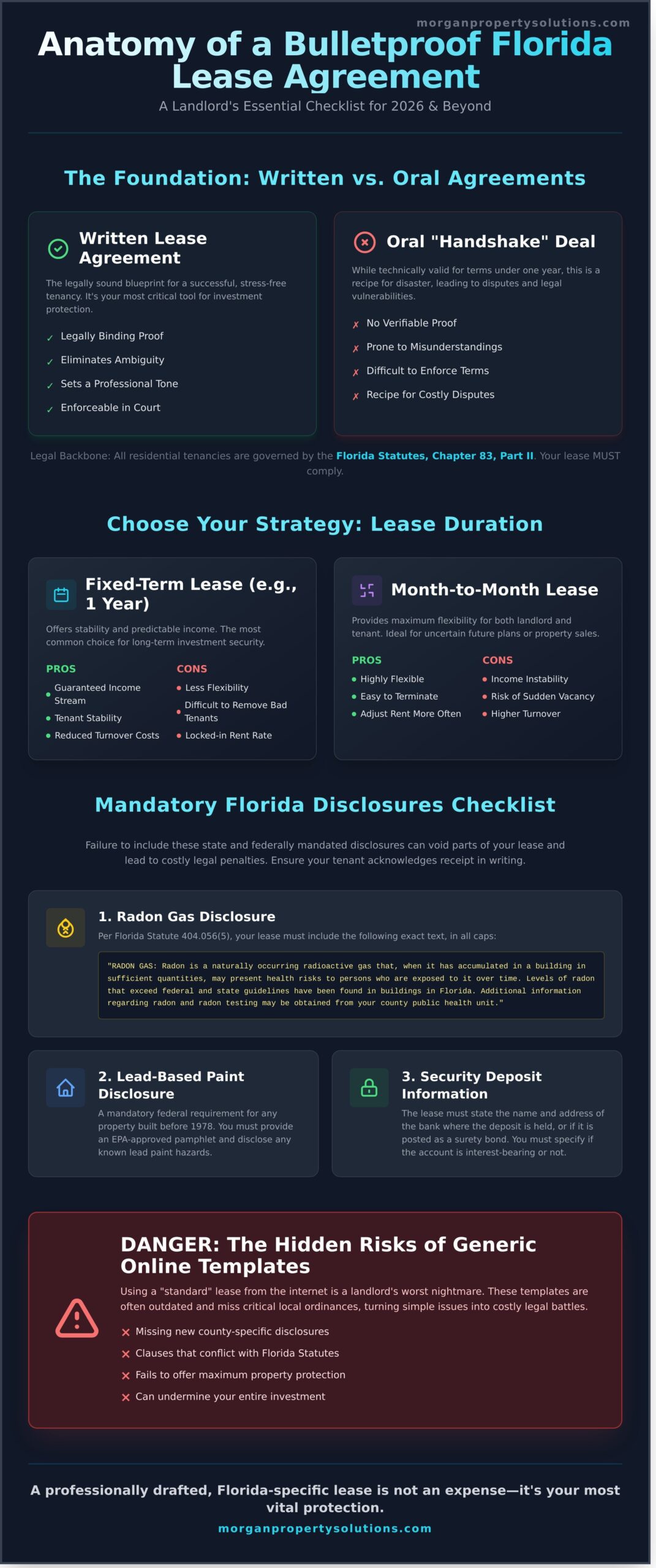
In Florida, an oral lease for a term of less than one year is technically valid. However, relying on a “handshake deal” in 2026 is a recipe for disaster. What happens when there’s a disagreement over the security deposit or the notice period for moving out? Without a written agreement, you have no proof. A well-drafted lease eliminates ambiguity and sets a professional, respectful tone from day one. It shows you’re a serious landlord who operates with clarity and fairness, which helps attract responsible tenants.
The Legal Backbone: Florida Statutes Chapter 83
Florida’s Landlord and Tenant Act, found in Chapter 83 of the Florida Statutes, is the official rulebook for residential tenancies. Think of it as the ultimate authority that dictates what you can and cannot include in your lease. If a clause in your agreement conflicts with this statute, the state law will always win in court. Specifically, Part II of this chapter governs the rights and responsibilities for landlords and tenants of residential dwelling units.
Fixed-Term vs. Month-to-Month: Which Fits Your Strategy?
Choosing the right lease duration is a key part of your rental strategy. The two most common options in Florida each come with distinct advantages and disadvantages. We’re here to help you understand which one makes the most sense for your property and your financial goals.
- Fixed-Term Lease (e.g., One Year): This is the most common type of florida residential lease agreement. Its primary benefit is stability. You secure a tenant and a predictable income stream for 12 months. The downside is a lack of flexibility; if you get a problematic tenant, the eviction process can be lengthy, and you can’t simply end the tenancy early without cause.
- Month-to-Month Lease (At-Will Tenancy): This offers maximum flexibility. Either party can terminate the agreement with proper notice (typically 15 days in Florida). This is great if you plan to sell the property soon or if the tenant is unsure of their long-term plans. The major risk is instability, as you could face an unexpected vacancy with very little warning.
For example, a majority of property investors in Orlando, especially those with properties near the University of Central Florida or Valencia College, prefer fixed 12-month leases. This strategy aligns with the academic calendar, helping to ensure the property is occupied and generating income year-round, which is a cornerstone of a successful investment.
Mandatory Florida Lease Disclosures: What You Legally Must Include
Crafting a solid lease agreement goes far beyond just listing the rent amount and due date. Certain state-mandated disclosures are non-negotiable, and failing to include them can expose you to significant legal and financial risk. These aren’t just suggestions; they are requirements outlined in Florida’s Residential Landlord Tenant Act that protect both parties and ensure transparency. Think of them as the legal foundation of your agreement. Without them, your lease could be challenged in court, potentially leading to voided clauses or even monetary damages.
Properly documenting these items is just as important as including them. Always ensure the tenant signs and dates an addendum or a section within the lease acknowledging they have received and read each required disclosure. This simple step creates a clear paper trail that can save you from future disputes.
To help you stay compliant, we’ve broken down the most critical disclosures you must have in your florida residential lease agreement.
Radon Gas and Lead-Based Paint Warnings
These two health-related warnings are absolute must-haves. For radon, Florida Statute 404.056(5) requires this exact notification, in all caps, to be included: “RADON GAS: Radon is a naturally occurring radioactive gas that, when it has accumulated in a building in sufficient quantities, may present health risks to persons who are exposed to it over time. Levels of radon that exceed federal and state guidelines have been found in buildings in Florida. Additional information regarding radon and radon testing may be obtained from your county public health unit.” For any property built before 1978, federal law also requires a lead-based paint disclosure, a signed acknowledgment form, and the EPA’s “Protect Your Family from Lead in Your Home” pamphlet. Both disclosures must be included directly in the lease or as a signed, attached addendum to be considered valid.
The Security Deposit Disclosure: A Common Pitfall
This is one of the most frequent errors we see landlords make. Florida law is very specific about how you handle security deposits. Within 30 days of accepting a deposit, you must provide the tenant with a written notice stating the name and address of the bank where the funds are held and whether the money is in an interest-bearing or non-interest-bearing account. Missing this 30-day deadline can result in the tenant having a claim to the entire deposit, regardless of damages. To make this process simple and ensure you’re covered, you can find state-compliant security deposit notice templates on our landlord resources page.
Landlord Identity and Contact Information
Your tenant has a legal right to know who they are leasing from and where to send official notices. The lease must include the name and address of the landlord or the person authorized to act on their behalf for the purpose of service of process. A P.O. Box is not sufficient for this requirement; a physical address is needed. For many independent landlords, this raises valid privacy concerns. This is a primary reason owners choose to work with a professional property management firm. We act as the authorized agent, providing our business address and insulating you from direct contact while ensuring your lease is fully compliant.
Your Florida Disclosure Checklist: The Essentials
- Radon Gas Notice: The exact, state-mandated wording must be included.
- Lead-Based Paint Disclosure: Required for all housing built before 1978.
- Security Deposit Information: Written notice of the bank’s name and address provided to the tenant within 30 days.
- Landlord/Agent Identity: A name and physical address for service of process.
- Fire Protection: For rentals in buildings higher than three stories, you must disclose the availability (or lack thereof) of a fire sprinkler system.
Key Clauses for Maximum Landlord Protection in 2026
A standard lease template covers the basics, but your investment property isn’t basic. It’s unique. To truly protect it, your florida residential lease agreement needs to go further, anticipating modern challenges and addressing the issues that keep landlords up at night: property damage, unauthorized occupants, and missed rent payments. The goal isn’t to be adversarial; it’s to create crystal-clear expectations that protect everyone. A well-drafted lease is your first and best line of defense, designed to be firm, fair, and legally sound.
Rent, Late Fees, and the “Grace Period” Myth
Let’s clear up a common misunderstanding. Many tenants believe there’s a legally required “grace period” for rent in Florida. There isn’t. According to state law, if rent is due on the 1st, it is legally late on the 2nd unless your lease specifies otherwise. Your lease must explicitly state the due date and the exact date a late fee will be applied. For the fee itself, keep it reasonable. A Florida judge is more likely to uphold a fee of $50 or 5% of the monthly rent than an excessive penalty. The easiest way to avoid late payments altogether is to make paying simple. We help our clients do this through a dedicated property management portal, which automates reminders and simplifies digital payments.
Maintenance Responsibilities and Right of Entry
In the Florida heat, the question “Who fixes the AC?” is critical. While landlords are responsible for ensuring major systems like air conditioning are in working order, the lease should detail the tenant’s obligations, such as routine filter changes. Clarity prevents disputes. Just as important is the landlord’s right of entry. You can’t just show up unannounced. Florida law requires “reasonable notice,” which is generally interpreted as at least 12 hours before entry for repairs or showings. For a detailed breakdown of these obligations, the official guide on Landlord-Tenant Law in Florida is an excellent resource. Of course, in a true emergency like a fire or major flood, this notice requirement is waived to protect the property and the tenant’s safety.
Pets, Smoking, and Subletting Rules
Your policies on pets, smoking, and guests are essential for protecting your property’s condition. It’s vital to understand the difference between a pet and an Emotional Support Animal (ESA). You can deny a pet based on breed or size, but you must provide reasonable accommodation for a properly documented ESA under the Fair Housing Act. To navigate this complex area, using a third-party verification tool like the Pet Screening service is a modern solution that helps you stay compliant. Your florida residential lease agreement must also have an updated smoking clause. A generic “No Smoking” rule is no longer enough. To be effective in 2026, it must explicitly prohibit all forms of smoking, including vaping, e-cigarettes, and cannabis, inside the premises.
The Lifecycle of a Lease: From Screening to Move-Out
An ironclad lease is a great start, but it’s only as strong as the tenant who signs it. Many landlords mistakenly see the lease signing as the finish line, but it’s actually the starting point. Think of your florida residential lease agreement not as a static document, but as a dynamic roadmap that guides the entire tenancy. From the first application to the final walkthrough, every step is connected. Getting the process right from the beginning is the key to a stress-free and profitable rental experience.
Why Screening is Part of Your Lease Strategy
Your tenant screening process is the most critical step in lease enforcement. Your written screening criteria should directly support the terms of your lease. A thorough background check reveals a person’s history of financial responsibility, which is the best predictor of their ability to pay rent on time. Applying these criteria identically to every single applicant isn’t just good practice; it’s essential for complying with the Fair Housing Act and avoiding costly discrimination claims.
Once you’ve selected a qualified tenant, the move-in inspection sets the baseline for the entire tenancy. This isn’t a quick walk-through. A detailed, written checklist accompanied by extensive photo and video documentation is non-negotiable. We recommend taking hundreds of photos covering every wall, floor, appliance, and fixture. This creates an objective record that protects both you and the tenant, making the security deposit reconciliation process smooth and evidence-based.
As the lease term nears its end, you’ll either handle a renewal or a move-out. Renewals typically involve signing a new agreement or a simple addendum. But if a tenant stays past their lease end date without permission, they become a “holdover tenant.” Florida law can be favorable to landlords in this situation, potentially allowing you to collect double the monthly rent, but it requires precise legal steps to manage correctly.
The Security Deposit Return Process
In Florida, handling the security deposit return is governed by strict timelines found in Florida Statute 83.49. You cannot afford to get this wrong. The rules are clear and unforgiving:
- The 15-Day Rule: If you do not intend to make a claim on the security deposit, you have exactly 15 days after the tenant vacates to return the full amount.
- The 30-Day Rule: If you plan to claim any portion of the deposit for damages beyond normal wear and tear, you have 30 days to send the tenant a written notice by certified mail. This notice must specifically itemize the charges and deductions.
Failing to send this claim notice within the 30-day window forfeits your right to keep any of the deposit, regardless of how severe the property damage is. It’s a simple administrative error that can cost landlords thousands of dollars.
Managing every phase of the tenant lifecycle, from background checks to deposit returns, requires expertise and constant attention to detail. Let our experienced property managers protect your investment and simplify the process for you.
Why Professional Management Makes Real Estate Simple
You’ve learned the essential components of a Florida lease, but the document itself is only half the battle. The other half is execution, enforcement, and evolution. This is where many well-intentioned DIY landlords discover the true cost of managing a rental property. It’s tempting to download a generic lease template for $5 and assume you’re covered, but that small saving often becomes a massive liability.
Think about it. Does that cheap template include the specific language required by Florida Statute 83.49 for handling security deposits? If it doesn’t, and you make a mistake, you could be liable for up to three times the deposit amount in damages. A boilerplate document simply cannot account for the dozens of local and state-specific nuances that protect you. A properly drafted florida residential lease agreement is your first and most important line of defense, and that defense should be built by professionals.
Beyond the legal jargon, it’s about shifting your entire mindset. Are you a “landlord” who gets frantic calls about a broken garbage disposal on a Saturday night? Or are you an “investor” who reviews a clear monthly statement while scouting your next property? Professional management absorbs the day-to-day operational headaches, freeing you to focus on the big picture. We bridge the gap between the rigid legal requirements of a lease and the very human reality of managing a tenancy. We ensure you’re protected legally while treating your tenants with the respect that fosters long, profitable relationships.
The Value of a Living, Breathing Lease
Our leases aren’t static PDFs pulled from a digital folder from 2018. They are living documents, constantly updated by our legal team to reflect new court rulings and legislative changes. For example, if a 2025 court case in Hillsborough County changes the interpretation of “normal wear and tear,” our lease agreements are updated within weeks to reflect that new precedent. As you can see on our about page, with over 20 years of local experience, we’ve learned that proactive compliance is key. We also handle the “tough talks” so you don’t have to, from enforcing late fees to managing the lawful eviction process with dignity and efficiency.
Making the Next Move: Your Peace of Mind Starts Here
Ultimately, a professionally managed florida residential lease agreement does more than just outline rules; it provides genuine peace of mind. It systematically reduces your liability, secures your income stream, and transforms your property from a source of constant stress into a high-performing, predictable asset. Your investment journey should be rewarding, not draining. If you’re ready for a deeper dive into smart ownership strategies and landlord best practices, feel free to explore our extensive library of more real estate articles.
It’s time to stop being a landlord and start being an investor. It’s time to find a trusted partner. Let us help you make real estate simple.
Secure Your Investment for 2026 and Beyond
Navigating Florida’s landlord-tenant laws doesn’t have to be a source of stress. As we’ve shown, your greatest tool for protection is a meticulously crafted lease. A comprehensive florida residential lease agreement for 2026 goes far beyond a simple template; it means including every state-mandated disclosure and incorporating key clauses that protect you from potential disputes, ensuring your investment remains secure.
Keeping up with legal updates and managing the day-to-day of a rental property is a full-time job. Why not let a trusted partner handle the heavy lifting? With over 20 years of Central Florida experience, an A+ BBB Rating, and a proven tenant screening process, Morgan Property Solutions is here to make your real estate journey simple. We help you stay compliant and profitable, reducing your stress every step of the way. Simplify your rental business with our expert property management services and discover the peace of mind that comes with having an expert on your side.
Here’s to a profitable and protected year ahead!
Frequently Asked Questions
Does a Florida residential lease agreement need to be notarized?
No, a standard residential lease in Florida does not need to be notarized to be legally valid. While notarization isn’t required, a lease for a term longer than one year must be signed by the landlord in the presence of two subscribing witnesses. For most typical 12-month leases, a simple signature from both the landlord and tenant is all that’s legally necessary to make the contract binding.
Can a landlord enter a property without notice in Florida?
No, a landlord cannot enter a property without notice except in an emergency. According to Florida Statute 83.53, landlords must provide at least 12 hours of reasonable notice before entering a rental unit for inspections, repairs, or showings. The only exceptions are for emergencies like a fire or flood, if the tenant gives consent for a specific entry, or if the tenant has unreasonably withheld consent.
How much can a landlord charge for a security deposit in Florida?
There is no state-mandated limit on how much a landlord can charge for a security deposit in Florida. While state law doesn’t set a cap, the common market rate is typically an amount equal to one or two months’ rent. Landlords set this amount based on factors like the property’s value and the applicant’s credit history. The specific amount must be clearly stated in the lease agreement.
Is there a limit on late fees for rent in Florida?
No, Florida law does not set a specific limit on the amount a landlord can charge in late fees. However, the fees must be considered “reasonable” and must be explicitly detailed in the written lease agreement to be enforceable. For example, many landlords charge a fee of 5% of the monthly rent or a flat fee between $50 and $100, but this must be agreed upon in the lease.
What happens if a tenant breaks a lease early in Florida?
If a tenant breaks a lease early, they are typically responsible for paying rent until a new tenant is found. Under Florida Statute 83.595, landlords must make a reasonable effort to re-rent the property to mitigate their losses. Some leases include an early termination clause that allows a tenant to pay a predetermined fee, often equal to two months’ rent, to end the lease without further obligation.
Are digital signatures legally binding for Florida leases in 2026?
Yes, digital signatures are legally binding for leases in Florida and will continue to be in 2026. The Florida Electronic Signature Act of 1996 gives electronic signatures the same legal weight as traditional handwritten ones. As long as all parties consent to using them, a digitally signed florida residential lease agreement is completely valid and enforceable, making the process faster and more convenient for everyone.
What is the “3-Day Notice” and how does it relate to the lease?
A “3-Day Notice” is the official written notice a landlord must give a tenant who has failed to pay rent. As required by Florida Statute 83.56, this notice is the first formal step in the eviction process. It gives the tenant three business days, not including weekends or holidays, to either pay the full rent amount due or vacate the property. It directly enforces the payment terms outlined in the lease.
Does Florida law require a written lease for rentals over one year?
Yes, Florida law absolutely requires a written lease for any rental agreement lasting longer than one year. Florida’s Statute of Frauds (725.01) states that any contract that cannot be performed within one year must be in writing to be legally enforceable. This written florida residential lease agreement must also be signed by the landlord in the presence of two witnesses. Oral leases are only valid for terms under one year.

Article by
Oliver Overton-Morgan
Oliver Overton-Morgan is a full-time Real Estate Broker since 2003, with years of experience helping thousands of people purchase and sell real estate throughout Central Florida. He holds a Graduate Realtor Institute designation, LCAM, and has held licenses in good standing as a Florida Mortgage Broker and a Notary Public. Oliver immigrated to central Florida in 2001, and within 5 years Oliver built a successful Real Estate brokerage in central Florida, where he recruited over 75 Sales Associates with 25+ million in sales production.