
Did you know that even after you agree on a final sales price, nearly ten percent of your home’s value could disappear before the check ever reaches your hand? It’s completely normal to feel a bit of anxiety when you see the initial estimates. Selling your home in Orlando or Windermere is a major life transition, and the last thing you want is a hidden fee eating into the equity you’ve worked so hard to build. You deserve to walk away from the closing table feeling rewarded, not surprised by the fine print.
We understand that the math behind closing costs for seller in florida can feel like a moving target. That’s why we’ve put together this 2026 guide to help you calculate your net proceeds with total accuracy. You’ll discover exactly which fees are mandatory, which ones you can negotiate, and how local customs in Central Florida differ from other regions like Miami-Dade. We’ll also share how our experience in professional property management helps owners of rental properties streamline this process for a smoother transition. From documentary stamp taxes to title insurance nuances; we are here to act as your steady ally through every step of the sale.
Key Takeaways
- Understand the current 2026 tax rates, like the documentary stamp tax, so you can estimate your net proceeds with total confidence.
- Get a clear breakdown of the typical closing costs for seller in florida, including which fees are mandatory and which ones are open for negotiation.
- Discover why title insurance customs in Orlando and Winter Park differ from South Florida, ensuring you aren’t paying for things you shouldn’t.
- Learn how professional property management simplifies the sale of tenant-occupied homes, helping you avoid common pitfalls at the closing table.
- Find out how strategic staging and professional representation can actually increase your final check by reducing time on the market.
Understanding Seller Closing Costs in Florida: What to Expect in 2026
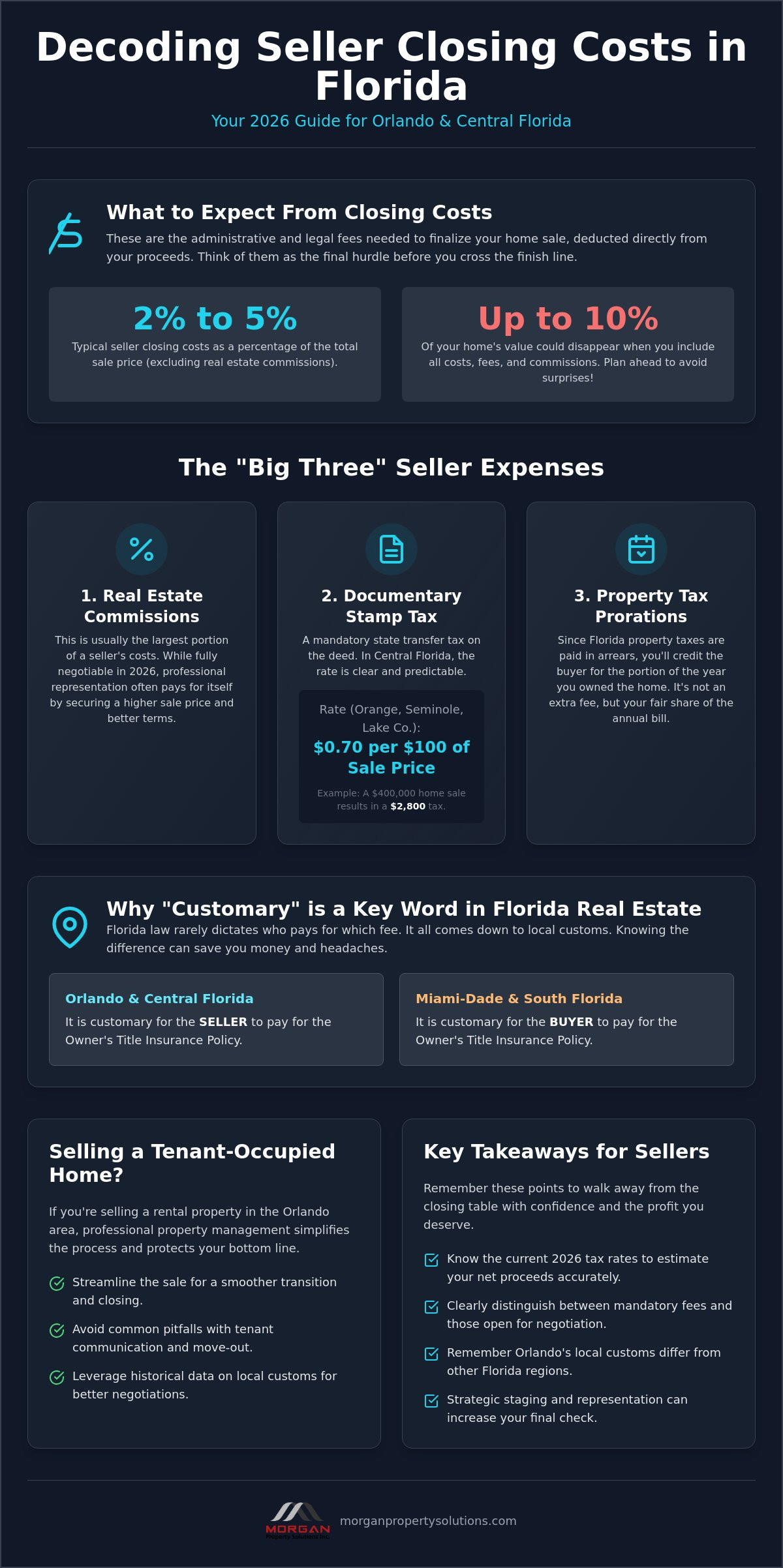
Think of closing costs as the final hurdle before you cross the finish line. After weeks of staging, showings, and negotiations, these costs represent the administrative and legal fees required to finalize your real estate transaction. While the buyer has their own set of expenses, understanding closing costs for seller in florida is vital because these fees are deducted directly from your home’s equity. You aren’t necessarily writing a check at the table, but the amount you walk away with will be lower than the sales price on your contract.
We find that in the 2026 market, a good rule of thumb is to expect these costs to land between 2% and 5% of the total sale price, excluding real estate commissions. This percentage isn’t just a random number. It fluctuates based on your county, the specific terms of your contract, and current inventory levels. Some of these, like the Florida documentary stamp tax, are mandatory and non-negotiable. Others, such as certain service fees or repairs, offer room for discussion depending on how much leverage you have in the current market.
Understanding these variables is key to a successful sale; for instance, you can explore Real Estate Transaction Commissions and Service Fees to see how Mountain View Realty LLC breaks down these costs for their clients.
This is why your “Net Sheet” is the most important document you’ll review during the process. It’s a line-by-line breakdown provided by your agent or the title company that shows exactly where every dollar goes. To ensure your net proceeds are calculated using the most accurate home value, Meridian Property Appraisers Inc. offers professional appraisal services to help you set a realistic starting point. Seeing these numbers early prevents that sinking feeling at the closing table and ensures you have a clear picture of your actual profit.
The Anatomy of a Florida Real Estate Closing
A closing agent or title attorney acts as the neutral third party who handles the paperwork, ensures the title is clear, and distributes the funds. In 2026, your leverage in negotiating who pays for what often depends on the local inventory in your specific neighborhood. Net Proceeds are the final amount of cash you actually pocket after every mortgage payoff, tax, and service fee is deducted from the gross sale price.
Why “Customary” Matters More Than You Think
You might be surprised to learn that Florida law rarely dictates which party pays for which fee. Instead, we rely on local custom. In Orlando and most of Central Florida, it’s customary for the seller to pay for the owner’s title insurance policy. However, if you head south to Miami or Broward County, the buyer often picks up that tab. If you’ve been working with an Orlando property manager to handle a rental home, they can often provide historical data on these local customs to help you prepare. Knowing these nuances early removes the psychological friction of the sale and lets you plan your next move with total confidence. We are here to act as your steady ally, ensuring you understand exactly what closing costs for seller in florida apply to your specific situation.
The “Big Three” Expenses: Commissions, Documentary Stamps, and Taxes
When you start tallying up the closing costs for seller in florida, three main categories will account for the bulk of your expenses. While you are likely focused on the final sales price, these three items determine how much of that price actually stays in your pocket. It is helpful to think of these as the “fixed” costs of doing business in the Florida real estate market. They are predictable, manageable, and easy to calculate once you know the formulas.
The next major item is the Documentary stamp tax. This is essentially a transfer tax on the deed, and it’s a mandatory fee for every seller in the state. Beyond taxes, property tax prorations also play a significant role. Since Florida property taxes are paid in arrears, you’ll owe the buyer a credit for the portion of the year you lived in the home. It isn’t an extra fee, but rather you paying your fair share of the annual bill.
Calculating the Florida Documentary Stamp Tax
In most counties across Central Florida, including Orange, Seminole, and Lake, the tax rate is $0.70 for every $100 of the sales price. For context, Miami-Dade uses a slightly lower rate of $0.60, but for our local Orlando market, the math is straightforward. If you sell a home for $400,000, you divide the price by 100 and multiply by 0.70. This results in a $2,800 tax bill due at the time of closing. We always include this in our initial net sheets so there are no surprises.
Real Estate Commissions in 2026
Real estate commissions represent the largest portion of your closing costs for seller in florida, typically split between the listing agent and the buyer’s agent. In the 2026 market, these fees are fully negotiable. However, professional representation often pays for itself by securing a higher sales price and better contract terms. This is why choosing the best real estate agent to sell your house is such a critical decision. An expert agent doesn’t just list your home; they protect your equity through aggressive marketing and skilled negotiation.
Finally, we have the mortgage payoff. Technically, this isn’t a closing cost, but it feels like one because it’s the largest deduction from your proceeds. Your closing agent will coordinate with your lender to ensure your existing loan is paid in full, including any interest accrued up to the day of closing. If you are selling a rental property, you can always browse our landlord resources to see how we help owners maximize their returns through efficient management and strategic sales.
Title Insurance and Closing Fees: Who Pays in Central Florida?
While the “Big Three” expenses we covered earlier represent the largest deductions from your equity, the administrative side of closing costs for seller in florida can still hold a few surprises. Title insurance and settlement fees are the gears that keep the legal transfer of your property moving. In Florida, the rates for title insurance are actually set by the state. You don’t have to worry about shopping around for a better price, but who pays for that policy is a different story entirely. These costs ensure that the buyer receives a “clean” title, free of any old debts or legal claims that could haunt them later.
Beyond the insurance itself, you’ll see a settlement or closing fee on your net sheet. This is the payment for the title agent or attorney who coordinates the entire closing costs for seller in florida process. They handle the mountain of paperwork, verify identities, and manage the escrow account where funds are held. It is a vital service that provides peace of mind for both parties, ensuring every signature is in the right place and every dollar is accounted for.
The Central Florida Title Custom Explained
In Orange and Seminole counties, including communities like Lake Nona and Winter Park, the local custom is for the seller to pay for the owner’s title insurance policy. This is a significant point of difference from South Florida counties like Broward or Sarasota, where the buyer typically picks up this tab. For a $400,000 home in Orlando, the state-mandated rate would be $2,075; calculated as $5.75 per $1,000 for the first $100,000 and $5.00 per $1,000 for the remainder. While these customs are the standard starting point, it’s important to remember that they are always negotiable in the sales contract.
Administrative and Recording Fees
Small administrative fees can add up quickly during the final days of a sale. You should expect to see charges for electronic filing, courier fees, and wire transfer costs. One fee that is particularly crucial for Orlando properties is the municipal lien search. This search looks for unrecorded liens, utility debts, or open building permits that a standard title search might miss. If you’ve been working with an Orlando property manager, they likely have these records organized, which can help speed up this verification. Finally, you will be responsible for the recording fees associated with the deed and the satisfaction of your existing mortgage, ensuring the public record accurately reflects your successful sale.
Variable Expenses: Prorations, HOA Fees, and Rental Property Considerations
While the taxes and commissions we’ve discussed are predictable, variable expenses are the wild cards of the closing costs for seller in florida process. These are the items that change based on your specific property type, your residency status, and the community where you live. For example, if you are an international seller, you’ll need to account for FIRPTA (Foreign Investment in Real Property Tax Act) withholdings. This is a complex federal requirement that requires a percentage of the sales price to be held at closing. Similarly, capital gains taxes may apply if the home wasn’t your primary residence. We always recommend consulting with a CPA early in the process to ensure you aren’t caught off guard by a tax bill after the keys have changed hands.
Another variable factor involves HOA estoppel fees. An estoppel letter is a legal document from your homeowners association that proves you are current on your dues and don’t have any outstanding violations. In recent years, these fees have become more expensive, often ranging from $250 to $500 per association. If your neighborhood has both a master and a sub-association, you might have to pay this twice. These are the types of details we help our clients navigate so the final net proceeds match their expectations.
Selling a Rental Property: The Landlords Closing Checklist
Selling a home with a tenant in place adds another layer of complexity to your closing costs for seller in florida. You’ll need to transfer the tenant’s security deposit to the new buyer as a credit at closing. Additionally, rent must be prorated. If the sale closes on the 15th of the month, you are entitled to keep the rent for those first 15 days, but the remaining half must be credited to the buyer. Managing these moving parts requires precision to avoid disputes. For a deeper look at managing these transitions, our residential property management services guide offers a comprehensive roadmap for owners.
HOA and CDD Fees in Central Florida
In master-planned communities like Lake Nona or Baldwin Park, you’ll often encounter Community Development District (CDD) fees. These are separate from your HOA dues and are used to fund the infrastructure of the community. At closing, these fees are prorated just like property taxes. You should also be aware of pending special assessments. If your HOA recently voted to repair the community pool or replace roofs, the contract will specify whether you or the buyer is responsible for paying the balance. If you’re feeling overwhelmed by these details, our team at Morgan Property Solutions can review your specific situation to ensure every fee is handled correctly.
Maximizing Your Proceeds: How a Strategic Partner Simplifies the Sale
While an online calculator can give you a rough estimate, it can’t account for the nuances of a high-stakes negotiation or the specific buyer psychology in our local market. Some sellers are tempted by “discount” brokers who promise lower commissions. It sounds like a great way to save money on paper. However, if that 1% savings leads to a 5% lower sales price because of poor marketing or weak negotiation, you’ve actually lost a significant amount of equity. We believe in maximizing your check through high-end professional staging and photography. These tools don’t just make your home look beautiful; they actively reduce your “days on market.” Every day your home sits unsold, you are paying for property taxes, insurance, and mortgage interest. Reducing those holding costs is just as vital as managing the closing costs for seller in florida.
Our team at Morgan Property Solutions acts as your steady ally throughout this transition. We don’t just list your property and wait for an offer. We dive deep into the numbers, reviewing your preliminary Closing Disclosure (CD) with a fine-toothed comb. We look for clerical errors, miscalculated prorations, or hidden fees that shouldn’t be there. Our background in professional property management gives us a unique edge in this area. We are used to managing complex financial ledgers and protecting owner ROI, so we know exactly where to look for discrepancies that could eat into your profit.
Why Professional Guidance Outperforms a Calculator
Whether you’re selling a luxury estate in Windermere or a charming bungalow in Winter Garden, local market conditions dictate your strategy. We don’t rely on generic state averages. Instead, we use our 20+ years of experience to help you calculate rental income and ROI if you’re transitioning an investment. This localized expertise ensures you aren’t just guessing on your listing price. You’ll move toward the closing table with the peace of mind that comes from a “no surprises” process. We handle the friction so you can focus on your next chapter.
Final Steps to the Closing Table
As you prepare for the big day, start gathering your essential documents early. You’ll need your most recent survey, any transferable home warranties, and all sets of keys and gate remotes. A few days before closing, you’ll receive the final Closing Disclosure. This is your chance to verify that the closing costs for seller in florida match the initial net sheet we provided. On closing day, remember to bring a valid government-issued ID and any required wiring instructions for your proceeds. It’s the moment all your hard work pays off. Ready to see what your Central Florida home is worth? Contact us today!
Your Path to a Successful Central Florida Closing
Selling your home doesn’t have to be a stressful guessing game. By understanding the “Big Three” expenses and the unique local customs in Orlando and Winter Park, you can plan your next move with total confidence. We’ve seen how everything from documentary stamps to HOA estoppel fees impacts your final check. Remember that while state taxes are fixed; many other service fees are negotiable with the right strategy in place. You deserve a process that is transparent and rewarding from the first showing to the final signature.
Our team brings over 20 years of combined Central Florida real estate expertise to your side. Whether you’re selling a primary residence or a tenant-occupied rental property, we specialize in simplifying the math. We provide customized net proceeds estimates for every client; ensuring you know exactly what to expect before you ever sign a contract. Don’t leave your equity to chance or rely on a generic online calculator that doesn’t understand our local market.
Take the first step toward a rewarding sale by getting a professional valuation. Get a Professional Home Valuation and Estimated Net Sheet from a team that understands every detail of closing costs for seller in florida. We are ready to act as your steady ally and help you navigate this transition with ease. You’ve worked hard for your home’s equity; let’s make sure you keep as much of it as possible.
Frequently Asked Questions
Who typically pays for title insurance in Orlando, Florida?
In Orange and Seminole counties, the seller customarily pays for the owner’s title insurance policy. This local tradition is a key part of the closing costs for seller in florida that you’ll need to budget for. While this is the standard practice in Central Florida, it’s important to remember that all terms in a real estate contract are negotiable between the buyer and seller.
How much is the Documentary Stamp Tax for sellers in Florida in 2026?
The tax rate for the deed is $0.70 for every $100 of the sales price in almost every county. For example, if you sell your home for $500,000, you will owe $3,500 at the closing table. Miami-Dade is the only exception to this rule, where the rate for single-family homes is $0.60 per $100.
Do Florida sellers pay the buyers closing costs?
Sellers are not required by law to pay a buyer’s costs, but it’s a very common negotiation tool. You might agree to a “seller concession,” which is a specific credit given to the buyer to help them cover their loan fees or escrow items. This can be a helpful strategy to attract more offers in a competitive market.
Are real estate commissions negotiable in Florida?
Yes, real estate commissions are fully negotiable and are not set by any state or federal law. You have the flexibility to discuss fee structures with your agent to find a balance that works for your goals. High-quality representation is vital for managing closing costs for seller in florida because an expert negotiator can often secure a higher final sales price.
What is an estoppel fee and why do I have to pay it?
An estoppel fee is a charge from your Homeowners Association to provide a certificate showing your account is in good standing. It proves to the buyer and the title company that you don’t owe any back dues or have active property violations. These fees typically range from $250 to $500 and are required by most title companies to ensure a clean transfer.
How are property taxes prorated at a Florida closing?
Property taxes are paid in arrears, so the bill due in November covers the current calendar year. At closing, you will give the buyer a credit for the days you owned the home from January 1st up until the day of the sale. This process ensures that you only pay for the exact time you occupied the property.
What happens to the security deposit if I sell my rental property?
The tenant’s security deposit is transferred to the new buyer as a credit on the closing statement. Since the money belongs to the tenant, it must stay with the property’s financial records. If you are using professional property management in Orlando, your manager will coordinate this transfer so the new owner is prepared to handle the eventual move-out correctly.
Can I deduct closing costs from my taxes?
Most closing costs aren’t directly deductible as an expense on your annual tax return. Instead, they are used to adjust the “cost basis” of your home, which can reduce the amount of capital gains tax you might owe on the profit. Tax laws are complex and change often, so we always recommend consulting with a CPA to discuss your specific sale.

Article by
Oliver Overton-Morgan
Oliver Overton-Morgan is a full-time Real Estate Broker since 2003, with years of experience helping thousands of people purchase and sell real estate throughout Central Florida. He holds a Graduate Realtor Institute designation, LCAM, and has held licenses in good standing as a Florida Mortgage Broker and a Notary Public. Oliver immigrated to central Florida in 2001, and within 5 years Oliver built a successful Real Estate brokerage in central Florida, where he recruited over 75 Sales Associates with 25+ million in sales production.