Did you know that a single missing disclosure could legally stall your next lease agreement in the Sunshine State? Staying on top of the latest florida rental application requirements for 2026 is no small feat, especially when local trends in the Orlando metro area change as quickly as the afternoon rain. Whether you’re a landlord screening tenants or a renter searching for a home in Lake Nona, the rules regarding flood risk disclosures and application fees have likely shifted since you last signed a contract.
We understand that the competitive Central Florida market can feel overwhelming, and the fear of missing a Fair Housing detail often adds unnecessary stress to the process. You deserve a clear path forward. Our guide simplifies these complexities by providing a direct look at 2026 legal standards, financial criteria, and specialized Orlando market insights. We’ll walk you through the new mandatory flood risk disclosures, the current state of application fee caps, and how professional property management helps you manage these steps with ease. By the end of this guide, you’ll have the tools needed to approach your next rental application with total confidence.
Key Takeaways
- Learn why every resident aged 18 or older must submit an application to ensure full compliance with standard screening protocols.
- Master the florida rental application requirements for 2026, including the common “3x rent” income rule and the specific documents you’ll need to have ready.
- Understand how the 2023 Preemption Law and Fair Housing Act protect your rights during the tenant screening process.
- Navigate unique Central Florida hurdles like the “HOA Factor” and the high demand in neighborhoods like Lake Nona and Winter Park.
- Discover how partnering with a professional property management team can distill complex legal steps into a simple, stress-free online experience.
Understanding Florida Rental Application Requirements in 2026
The process of securing a home in Central Florida starts long before you unpack your first box. When you look at florida rental application requirements in 2026, it’s helpful to view the application as a bridge between your history and your future home. For property managers, this document is a vital screening tool designed to manage risk and ensure the safety of the community. It’s a standard practice. In Florida, every person aged 18 or older who plans to live in the property must submit their own application. This ensures everyone is properly vetted through background and credit checks, creating a secure environment for all residents.
There’s a distinct difference between being a “Tenant” and an “Occupant.” A tenant is legally responsible for the terms of the lease and the monthly payments. An occupant lives in the home but doesn’t necessarily carry the same financial liability. Understanding Lease Agreements is essential here, as these roles dictate who is on the hook if things go sideways. In the fast paced Orlando market, most of this happens through digital-first platforms. This shift has simplified how we handle florida rental application requirements, allowing you to upload documents and track your status in real time without the friction of paper forms.
The Role of the Application Fee
You’ll notice that application fees vary across the state. As of 2026, Florida law doesn’t cap these fees, which usually range from $30 to $75 per adult. They’re non-refundable because they cover the immediate costs of running credit and background reports. While these costs add up, many firms now offer deposit-free renting. This modern alternative replaces the heavy upfront security deposit with a manageable monthly fee, significantly lowering your move-in costs.
Who Needs a Guarantor or Cosigner?
If your credit or income doesn’t quite meet the standard, you might need extra support. A cosigner signs the lease and can live in the unit, while a guarantor only guarantees payment. This is a common solution for students or young professionals in the Orlando area. For more details on these roles, see our article on Guarantor vs. Cosigner. Having this support can be the deciding factor in a competitive market.
The Financial and Documentation Checklist for Applicants
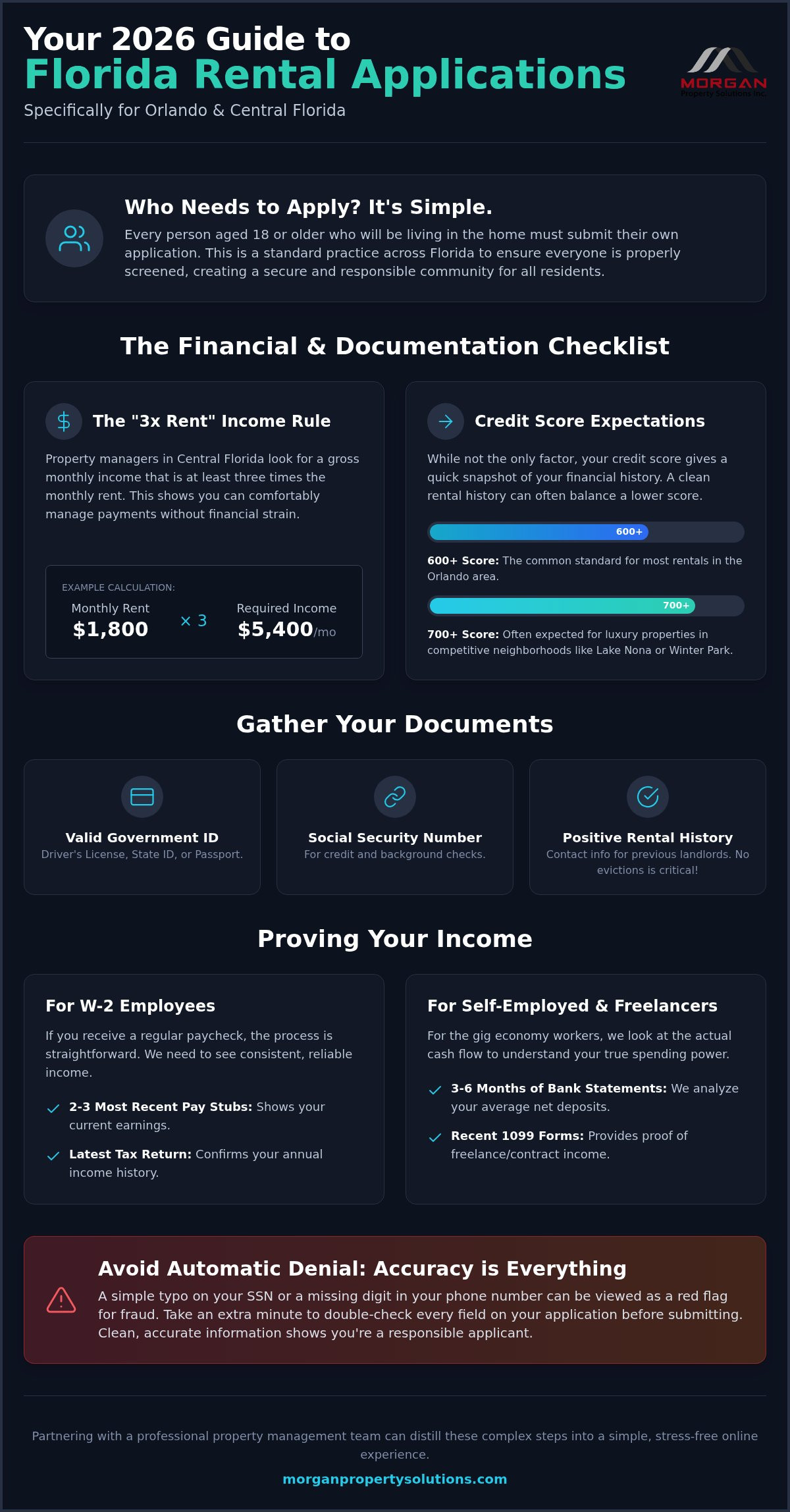
Securing a home in the Orlando area requires more than just a quick tour and a handshake. Meeting the financial side of florida rental application requirements often starts with the “3x rent” rule. This is a standard used by property managers across Central Florida to ensure you can comfortably manage your monthly payments without being “house poor.” For example; if the rent is $1,800, your gross monthly income should be at least $5,400. To prove this, you’ll need to provide essential identification documents like a valid Driver’s License, a Passport, or your Social Security card. Understanding how these florida rental application requirements apply to your specific financial situation can save you both time and money during your search.
Accuracy is everything during this phase. Even a small typo on your SSN or a missing digit in your phone number can trigger an automatic denial. Property managers view these errors as red flags for potential fraud, so take an extra minute to review your submission. The entire process is governed by Florida’s Residential Landlord and Tenant Act, which sets the stage for how these screenings must be handled. Beyond just income, we’ll verify your employment status and talk to your previous landlords. A clean rental history often speaks louder than a high salary; it shows you’re a responsible neighbor who respects the property.
Income Verification for W-2 and Self-Employed
If you’re a W-2 employee, the process is usually straightforward. Most managers ask for your two or three most recent pay stubs and your latest tax return. For our self-employed applicants or freelancers in the gig economy, the requirements look a bit different. You’ll usually need to provide three to six months of personal bank statements and any 1099 forms you’ve received. We calculate your “verifiable income” by looking at your average net deposits. This helps us get a clear picture of your actual spending power rather than just your gross sales numbers.
Credit Score Expectations and History
While every property owner has different standards, most Orlando landlords look for a credit score of 600 or higher. If you’re looking at luxury rentals in neighborhoods like Lake Nona or Winter Park, that expectation might climb to 700. Don’t panic if your score is a little lower than you’d like. A solid rental history with zero evictions can sometimes outweigh a few credit hiccups. We believe in transparency, so we always encourage applicants to review the Morgan Property Solutions screening criteria before they apply. Knowing exactly what we look for removes the guesswork and helps you prepare a stronger application. If you have questions about your specific situation, reaching out to an experienced Orlando property manager can provide the clarity you need.
Legal Standards and Mandatory Disclosures in Florida
Staying compliant with florida rental application requirements means understanding the legal guardrails that protect both parties. The federal and state Fair Housing Acts are the foundation of this process. They prohibit any discrimination based on race, color, religion, sex, national origin, familial status, or disability. In our experience, the most effective way to navigate these rules is to maintain a set of written, objective screening criteria. When you apply the same standards to every applicant, you create a professional environment that naturally mitigates the risk of Fair Housing complaints.
The 2023 Preemption Law (F.S. §83.425) brought much-needed clarity to the Central Florida market. This law ensures that local governments cannot enact their own regulations on residential tenancies that go beyond state law. For landlords in Orlando or Lake Nona, this means you don’t have to worry about a patchwork of different local rules for application fees or screening procedures. It simplifies the process and provides a stable framework for everyone involved in the rental market. Consistency isn’t just about fairness; it is your strongest legal defense.
The 2026 Flood Risk Disclosure
A significant change for 2026 is the mandatory flood risk disclosure. Under Fla. Stat. § 83.512, landlords must now provide a separate written document to prospective tenants before a lease of one year or longer is signed. This disclosure isn’t just a courtesy; it’s a legal requirement. You must state whether you have knowledge of past flooding, have filed flood insurance claims, or have received federal assistance for flood damage. Fla. Stat. § 83.512 is the 2026 standard for flood transparency, ensuring tenants are fully informed about the property’s history before they commit.
Fair Housing and Service Animals
Managing requests for Emotional Support Animals (ESAs) and Service Animals is another area where legal standards are strict. These animals are not considered pets under Fair Housing laws; they are vital accommodations for individuals with disabilities. As a result, landlords cannot charge “pet rent” or pet deposits for these animals. To keep this process organized and legally sound, we recommend utilizing a professional Pet Screening portal. This tool helps distill the verification process into manageable steps, ensuring that every request is handled fairly and in full compliance with florida rental application requirements. By using a neutral, third-party system, you remove the psychological friction often associated with these sensitive requests.
Navigating Orlando and Central Florida Rental Nuances
Living in Central Florida offers a lifestyle like no other, but the rental market here moves at lightning speed. In high demand areas like Lake Nona and downtown Orlando, properties often receive multiple applications within hours of being listed. Meeting the standard florida rental application requirements is just the first step. To stand out, you need to understand the local quirks that generic guides often overlook. Whether you’re eyeing a modern condo or a family home in Windermere, the key to success is moving with both speed and precision.
One of the biggest hurdles in our region is the “HOA Factor.” Many of the best rental homes are located within community associations that have their own set of rules and approval processes. This means that even after a landlord says yes, you aren’t quite across the finish line. This is where professional Orlando property management becomes an essential ally. We help navigate the communication between owners, tenants, and associations to ensure nothing falls through the cracks during these complex transitions.
The HOA Approval Process
Community associations often require a second, completely separate application. These HOA approvals can take anywhere from 7 to 30 days, regardless of how quickly the landlord wants you to move in. These associations often have their own florida rental application requirements that run parallel to the landlord’s screening. You should also expect additional application fees and background checks mandated by the association. We always advise tenants to ask about specific HOA rules and timelines before they pay a landlord’s application fee. Knowing the neighborhood’s parking restrictions or pet weight limits ahead of time prevents expensive surprises later on.
Market Speed: Why “Ready to Rent” Matters
In growing suburbs like Winter Garden or Clermont, the turnaround time for a quality rental is incredibly tight. If you wait until the showing to start gathering your paperwork, you’ve likely already lost the home. A simple tip to win in this market is to have all your identification, pay stubs, and tax documents scanned and ready to send before you even book a tour. At Morgan Property Solutions, we prioritize efficient processing through our online portal to help you secure your spot as quickly as possible. If you want to streamline your move, contact our Orlando property management team today to see our latest listings and get started on your application.
How to Streamline Your Application with Morgan Property Solutions
Renting a home shouldn’t feel like a second job. When you’re trying to meet the florida rental application requirements in 2026, the last thing you need is a complicated, paper-heavy process that leaves you wondering where you stand. Choosing a home managed by a professional firm like Morgan Property Solutions changes that dynamic. We focus on removing the psychological friction from the leasing process by providing clear, consistent communication and a structured path to your new front door. Unlike private landlords who may have inconsistent screening habits, we use standardized systems to ensure every applicant is treated with the same level of care and professionalism.
One of the ways we simplify your move is through our deposit-free renting program. We know that the upfront costs of moving in Central Florida can be a major stressor. By offering an alternative to the traditional large security deposit, we help you keep more money in your pocket while still providing owners with the protection they need. This modern approach is part of our commitment to making the rental journey as smooth as possible for everyone involved.
Step-by-Step: Applying Through Morgan Property Solutions
We’ve distilled the application process into three manageable steps to get you into your home faster:
- Step 1: Browse our current listings in Orlando, Lake Nona, and Winter Park directly on our website to find your perfect fit.
- Step 2: Before you pay any fees, review our detailed screening criteria online. This transparency ensures you know exactly what we’re looking for regarding credit, income, and history.
- Step 3: Complete your application through our secure online portal. You can upload all your supporting documents and pay the application fee in one sitting.
The Morgan Advantage for Property Owners
For landlords, our role is to act as your steady ally in a shifting market. Navigating the florida rental application requirements in 2026 requires a methodical approach to avoid legal pitfalls and maximize your ROI. Our professional screening process is designed to find high-quality tenants, which naturally reduces eviction rates and keeps your investment profitable. We handle the complex 2026 flood disclosures and Fair Housing compliance so you don’t have to. If you’re looking for more ways to optimize your rental, we invite you to explore our Landlord Resources or read our complete guide on Residential Property Management. With over 20 years of experience in Central Florida, we’re here to help you succeed through every phase of your professional journey.
Taking the Next Step in Your Central Florida Rental Journey
Mastering the florida rental application requirements doesn’t have to be a source of stress. By staying informed about the 2026 flood risk disclosures and preparing your financial documents early, you’re already ahead of the competition. Remember that local hurdles like HOA approvals in Orlando or Lake Nona just require a little extra planning. We believe that a successful rental experience is built on a foundation of trust and clear communication between owners and residents. It’s about more than just a lease; it’s about finding a community where you can thrive.
With over 20 years of combined experience in the Central Florida market, Morgan Property Solutions acts as your steady ally. We offer A+ rated property management services and provide transparent screening criteria to remove the guesswork from your search. Our team is dedicated to helping you navigate these transitions with confidence and ease. Ready to find your next home? Explore our Orlando rental listings today! We look forward to helping you find a place you’ll love to call home.
Frequently Asked Questions
What is the maximum application fee a landlord can charge in Florida?
Florida law does not set a maximum limit on rental application fees as of 2026. While there’s no legal cap, most landlords in the Orlando area charge between $30 and $75 per adult applicant to cover the costs of screening reports. These fees are generally non-refundable once the background check is processed. It’s best to review the screening criteria before paying to ensure you meet the basic qualifications for the home.
How long does a Florida rental application usually take to process?
A standard application usually takes between one and three business days to process. However, if the home is located within a community governed by an association, the timeline can stretch significantly. HOA approvals in Central Florida often take between 7 and 30 days. Having all your documents scanned and ready to upload will help prevent unnecessary delays during the initial screening phase with the landlord or the property management firm.
Can a Florida landlord deny me based on a past eviction?
Yes, a landlord can legally deny your application if you have a past eviction on your record. Most property managers in Orlando look for a clean rental history over the last five to seven years. If you have an eviction, it’s helpful to be upfront about the circumstances. Some owners may be willing to work with you if you have a solid guarantor or if the incident happened many years ago.
Is the 2026 Flood Risk Disclosure mandatory for all Florida rentals?
Yes, providing a written flood risk disclosure is a mandatory part of the florida rental application requirements in 2026 for any lease of one year or longer. Under Fla. Stat. § 83.512, landlords must disclose if they have knowledge of past flooding or flood insurance claims. This information must be provided on a separate document before you sign the lease to ensure you have full transparency regarding the property’s history before committing.
Do I need to see the property in person before applying in Orlando?
While Florida law doesn’t require an in-person viewing, many professional property management firms in Orlando insist on it. Seeing the property yourself helps prevent rental scams and ensures the home meets your expectations. If you’re moving from out of state, some managers may allow a trusted friend or family member to view the property on your behalf or offer a live video tour as a modern and secure alternative.
What happens if I have a service animal but the rental says “no pets”?
Service animals and Emotional Support Animals (ESAs) are not considered pets under federal and state Fair Housing laws. Even if a rental has a “no pets” policy, a landlord cannot deny you or charge pet rent for a legitimate service animal. You’ll need to provide proper documentation from a healthcare professional. Using a specialized screening portal helps streamline this verification process while ensuring everyone’s rights are respected and protected throughout the process.
Can I apply for a rental if I am self-employed in Florida?
You can absolutely apply for a rental if you are self-employed in Florida. Instead of traditional pay stubs, you’ll typically need to provide three to six months of personal bank statements or your most recent 1099 forms. Property managers calculate your income by looking at your average monthly deposits. Providing clear, organized financial records is the best way to prove you meet the florida rental application requirements for income verification and stability.
What is the minimum credit score required for most Orlando rentals?
Most landlords in the Orlando metro area look for a minimum credit score of 600. Some high demand neighborhoods or luxury properties in areas like Winter Park may require a score of 700 or higher. If your score is slightly below these marks, a strong rental history and stable income can sometimes help your case. It’s always a good idea to check the specific screening criteria of the property manager before submitting your application.

Article by
Oliver Overton-Morgan
Oliver Overton-Morgan is a full-time Real Estate Broker since 2003, with years of experience helping thousands of people purchase and sell real estate throughout Central Florida. He holds a Graduate Realtor Institute designation, LCAM, and has held licenses in good standing as a Florida Mortgage Broker and a Notary Public. Oliver immigrated to central Florida in 2001, and within 5 years Oliver built a successful Real Estate brokerage in central Florida, where he recruited over 75 Sales Associates with 25+ million in sales production.