
Last week, a hopeful renter in Orlando discovered their dream apartment in Winter Park, but their income didn’t quite hit the three-times-the-rent threshold required by most local property managers. When they asked a parent to help, they were suddenly faced with a form asking them to choose between a guarantor and a cosigner. It’s a stressful moment that many face when trying to meet the strict rental application requirements Florida landlords set today. You aren’t alone in feeling anxiety about whether this decision might accidentally put a loved one’s credit score at risk in such a competitive market.
At Morgan Property Solutions, we’ve spent over 20 years helping people move through these complex transitions with confidence. We want to make this process simple for you and your support system. This guide will help you master the legal and practical differences between these two roles so you can secure your new home with ease. You’ll learn exactly how liability timing and occupancy rights separate a guarantor from a cosigner, ensuring you protect the people who are helping you succeed.
Key Takeaways
- Master the standard rental application requirements Florida landlords expect, such as the widely used income rule of three times the monthly rent.
- Distinguish between a cosigner and a guarantor to ensure the person helping you understands their legal rights and residency options.
- Learn how a secondary signer acts as a financial safety net to help your application stand out in the competitive Central Florida market.
- Use our manageable steps to determine which support role best protects your family member’s credit while securing your lease.
- Explore how working with experienced Orlando property management experts can remove friction and lead to a successful rental journey.
What are the Standard Rental Application Requirements in Florida?
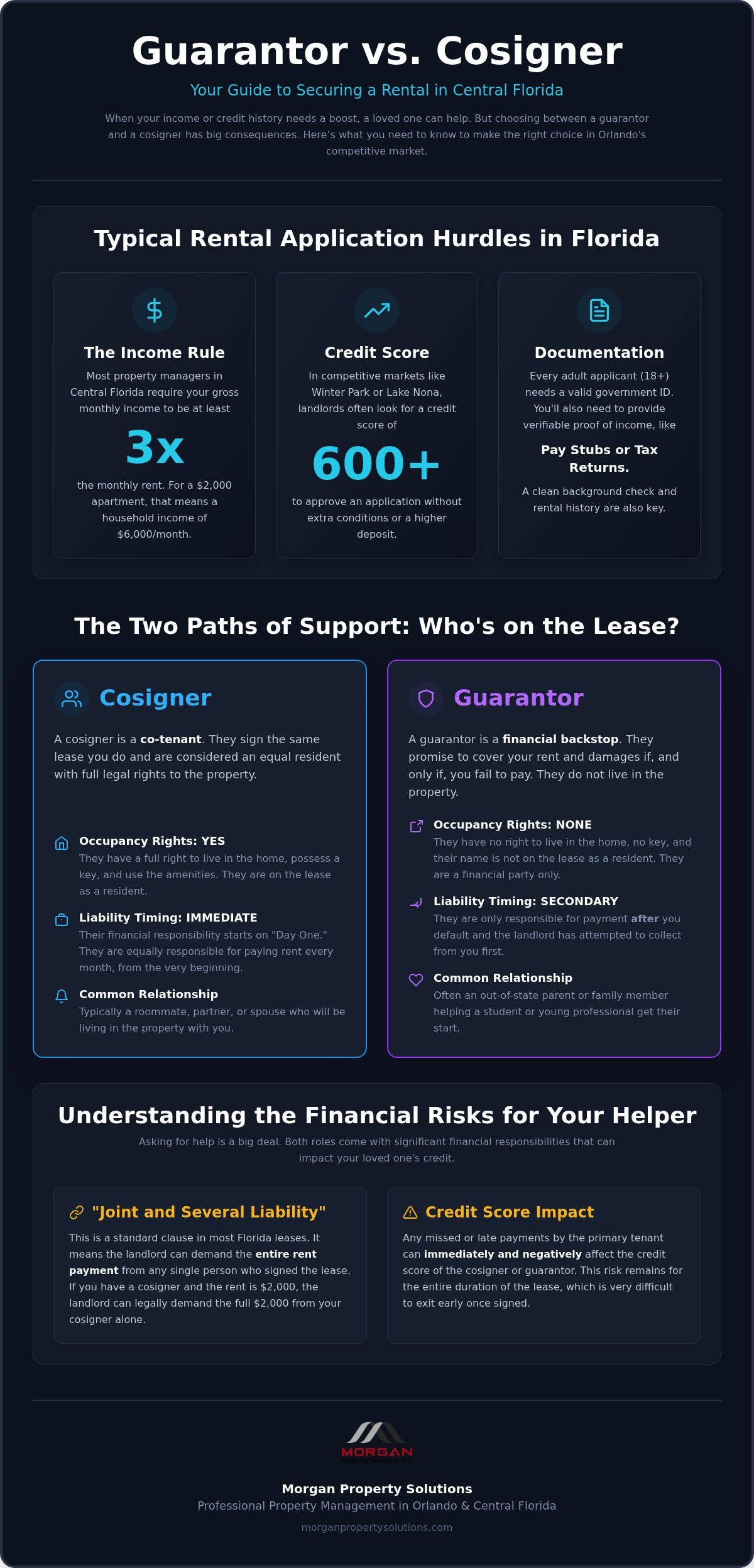
Florida law and standard industry practices create a specific path for every renter. Every adult who will live in the home must be at least 18 years old and provide a valid government issued photo ID. This isn’t just a formality; it’s a key part of the rental application requirements Florida property managers use to ensure the safety and security of the community. Beyond identity, the most significant hurdle is often the income rule. In Central Florida, you’ll typically need to show gross monthly income that is at least three times the monthly rent. If you’re looking at a $2,000 apartment, your household should earn at least $6,000 a month before taxes to qualify comfortably.
When your personal financial profile doesn’t quite meet these benchmarks, a secondary signer can bridge the gap. This role is often misunderstood, but it’s legally based on the concept of what is a surety. This is a legal arrangement where one person takes responsibility for another’s debt. It provides the landlord with a financial safety net, making them more likely to approve an applicant who might have a shorter credit history or a lower income than the standard rules require.
Common Screening Criteria in Orlando
In competitive markets like Winter Park or Lake Nona, landlords often look for a credit score of 600 or higher to approve an application without extra conditions. They also look at your debt to income ratio to see if you have enough breathing room after paying your other bills. If your monthly debts are too high, it might trigger a request for a guarantor even if your income looks good. You can view our full screening criteria for a transparent look at how we evaluate every potential tenant.
Why Documentation Matters
Providing consistent and verifiable documents is the fastest way to get an approved status when meeting the rental application requirements Florida residents face today. We look for recent pay stubs or signed tax returns to confirm your earnings. Using a professional management firm provides you with a sense of procedural ease because we use secure online portals for all document submissions. This organized approach ensures that every applicant is treated fairly and consistently. It helps us maintain strict compliance with Fair Housing laws while protecting the owner’s investment by ensuring only qualified residents move in.
Guarantor vs. Cosigner: Key Differences in Liability
Understanding the legal nuances of your lease is vital for both you and the person helping you. While both roles provide financial backing, they differ significantly in daily life and legal standing. A cosigner is essentially a joint applicant. They sign the lease and have the full right to occupy the home. If you’re moving into a Winter Park rental with a partner, they’re your cosigner. A guarantor, however, is purely a financial safety net. They don’t live in the property and don’t even get a key. This distinction is a core part of the rental application requirements Florida landlords use to manage risk.
The “Day One” rule helps clarify the financial side. A cosigner is responsible for the rent from the moment the lease starts. They’re expected to pay just like you are. A guarantor’s liability is usually secondary. They only step in if you fail to pay and the landlord has already attempted to collect from you. Guarantors are frequently out-of-state parents or relatives who want to help a student or a young professional get started in Orlando. Since they don’t plan to live in the home, they prefer the guarantor role to avoid being tied to the physical property.
Comparison Table: Cosigner vs. Guarantor
This table simplifies the main differences we see in Central Florida rentals.
| Feature | Cosigner | Guarantor |
|---|---|---|
| Occupancy Rights | Yes (Right to a key) | No (No residency rights) |
| Liability Timing | Immediate (Day One) | Secondary (After default) |
| Credit Requirement | High (Usually 600+) | High (Often higher than tenant) |
| Common Relationship | Roommate or Partner | Parent or Family Member |
In Florida, leases often include a concept called “joint and several liability.” This sounds like dense legal jargon, but it just means the landlord can collect the full rent from anyone who signed. If you have a cosigner, the landlord doesn’t care who pays the rent as long as it’s paid in full. Everyone is in the same boat, and everyone is 100% responsible for the entire balance.
Financial Risks for the Helper
Helping a family member is a kind gesture, but it comes with real risks. If a tenant misses a payment, it can immediately lower the helper’s credit score. Once a lease is signed in Florida, removing someone from the agreement is very difficult without the landlord’s written consent. Meeting the rental application requirements Florida property managers set requires a clear understanding of who is truly on the hook for the rent. Because the risk is so high, we maintain high credit standards for signers to ensure they can actually cover the costs if needed. If you have questions about how these roles fit into your specific situation, you can learn more about our team’s approach to supporting local renters.
Why Central Florida Landlords Require a Secondary Signer
The Central Florida rental market remains incredibly active, with high demand in neighborhoods like Lake Nona and the bustling areas surrounding UCF. Because inventory is often tight, landlords apply high levels of scrutiny to every application file. Meeting the rental application requirements Florida owners expect can be difficult for young professionals starting their careers or students who haven’t yet built a long credit history. This is where a secondary signer becomes a vital tool for success. It isn’t just about having enough money in the bank; it’s about proving to a landlord that the financial risk is fully covered by a stable, verified source. Professional residential property management helps balance these resident needs with the owner’s necessity for long-term financial safety.
Meeting Orlando’s Competitive Standards
In high-demand markets like Windermere or Winter Garden, property owners frequently prefer a guarantor for renters who are just beginning to build their financial profiles. This preference has become more standardized due to Florida’s 2023 preemption law (F.S. §83.425). This legislation helped create more consistency in how screening is handled across the state, ensuring that applicants are treated fairly regardless of the city they choose. Instead of navigating a confusing patchwork of local rules, renters now face a more uniform set of expectations. Having a professional ally who understands these shifting regulations simplifies the journey, turning a complex legal process into a series of manageable steps that move you closer to your new home.
The Landlord’s Perspective on Risk
From an owner’s point of view, the primary goal is protecting their property and their income. Evictions in Florida can be costly and time-consuming, often taking weeks to resolve while the property generates no revenue. Secondary signers act as a preferred preventative measure, ensuring that the rent is covered even if the primary tenant faces an unexpected life event. A deep understanding of Florida landlord tenant law is essential for this process. It governs how these roles are enforced and what specific rights each party holds throughout the lease term. We act as a steady ally for both owners and tenants, providing a transparent framework that reduces anxiety and ensures a successful leasing experience for everyone involved.
How to Decide: Is a Guarantor or Cosigner Right for You?
Selecting the right path for your lease doesn’t have to be a source of anxiety. It’s about matching your living situation with the right legal structure. We recommend a four-step approach to make this choice simple. First, determine if the person helping you will actually be living in the home. This is the primary filter that dictates your options. Second, check the specific policy of the management firm. Some Orlando property managers have role preferences, such as only allowing guarantors for full-time students. Third, evaluate your helper’s credit score. If their score is below the common 600 threshold, they might not help you meet the rental application requirements Florida landlords demand. Finally, have an open conversation about the long-term liability. Both parties must be comfortable with the financial commitment before the lease is signed.
Our team at Morgan Property Solutions is committed to helping you find the right fit. We believe that procedural ease starts with clear communication. If you’re unsure which role fits your situation, we can guide you through our standard screening criteria to see where you stand.
When to Choose a Cosigner
A cosigner is the ideal choice for romantic partners or roommates who plan to share daily living expenses. This setup is best when both parties need to build a local rental history for future moves within Central Florida. It’s also often a necessity because many landlords require all adult occupants to be co-tenants on the lease. By signing together, you both establish a track record of on-time payments, which makes your next application even stronger.
When to Choose a Guarantor
We often call this the “parental” choice. It’s perfect for students or recent graduates who have family support but whose helpers live in another city or state. A guarantor is the right move when your helper wants zero involvement in the day-to-day household and simply wants to provide a financial safety net. This is a great way to secure a home in areas like Clermont or Oviedo while you work on building your own credit. It satisfies the rental application requirements Florida owners set without complicating the helper’s daily life. If you’re ready to start your journey, contact our Orlando property management experts today to see our available listings.
Qualifying for Your Orlando Rental with Morgan Property Solutions
At Morgan Property Solutions, we believe that partnership is the heart of a successful leasing experience. Meeting the rental application requirements Florida property managers demand shouldn’t feel like an impossible task. We’ve spent over 20 years refining our process to ensure it’s as smooth and transparent as possible for both tenants and their financial supporters. Our team acts as a steady ally, guiding you through each step of the journey with professional care and a commitment to your long-term success in the Central Florida market.
Our commitment to Fair Housing is unwavering. We utilize a human-centric screening approach that prioritizes transparency and consistency. By distilling complex legal expectations into manageable steps, we help mitigate the anxiety often associated with applying for a new home. Whether you’re a first-time renter in Lake Nona or a seasoned professional moving to Winter Park, we’re here to help you navigate the nuances of your application with confidence.
Navigating the Application Process
When you’re ready to apply, having your documentation organized is the best way to ensure procedural ease. If you’re using a guarantor or cosigner, you’ll generally need to provide the following items for them today:
- A valid government-issued photo ID.
- Proof of income, such as recent pay stubs or tax returns.
- A signed agreement acknowledging their specific financial role.
- Their current contact information for a quick verification check.
We make it easy. Our team uses a secure online portal to ensure that every document you submit is handled with the highest level of care. This technology removes the psychological friction of paperwork, allowing you and your helper to complete the necessary steps from the comfort of home. Working with a seasoned authority in Orlando means you benefit from 20+ years of local expertise, ensuring your application is processed efficiently and fairly.
Expert Guidance for Property Owners
For those already investing in rental properties, we provide the specialized knowledge needed to protect your ROI. Handling complex lease signings with guarantors and cosigners requires precision and a deep understanding of local market dynamics. We manage these details so you don’t have to, ensuring every lease is legally sound and every tenant is properly vetted. If you’re looking for the best homes for rent in orlando fl, or you need professional management for your own portfolio, we invite you to experience the Morgan Property Solutions difference. View our available Orlando rentals and start your application today.
Take the Next Step Toward Your New Central Florida Home
Navigating the rental application requirements Florida landlords expect is much easier when you understand the specific legal roles of those helping you. By distinguishing between the occupancy rights of a cosigner and the financial safety net of a guarantor, you can make a choice that protects your loved ones while securing your lease. Every step of this journey becomes simpler when you have the right information and a professional team on your side.
Our team at Morgan Property Solutions brings over 20 years of Central Florida expertise and an A+ rated management style to every property we oversee. We take pride in our transparent, human-centric screening process, which is designed to remove the psychological friction often found in today’s competitive market. Whether you’re a student near UCF or a professional moving to Lake Nona, we’re here to act as your steady ally throughout the entire leasing process. Let us help you find your perfect Orlando rental—browse our listings today! We look forward to helping you settle into a home you love.
Frequently Asked Questions
Can a guarantor be someone who lives in a different state than Florida?
Yes, a guarantor can absolutely live outside of Florida. Many students at UCF or young professionals in Lake Nona use out-of-state parents to meet the financial benchmarks. We verify their income and credit through our secure online portal just like a local applicant. This flexibility helps you meet the rental application requirements Florida landlords set while keeping your support system in place, regardless of where they reside.
Does a cosigner have to pay rent every month or only if I miss a payment?
A cosigner is legally responsible for the rent from the very first day. While most roommates or partners decide between themselves who sends the payment, the landlord views both parties as equally liable. If a payment is missed, the landlord can collect the full amount from either person. This joint responsibility is why we encourage clear communication between all parties before signing a lease in Clermont or Oviedo.
What is the minimum credit score required for a guarantor in Orlando?
Most professional managers in Orlando look for a guarantor credit score that is significantly higher than the tenant’s requirement. While a tenant might qualify with a 600, a guarantor often needs a score of 700 or above to effectively offset the risk. This higher standard ensures they have the financial stability to cover the lease if the primary resident faces an unexpected hardship during their stay in Winter Garden.
Can I have both a cosigner and a guarantor on the same Florida lease?
Yes, it is technically possible to have both, though it’s uncommon in the Orlando market. A landlord might request this if multiple applicants have low credit scores but a strong combined income. Having both a cosigner living in the home and an external guarantor provides the property owner with maximum security. This arrangement can help a group of young renters successfully navigate the rental application requirements Florida property managers utilize.
What happens if my guarantor wants to be removed from the lease later?
Removing a guarantor before the lease ends is very difficult. Most Florida lease agreements are binding for the entire term. To release a guarantor, the primary tenant usually needs to prove they now meet the income and credit requirements on their own. This often requires a lease addendum or waiting until the renewal period. We recommend discussing these long-term commitments with your family or friends before they sign any documents.
Is a guarantor responsible for property damages or just the monthly rent?
A guarantor is typically responsible for all financial obligations under the lease, which includes property damages. If the cost of repairs exceeds the security deposit, the landlord can seek those funds from the guarantor. Their role is to ensure the entire lease agreement is fulfilled. This is why we provide detailed inspections and financial reporting to keep all parties informed about the condition of the home throughout the tenancy.
How does being a cosigner affect someone’s ability to get their own mortgage?
Being a cosigner can definitely impact someone’s ability to get a mortgage. Lenders view the full monthly rent as a potential debt for the cosigner, which increases their debt to income ratio. Even if the primary tenant pays every month, the liability still shows up on a credit check. This is an important factor for relatives in Windermere or Apopka to consider if they plan on buying their own property soon.
Does Florida law require landlords to accept a guarantor if I meet all other criteria?
No, Florida law doesn’t require a landlord to accept a guarantor. Owners have the right to set their own screening criteria as long as they follow Fair Housing regulations. Some landlords prefer tenants who meet all requirements independently to minimize legal complexity. However, many professional firms in the Orlando area are happy to work with guarantors to help qualified individuals secure a home while protecting the owner’s investment.

Article by
Oliver Overton-Morgan
Oliver Overton-Morgan is a full-time Real Estate Broker since 2003, with years of experience helping thousands of people purchase and sell real estate throughout Central Florida. He holds a Graduate Realtor Institute designation, LCAM, and has held licenses in good standing as a Florida Mortgage Broker and a Notary Public. Oliver immigrated to central Florida in 2001, and within 5 years Oliver built a successful Real Estate brokerage in central Florida, where he recruited over 75 Sales Associates with 25+ million in sales production.