
Imagine a typical Tuesday afternoon in Orlando when a sudden summer downpour leaves your rental’s walkway slick with a thin layer of algae. If a tenant slips and falls, are you automatically on the hook for their medical bills? It’s a question that keeps many Central Florida property owners awake at night. Dealing with the complexities of landlord liability for tenant injury florida can feel overwhelming, especially when you’re worried about expensive litigation or hidden hazards like faulty wiring and mold. You’ve worked hard to build your investment, so it’s completely natural to feel anxious about a single accident potentially wiping out your financial gains.
The good news is that Florida law provides clear boundaries, and you don’t have to face these risks alone. This guide will help you understand the legal definition of negligence in the Sunshine State and show you how to use proactive risk management to stay protected. We’ll explore how documenting routine maintenance serves as your best defense, the importance of the 51% fault rule, and how professional property management in the Orlando area acts as a vital buffer for your assets. By the end, you’ll have a clear roadmap for maintaining a safe property while shielding your bank account from liability claims.
Key Takeaways
- Understand the specific 2026 legal standards and Florida Statutes that define your duties to keep residents safe and your property up to code.
- Learn how to navigate landlord liability for tenant injury florida by identifying common Central Florida environmental hazards before they turn into costly lawsuits.
- Discover how detailed inspections and a “paper shield” of documentation can protect your financial investment from unfair or inflated injury claims.
- See why many Orlando property owners use professional management to handle maintenance requests and statutory compliance automatically and efficiently.
- Gain peace of mind by shifting from reactive stress to a proactive risk management strategy that keeps your rental business profitable and legally sound.
Understanding Landlord Liability for Tenant Injuries in Florida
Owning rental property in Central Florida is a rewarding venture, but it carries significant legal responsibilities. You aren’t just a rent collector; you’re a property owner bound by the Florida Residential Landlord and Tenant Act. Understanding the nuances of landlord liability for tenant injury florida is the first step toward protecting your assets and your residents. It helps you move from a place of worry to a place of prepared confidence.
At its core, these legal cases are built on premises liability principles. This legal doctrine determines who’s responsible when a hazardous condition causes harm. It’s a common misconception that landlords are “strictly liable” for every scrape or fall on their property. In Florida, the law doesn’t expect you to be a psychic. Instead, it expects you to be reasonable. You’re generally only liable if your negligence caused the injury. Tenants are legally classified as “invitees,” meaning they’re on the property for your business benefit. This gives them the highest level of legal protection. Trespassers, on the other hand, have very limited rights unless a property owner intentionally sets a trap or causes them harm.
The Four Elements of a Negligence Claim
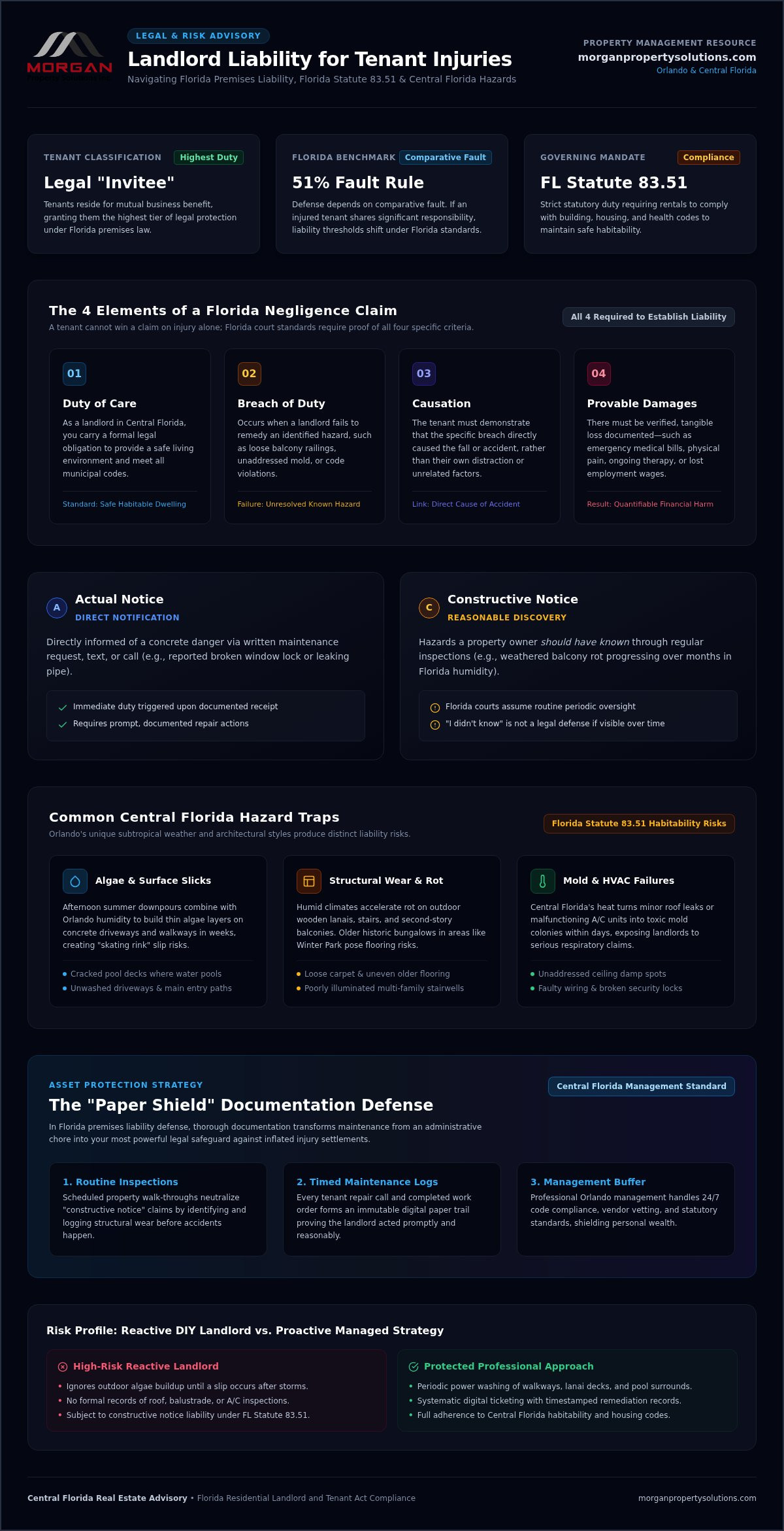
To win a lawsuit, an injured tenant must prove four specific things. First is Duty. As a landlord in Orlando, you have a legal obligation to maintain a safe environment and follow local building codes. Second is Breach. This happens if you fail to address a known hazard, like a loose stair railing or a mold issue.
Third is Causation. The tenant must show that your specific breach of duty directly caused their injury. If they tripped because they were distracted by their phone, your broken floorboard might not be the primary cause. Finally, there are Damages. There must be a real loss, such as medical bills, physical pain, or lost wages. Without all four pieces, a negligence claim typically won’t stand in a Florida court.
Actual vs. Constructive Notice
A major part of defending against landlord liability for tenant injury florida involves the concept of “notice.” You can’t fix what you don’t know is broken, but the law looks at “knowing” in two different ways.
Actual Notice is straightforward. This is when a tenant calls you or sends a text to report a specific problem, like a broken window lock. Once you’re notified, you have a duty to act. Constructive Notice is trickier. This refers to hazards you should have known about through regular inspections. If a balcony railing has been visibly rotting for months in the Florida humidity, a judge will likely decide you should have caught it. This is why many owners rely on landlord resources and professional management to ensure nothing slips through the cracks during the busy rental season.
Common Hazard Traps for Central Florida Landlords
While the legal definitions we discussed earlier provide the framework, the actual risks often hide in plain sight. In Central Florida, our unique climate and aging infrastructure in neighborhoods like Winter Park or Downtown Orlando create specific “hazard traps” that can quickly lead to a lawsuit. Under Florida Statute 83.51, a landlord is legally required to maintain a residential dwelling in a condition that complies with all applicable building, housing, and health codes, ensuring the property remains fundamentally fit for human habitation. Failing to meet these standards often triggers the implied warranty of habitability and landlord obligations, which can turn a simple maintenance oversight into a six-figure legal settlement.
Slip, Trip, and Fall Hazards
In Orlando, the combination of intense humidity and frequent summer downpours makes exterior surfaces incredibly dangerous. Algae and mildew can build up on concrete driveways and walkways in just a few weeks, creating a skating rink effect after a storm. If you don’t pressure wash these areas regularly, you’re opening the door to a claim. Other common issues include:
- Uneven flooring or loose carpeting in older bungalows.
- Poorly lit stairwells in multi-family units.
- Rotted wood on lanais or second-story balconies.
- Cracked pool decks where water pools and creates slip hazards.
These aren’t just minor inconveniences. A tenant tripping over a loose carpet edge or falling through a weakened balcony rail represents a significant breach of your duty of care. When simple maintenance is ignored, the resulting injuries can lead to massive financial losses for the owner.
Environmental and Security Concerns
Mold is perhaps the most persistent threat to landlord liability for tenant injury florida. Our subtropical environment means that a small roof leak or a malfunctioning A/C unit can lead to toxic mold growth within days. If a tenant develops respiratory issues because you ignored a damp spot on the ceiling, the financial consequences can be devastating.
Security is another area where landlords often stumble. Florida law requires specific safety features, including working window latches and deadbolts. In historic areas, you might also have to deal with lead-based paint or asbestos. If these materials aren’t handled correctly during a renovation, you could be liable for long-term health complications. Managing these diverse risks is why many local owners choose Orlando property management to ensure their rentals stay compliant and safe year-round.
Florida Statute 83.51: Your Legal Obligations
Florida Statute 83.51 isn’t just a list of suggestions; it’s the legal foundation that defines your role as a property owner. This statute establishes what’s known as the “implied warranty of habitability.” Essentially, it’s a promise that the home is safe and livable from the moment the keys are handed over, regardless of whether that specific promise is written in the lease. When we talk about landlord liability for tenant injury florida, this statute is often the first place a court looks to see if you met your basic duties.
In Orlando and the surrounding counties, you’re required to keep roofs, windows, doors, floors, and foundations in good repair. This goes beyond simple aesthetics; it’s about structural integrity. If a porch railing fails or a floorboard gives way because it wasn’t maintained to code, you could be facing a serious legal challenge. Failing to meet these structural requirements doesn’t just lead to unhappy tenants, it creates a direct path for negligence claims if an accident occurs.
Mandatory Safety Features for Florida Rentals
Safety starts with the basics. To stay compliant with local Orlando codes and state law, every rental unit must meet specific safety benchmarks. This includes having functioning smoke detectors installed according to current standards and ensuring that all exterior doors and windows have secure, standard locking mechanisms.
Your electrical wiring and plumbing systems must also be safe and fully operational. In multi-family units, the law is even more specific about keeping common areas clean and safe. If a tenant is injured in a dimly lit hallway or on a cracked common-area walkway, the responsibility often falls on the landlord for failing to maintain those shared spaces to statutory standards.
Pest Control and Screen Requirements
Florida has some unique rules that often surprise out-of-state investors. For instance, landlords are typically responsible for the extermination of rats, mice, roaches, and wood-destroying organisms like termites. A vermin infestation isn’t just a nuisance; it’s a health hazard that can lead to respiratory issues or other illnesses. If an infestation is caused by structural defects you failed to fix, you’re looking at a significant liability risk.
Another specific Florida requirement involves window and door screens. You must ensure they are in good condition at the start of the lease and repair them once a year if needed. These small details are exactly what we track through our landlord resources to ensure every property remains fully compliant. Keeping up with these statutory minimums is the most effective way to protect your investment and your tenants simultaneously.
How to Minimize Your Legal Risk as a Property Owner
Winning a legal battle often comes down to who has the better records. To protect yourself from landlord liability for tenant injury florida, you need to build what we call a “Paper Shield.” This is a comprehensive trail of documentation that proves you’ve acted with reasonable care. Relying on verbal agreements or a handshake deal with a tenant is a recipe for disaster in Florida courts. If it isn’t in writing, it basically didn’t happen.
Every maintenance request should be logged with a timestamp, and every repair should be handled by a licensed and insured contractor. Vetting your vendors is crucial because hiring an unlicensed handyman can actually increase your liability if their work doesn’t meet local building codes. When you respond immediately to concerns and keep clear records of those actions, you demonstrate that you take your responsibilities seriously. It shows you aren’t just ignoring the property, but actively working to keep it safe.
The Power of Routine Inspections
Detailed inspections are your most effective defense against claims that you should have known about a hazard. You should conduct thorough move-in and move-out inspections using timestamped photos to document the exact condition of the property. Scheduling bi-annual safety walkthroughs allows you to catch small issues, like a loose tile or a flickering porch light, before they become major hazards. It also helps to start with the right people. Following strict Morgan Property Solutions Inc. screening criteria ensures you’re placing residents who are more likely to report issues promptly and respect the property’s safety standards.
Insurance and Liability Coverage
Insurance is your final safety net. Many new investors make the mistake of keeping a standard homeowners policy, but these often don’t cover injuries that happen at a rental property. You need a specific landlord policy that includes premises liability coverage. We also recommend requiring your tenants to carry renters insurance. This can deflect claims for their personal property damage and even some guest-related liability incidents. For those with high-value Central Florida portfolios, an umbrella policy provides an extra layer of protection, often covering $1 million or more in damages that exceed your primary policy limits.
If you’re ready to secure your investment with a professional documentation strategy, contact our Orlando property management team today.
Protecting Your Investment with Professional Property Management
Managing a rental property on your own can feel like a high-stakes balancing act. Between tracking changing regulations and responding to midnight emergencies, it’s easy for a small maintenance detail to fall through the cracks. This is where the value of professional oversight truly shines. By partnering with an Orlando property management expert, you’re not just hiring help; you’re building a defensive wall around your assets. We take on the daily burden of diligence, ensuring that every statutory requirement is met so you don’t have to worry about the complexities of landlord liability for tenant injury florida.
Our 24/7 maintenance portals play a vital role in reducing your response-time liability. In a legal setting, the time between a tenant reporting a hazard and your action to fix it is scrutinized heavily. Our system creates an immediate, timestamped record of every request. We then dispatch vetted, insured vendors who know exactly how to perform repairs that meet Florida building codes. This ensures that a leaky pipe or a loose stair railing is handled correctly the first time, preventing the kind of systemic property issues that lead to expensive lawsuits.
Documented Compliance and Reporting
Digital record-keeping is the key to a strong legal defense. Every interaction, inspection, and repair request is logged, providing a clear audit trail for insurance companies if a claim ever arises. Professional managers are trained to spot hazards that DIY owners might overlook, like subtle signs of water intrusion or aging electrical components. This proactive approach identifies items that could be considered constructive notice long before they become a danger to your residents. It’s about being methodical and thorough so that your property remains a safe, profitable investment.
The Morgan Property Solutions Inc. Advantage
At Morgan Property Solutions Inc., we leverage over 20 years of combined experience in the Central Florida market to simplify the complexities of the law. Our detailed inspections and transparent financial reporting are designed to give you total peace of mind. We act as your steady ally, navigating the procedural hurdles so you can focus on the returns of your investment rather than the risks. We believe in guidance and partnership, helping you move from general interest to a specific, secure strategy for your portfolio. If you want to protect your assets with a team that truly cares about your long-term success, Contact Morgan Property Solutions Inc. for a free consultation today.
Securing Your Future as a Central Florida Landlord
Owning property in the Orlando area doesn’t have to be a source of constant anxiety. By understanding the legal boundaries of landlord liability for tenant injury florida, you’ve already taken a massive step toward securing your financial future. Remember that staying compliant with Florida Statute 83.51 and maintaining a clear audit trail are your best defenses against unpredictable claims. These simple steps protect your residents while shielding your bank account from expensive litigation.
You don’t have to manage these risks on your own. With over 20 years of Central Florida experience, our team provides the expert guidance you need to navigate complex regulations with ease. We use 24/7 maintenance response and detailed digital records to ensure your property stays safe and your liability stays low. It’s about turning a complicated process into a manageable, stress-free investment. Let us handle the details so you can enjoy the rewards of your hard work. Protect your investment with professional Orlando property management today and gain the peace of mind you deserve.
Frequently Asked Questions
Is a Florida landlord liable for a tenant’s slip and fall?
A landlord isn’t automatically liable for every fall that happens on their property. In Florida, the tenant must prove that a hazardous condition existed and that you failed to fix it despite knowing about the danger. Under the state’s modified comparative fault rule, if a tenant is found to be more than 50% responsible for their own accident, they are completely barred from recovering any compensation from you.
What happens if a tenant is injured due to mold in a Florida rental?
You may be held liable for mold related illnesses if the growth resulted from a structural failure or leak that you failed to address. Florida’s intense humidity means that even small leaks can lead to toxic mold within days. Under Statute 83.51, you’re responsible for keeping the roof and walls in good repair. If you ignore a reported leak in a Windermere home and mold develops, a court may find you negligent.
Does renters insurance cover tenant injuries on the property?
Renters insurance primarily covers the tenant’s personal property and their own personal liability if they accidentally cause an injury to someone else. While it doesn’t shield you from your own negligence, it can cover guest injuries if the tenant was the one at fault. Many professional managers in Winter Garden require tenants to carry $100,000 in liability coverage to create an extra layer of financial protection for the owner.
How long does a tenant have to sue a landlord for injury in Florida?
Under current law, a tenant generally has 2 years from the date of the injury to file a lawsuit. This timeframe was established by House Bill 837 and applies to general negligence and personal injury claims. It’s vital to keep all maintenance logs and inspection photos for at least this long to ensure you have a solid defense ready if a claim regarding landlord liability for tenant injury florida ever arises.
Am I liable if a tenant’s guest gets hurt at my rental property?
Yes, you owe a duty of care to anyone legally on the premises, including a tenant’s guests. If a guest trips on a cracked walkway in Clermont that you knew was dangerous, they have the same right to sue for damages as the resident. Because guests aren’t always familiar with the home’s layout, it’s even more important to ensure that common hazards like loose railings or uneven steps are repaired promptly.
Can a landlord be held liable for criminal acts committed against a tenant?
You can be held liable for third party criminal acts if you failed to provide adequate security. However, Florida Statute 768.0706 offers a presumption against liability for owners of multi-family properties who meet specific security standards. This includes installing 1-inch deadbolts, providing adequate lighting in parking lots, and using security cameras. Following these steps in areas like Lake Nona or Apopka helps protect both your residents and your financial investment.
What is the “Reasonable Care” standard for Florida landlords?
Reasonable care is the legal standard that requires you to act as a prudent property owner would to keep the premises safe. This includes performing regular inspections to identify hazards you should have known about, such as algae on walkways or rotted porch wood. Meeting this standard is your primary defense against any claim involving landlord liability for tenant injury florida, as it proves you weren’t negligent in your duties.
Does professional property management reduce my legal liability?
Partnering with a professional firm like Morgan Property Solutions Inc. significantly reduces your risk by ensuring every repair and inspection is documented. We provide a clear audit trail through our digital portals, proving you met your duty of care. With over 20 years of experience in Central Florida, we handle the statutory notice requirements and vendor vetting that DIY owners often miss, effectively shifting the burden of diligence away from you.

Article by
Oliver Overton-Morgan
Oliver Overton-Morgan is a full-time Real Estate Broker since 2003, with years of experience helping thousands of people purchase and sell real estate throughout Central Florida. He holds a Graduate Realtor Institute designation, LCAM, and has held licenses in good standing as a Florida Mortgage Broker and a Notary Public. Oliver immigrated to central Florida in 2001, and within 5 years Oliver built a successful Real Estate brokerage in central Florida, where he recruited over 75 Sales Associates with 25+ million in sales production.