
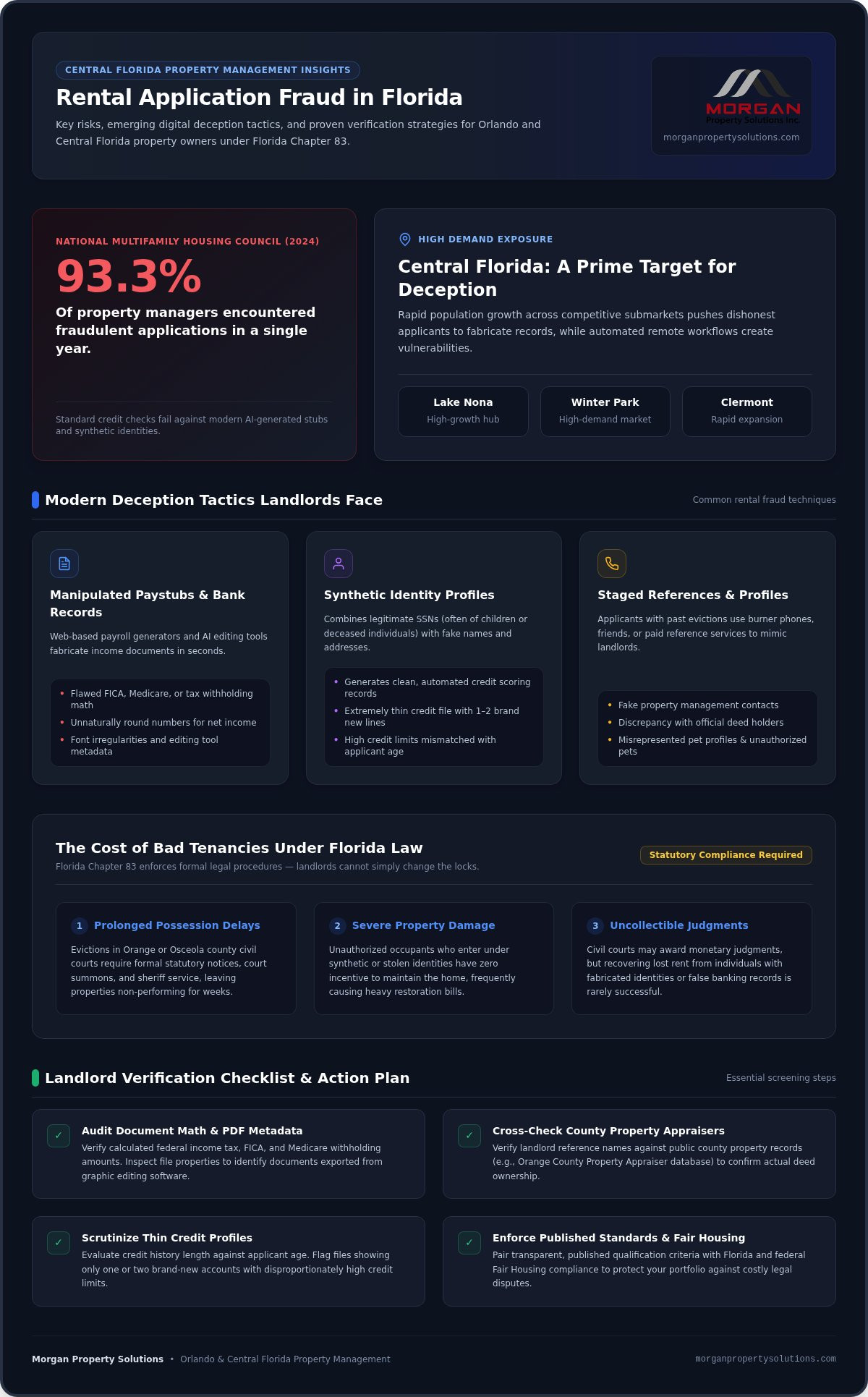
A 2024 survey by the National Multifamily Housing Council revealed that 93.3% of property managers encountered fraudulent applications in a single year. When it comes to preventing rental application fraud Florida property owners face, relying on a basic credit pull simply isn’t enough. Today’s dishonest applicants use sophisticated tools to fabricate everything from AI-generated pay stubs to fake landlord references, making casual reviews nearly useless.
We know how stressful it feels to balance filling a vacancy quickly with the fear of an expensive, drawn-out eviction. With civil court fees, lost rent, and potential property damage, a single fraudulent placement can easily drain thousands of dollars from your bottom line. You deserve total peace of mind every time you approve a file and hand over the keys.
That is why this guide shows you how to spot sophisticated application fraud and protect your Central Florida rental property with a proven verification process. We’ll walk you through a clear checklist to verify applicant income, explore critical Florida compliance standards, and share practical screening methods to keep your rental income safe.
Key Takeaways
- Master a step-by-step verification framework designed for preventing rental application fraud Florida landlords encounter across competitive markets like Orlando.
- Spot subtle red flags in modern applications, including AI-generated pay stubs, altered bank statements, and staged landlord references.
- Safeguard your investment from costly legal disputes by pairing transparent, published qualification criteria with federal and Florida Fair Housing standards.
- Learn how partnering with a professional Orlando property manager gives you access to enterprise screening technology that filters out deceptive files before move-in.
The Rise of Rental Application Fraud Across Florida Properties
Under the accepted legal definition of fraud, an individual intentionally misrepresents material facts to secure an agreement they wouldn’t otherwise qualify for. In residential leasing, this deceptive practice has evolved far beyond a small exaggeration about monthly income. Today, bad actors deploy digitally altered bank records, fake pay stubs, and synthetic identities to slip past conventional screening checks.
For independent landlords, the consequences of a fraudulent tenancy are immediate and severe. Florida Chapter 83 governs residential tenancies, setting firm statutory procedures that every landlord must follow. Even if a lease was signed under false pretenses, you cannot simply change the locks. You must navigate formal statutory notices and local civil courts to regain possession. Because missteps can stall the process, consulting a qualified Florida attorney is often necessary when disputes arise.
Why Central Florida Rental Markets Are Prime Targets
Central Florida continues to see rapid population growth. Submarkets like Lake Nona, Winter Park, and Clermont attract thousands of relocating professionals and families each year. This intense demand creates a fiercely competitive applicant pool where dishonest individuals feel pressured to fabricate qualifications to beat the competition.
Additionally, modern remote leasing workflows have opened unexpected vulnerabilities. Online applications, virtual tours, and self-guided entry make renting convenient, but they remove face-to-face interaction. For Central Florida property owners handling listings independently, these automated systems create dangerous blind spots that scammers actively target.
The True Cost of Bad Tenants: Evictions and Damage
A bad tenancy creates financial fallout that extends well beyond missed monthly payments. Prioritizing strategies for preventing rental application fraud Florida landlords can trust is critical because recovering your losses after the fact is exceptionally difficult. The real toll often includes:
- Prolonged possession delays: Filing an eviction in Orange or Osceola county civil courts requires statutory notices, court summons, and sheriff service, leaving your property vacant and non-performing for weeks.
- Severe property damage: Unauthorized occupants who enter under false identities have zero incentive to protect your investment, often resulting in heavy restoration bills.
- Uncollectible court judgments: While a judge may award monetary damages, collecting funds from an individual who fabricated their identity or bank accounts is rarely successful.
Relying on seasoned Orlando property management helps safeguard single-family rentals against these avoidable expenses by shutting out fraudulent files before a lease is ever signed.
Common Types of Rental Fraud Landlords Encounter in 2026
The Federal Trade Commission regularly alerts consumers to common rental scams, but property owners face equally deceptive tactics from incoming applicants. Successfully preventing rental application fraud Florida landlords face requires recognizing modern digital manipulation techniques before executing a lease agreement.
Manipulated Paystubs, W-2s, and Altered Bank Statements
Web-based payroll generators and AI editing tools allow bad actors to produce convincing income documentation in seconds. Spotting these fabrications requires looking beyond the bottom line and checking for clear formatting flaws:
- Tax withholding math: Altered pay stubs frequently display incorrect FICA, Medicare, or federal income tax withholdings, or they display unnaturally round numbers for net income.
- Font irregularities: Look for subtle discrepancies in typeface, font size, or misaligned text where original numbers were replaced.
- File metadata: Check the document properties of submitted PDF statements. Legitimate payroll systems export directly from accounting software, whereas manipulated files often reveal editing in image-altering software.
Synthetic Identity Fraud and Stolen Social Security Numbers
Synthetic identity fraud combines legitimate Social Security numbers, often belonging to children or deceased individuals, with fictitious names and addresses. Because automated credit scoring systems create a fresh record for this newly minted profile, basic screening reports can come back surprisingly clean.
You can identify these profiles by watching for thin credit files that show only one or two brand-new accounts with unusually high credit limits. When a full credit history does not match an applicant’s age or professional background, treat it as an urgent warning sign.
Fake Landlord References and Misrepresented Pet Profiles
Applicants with past evictions frequently list friends, relatives, or paid reference services operating burner phones as their previous property managers. Central Florida landlords can verify these claims by cross-referencing previous rental addresses with the Orange County Property Appraiser database. If the reference’s name doesn’t match the deed holder or a registered management company, the reference is compromised.
Similarly, unauthorized pets often enter homes through online certificate mills that sell illegitimate assistance animal letters. Standardizing your intake process through specialized verification systems like PetScreening helps validate authentic medical accommodation requests while deterring pet policy bypasses. Establishing clear, published screening criteria keeps your entire vetting workflow uniform and objective.
Step-by-Step Verification: How to Detect Rental Fraud
Stopping dishonest applicants requires moving past automated credit pulls and following a dependable, repeatable routine. A structured review protocol is the single most reliable method for preventing rental application fraud Florida real estate investors face. By taking each submission through a clear, multi-step review, you quickly separate authentic tenants from sophisticated fabrications.
Step 1: Authenticate Identity and Government Documentation
Start by verifying that your applicant actually exists and matches their submitted credentials. Review government-issued photo identification closely, checking for intact security watermarks, consistent holographic seals, and uniform fonts across the document. Modern identity software makes this simpler by prompting applicants to take a live selfie that matches the photo on their driver’s license.
You can also cross-examine submitted details against public voter registration databases. A real local applicant in Orange or Seminole county will typically leave a consistent public footprint that aligns with their stated residence timeline.
Step 2: Independently Validate Employment and Earnings
Never rely on phone numbers listed directly on the rental application. Dishonest applicants regularly set up friends or burner numbers to pose as direct supervisors. Instead, search online directories or state registries to locate the employer’s main switchboard, then ask to speak directly with Human Resources.
If the applicant claims local business ownership, confirm that the entity is active and in good standing via Florida’s Sunbiz database. For W-2 employees, request direct payroll portal exports or automated bank verification linking. Direct bank integrations eliminate the risk of altered PDF files entirely by pulling raw transaction data straight from financial institutions.
Step 3: Conduct Deep Background, Eviction, and History Checks
A comprehensive screening check should always encompass nationwide criminal databases, credit histories, and civil court records. Be sure to align your background reporting protocols with official FTC guidance on using consumer reports to remain fully compliant with the Fair Credit Reporting Act.
- County docket reviews: Directly search local court portals, such as the Orange County Clerk of Courts, to identify recent unlawful detainer or eviction filings that may not yet appear on credit files.
- Cross-state records: Inbound migration into Central Florida means you must search national eviction databases to catch unpaid judgments originating out of state.
- Statutory alignment: Grounding your review process in the rules outlined in our Florida Landlord Tenant Law guide ensures your tenant selections stay strictly within legal boundaries.
Taking the time to complete these checks protects your investment property against deceptive practices before a lease agreement is finalized.
Staying Compliant with Florida and Federal Fair Housing Laws
Tightening your tenant filters is necessary, but it must be balanced with strict legal compliance. While focused on preventing rental application fraud Florida rental owners can unintentionally expose themselves to housing discrimination complaints if their verification rules shift from person to person. Setting uniform, transparent guidelines protects your property from dishonest applicants while shielding you from expensive allegations of bias.
Publishing Objective, Written Screening Criteria
The safest strategy is making your qualification standards public before you collect an application or charge a screening fee. Define your income-to-rent ratios, minimum credit thresholds, and acceptable rental verification baselines in writing. Reviewing our published screening criteria offers a great blueprint for how clear and objective these guidelines should be.
When every prospective resident is measured against identical, documented benchmarks, you eliminate subjective decision-making that could spark disparate impact claims. This consistency also applies to handling pet screening versus legitimate service and emotional support animal accommodation requests, ensuring every file receives lawful, equal consideration.
Complying with FCRA Adverse Action Requirements
Whenever you turn down an applicant or issue a conditional approval based on consumer report findings, federal law requires a formal Adverse Action notice. Whether you deny the application entirely or require a cosigner, your notice must include:
- Credit bureau contact information: The name, address, and toll-free telephone number of the consumer reporting agency that provided the data.
- Agency disclaimer: Clear language stating that the reporting bureau did not make the decision to deny the file and cannot provide specific reasons for the rejection.
- Applicant dispute rights: Explicit instructions informing the applicant of their right to obtain a free copy of the report within 60 days and dispute inaccurate records.
Maintain detailed digital logs of every submitted application, verification record, and adverse action delivery timestamp. If you ever feel uncertain about managing a complex applicant dispute or lease denial, we always recommend consulting a qualified Florida attorney. For hands-on help streamlining your screening process and keeping your portfolio protected, check out our helpful landlord resources today.
Protecting Your Central Florida Rental with Professional Management
Managing tenant acquisition on your own often feels simple until a deceptive application slips past your defenses. When it comes to preventing rental application fraud florida property owners discover that staying ahead of bad actors requires significant time, specialized tools, and ongoing vigilance. Partnering with a dedicated property manager replaces guesswork with enterprise screening technology and experienced human review, keeping your rental revenue secure and predictable.
The Value of Local Central Florida Property Management
Every submarket carries unique leasing nuances. Having boots-on-the-ground expertise across Orlando, Winter Park, Windermere, and Oviedo allows seasoned managers to spot irregularities immediately, such as questionable employer addresses or inconsistent regional utility records. While independent landlords often rely on basic credit pulls, full-service management teams deploy enterprise-grade verification platforms.
These advanced platforms connect directly with financial institutions and identity databases, exposing altered payroll documents before a lease is drafted. Choosing dedicated Orlando property management pairs thorough tenant vetting with structured leasing agreements, ensuring you place reliable residents who treat your property with care.
Partnering with Morgan Property Solutions Inc. for Peace of Mind
With over 20 years of combined Central Florida property management experience, Morgan Property Solutions Inc. provides property owners with dependable, stress-free guidance. We remove the burden of manual document verification by applying standardized, transparent screening criteria across every submission. This consistent process ensures full Fair Housing compliance while screening out synthetic identities, forged pay stubs, and unauthorized pets.
You don’t have to carry the risk of leasing alone. Explore our educational materials in the landlord resources hub to learn more about protecting your investment, or connect with our team to safeguard your portfolio from day one. Protect your rental with professional property management and enjoy total confidence in your tenant placement.
Take Control of Your Central Florida Leasing Process
Protecting your cash flow starts long before move-in day. By combining independent employment validation, direct banking checks, and objective qualification standards, preventing rental application fraud Florida property owners encounter becomes an achievable, repeatable process rather than a stressful guessing game. Taking these proactive steps keeps unauthorized occupants out of your home and shields your bottom line from costly legal evictions.
You don’t have to navigate these complex verification challenges on your own. Backed by over 20 years of combined Central Florida property management experience, Morgan Property Solutions helps owners implement rigorous fraud detection systems, including advanced digital identity reviews and pet verification protocols. Our standardized written screening criteria protect your rental income while ensuring complete Fair Housing compliance. Safeguard your investment with expert Central Florida property management and enjoy true peace of mind with every tenant you place.
Frequently Asked Questions
Is it illegal for a tenant to lie on a Florida rental application?
Yes, intentionally falsifying material facts or submitting fraudulent documents to obtain housing violates Florida law and constitutes fraud. Material misrepresentations immediately breach the lease agreement and forfeit the applicant’s right to occupy the property. Because statutory eviction procedures and legal penalties depend on the specific circumstances of each case, landlords dealing with tenancy fraud should always consult a qualified Florida attorney for formal guidance.
How can Florida landlords detect fake or altered paystubs effectively?
Florida landlords can detect fake paystubs by recalculating withholding percentages and requiring direct banking connections. Deceptive templates created with online editing tools frequently contain mathematical rounding errors or mismatched withholdings for FICA and federal taxes. You can also inspect PDF document properties for editing software footprints. To bypass manipulated files completely, utilize digital screening platforms that pull verified income data straight from the applicant’s bank account.
Can a landlord reject an applicant who submits false pet screening documents in Florida?
Yes, landlords can reject applicants who provide fraudulent assistance animal documentation. While federal and Florida Fair Housing laws protect authentic service and emotional support animal accommodation requests, fabricated certificates bought from online diploma mills are not protected. Partnering with specialized verification platforms like PetScreening allows property owners to validate legitimate medical accommodation requests lawfully, keeping unauthorized pets out while remaining in full compliance with housing regulations.
What should a Florida landlord do if they discover an applicant used a fake identity?
If you uncover a synthetic identity before lease signing, immediately issue a written adverse action notice denying the application. If the individual has already taken possession of your rental property, you cannot change the locks or remove their belongings yourself. Regaining possession requires navigating the formal statutory notice and court procedures outlined in Florida Chapter 83, so contact a qualified Florida attorney right away.
Do background check services catch out-of-state evictions for Florida rentals?
Standard background check services only catch out-of-state evictions if they pull from nationwide civil court registries rather than single-state databases. Many basic credit reports miss recent filings because civil court reporting rules vary significantly across jurisdictions. When focusing on preventing rental application fraud Florida property owners should always utilize national screening platforms that search nationwide eviction records, especially given the continuous inflow of out-of-state residents moving to Central Florida.
How does professional property management prevent rental application fraud in Orlando?
Professional property management prevents deception by replacing manual document reviews with enterprise-grade identity authentication and automated banking verification. A seasoned Orlando property manager cross-checks employer and landlord references against public deeds and Florida Sunbiz records. At Morgan Property Solutions, our objective screening criteria and proven verification systems simplify preventing rental application fraud Florida investors encounter across Orlando, Lake Nona, Winter Park, and surrounding submarkets.

Article by
Oliver Overton-Morgan
Oliver Overton-Morgan is a full-time Real Estate Broker since 2003, with years of experience helping thousands of people purchase and sell real estate throughout Central Florida. He holds a Graduate Realtor Institute designation, LCAM, and has held licenses in good standing as a Florida Mortgage Broker and a Notary Public. Oliver immigrated to central Florida in 2001, and within 5 years Oliver built a successful Real Estate brokerage in central Florida, where he recruited over 75 Sales Associates with 25+ million in sales production.