
What if setting emotional boundaries with tenants could strengthen the relationship rather than make you seem uncaring? When a message feels urgent or personal, it’s easy to reply immediately, feel guilty about saying no, or keep thinking about the issue long after you put your phone down. Wanting to be supportive is natural, but clear limits help you respond with care and consistency.
You can protect your time without ignoring tenants or letting difficult conversations become personal. This guide covers practical ways to communicate calmly, set expectations, and decide when to handle an issue directly and when professional support may help.
We’ll look at how to create a predictable communication routine, respond to emotional messages without escalating tension, and hold firm boundaries respectfully. If tenant communication has become persistently stressful, professional property management may offer more structure. For rental owners in Orlando and Central Florida, an online portal can help keep requests organized and conversations focused.
Key Takeaways
- Notice recurring communication patterns to identify where a clear, respectful limit could make tenant interactions more manageable.
- Use a simple process for setting emotional boundaries with tenants: choose an expectation, explain it clearly, and apply it consistently.
- Respond to difficult conversations with calm, professional language instead of reacting emotionally or avoiding the issue.
- Build a repeatable communication routine to organize requests and make open items easier to review.
- Consider professional property management if tenant communication is persistently affecting your wellbeing or other responsibilities.
Why setting emotional boundaries with tenants can make renting more sustainable
As a landlord, you may be the first person a tenant contacts with a question, concern, or complaint. Even when each message is reasonable on its own, handling them all can feel like carrying the rental relationship with you throughout the day. A concern that arrives while you’re busy or trying to rest may seem urgent, especially if you haven’t agreed on how or when routine messages should be handled.
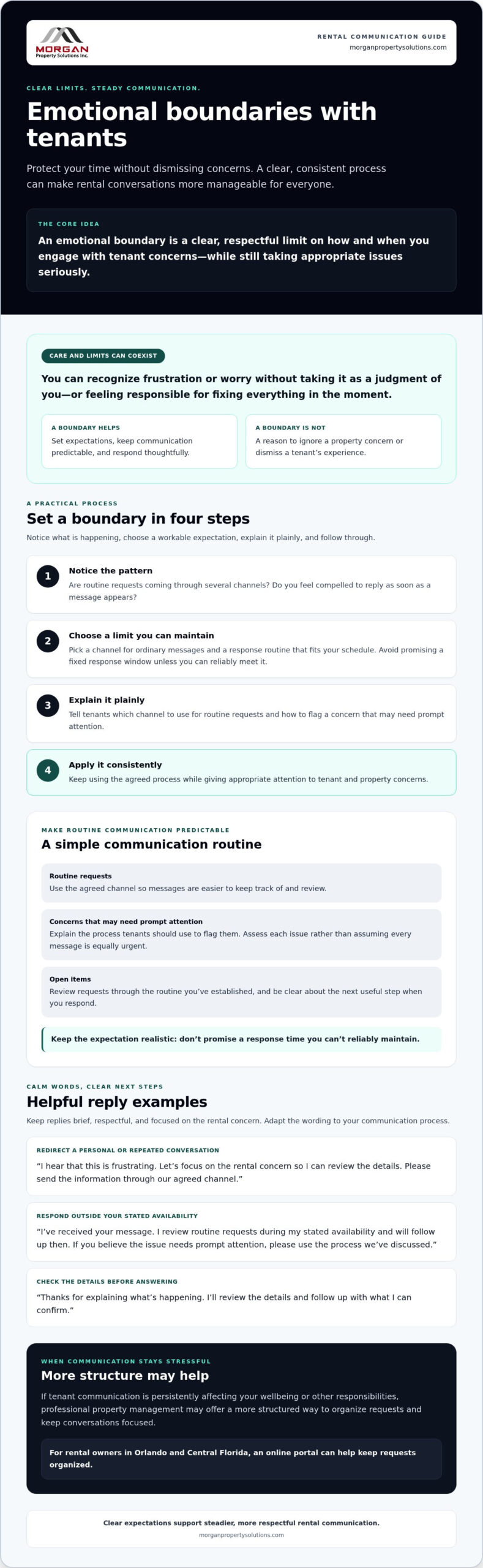
An emotional boundary is a clear, respectful limit on how and when you engage with tenant concerns, while still taking appropriate issues seriously. Setting emotional boundaries with tenants isn’t about withdrawing care. It makes communication more predictable, so you can listen and respond thoughtfully instead of feeling responsible for resolving every emotion in the moment.
You can recognize that a tenant is frustrated, worried, or disappointed without taking their feelings as a judgment of you or a demand to fix everything immediately. The idea is related to personal boundaries: limits help people understand what to expect in a relationship. In a rental setting, clear expectations can support a more respectful working relationship for both sides.
How tenant communication can spill into personal time
Repeated messages across different channels, contact outside your usual routine, or a conversation that ends without a clear next step can keep an issue on your mind. The tenant may simply be looking for an update; you may be left wondering whether to reply now or risk seeming uncaring. Without shared expectations, ordinary requests can feel more urgent than they are.
Look for patterns rather than blaming the person. Is the same question arriving by text and email? Are you checking messages during personal time because you’re unsure what can wait? Use those patterns to choose a practical limit, such as a preferred channel for routine requests or a clear way to flag concerns that may need prompt attention.
What a healthy landlord-tenant boundary looks like
A healthy boundary makes your availability clear. You might explain which channel to use for routine communication and when you generally review messages, then follow through consistently. Avoid promising a fixed response window unless you can reliably meet it. A calm limit explains what to expect without dismissing a concern or making the tenant feel at fault for raising it.
For example, “Please send routine requests through the agreed channel so I can keep track of them” is clearer than an irritated reply or no reply at all. Boundaries should never become a reason to overlook a property concern. They provide a steadier way to receive, assess, and respond to issues while keeping communication professional.
How to set emotional boundaries with tenants without losing compassion
Compassion doesn’t require unlimited access to your attention. You can care about a tenant’s concern and still set a clear limit on how you’ll address it. A steady approach helps you stay helpful without replying from guilt, frustration, or pressure.
Try this four-step process:
- Notice the pattern. Are routine requests arriving through several channels, or do you feel compelled to respond the moment a message appears?
- Choose a limit. Decide which channel you’ll use for ordinary messages and what response window you can reliably maintain.
- Communicate it plainly. Explain the expectation and how tenants can share concerns that may need prompt attention.
- Apply it consistently. Keep using the agreed process while still giving appropriate attention to property and tenant concerns.
Choose expectations you can reliably maintain
Pick a practical channel for routine questions and maintenance requests, then tell tenants how to use it. Set an ordinary response window that fits your schedule instead of promising immediate replies or a turnaround you can’t guarantee. Explain how to flag an issue that may need prompt attention, too. Follow the applicable lease terms and seek qualified guidance if you’re unsure how to handle a particular concern.
Thinking about the psychology of landlord-tenant relationships can help you separate empathy from taking every exchange personally. You can acknowledge a tenant’s frustration without accepting blame before you understand the issue or promising an outcome you can’t confirm.
Use calm scripts when a tenant pushes against a limit
Keep replies brief, respectful, and focused on the next useful step. You don’t need to defend the boundary at length. Adapt these examples to your communication process:
- To redirect a personal or repeated conversation: “I hear that this is frustrating. Let’s focus on the rental concern so I can review the details. Please send the information through our agreed channel.”
- For a message outside your stated availability: “I’ve received your message. I review routine requests during my stated availability and will follow up then. If you believe the issue needs prompt attention, please use the process we’ve discussed.”
- When you need to check before answering: “Thanks for explaining what’s happening. I’ll review the details and follow up with what I can confirm.”
These scripts aren’t a substitute for responding appropriately to a serious concern. They offer a calm starting point. If tenant communication is persistently disrupting your responsibilities, exploring Orlando property management may help you consider a more structured approach to managing the relationship.
Are boundaries uncaring? Handle difficult tenant situations professionally
No. A clear, respectful limit isn’t indifference. It helps you respond to a tenant’s concern without making the conversation personal or promising more than you can deliver. Take the issue seriously while keeping your words calm, factual, and focused on a practical next step.
If a message feels accusatory or upsetting, pause before replying. Read it again when you feel calmer, identify the specific rental or property issue, and draft a short response that addresses it. Advice on how to handle difficult tenant situations also emphasizes staying composed and assessing the facts rather than reacting in the moment.
Respond to charged messages with facts and next steps
Acknowledge the concern without agreeing to claims you haven’t checked. For example: “I understand this has been frustrating. I’ll review the details and follow up about the next step.” Keep written messages concise, factual, and suitable for the rental record. If a situation raises legal questions, seek qualified legal guidance instead of relying on an emotional exchange or general online advice.
| Response pattern | What it can sound like | Why it matters |
|---|---|---|
| Professional | “I’ve received your message. I’ll review the details and respond through our agreed channel.” | Recognizes the concern and keeps the conversation focused. |
| Reactive | “You’re always accusing me of something.” | Turns the exchange into an argument about motives. |
| Avoidant | No response or acknowledgment, even when a follow-up is needed. | Leaves expectations unclear and the issue unresolved. |
| Overly personal | Sharing private details or taking responsibility for the tenant’s feelings. | Can blur the professional relationship without resolving the rental concern. |
Keep empathy separate from personal involvement
You can say, “I’m sorry this has been stressful,” without sharing private information or stepping into a counseling role. Then guide the discussion back to the relevant property or lease matter: “Let’s focus on the repair request and what information is needed next.” This shows respect while keeping the relationship clear.
Setting emotional boundaries with tenants also means being consistent. Fair housing and Florida landlord-tenant requirements can affect how rental situations should be handled, so verify current guidance with authoritative sources or a qualified professional rather than interpreting complex rules from memory. A calm, consistent process supports respectful communication without asking you to carry every conversation personally.
A practical routine for consistent tenant communication in Central Florida
Clear expectations work best as part of a routine, not something you have to reinvent with every message. For rental owners in Orlando, Winter Park, Lake Nona, Clermont, Oveido, Windermere, Winter Garden, Apopka, Wedgefield, and Hunters Creek, a simple process can keep tenant communication organized and help protect personal time without losing track of open concerns.
Create a communication process tenants can understand
Explain in writing which channel tenants should use for routine questions and property-related requests. If you use an online portal, direct tenants there so messages and requests aren’t scattered across texts, emails, and calls. Make sure tenants know how to raise a concern that may need prompt attention, and avoid promising response times you can’t reliably meet.
A basic log can help you stay consistent. For each open item, record:
- The issue: What was reported, and when?
- Your response: What information or acknowledgment did you provide?
- The next step: What remains open, and when should you review it?
Use the same communication expectations across tenants. Reviewing open items at a regular point in your routine can prevent follow-up from relying on memory or on whoever sends the most messages. That structure makes setting emotional boundaries with tenants easier because each concern has a clear place in your process.
Know when a concern needs another kind of support
An organized process can’t answer every question. If you’re unsure about a legal issue, consult a qualified professional or current authoritative Florida landlord-tenant guidance rather than treating a general article as legal advice. This section isn’t a Florida landlord-tenant guide, and legal requirements should be verified through appropriate sources.
Pay attention to how the process is affecting you, too. If tenant messages keep disrupting other responsibilities or leave you feeling unable to switch off, reconsider how communication and property management are organized. Morgan Property Solutions Inc. provides residential property management in Orlando and Central Florida, with an online portal, detailed inspections, and financial reporting. Owners looking for more structure can explore Morgan Property Solutions Inc.’s landlord resources for relevant owner education.
When professional property management can support healthier boundaries
Self-management may suit you when you can keep communication organized, respond consistently, and handle tenant concerns alongside your other responsibilities. Consider a different approach if you find yourself checking messages constantly, carrying unresolved conversations into personal time, or struggling to follow the expectations you’ve set. These are reasons to review your process, not to feel guilty.
Professional property management can change how involved you are in routine management, though the exact arrangement depends on the provider. Before deciding, compare what you want to retain with what you’d like support handling:
| Consideration | Self-management | Professional management |
|---|---|---|
| Communication structure | You establish and maintain the process for tenant communication. | Ask how tenant requests are received, documented, and shared with you. |
| Owner involvement | You remain directly involved in routine interactions and follow-up. | Clarify which decisions or updates will still need your attention. |
| Reporting | You organize and review your own records and financial information. | Ask what reporting is provided and how you’ll receive financial information. |
Decide what kind of support would help
Think about the balance you want between direct control and less personal involvement in day-to-day management. Ask yourself: Can I maintain clear expectations and follow through? Do I want to remain the main point of contact for every routine question? What information would help me feel informed without managing each exchange myself? Your answers can help you compare providers and understand the scope of their residential property management services.
Before choosing a manager, ask how tenant requests are handled, how interactions are documented, what gets shared with owners, and how updates and financial reporting work. Confirm the details rather than assuming every company follows the same process. Morgan Property Solutions Inc. serves Orlando and Central Florida, with an online portal, online payments, detailed inspections, and financial reporting. These are useful specifics to discuss as you assess whether professional support fits your needs.
Explore a more structured approach
Setting emotional boundaries with tenants can be harder when every communication and follow-up rests with you. To understand what support may look like, explore Orlando property management services from Morgan Property Solutions Inc. and consider whether a more structured approach could help you manage your rental with clearer boundaries.
Build a more sustainable landlord-tenant relationship
Clear boundaries help keep tenant communication respectful and professional. With expectations you can maintain and a consistent way to track concerns, you can care about tenants’ needs without letting every exchange take over your personal time.
If you’d like support managing your rental, Morgan Property Solutions Inc. provides residential property management in Orlando and Central Florida. Its services include an online portal, online payments, detailed inspections, and financial reporting, with over 20 years of combined experience.
Consider whether a more structured approach fits your needs. Explore Orlando property management and take a confident next step toward a more sustainable landlord-tenant relationship.
Frequently Asked Questions
How do you set emotional boundaries with tenants?
Start by identifying which interactions feel unsustainable, such as routine requests arriving through several channels or messages that make it hard to switch off. Choose a preferred channel and explain your usual availability for routine communication. Share these expectations calmly, in writing where useful, and apply them consistently. Boundaries don’t excuse ignoring property concerns. For legal responsibilities or urgent situations, check current authoritative guidance instead of relying on a general article.
Is it uncaring to set boundaries with tenants?
No. A respectful boundary makes communication clearer; it doesn’t mean refusing to help. You can acknowledge a concern, explain the appropriate channel, and identify a practical next step without taking on personal responsibilities beyond the rental relationship. Keep your tone calm and follow through consistently. Boundaries don’t replace applicable legal or lease obligations, so make sure your communication limits don’t interfere with responsibilities that apply to the specific situation.
Can landlords stop responding to tenants after hours?
Don’t rely on a blanket rule to ignore messages without considering the issue and your responsibilities. You can state your availability for routine requests and explain how tenants should report concerns, but avoid promising a response time you can’t maintain. For a specific situation, review the lease and current Florida requirements before deciding how to respond. Don’t assume every after-hours message can wait or that one rule covers every concern.
What should I say when a tenant keeps contacting me about the same issue?
Acknowledge the repeated concern, summarize what you know, and state the next practical step without arguing or promising an unverified outcome. For example: “I understand you’re following up. I’ve recorded the concern and will update you through our agreed channel when I have more information.” Keep relevant messages organized, and ask the tenant to use the established channel for updates. If the issue raises legal, safety, or habitability questions, seek qualified guidance.
How can I handle an angry tenant without taking it personally?
Pause before replying, separate the stated concern from the tone, and focus on verifiable facts and next steps. A brief, professional response keeps attention on the rental issue rather than escalating the exchange. Don’t match anger or share private details. If the communication feels unsafe or the issue may have legal implications, document relevant interactions and seek appropriate professional support. You can be respectful without accepting blame or making assumptions about the tenant’s intent.
When should I hire a property manager to handle tenant communication?
Consider professional management if tenant communication regularly disrupts personal life, you struggle to maintain clear expectations, or you want more structure. Ask how tenant requests are received and documented, how owner updates work, and what inspections and financial reporting are included. Morgan Property Solutions Inc. provides residential property management in Orlando and Central Florida, including an online portal, online payments, detailed inspections, and financial reporting. Management can offer support, but it can’t guarantee every interaction will be easy.
Do emotional boundaries change a landlord’s legal responsibilities in Florida?
No. Communication boundaries don’t determine or replace legal responsibilities. Review the lease and current authoritative Florida guidance for the specific issue, and consult a qualified attorney if you need legal interpretation. A Florida landlord-tenant guide can provide general educational context, but it isn’t a substitute for advice about your circumstances. Requirements can depend on the situation, so don’t rely on a general article or an informal communication rule to decide what applies.

Article by
Oliver Overton-Morgan
Oliver Overton-Morgan is a full-time Real Estate Broker since 2003, with years of experience helping thousands of people purchase and sell real estate throughout Central Florida. He holds a Graduate Realtor Institute designation, LCAM, and has held licenses in good standing as a Florida Mortgage Broker and a Notary Public. Oliver immigrated to central Florida in 2001, and within 5 years Oliver built a successful Real Estate brokerage in central Florida, where he recruited over 75 Sales Associates with 25+ million in sales production.