
A lease renewal isn’t automatic, and a Florida landlord generally doesn’t have to explain a decision not to offer one. If you’re wondering, can a landlord refuse to renew a lease in Florida for no reason, the short answer is generally yes, as long as the decision isn’t discriminatory or retaliatory and the required notice is handled correctly.
Important details can change what happens next: Does the lease set a notice deadline? Is it a fixed-term lease or a month-to-month tenancy? What should you keep in writing if the reason for nonrenewal feels questionable? Nonrenewing a lease at the agreed end date is different from ending a tenancy early or pursuing an eviction. This guide covers the general Florida rule and its limits, explains which lease terms and notice details to review, and offers practical steps for documenting communications and planning ahead. For owners in Orlando and Central Florida, organized lease administration can help keep renewal decisions, offer letters, and records clear for everyone involved.
Key Takeaways
- In many cases, can a landlord refuse to renew a lease in Florida for no reason? Yes, but a nonrenewal still can’t be based on a prohibited motive.
- A lease ending and an eviction are different situations. Knowing which applies can help you understand the next steps.
- Check whether the agreement is fixed-term or periodic, then review its renewal language and notice requirements.
- Landlords and tenants can reduce confusion by tracking key dates, communicating in writing, and keeping lease and notice records.
- Organized renewal administration can help owners manage the process, from a mid-year inspection and rent-rate analysis to offer letters and new lease drafting.
Can a Landlord Refuse to Renew a Lease in Florida Without a Reason?
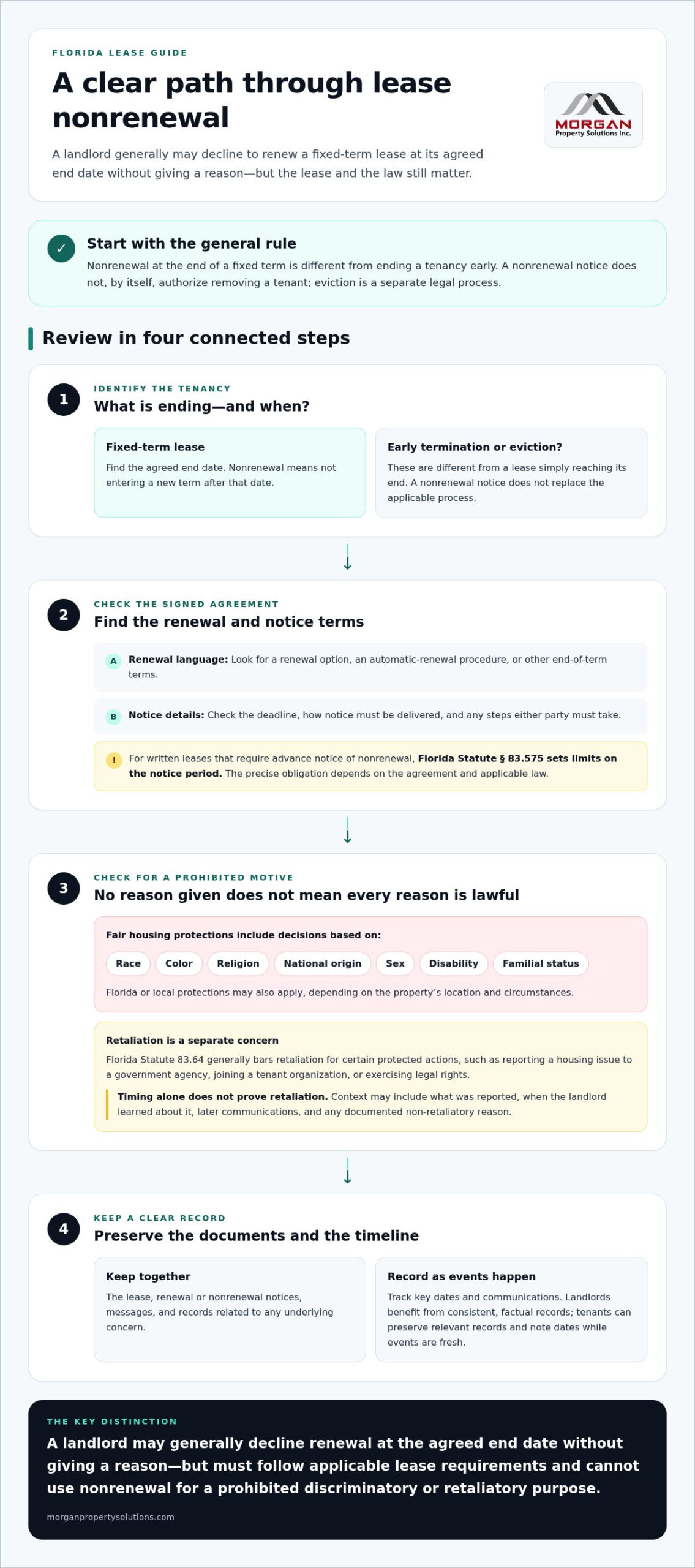
Generally, a Florida landlord may choose not to renew a fixed-term lease when its agreed term ends, even without giving a reason, as long as the decision doesn’t violate the law or the lease’s requirements. Renewal clauses, notice provisions, and the type of tenancy can affect the steps required. Before relying on a general rule, read the signed agreement and identify the date the current term ends.
A lease reaching its end is different from a landlord trying to remove a tenant before the term is over. Nonrenewal concerns what happens when the agreed term ends. Eviction is a legal process for removing a tenant who remains in a property or whose tenancy is being ended under other circumstances. A nonrenewal notice doesn’t authorize a landlord to remove a tenant without following the applicable process.
A landlord may decide not to renew without giving a reason, but may not use nonrenewal to carry out an unlawful discriminatory or retaliatory motive.
What does nonrenewal mean when a fixed-term lease ends?
With a fixed-term lease, the parties agree to a rental period with a defined end date. Nonrenewal means the landlord decides not to enter a new term after that date. It isn’t the same as ending the current agreement early, and it doesn’t by itself resolve what happens if the tenant stays after the term ends.
Lease terms vary. An agreement may describe a renewal option, an automatic-renewal procedure, or a deadline for giving notice. Others may handle the end of the term differently. Don’t assume the lease renews automatically or that every fixed-term lease ends under identical conditions. Check the language in the specific agreement.
Does a landlord generally have to explain the decision?
As a general rule, a landlord doesn’t have to provide a reason for declining to renew a fixed-term lease. That doesn’t make every reason lawful. A decision can still cross legal boundaries if it is driven by a prohibited motive, and the absence of an explanation doesn’t establish that the decision was proper.
Start with the signed lease. Look for language about renewal, notice, how notice must be delivered, and any steps either party must take before the end date. For written leases that require advance notice of nonrenewal, Florida Statute § 83.575 sets limits on the notice period. The precise obligation depends on the agreement and applicable law, so don’t assume a general timeline overrides the written terms.
For general background, landlord-tenant law covers the rights and responsibilities that shape rental relationships. Florida’s specific rules and the lease itself matter for a particular property. Keep the agreement and any renewal or nonrenewal communications together so both sides can see what was decided and when.
When Can a Florida Lease Nonrenewal Cross a Legal Line?
A landlord may not need to give a reason for declining to renew, but “no reason given” doesn’t excuse a prohibited motive. If you’re asking, can a landlord refuse to renew a lease in Florida for no reason, the answer depends in part on whether the decision is lawful or masks discrimination or retaliation. The question isn’t only what the notice says. It’s also whether the decision was based on a reason the law forbids.
A landlord may choose not to renew a lease at its end, but may not base that decision on a tenant’s protected characteristic or use it to punish the tenant for protected activity.
How can discrimination concerns affect a nonrenewal?
Federal fair housing law prohibits housing decisions based on race, color, religion, national origin, sex, disability, or familial status. A landlord can’t use nonrenewal to treat a tenant differently because of a characteristic protected by applicable law. Florida or local protections may also apply, so the relevant rules can depend on the property’s location and circumstances.
For example, if a tenant believes a renewal was refused because of a protected characteristic, the fact that the landlord gave no reason doesn’t settle the concern either way. The decision’s context and available records may matter. A neutral-sounding explanation doesn’t automatically make a decision lawful, and a tenant’s suspicion alone doesn’t prove discrimination.
When might a nonrenewal raise retaliation concerns?
Retaliation is separate from discrimination. Under Florida Statute 83.64, a landlord generally may not retaliate against a tenant for certain protected actions, such as making a complaint to a government agency about a housing issue, joining a tenant organization, or exercising legal rights. The statute and its application depend on the facts. Florida Statutes, Chapter 83 provides the state’s landlord-tenant framework, including the provision addressing retaliation.
Timing can prompt a closer look, but it doesn’t establish retaliation by itself. A nonrenewal that follows a tenant complaint may raise a question, yet the sequence alone doesn’t prove that the complaint caused the decision or that a violation occurred. Relevant context may include what the tenant reported, when the landlord learned about it, what communications followed, and whether there is a documented, non-retaliatory reason for the decision.
Both parties can clarify events by keeping the lease, notices, messages, and records related to the underlying concern. Landlords benefit from documenting renewal decisions consistently and keeping communications factual. Tenants who are concerned can preserve relevant records and write down dates while events are fresh. Avoid drawing a firm legal conclusion from one message or a close timeline alone.
For owners, organized lease administration can help keep renewal communications and records clear. Orlando property management can include support with lease renewals and related documentation.
How Do Florida Notice Rules Differ by Lease Type?
The notice process depends on whether the agreement has a defined end date or continues in rental periods. If you’re asking, can a landlord refuse to renew a lease in Florida for no reason, the next practical question is when and how notice must be given. The lease language matters, and state rules distinguish a fixed-term agreement from a month-to-month tenancy.
The comparison below summarizes general state rules. Treat the timeframes as deadlines to verify against the current statute, the signed agreement, and any applicable local requirements. The Florida Residential Landlord Tenant Act overview from The Florida Bar offers broader context on Florida rental agreements and termination.
| Tenancy type | General notice framework | What to check |
|---|---|---|
| Fixed-term lease | If the written lease requires nonrenewal notice, Florida Statute § 83.575 sets a period of 30 to 60 days. | End date, renewal clause, notice deadline, and delivery method. |
| Month-to-month tenancy | Florida Statute § 83.57 generally requires at least 30 days’ written notice before the end of a monthly period. | Notice date, rental-period end date, and any applicable local rule. |
What should readers check in a fixed-term lease?
Start with the expiration date, then find any renewal option or automatic-renewal language. Check whether the agreement requires either party to give notice, how far in advance it must be given, and how notice must be delivered. A provision may require action even if neither party plans to change the rent or other terms.
Read the wording alongside § 83.575 rather than assuming one deadline fits every lease. The statute limits a required notice period to between 30 and 60 days, but the agreement’s specific terms still matter. For example, a lease may set a 60-day notice requirement. Mark the deadline and preserve a copy of any notice sent or received.
How is a month-to-month tenancy different?
A month-to-month tenancy has no single fixed expiration date in the same way as a lease with a set end date. Under § 83.57, the general state requirement is at least 30 days’ written notice before the end of a monthly rental period. Timing is tied to that period, so count from the relevant end date rather than assuming notice can take effect on any day of the month.
Local rules may add requirements. For example, Orange County has a 60-day written notice requirement for terminating a month-to-month or quarterly tenancy. Confirm which rule applies to the property and read it together with the agreement.
A fixed-term lease doesn’t automatically become month-to-month in every situation. What happens after the stated end date depends on the agreement and the parties’ actions. Owners can keep renewal deadlines and communications organized through Orlando property management.
What Should Landlords and Tenants Do Before a Florida Lease Ends?
A calm, organized process helps both sides understand what happens next. Can a landlord refuse to renew a lease in Florida for no reason? The answer can depend on the agreement, notice rules, and facts behind the decision. Before the lease ends, focus on four practical steps: review the paperwork, mark important dates, communicate clearly, and keep a complete record.
- Review the agreement. Find the expiration date, renewal language, and any notice provision. Check amendments too, since they may have changed the original terms. Make sure you’re working from the signed, current version.
- Identify deadlines. Put the lease end date and any notice deadline on a calendar. If the date or calculation is unclear, don’t guess. The tenancy type, lease wording, and applicable rules can affect how timing works.
- Communicate in writing. State whether you’re offering renewal, declining it, or asking about the tenant’s plans. Keep the message factual and consistent with the agreement. If a conversation takes place by phone or in person, make a dated note of what was discussed.
- Retain the records. Save the agreement, notices, messages, and any delivery records together. Organized files make it easier to establish what was sent, when it was sent, and what each party understood.
These steps help clarify the process; they don’t guarantee a particular legal outcome. If a landlord changes plans, for example, keeping a copy of the original notice and the later communication can help show how the decision developed. Tenants should keep their own copies rather than relying only on a landlord’s or manager’s records.
What records can help clarify a nonrenewal?
Keep the signed lease and amendments, written renewal or nonrenewal notices, and dated communications such as emails, texts, and letters. Include relevant records about delivery and any discussion that explains a change in plans. Both sides should preserve complete messages, not just selected lines, and avoid editing or annotating the original documents. A factual timeline can help an attorney assess a dispute.
When should someone seek case-specific legal advice?
Consider speaking with a Florida landlord-tenant attorney if lease provisions conflict, the parties disagree about whether notice was properly given, or the circumstances suggest possible discrimination or retaliation. Bring the relevant documents and a brief timeline so the attorney can review the specific facts. An article can explain general concepts, but it can’t determine the outcome of an individual dispute or interpret every lease.
For owners who want a more organized renewal process, professional property management can help keep lease terms, dates, and communications in one clear workflow. Explore property management support for rental owners in Orlando and Central Florida.
How Can Professional Property Management Help Owners Handle Renewals?
A renewal involves more than deciding whether to keep a tenant. Owners also need to track the lease term, consider the next rental period, communicate an offer or nonrenewal clearly, and keep paperwork organized. A consistent process makes each step easier to follow and can reduce confusion for both the owner and tenant.
Owners may ask, “Can a landlord refuse to renew a lease in Florida for no reason?” A property manager can help organize the renewal process, but management doesn’t change the legal limits on a landlord’s decision. The lease and applicable rules still matter, and no process can guarantee that a tenant will accept an offer or that a disagreement won’t arise.
What can a managed renewal process include?
Morgan Property Solutions’ lease renewal services include a mid-year inspection, rent-rate analysis, offer letters, and new lease drafting. Together, these steps give owners a structured way to review the tenancy and prepare for the lease end date rather than leaving renewal decisions until the last minute.
A rent-rate analysis can inform an owner’s renewal decision, while an offer letter puts proposed terms in writing for the tenant to consider. If the parties agree to continue, drafting a new lease documents the terms of the next rental period. Clear paperwork helps everyone understand what has been proposed and agreed, though it can’t ensure acceptance or prevent every dispute.
Organized administration also keeps dates and communications connected to the right lease. For example, a written record of an offer and the tenant’s response helps show how the renewal discussion progressed. Morgan Property Solutions’ property management offering includes attorney-written leases. These leases support the management process, but they don’t make the company a legal adviser or replace case-specific advice from an attorney.
Where can Orlando-area owners find management support?
Morgan Property Solutions provides residential property management in Central Florida. For owners, a consistent process for tracking lease dates, renewal communications, and documents can make administration more manageable while keeping decisions clear. The goal is an orderly process, not a promise of a particular legal or leasing outcome.
If you own a rental in Orlando or the surrounding Central Florida area, you can explore Orlando property management to learn about support with lease renewals and ongoing property management. Morgan Property Solutions serves owners in Orlando, Winter Park, Lake Nona, Clermont, Oveido, Windermere, Winter Garden, Apopka, Wedgefield, and Hunters Creek. Learn about the management process and discuss your rental property’s needs.
Plan Your Next Lease Renewal With Confidence
A lease decision is easier to manage when it’s planned before the end date approaches. For owners, that means treating renewal as part of ongoing property care, not a last-minute task. For tenants, it means asking clear questions and keeping important communications together. If you’re still wondering, can a landlord refuse to renew a lease in Florida for no reason, remember that the decision must stay within the law and follow the applicable lease and notice requirements.
When the process feels complicated, steady support can help bring the dates, documents, and next steps into focus. Morgan Property Solutions brings over two decades of Central Florida real estate sales and leasing experience to residential property management, including lease renewal support. An organized process helps owners approach each renewal with clear communication and well-kept records.
Ready to make lease administration more manageable? Explore Orlando property management support and take a practical next step for your rental property. A clear plan can make the road ahead feel simpler.
Frequently Asked Questions
Can a landlord refuse to renew a fixed-term lease in Florida without giving a reason?
Generally, yes. If you’re asking, can a landlord refuse to renew a lease in Florida for no reason, a landlord may usually decline to offer another term when a fixed-term lease expires, subject to legal protections and the lease’s requirements. For example, an owner might decide to use the property differently. Check the renewal clause and any notice terms before acting, and don’t assume that silence from either party automatically renews the agreement.
Does a Florida landlord have to give written notice of nonrenewal?
It depends on the tenancy and the lease. A fixed-term agreement may require notice under its own terms, while Florida law sets notice rules for certain tenancies. If a fixed-term lease requires advance nonrenewal notice, statutory limits apply. For month-to-month tenancies, written notice is generally required. Keep a copy of the notice and any record of how and when it was delivered, since those details can matter if the timing is disputed.
Can a landlord refuse to renew a lease as retaliation in Florida?
No, a landlord can’t use nonrenewal to retaliate against a tenant for protected activity covered by Florida law. Florida Statute § 83.64 addresses landlord retaliation, including certain tenant complaints or the exercise of legal rights. A tenant who believes this may have happened should preserve relevant messages, complaint records, and notices. Timing may be part of the context, but it doesn’t by itself prove that a landlord acted unlawfully.
Can a Florida landlord refuse to renew a lease for discriminatory reasons?
No. Federal fair housing law prohibits discrimination in housing decisions based on protected characteristics, including race, color, religion, national origin, sex, disability, and familial status. Other protections may apply under Florida or local law, depending on the situation. A tenant concerned about discrimination can keep communications and write down specific events and dates. A Florida landlord-tenant attorney or fair housing agency can help assess the facts and explain possible next steps.
What happens if a tenant stays after a Florida lease is not renewed?
The outcome depends on what the landlord and tenant do after the stated lease end. If the tenant remains and the landlord accepts rent, the arrangement may become a month-to-month tenancy, which can require a new notice process to end. If the landlord doesn’t agree to continued occupancy, the tenant shouldn’t assume they can stay indefinitely. Owners should follow the required legal process rather than trying to remove a tenant themselves.
Is a month-to-month lease different from a fixed-term lease for nonrenewal in Florida?
Yes. A fixed-term agreement has a defined end date, while a month-to-month tenancy continues by rental periods and follows separate termination-notice rules. Florida generally requires 30 days’ written notice for a month-to-month tenancy; Orange County has a 60-day rule. Owners in Orlando, Winter Park, Lake Nona, Clermont, Oviedo, Windermere, Winter Garden, Apopka, Wedgefield, and Hunters Creek should identify the property’s jurisdiction before relying on a notice timeline.
Can a landlord change the lease terms instead of renewing the same lease?
Yes, a landlord can propose different terms for a new lease, such as a different rent amount or updated provisions, for the tenant to consider. That proposal doesn’t by itself change the current agreement before it ends. The tenant can decide whether to accept the offer, and the parties should document any agreement in writing. Notice rules and legal protections still apply, so a proposed change can’t be used to bypass them.

Article by
Oliver Overton-Morgan
Oliver Overton-Morgan is a full-time Real Estate Broker since 2003, with years of experience helping thousands of people purchase and sell real estate throughout Central Florida. He holds a Graduate Realtor Institute designation, LCAM, and has held licenses in good standing as a Florida Mortgage Broker and a Notary Public. Oliver immigrated to central Florida in 2001, and within 5 years Oliver built a successful Real Estate brokerage in central Florida, where he recruited over 75 Sales Associates with 25+ million in sales production.