
Florida’s landlord-tenant rules are easier to work with when you treat them as a checklist for the life of a rental, rather than a stack of legal language. If notices, deposits, records, and responsibilities feel hard to translate into daily decisions, you’re not alone. This landlord guide to florida statute 83 explains how Chapter 83 relates to residential rentals and why an old lease or checklist shouldn’t be your only reference.
You’ll learn where to find the current official statute, how to build a repeatable habit for checking requirements and documenting rental activity, and when to seek advice from a qualified Florida attorney. We’ll also connect the rules to practical property-management routines, including leasing, maintenance coordination, and recordkeeping. In Orlando and across Central Florida, professional management can help owners keep these tasks organized. Morgan Property Solutions Inc. uses attorney-written leases as part of its management process, not as a substitute for individualized legal advice.
Key Takeaways
- Use Chapter 83 as a starting point for understanding residential rental responsibilities, then check the current official statute for the rules that apply to your situation.
- A signed lease is only one part of managing a rental. Review relevant statutory requirements alongside the lease terms.
- Keep deposits, rent notices, and tenancy changes organized as separate processes, with records that help you track what happened and when.
- Follow a repeatable landlord guide to florida statute 83: identify the issue, find the applicable section, confirm it applies, document your actions, and seek legal advice when needed.
- Professional management can help coordinate leasing, rent collection, inspections, maintenance, and property records in Central Florida.
Florida Statute 83 for landlords: what the chapter covers and where to start
Statutory wording can feel far removed from everyday rental decisions. You might be trying to work out which rules apply to a lease, tenant concern, or management task, only to find that the language raises more questions. A useful landlord guide to florida statute 83 starts by narrowing the search to the right part of the law, then checking the current official text before acting.
Florida Statute Chapter 83 sets out rules for landlord-tenant relationships, and the official Florida Statutes are the primary source for its current requirements. The chapter is part of the broader framework of landlord-tenant law, but general explanations, templates, and lease wording aren’t substitutes for the statute itself. For a question that depends on your rental’s facts, consult a qualified Florida attorney.
Which parts of Chapter 83 should residential landlords look at?
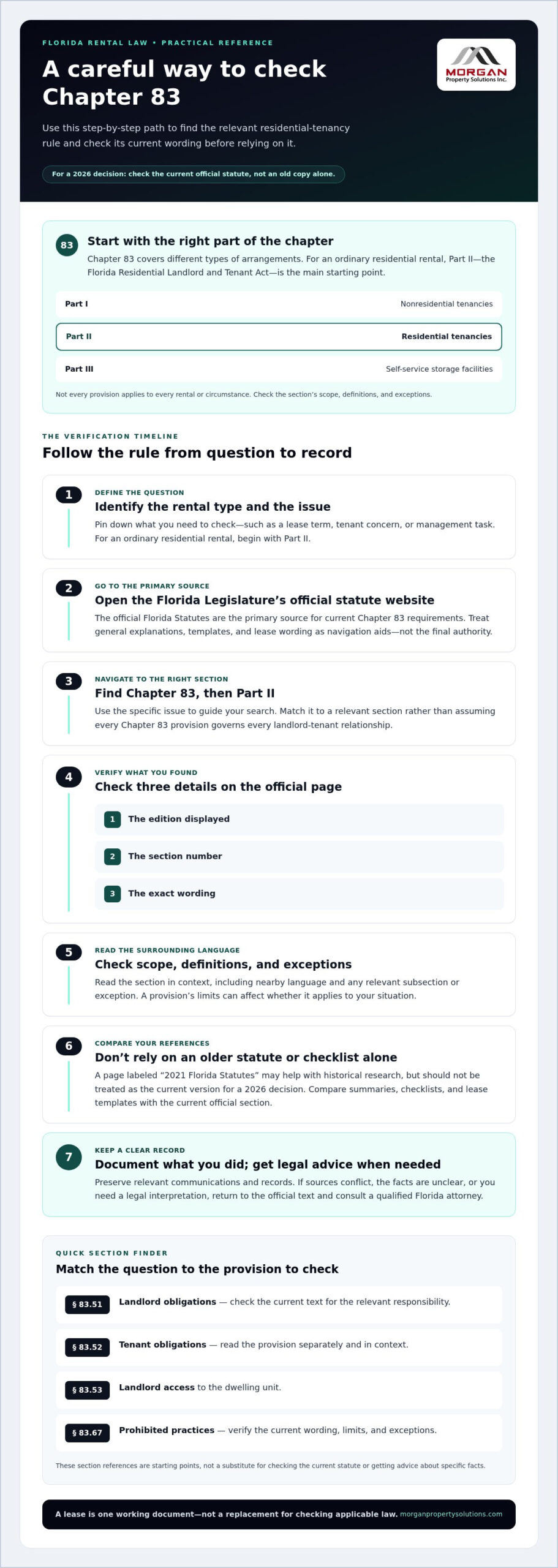
Chapter 83 covers more than one kind of arrangement. Part I addresses nonresidential tenancies, Part II is the Florida Residential Landlord and Tenant Act, and Part III covers self-service storage facilities. For an ordinary residential rental, Part II is the main starting point. Not every provision necessarily applies to every rental or circumstance. Read the section’s language and scope, including any definitions or exceptions, before treating it as a rule for your situation.
This distinction helps prevent a common misstep: finding a provision in Chapter 83 and assuming it governs every landlord-tenant relationship. First identify the type of rental and the issue at hand. Then find the relevant part and section. If the facts don’t fit neatly, seek legal advice rather than relying on a general summary.
How to check that the statute is current in 2026
Start with the Florida Legislature’s official statute website. Locate the Florida Statutes, open Chapter 83, and go to Part II for residential-tenancy provisions. Before relying on a rule, check three details: the edition displayed, the section number, and the exact wording. Read the surrounding language too, since a subsection or exception may affect how the rule applies.
A page labeled “2021 Florida Statutes” can be useful for historical research, but it shouldn’t be treated as the current version for a 2026 decision. Laws and statutory wording can change. Compare older material with the current edition shown on the Legislature’s site, and confirm that a summary, checklist, or lease template points to the same current section. If there’s a mismatch or uncertainty, return to the official text and seek advice from a qualified Florida attorney before taking action.
Use summaries and templates as navigation aids, not as the final authority. Checking the source gives owners and property managers a clear first step, without relying on a lease or an old checklist to answer a legal question on its own.
Florida Statute 83 landlord duties: what a lease cannot replace
A signed lease sets out terms agreed to by a landlord and tenant, but it doesn’t replace checking the laws that apply to the rental. If a lease clause and a statutory requirement seem to point in different directions, don’t assume the contract settles the question. Read the relevant statute in context and get legal advice when the answer depends on the lease or the facts.
A lease records agreed rental terms; Chapter 83 provides the statutory framework those terms must be read within. That distinction is central to any landlord guide to florida statute 83. A lease is an important working document, but the applicable law can affect how its terms operate. A plain-language overview from The Florida Bar’s Rights and Duties of Tenants and Landlords under Florida Law can help orient readers. For a specific dispute or legal interpretation, consult a qualified Florida attorney.
How to read landlord and tenant responsibilities together
Start with the current official text of Florida Statutes section 83.51, which addresses a landlord’s obligations, and section 83.52, which addresses a tenant’s obligations. Read each provision separately, then consider how they relate to the lease and the issue at hand. The lease can document agreed responsibilities and procedures, but it shouldn’t be treated as permission to disregard a governing statute.
For example, if a tenant reports a repair issue, review the relevant lease language and statutory text before deciding what to do next. This example doesn’t establish who is responsible for a particular repair. The answer may depend on the property, the circumstances, and current law.
Maintenance, access, and conduct: verify the rule before acting
Different questions point to different provisions. Section 83.51 concerns landlord obligations, section 83.53 addresses a landlord’s access to the dwelling unit, and section 83.67 addresses prohibited practices. Section 83.52 covers tenant obligations. Check the current text of each applicable section, including its limits and exceptions, rather than relying on a remembered rule or a clause read in isolation.
This matters in routine management. A maintenance concern, a request to enter a unit, and a concern about conduct are different situations. Identify the specific issue first, then match it to the relevant lease terms and statute. Don’t infer a deadline, permission, or remedy from a general summary when the exact wording could change the answer.
Keep the process practical: document the concern, identify the section that may apply, and preserve relevant communications and records. That creates a clearer account of what happened, but it doesn’t resolve a legal dispute. For fact-specific questions about responsibility, access, or prohibited conduct, ask a qualified Florida attorney to interpret how the law applies.
Owners who want help organizing routine rental administration can use Orlando residential property management to bring leasing, maintenance coordination, and recordkeeping into a more consistent process. Management support can help with day-to-day administration, while legal questions remain a matter for an attorney.
Deposits, rent notices, and ending a tenancy under Florida Statute 83
A security deposit question, unpaid rent, and a decision to end a tenancy can involve formal steps, but they aren’t the same process. Handle deposit, rent, and termination procedures separately because each has its own statutory provisions, conditions, and records. For a reliable landlord guide to florida statute 83, identify the issue first, then verify the corresponding section in the current official Florida Statutes before acting.
The sections below are starting points for locating the relevant rules, not a substitute for checking the full text. Read the applicable subsection and any exceptions. The right procedure can depend on the lease, the tenancy, and the facts involved.
Security deposits: identify the applicable rule and preserve records
Start with Florida Statutes section 83.49, which addresses security deposits and advance rent. Review its current wording for the deposit arrangement, applicable notices, and any exceptions relevant to your situation. Keep the signed lease, records showing payment and handling of the deposit, related correspondence, and move-in or move-out documentation together. Clear records can help establish what was agreed, received, communicated, and observed, but they don’t guarantee a particular outcome in a dispute.
Rent notices and tenancy termination: keep procedures distinct
For rent-related termination questions, section 83.56 includes provisions addressing nonpayment and termination of a rental agreement. Other termination situations may involve different statutory sections, including sections 83.57 and 83.575. Don’t assume one notice or process applies to every reason for ending a tenancy. Verify the current statutory conditions and the facts before preparing or delivering a notice. Notice requirements are distinct from any later court process.
| Topic | Relevant official section | Action to verify | Records to retain |
|---|---|---|---|
| Security deposit | Section 83.49 | Check which deposit provisions and notice rules apply to the arrangement. | Lease, payment records, correspondence, and move-in or move-out documentation. |
| Rent nonpayment | Section 83.56 | Confirm the current legal conditions and notice procedure for the situation. | Lease, payment history, communications, and copies of notices and delivery records. |
| Ending a tenancy | Sections 83.56, 83.57, or 83.575, depending on the issue | Identify the reason and tenancy type, then verify the section that governs. | Lease and amendments, relevant communications, and notice records. |
Use the table as a filing guide, not a substitute for reading the statute. Before taking action, match the issue to the right section and confirm that the provision applies to the tenancy. Keep records in a way that lets you follow the timeline without relying on memory.
If a notice’s wording, timing, delivery, or legal effect is uncertain, pause and speak with a qualified Florida attorney. A general explanation can help you find the right question, but it can’t resolve a fact-specific situation or direct a particular case.
A practical Florida Statute 83 compliance workflow for landlords
Knowing where a rule appears is only the first step. A repeatable process can help you apply the right section to a rental issue, keep a clear record of what you did, and recognize when a question needs legal advice. Use this workflow as an organizational aid, not a guarantee of compliance. A useful landlord guide to florida statute 83 starts with a reliable habit: verify the current law before acting.
- Identify the issue. Define what needs attention, such as a lease update, repair concern, tenant communication, or change to a rental procedure. Avoid treating different situations as if they raise the same legal question.
- Locate the current section. Find the applicable provision in the current official Florida Statutes. Note the section number and read the relevant text in context, including language that may affect its scope.
- Verify that it applies. Consider the rental arrangement, lease terms, and facts involved. If the statutory language or its application is unclear, don’t rely on a template or general summary to settle the issue.
- Document the action. Record what happened, when it happened, what was communicated, and any follow-up. Keep the supporting documents with the property’s records.
- Seek counsel when needed. Pause for advice from a qualified Florida attorney if facts are disputed, a legal interpretation is uncertain, litigation is threatened, or the tenancy presents unusual circumstances.
Build a repeatable recordkeeping process
Set up a consistent record for each property. Keep current and prior lease versions, applications, notices, payment history, tenant communications, and inspection reports organized so you can find related materials together. For an important communication, record its date, delivery details, response, and follow-up. Preserve original documents; don’t alter or backdate a record to make it appear different.
Separate routine rental administration from confidential information, and handle personal records carefully under applicable privacy requirements. Clear files support continuity when a property changes hands or a question arises. They’re an organizational tool, not proof by themselves that a particular legal requirement has been met.
Know when to pause and get legal guidance
Some questions can’t be resolved with a checklist. If the parties disagree about what happened, a provision is difficult to interpret, litigation is threatened, or the tenancy has unusual facts, stop before taking a consequential step and consult a qualified Florida attorney. An online summary or property-management article can help you identify an issue, but it isn’t individualized legal advice.
Build a review point into your process before updating a lease or making a material change to rental procedures. Check the current statute again rather than assuming existing forms still reflect current requirements. Morgan Property Solutions Inc.’s Florida landlord-tenant law guide can be a helpful educational reference alongside the official text.
For help organizing routine leasing, records, and property administration in Central Florida, explore residential property management with Morgan Property Solutions Inc. Management support can help keep everyday tasks moving; fact-specific legal questions belong with a qualified attorney.
How professional property management supports Florida Statute 83 processes
Understanding the law is one part of managing a rental. Keeping leasing, maintenance, payments, and property records organized takes steady attention too. A professional manager can help owners build consistent routines for these everyday tasks, making it easier to find relevant documents and follow activity over time. That administrative support complements a landlord guide to florida statute 83, but it doesn’t replace checking current law or getting legal advice when a specific situation calls for it.
Which routine management tasks can be organized professionally?
Leasing administration can bring tenant screening and lease preparation into a structured process. Morgan Property Solutions Inc. provides comprehensive tenant screening and attorney-written leases containing pro-landlord clauses. A lease is one part of organized management, not a promise of legal representation or individualized legal advice. Questions about how a law applies to a particular tenant, property, or dispute should go to a qualified Florida attorney.
Ongoing management can also connect routine tasks and records. Online rent payments and financial reporting help owners keep payment activity and property finances organized. Photo inspection reports document property condition, while maintenance coordination helps manage repair-related activity. These are practical management functions, not a guarantee that a rental complies with every statutory requirement. Owners still need to verify applicable rules and address legal questions appropriately.
For example, if a tenant reports a maintenance concern, a manager can coordinate the operational response and maintain related records. The legal significance of the issue, including what a landlord must do in the specific circumstances, may require separate review. Keeping the administrative record clear can support follow-through, but it doesn’t settle a legal interpretation.
A local management partner for Central Florida rental owners
Morgan Property Solutions Inc. manages residential properties in Central Florida, including the Orlando area. Its management work brings leasing, online payments, inspections, maintenance coordination, and financial reporting together as part of ongoing property administration. For owners, that structure can reduce the burden of tracking each task across separate files and communications, while creating a more consistent way to oversee rental activity.
Attorney-written leases containing pro-landlord clauses are one element of that process. They don’t create an attorney-client relationship, provide legal representation, or answer every fact-specific legal question. A qualified Florida attorney remains the right resource for advice on a particular dispute or interpretation of the law.
Morgan Property Solutions Inc. serves rental owners in Orlando, Winter Park, Lake Nona, Clermont, Oveido, Windermere, Winter Garden, Apopka, Wedgefield, and Hunters Creek. To get support with the day-to-day work of a rental, explore residential property management with Morgan Property Solutions Inc. A steady management process can help keep leasing and property administration moving while you focus on ownership decisions.
Make your next rental decision with confidence
Use the landlord guide to florida statute 83 to build a habit you can carry into every rental decision: pause, check the current rule, and make sure your next step fits the situation. A simple review routine can keep legal research from becoming a last-minute scramble, especially when a lease or management practice is due for an update. If a question turns on specific facts or legal interpretation, bring it to a qualified Florida attorney.
Managing a rental also means keeping everyday responsibilities moving while you focus on ownership. Morgan Property Solutions Inc. works with residential property owners across Central Florida, helping organize the ongoing work behind a rental. Property management includes online payments, detailed photo inspection reports, financial reporting, and 24/7 maintenance coordination.
Explore residential property management with Morgan Property Solutions Inc. A steady process can help you stay focused on your property while routine management tasks are handled.
Frequently Asked Questions
Is Florida Statute Chapter 83 the same as Florida landlord-tenant law?
Chapter 83 is a central statutory source for Florida landlord-tenant rules, but it may not answer every legal question on its own. A rental issue can also involve other current laws, court rules, lease terms, and the specific facts. This landlord guide to florida statute 83 can help you identify where to start, but a chapter summary doesn’t resolve every dispute. Pinpoint the issue, then verify the relevant current official text.
Can a Florida landlord rely on a lease instead of checking Chapter 83?
No. A lease records terms between the parties, but it shouldn’t replace checking the current law that may apply to the rental. When reviewing a clause, compare it with the relevant statutory text and consider the full circumstances rather than assuming the lease settles the question. If wording or facts raise concerns, ask a qualified Florida attorney for advice before relying on a particular interpretation.
How can a landlord find the current version of Florida Statute 83?
Go to the Florida Legislature’s official statute website and locate Chapter 83 in the current Florida Statutes. Check the edition year, chapter, section number, and exact wording, including any subsection relevant to your question. An older page, such as a 2021 edition, may not reflect current text. If a provision’s meaning or an amendment’s effect is unclear, consult current official materials and a qualified Florida attorney before acting.
Does Florida Statute Chapter 83 apply to every rental property?
Not necessarily. The answer depends on the rental arrangement and the specific provision being considered. Don’t assume a rule written for one type of tenancy applies to every property. Read the scope language in the current statute and check whether the relevant section fits the situation. For an unusual arrangement or an active dispute, seek advice from a qualified Florida attorney instead of relying on a general online summary.
What should a landlord do if a tenant disputes a notice or deposit action?
Preserve the lease, relevant payment and inspection records, the notice, any available delivery details, and all related communications. Keep the materials together and write down a clear timeline while events are fresh. Then check the current statutory provision that may apply. Avoid improvising a response based on a generic guide. Because the right next step can depend on the facts and procedure, discuss the specific dispute with a qualified Florida attorney.
Can a property manager give legal advice about Florida Statute 83?
Property management support and legal advice are different roles. A manager may help administer leasing and rental records, but those tasks don’t make a management service or article individualized legal counsel. This distinction matters for owners in Orlando, Winter Park, Lake Nona, Clermont, Oviedo, Windermere, Winter Garden, Apopka, Wedgefield, and Hunters Creek. For statutory interpretation, a lease dispute, or advice about a specific action, speak with a qualified Florida attorney.
How often should Florida landlords review Chapter 83?
Check the current official statute when updating a lease, changing a rental procedure, or facing an unfamiliar issue. Don’t assume an old printout or saved summary still reflects the current wording. You can note the edition and date you checked in your administrative records, then revisit the source when a new question arises. This is a prudent review habit, not a statutory deadline. For uncertain applications, consult official materials and qualified counsel.

Article by
Oliver Overton-Morgan
Oliver Overton-Morgan is a full-time Real Estate Broker since 2003, with years of experience helping thousands of people purchase and sell real estate throughout Central Florida. He holds a Graduate Realtor Institute designation, LCAM, and has held licenses in good standing as a Florida Mortgage Broker and a Notary Public. Oliver immigrated to central Florida in 2001, and within 5 years Oliver built a successful Real Estate brokerage in central Florida, where he recruited over 75 Sales Associates with 25+ million in sales production.