
What if a routine lease notice looks like payback because it follows a tenant complaint? For Florida landlords, avoiding tenant retaliation claims in Florida starts with understanding the context behind each decision, not simply avoiding lease enforcement.
Landlords may need to address unpaid rent or lease violations while taking tenant concerns seriously. Florida Statute § 83.64 addresses protections for tenants who exercise certain rights in good faith, including reporting suspected code violations or raising concerns about a landlord’s maintenance responsibilities. It also addresses actions such as discriminatory rent increases, reducing services, or pursuing possession primarily as retaliation.
This guide outlines the general statutory framework and practical steps for handling complaints and lease issues fairly. Consistent decisions and clear records of communications, inspections, repair requests, and enforcement can help explain the reason for an action. For landlords in Orlando and Central Florida, professional property management can help keep those processes organized, while attorney-written leases can set clear expectations from the start.
Key Takeaways
- A tenant complaint alone doesn’t establish retaliation. The circumstances and reason for a landlord’s response matter.
- Florida’s retaliation statute lists examples of protected tenant activity, but those examples don’t predict every dispute.
- Before enforcing a lease, compare the tenant’s protected activity with any independent, documented issue and review the facts behind your decision.
- Use a consistent process to receive concerns, assess them, record relevant details, respond, and review consequential decisions.
- For avoiding tenant retaliation claims florida, organized property management can help keep communications, maintenance requests, and inspection records together.
What Florida landlords should know about tenant retaliation claims
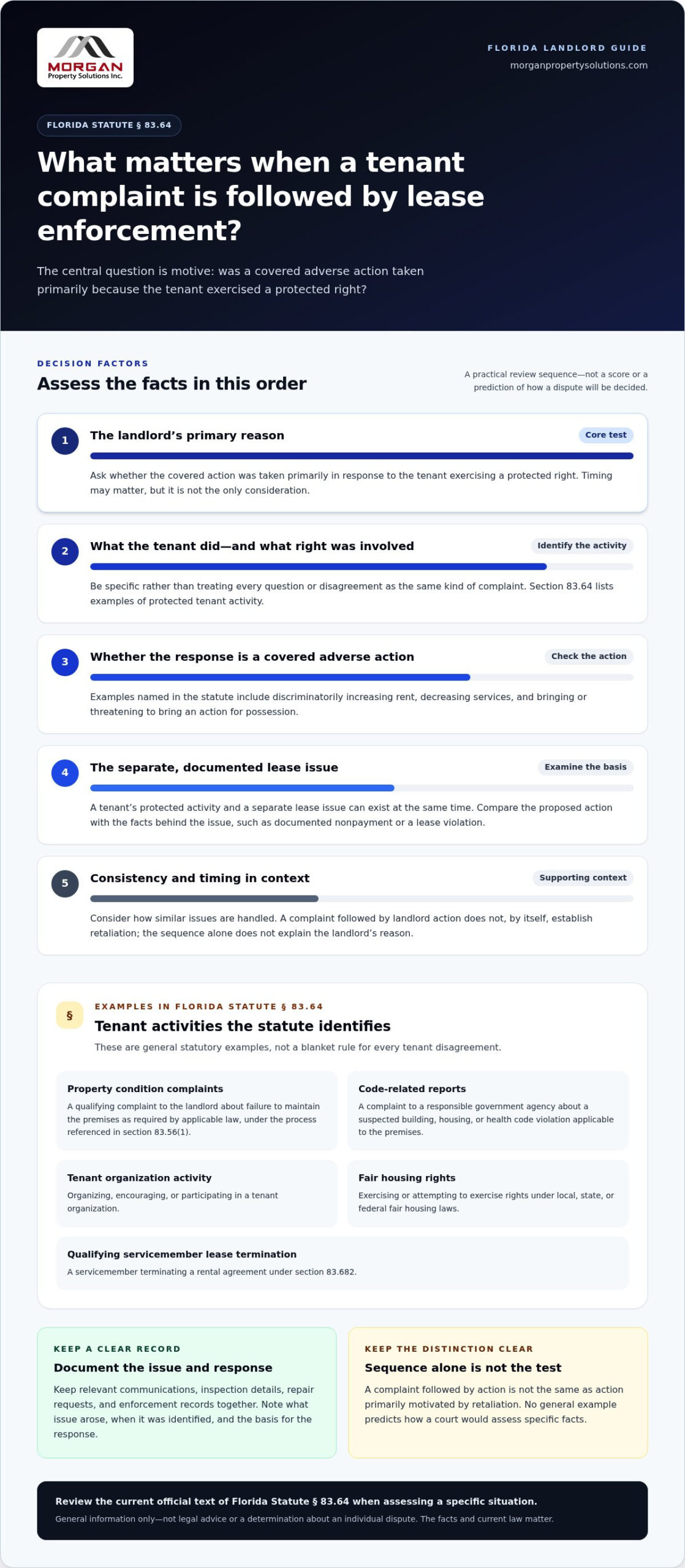
A tenant complaint does not, by itself, establish retaliation. A landlord may still need to address a separate lease issue, but the timing and circumstances can prompt questions about why the landlord acted. For Orlando landlords, start by separating the tenant’s complaint from the documented reason for any later decision.
Florida Statute § 83.64 addresses retaliatory conduct in residential tenancies. In general, it focuses on certain adverse actions taken primarily because a tenant exercised a protected right. The statute identifies actions such as discriminatorily increasing rent, decreasing services, and bringing or threatening to bring an action for possession. The wording and scope matter, so consult the current official statute when assessing a specific situation.
What does Florida law mean by retaliatory conduct?
In plain language, the central question is motive: was a covered action taken primarily to retaliate against the tenant for exercising a protected right? The statute does not make the sequence of events the only consideration. Timing may be part of the circumstances, but a complaint followed by an action doesn’t, by itself, explain why the landlord acted.
Florida’s central test is whether a covered adverse action was taken primarily because the tenant exercised a protected right. This is a plain-language summary, not a quotation of the statute or a legal conclusion about an individual dispute. For general background on the broader relationship between renters and property owners, see Landlord-tenant law. Florida’s statute governs the specific state framework discussed here.
Why a tenant complaint does not automatically decide the issue
Consider a tenant who reports a repair concern and later receives a notice about an unrelated lease violation. Both events may be relevant, but their order alone doesn’t establish that the notice was retaliatory. The landlord’s reason, the records supporting it, and how similar issues are handled can help explain the decision. No general example can predict how a court would assess a particular set of facts.
Keep the distinction clear: a complaint followed by landlord action is not the same as action primarily motivated by retaliation. A dated record can show what issue arose, when it was identified, and the basis for the response. Avoiding tenant retaliation claims florida therefore calls for careful, consistent decision-making, not an automatic pause on legitimate lease enforcement.
This section is general information, not legal advice or a determination about an individual dispute. For a broader overview of Florida landlord-tenant topics, explore the Florida landlord resources. The specific facts and current law matter when a consequential action is under consideration.
Which tenant actions receive protection under Florida’s retaliation law?
Florida Statute § 83.64 gives examples of tenant activities a landlord may not retaliate against. The details of the activity matter, and the examples do not predict how every dispute will be treated. A repair question, for instance, should not automatically be treated the same as a complaint that falls within a statutory example.
For Orlando landlords, identify what the tenant did and what right they were exercising rather than relying on a broad label such as “complaint.” The Florida Tenant and Landlord Rights and Duties pamphlet provides broader context on the responsibilities of both parties. The protections below are general information, not a legal assessment of an individual situation.
Complaints about property conditions and repairs
Section 83.64 includes a tenant’s complaint to the landlord, under the process referenced in section 83.56(1), about the landlord’s failure to maintain the premises as required by applicable law. It also lists a complaint to a government agency responsible for enforcing building, housing, or health codes about a suspected violation applicable to the premises. These examples are specific, so don’t assume every request or disagreement fits them.
Receiving a complaint and evaluating it are separate steps. Record what the tenant reported, assess the condition, and document any inspection or repair response. A consistent process keeps attention on the property issue and the action taken, rather than on the tenant’s decision to raise it. Landlord resources can also support an organized approach to routine management questions.
Other examples of protected tenant activity
The statute also names organizing, encouraging, or participating in a tenant organization; exercising or attempting to exercise rights under local, state, or federal fair housing laws; and a servicemember terminating a rental agreement under section 83.682. These are distinct examples, not a blanket rule that every tenant disagreement receives the same legal treatment.
In short, the statutory examples include code-related complaints to a responsible government agency, qualifying complaints to the landlord about maintenance, tenant-organization activity, fair housing rights, and a servicemember’s qualifying lease termination. The exact wording and cross-references matter, so review the current official text of section 83.64 before relying on a particular example. For landlords seeking support with organized residential management in Central Florida, professional property management can help coordinate tenant communications and property records.
How to distinguish retaliation concerns from legitimate lease enforcement
A tenant’s protected activity and a separate lease issue can exist at the same time. Evaluate the reason for the proposed action on its own facts, then compare it with how similar situations are handled. Florida Statute § 83.64 recognizes a good-cause concept. Its examples include nonpayment of rent and violations of the rental agreement or reasonable rules.
Use this comparison to organize your review, not as a formula that decides whether an action is lawful:
| What to compare | What to review | Questions before acting |
|---|---|---|
| Protected activity | A tenant reports a concern or exercises a right covered by the statute. | What did the tenant do, and when? Is the proposed response connected to that activity? |
| Independent documented issue | A separate concern, such as unpaid rent or a documented lease or reasonable-rules violation. | When did the issue arise? What records support it? Would the same issue matter for another tenant? |
| Decision and process | The action being considered and how comparable situations have been handled. | Is the response consistent with the lease and past practice, or does it appear to single out this tenant? |
When a complaint and a separate lease issue overlap
Suppose a tenant raises a maintenance concern while management separately identifies an unpaid balance or a possible lease violation. Don’t treat the complaint as a reason to ignore the other issue, and don’t treat the tenant’s history of complaints as a reason to dismiss a new concern. Ask whether the separate issue arose independently, what evidence supports it, and whether the same process would apply in a comparable case.
This review helps distinguish routine, consistent enforcement from a response that may appear complaint-driven. A timeline can clarify when the concern was identified and what information informed the decision, but timing alone doesn’t settle the question. The full circumstances still matter.
What good cause can mean under section 83.64
Section 83.64 provides that a landlord may defeat a retaliation claim by proving good cause for the action. Its examples include nonpayment of rent and a tenant’s violation of the rental agreement, reasonable rules, or Chapter 83 of the Florida Statutes. These examples guide the review; they don’t establish the outcome of a particular dispute.
A documented lease-related reason can help explain an action, but it does not by itself resolve whether the action was primarily retaliatory. Consider the facts, records, and consistency of enforcement. A checklist, lease clause, or management service can support a sound process, but none can guarantee that a claim won’t be made. Careful, fair review is a practical step toward avoiding tenant retaliation claims florida, not a promise of a particular legal result.
A practical Florida landlord process for handling complaints and documenting decisions
A steady process can help Orlando landlords respond to tenant concerns without letting frustration shape the next decision. Keep a dated record from the first message through follow-up, and use the same lease-based approach for comparable situations. These practices support clarity, but records alone don’t determine a legal outcome.
- Receive the concern. Save the tenant’s original message and note when and how it arrived. Where practical, record the issue in the tenant’s own words without adding assumptions about motive.
- Acknowledge it. Confirm receipt and note the date of your response. Keep the tone neutral and professional, even if the tenant’s message is frustrated.
- Assess the issue. Review the reported condition or request, relevant lease terms, and available inspection information. If an inspection is appropriate, record when it occurred and what you observed.
- Document the facts. Keep dated notes of communications, maintenance requests, inspection findings, follow-up, and decisions. Separate what someone reported from what management observed or did.
- Respond and track follow-up. Record the action taken, any communication about next steps, and whether further attention is needed. Keep maintenance records distinct from unrelated lease-enforcement matters.
- Review before consequential action. Identify the specific, independent reason for the proposed action. Check the supporting records and consider whether the same process would apply in a comparable situation.
Record the complaint and the response
Clear records describe events, not opinions. Write “Tenant reported water near the kitchen sink on Tuesday” rather than “Tenant is difficult” or “Tenant is making excuses.” Add inspection observations, follow-up dates, and actions taken. Morgan Property Solutions Inc.’s photo inspection reports contain hundreds of photos, providing detailed visual records of property condition. Photos support documentation; they don’t prevent a claim or decide its outcome.
Keep maintenance and enforcement decisions consistent
Track a repair request from receipt through assessment and follow-up, even if a separate lease concern also needs attention. Keeping the records distinct makes it easier to understand the basis for each management decision. Attorney-written leases can help set out clear terms and expectations, but they aren’t a guarantee against disputes. A consistent system for communications, inspections, and maintenance can help landlords stay organized.
For avoiding tenant retaliation claims florida, focus on the facts, consistent treatment, and a clear record of why each decision was made. An organized residential property management approach can help coordinate those records. Explore professional property management for your Orlando rental to bring tenant communications, maintenance, and inspections into a more organized process.
How Central Florida property management can support a consistent response
For landlords in Orlando and across Central Florida, tenant concerns can involve several moving parts: a message to the owner, a repair request, an inspection, and a separate lease issue. Professional property management can help keep those pieces connected in an orderly record, making communications and decisions easier to follow over time.
What organized property management can contribute
A property manager can coordinate tenant communications, track maintenance requests, and organize inspection records. This creates a clearer picture of what was reported, what was observed, and how the matter was handled. Morgan Property Solutions Inc. coordinates maintenance 24/7, helping keep requests within an organized management process.
Inspection reports can support a record of property conditions, while comprehensive tenant screening processes each adult applicant in compliance with Fair Housing laws. These practices serve different purposes, but both reflect the value of careful, consistent management. They don’t determine whether a landlord’s conduct is lawful or guarantee that a retaliation claim won’t be made. A property manager can help organize the facts and apply established processes, but legal questions about a specific dispute may require legal advice.
Consider professional support for an Orlando rental
Consistency depends on more than having a written procedure. Communications need to be handled professionally, maintenance requests need to remain trackable, and inspection information should be accessible when management decisions are reviewed. When several people are involved in a rental’s day-to-day oversight, a coordinated point of contact can help maintain continuity and reduce reliance on scattered messages or memory.
That structure can be useful when a tenant raises a concern while another property matter also needs attention. A manager can help keep those matters distinct in the records, follow the established lease and management process, and document the basis for decisions. This supports thoughtful administration, not a predetermined legal outcome.
For landlords focused on avoiding tenant retaliation claims florida, professional management offers a practical way to organize communications, maintenance, and property records without treating any service as a guarantee against claims. Morgan Property Solutions Inc. serves landlords in Orlando and surrounding Central Florida communities, including Winter Park, Lake Nona, Clermont, Oveido, Windermere, Winter Garden, Apopka, Wedgefield, and Hunters Creek. Explore Orlando property management to learn how Morgan Property Solutions Inc. can support your rental’s ongoing management.
Build a steadier management routine
A tenant concern can be a useful prompt to review how decisions are made across your rental. Check that communication and recordkeeping practices are clear, consistent, and easy to follow. When a new issue comes up, a familiar process gives you a practical starting point instead of leaving you to make decisions in the heat of the moment.
For Orlando landlords, avoiding tenant retaliation claims florida is not about avoiding every difficult conversation or delaying legitimate management decisions. It’s about approaching each situation thoughtfully, with a clear reason for the action and a process that treats tenants fairly. Professional support can help make that approach part of ongoing rental management.
Explore professional property management in Orlando and learn how Morgan Property Solutions can support your rental’s day-to-day management. A more organized process can help you move forward with greater confidence.
Frequently Asked Questions
Can a Florida landlord evict a tenant after the tenant files a complaint?
Possibly, but a complaint followed by an eviction action doesn’t settle whether the action was retaliatory. Florida Statute § 83.64 addresses actions primarily motivated by retaliation and includes a good-cause provision. For example, the statute identifies nonpayment of rent as a possible good-cause basis. The specific records and circumstances matter, and no general answer can determine whether a particular eviction is lawful. This is general information, not legal advice.
Is every rent increase after a tenant complaint considered retaliation in Florida?
No. Section 83.64 addresses a discriminatory rent increase when it is primarily motivated by retaliation; it doesn’t characterize every increase after a complaint as retaliation. That distinction doesn’t mean timing can be ignored or that a particular increase is lawful. Review the current statutory language alongside the facts behind the decision, including how the increase was determined and applied. A specific situation may require individualized legal guidance.
What tenant complaints are protected from retaliation in Florida?
Section 83.64 lists examples such as certain complaints to responsible government agencies about suspected code violations, qualifying complaints to a landlord about maintenance, tenant-organizing activity, and exercising fair housing rights. The statutory examples are not a shortcut for deciding how every complaint should be treated. For an Orlando rental, identify the conduct involved and consult the current official text, including any cross-references, before drawing conclusions about a specific tenant’s rights.
Can a landlord reduce services after a tenant reports a property problem?
Florida’s retaliation statute addresses certain reductions in services when they are primarily motivated by retaliation. If a service change is being considered after a tenant reports a problem, keep the report and the reason for the proposed change distinct in your records. Note what service was affected and the management reason for the decision. Records can help explain the sequence, but they don’t guarantee a particular legal outcome.
Can a tenant use retaliation as a defense in a Florida eviction case?
Section 83.64 recognizes retaliatory conduct as a defense in an action for possession, according to the statutory framework. Whether that defense applies or affects a particular case depends on its facts and the current law. Landlords in Central Florida should avoid assuming that a notice or documented lease issue resolves the matter by itself. This is general information, not advice about court procedure or a prediction of a case result.
What records should a Florida landlord keep after receiving a tenant complaint?
Keep dated records of the original complaint, related communications, inspection observations, maintenance requests, follow-up, and the reason for each management decision. Separate what the tenant reported from what you observed, and use neutral language rather than labels or guesses about motive. Morgan Property Solutions Inc. provides photo inspection reports as part of its property management services. Organized records can make the history easier to follow, but they can’t guarantee a legal outcome.

Article by
Oliver Overton-Morgan
Oliver Overton-Morgan is a full-time Real Estate Broker since 2003, with years of experience helping thousands of people purchase and sell real estate throughout Central Florida. He holds a Graduate Realtor Institute designation, LCAM, and has held licenses in good standing as a Florida Mortgage Broker and a Notary Public. Oliver immigrated to central Florida in 2001, and within 5 years Oliver built a successful Real Estate brokerage in central Florida, where he recruited over 75 Sales Associates with 25+ million in sales production.