What if the next rental property isn’t the hardest part of growing your portfolio? For many owners, the bigger challenge is keeping each property’s finances, tenants, and maintenance organized as the workload grows. Scaling a rental portfolio in Central Florida works best when expansion is matched with a dependable plan for day-to-day operations.
If you’re unsure whether your current rental is ready to support another purchase, or you’re comparing opportunities in Orlando, Winter Park, Lake Nona, and nearby communities, a clear process can help. Growth doesn’t have to mean taking on every task yourself. The right systems can make it easier to stay informed and make thoughtful decisions as you add properties.
This guide walks through practical steps for assessing your existing rental, comparing local opportunities, and checking whether a potential purchase fits your goals. You’ll also learn how to prepare for tenant communication, financial tracking, inspections, and maintenance, and when professional property management can help keep those responsibilities manageable.
Key Takeaways
- Define what you want your portfolio to achieve before adding properties, including your income goals, preferred workload, and location strategy.
- Use a consistent evaluation process to compare opportunities in Orlando, Winter Park, Lake Nona, Clermont, and other Central Florida areas.
- Match your growth pace to your capital and capacity, and review financing decisions with qualified financial guidance.
- Build repeatable systems for records, tenant processes, maintenance, inspections, and reporting before adding more rentals.
- Scaling a rental portfolio in central florida may call for operational improvements or delegated property management before the next acquisition.
Before scaling a rental portfolio in Central Florida, define what growth should achieve
Adding another rental is easy to count. A stronger portfolio is harder to measure: it should support your financial goals without creating a workload or level of risk you don’t want. Before scaling a rental portfolio in central florida, decide what a successful next step looks like for your income, time, and involvement. More properties alone don’t guarantee better results or simpler operations.
Location is part of that decision. Central Florida includes communities with different local conditions and economic patterns, so decide whether you want to concentrate near existing properties or spread ownership across several areas. Morgan Property Solutions Inc. serves the Central Florida area, including Orlando, Winter Park, Lake Nona, Clermont, Oveido, Windermere, Winter Garden, Apopka, Wedgefield, and Hunters Creek. A useful starting point is this overview of Central Florida economy and demographics. Treat regional context as background, then ground each property decision in its own records and local research.
Set a growth target that fits your ownership goals
Write down what you want the portfolio to do for you. Is your priority to increase rental income, build long-term holdings, keep management close to home, or reduce the time spent handling tenant and maintenance issues? Rank these goals. They can compete: adding properties in distant communities may broaden your holdings but also make oversight more complex.
Separate the near-term purchase target from the longer-term ownership plan. You might aim to evaluate one acquisition while deciding whether you eventually want to manage rentals personally or delegate recurring work through professional property management. There’s no single right pace. The best plan is one you can support financially and operationally.
Check whether the current portfolio is ready to grow
Review each rental on its own before using it as proof that you’re ready to expand. Compare actual income with recorded expenses, and note vacancies, upcoming maintenance, and recurring tenant-management tasks that still need attention. If a property’s performance is unclear, resolve the gaps first. Otherwise, an optimistic estimate or an overlooked repair can distort your view of what the portfolio can support.
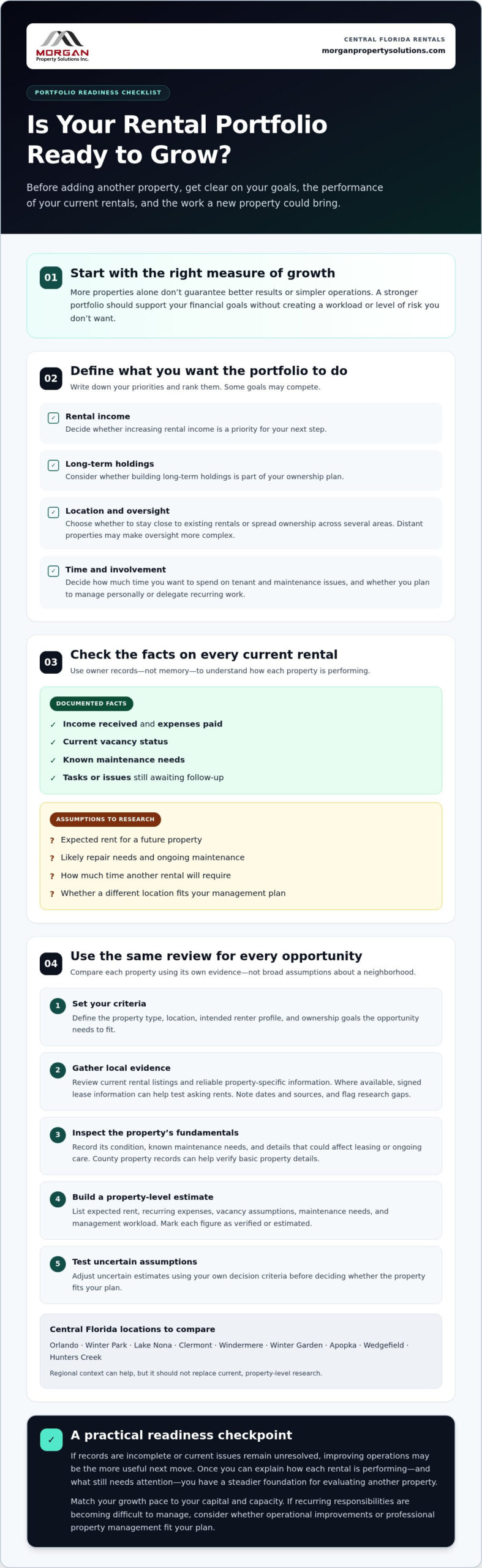
A simple readiness check can separate what you know from what still needs investigation. Keep these two lists beside each property’s records:
- Documented facts: Rental income received, expenses paid, current vacancy status, known maintenance needs, and tasks or issues still awaiting follow-up.
- Assumptions to research: Expected rent for a future property, likely repair needs, how much time another rental will require, and whether a different location fits your management plan.
Use owner records, not memory, to complete the first list. For the second, gather property-specific information before making a commitment. Morgan Property Solutions Inc.’s landlord resources can also support a more organized approach to recurring ownership tasks.
Consider growth readiness a decision point, not a pass-or-fail test. If records are incomplete or current issues remain unresolved, improving operations may be the more useful next move. Once you can explain how each existing rental is performing and what still needs attention, you’ll have a steadier foundation for evaluating another one.
Build a repeatable system for evaluating Central Florida rental opportunities
A property in Orlando shouldn’t be judged by the same market label as one in Winter Park, Lake Nona, Clermont, or another Central Florida community. Even within the same area, property type, condition, likely renter profile, and ongoing workload can change the decision. A consistent review process helps you compare opportunities on their own evidence instead of relying on broad assumptions about a neighborhood.
Compare submarkets without assuming they behave alike
Start by deciding what kind of property you’re looking for and who you expect it to serve. Then gather current evidence for the specific location and property. Recent rental listings can offer a point of comparison, while signed lease information, where available to you, can help test whether asking rents reflect actual rental activity. County property records can help verify basic property details. Keep the date and source of each item, since local conditions and listings change.
A regional overview or forecast can add context, but it shouldn’t replace property-level research. For example, the Central Florida real estate market forecast can inform your view of broader trends. Use it alongside current evidence for the candidate property, not as a promise about its future performance.
Review each property with the same decision framework
Use this workflow for every candidate, whether it’s near an existing rental or in a different submarket. Applying the same steps makes differences easier to spot and gives you a clear record of why you moved forward or passed.
- Set your criteria. Define the property type, location, intended renter profile, and ownership goals the opportunity needs to fit.
- Gather local evidence. Review current rental listings and other reliable, property-specific information. Note the dates and sources, and flag gaps that need more research.
- Inspect the property’s fundamentals. Record its condition, known maintenance needs, and any details that could affect leasing or ongoing care.
- Build a property-level estimate. List expected rent, recurring expenses, vacancy assumptions, maintenance needs, and management workload. Mark each figure as verified or estimated.
- Test your assumptions. Adjust uncertain estimates using your own decision criteria. Consider whether the property still fits if rent is lower than expected, expenses are higher, or management takes more time.
- Document the decision. Record what supports the purchase, what remains uncertain, and what would change your mind. Revisit the same criteria for the next opportunity.
This process helps make scaling a rental portfolio in central florida more deliberate. A property that looks appealing at first may not fit your goals once expenses, condition, and management demands are considered. If you’d like support thinking through rental operations alongside acquisition decisions, Central Florida property management can be part of the conversation.
Choose a growth approach that matches your capital and capacity
There’s no single right pace for adding rentals. A gradual approach can leave room to learn from each property before taking on another. Faster expansion may help an owner pursue several opportunities in a shorter period, but it can also increase the coordination required across tenants, vendors, records, and property decisions. The right choice depends on your finances, goals, available time, and comfort with operational complexity.
Weigh gradual growth against a faster acquisition pace
Compare the approaches against your actual capacity, not just the number of properties you hope to own. For instance, an owner with unresolved maintenance or inconsistent records may benefit from stabilizing operations first. Someone with clear processes and support in place may be better positioned to evaluate multiple opportunities. Neither pace guarantees a better outcome.
| Consideration | Gradual acquisitions | Faster expansion |
|---|---|---|
| Control | More time to review each purchase and adjust plans between acquisitions. | Several decisions may need attention close together, so priorities and approval processes matter. |
| Workload | Can make it easier to observe a new property’s day-to-day demands before adding another. | Can increase tenant, vendor, and record coordination at the same time. |
| Capital demands | Capital is committed one acquisition at a time, subject to each property’s needs and financing. | Multiple acquisitions can place greater demands on available capital and reserves. |
| Operational complexity | May allow systems to develop alongside the portfolio. | Requires management processes that can keep pace as properties are added. |
Use the comparison as a prompt, not a rulebook. Consider your existing obligations and the reserves you want available for property needs. A purchase that looks manageable on paper may feel different if a vacancy, repair, or other expense overlaps with another property’s needs.
Treat financing as one input, not the whole growth plan
Financing methods differ, and the options that fit one investor may not fit another. Review your circumstances with qualified financial professionals, including how a potential purchase interacts with your obligations, available capital, and longer-term plans. Don’t assume a financing approach makes a property a sound acquisition on its own.
Property-level research and a workable management plan still matter. Check the rental and expense assumptions for the specific opportunity, then consider how you’ll handle leasing, tenant communication, maintenance, and records if you proceed. The University of Florida’s Florida housing market research and rental studies can provide broader context, while your purchase decision should rest on evidence relevant to the property and your own criteria.
For owners comparing the acquisition plan with the practical work of managing rentals, Central Florida property management support can be part of the discussion. A pace you can sustain is more useful than a growth target that leaves too little time or capacity to care for the portfolio.
Create portfolio systems before additional rentals multiply the workload
More rentals mean more records, tenant questions, maintenance requests, and follow-up. A consistent process keeps these tasks from living in separate inboxes or in your memory. As you plan for scaling a rental portfolio in central florida, build a simple operating system first, then use it for each property. That makes it easier to see what needs attention and compare performance across your portfolio.
Standardize the recurring work across properties
Start with a separate, consistently organized file for each rental. Use the same categories and naming approach so you can find information without relearning the system every time. A useful sequence is:
- Organize property records. Keep leases, contact details, key property information, and relevant correspondence together for each address.
- Track income and expenses. Record rent received and property expenses consistently, with enough detail to review each rental on its own.
- Log maintenance. Note the request, date, status, work completed, and any follow-up. A clear record helps you spot recurring issues and open items.
- Keep inspection documentation. Save reports and notes in the same place, using a consistent format to make changes easier to review over time.
- Standardize tenant communication and reporting. Use repeatable processes for routine messages and payment tracking, then review property updates on a regular schedule.
Good documentation supports oversight. If a maintenance request remains open or a payment needs follow-up, a shared record makes that visible. Consistent categories also help you compare expenses and operating needs across rentals without confusing one property’s history with another’s. For practical residential property management guidance, use resources that help you build repeatable routines.
Decide what to manage yourself and what to delegate
Self-management gives you direct involvement in marketing, tenant communication, leasing, maintenance coordination, and recordkeeping. It also means those tasks stay on your schedule as the portfolio grows. Delegating recurring work can reduce the number of separate processes you personally handle, while still allowing you to retain ownership and review property information.
- Owner-led management: You handle the recurring work and maintain direct oversight. This can suit owners who have the time and systems to keep each property organized.
- Professional management: A manager can coordinate rental marketing, tenant screening, leasing, maintenance, and reporting through established processes. Morgan Property Solutions Inc. markets rentals across hundreds of top sites, schedules showings 7 days a week, coordinates maintenance 24/7, and provides inspection reports containing hundreds of photos.
Choose based on the work you want to keep and the tasks that are becoming difficult to manage consistently. Orlando property management provides a structured option for owners who want support with ongoing rental operations.
Ready to make recurring rental tasks easier to oversee? Explore property management support as part of your portfolio plan.
Scale your Central Florida rentals with a management plan that can keep up
As your portfolio grows, the next useful move may not be another purchase. It could be improving how you handle current rentals or delegating recurring work that’s taking time away from other priorities. Look at what’s creating friction now: Are tenant questions and maintenance requests piling up? Are properties in different communities becoming harder to oversee? Do you have a clear picture of each rental’s activity and finances?
Those are signs to pause and choose the next step deliberately. If operations are organized and you have the capacity to take on more, another acquisition may fit your plan. If records or processes need attention, improve them first. If the recurring workload is the main obstacle, professional management can help you retain ownership while handing off day-to-day responsibilities.
Recognize when professional management may support growth
Management support can be useful when leasing tasks, tenant communication, and property follow-up compete with your other responsibilities, especially if your rentals are spread across Orlando and nearby Central Florida communities. Consistent marketing, tenant screening, lease coordination, online payment and financial services, inspection reports, and maintenance coordination can bring recurring tasks into a more organized process.
That structure can also make it easier to keep track of what’s happening at each property without personally handling every step. Morgan Property Solutions Inc. provides residential property management for Central Florida rentals, including these operational services. Consider which tasks you want to continue overseeing directly and which you’d prefer to delegate. That distinction helps shape a management plan around your ownership preferences.
Turn the growth plan into a manageable next step
Before making a decision, put the essentials in one place. A short summary gives you a practical starting point for your next acquisition or a conversation about management needs:
- Target area: Note the Central Florida communities you’re considering and whether your current properties are nearby or dispersed.
- Property criteria: Define the property type and features that align with your ownership goals.
- Operating capacity: Identify the recurring tasks you can manage and the ones you’d like help coordinating.
- Open questions: List uncertainties about property performance, tenant processes, maintenance, or reporting that still need attention.
This summary doesn’t need to answer every question. It helps focus the next discussion on your actual properties, priorities, and operating needs rather than on a general idea of growth. For owners scaling a rental portfolio in central florida, a sound management plan supports informed decisions without promising a particular investment result.
If you’d like to explore support for the recurring work involved in owning Central Florida rentals, learn about Orlando property management. You can keep ownership while building an approach to rental operations that fits your portfolio and the level of involvement you want.
Take your next step with a plan you can sustain
Growth doesn’t need to happen all at once. Give yourself room to make one thoughtful decision, learn from how it affects your portfolio, and adjust your approach as your goals or capacity change. That flexibility can make scaling a rental portfolio in central florida feel more manageable, whether your next move is improving operations, delegating recurring work, or evaluating another property.
Before you act, write down the decision you’re considering and what you still need to understand. A focused conversation about your properties and management priorities can help turn a broad growth goal into a practical next step. You stay in control of your ownership plan while getting support that fits the work you want to delegate.
Explore Central Florida property management support and take the next step at a pace that works for you. A clear plan can help you grow with greater confidence.
Frequently Asked Questions
How do I know when my rental portfolio is ready to scale?
It may be ready when you can explain how each property is performing and keep routine tasks from relying on memory. For scaling a rental portfolio in central florida, try tracing a recent rent payment, repair request, and vacancy decision from start to finish using your records. If key details are hard to find, or an unresolved issue regularly interrupts your schedule, improve that process before taking on another rental. There’s no universal property count that signals readiness.
What should I consider before buying another rental property in Central Florida?
Look beyond the city name and compare the candidate with similar properties in its immediate area. For example, a home’s bedroom count, condition, and rental status can affect how useful a nearby listing is as a comparison. Separate advertised rents from information you can verify, and note when each source was updated. Also consider the likely renter profile and how you’d handle the property’s day-to-day needs. Ask qualified professionals about financial or legal questions outside your expertise.
Is it better to scale a rental portfolio slowly or quickly?
Neither pace is automatically better; choose one that fits your finances, goals, and ability to oversee the work. Before pursuing a faster pace, picture a busy month when more than one property needs attention. Would you still have time to review updates and make decisions? A slower approach may give you more opportunity to learn from each rental’s operations. Treat pace as a planning choice, not a scorecard for success.
Can a property manager help me grow a rental portfolio?
Yes, professional management can take recurring tasks off your hands while you retain ownership. Consider which activities you want to delegate and how you’ll stay informed about each property. Morgan Property Solutions provides residential property management, including financial services with online statements and annual 1099 tax filing. A property-specific discussion can help clarify which management tasks fit your needs, without assuming that delegation will produce a particular investment result.
How much cash should I keep in reserve when scaling rentals?
There isn’t one reserve amount that suits every owner or property. Start by reviewing each rental’s actual operating expenses, financing obligations, condition, and planned work. Then consider which costs could overlap, such as a repair while a unit is vacant. Keep your estimates separate from known expenses, and avoid treating expected rent as cash already available. A qualified financial professional can help you assess a reserve approach for your circumstances.
Should I buy rentals in different Central Florida neighborhoods?
That depends on whether owning in multiple locations fits your goals and management capacity. Before choosing a property farther from your current rentals, map the locations and consider how you’ll coordinate visits, vendor access, and follow-up across them. A different neighborhood may offer a property that fits your criteria, but geographic variety alone doesn’t guarantee better results. Compare each opportunity on its own evidence and consider whether added distance makes oversight harder.
What systems should I set up before adding another rental?
Set up a simple way to see what needs attention and who will handle it. For example, keep a dated log of open maintenance requests with the next follow-up noted, and use the same file labels for comparable records across properties. A recurring review of unresolved items can help prevent small tasks from disappearing in email or text threads. Choose owner-managed or professional support based on the time and oversight you want to keep.

Article by
Oliver Overton-Morgan
Oliver Overton-Morgan is a full-time Real Estate Broker since 2003, with years of experience helping thousands of people purchase and sell real estate throughout Central Florida. He holds a Graduate Realtor Institute designation, LCAM, and has held licenses in good standing as a Florida Mortgage Broker and a Notary Public. Oliver immigrated to central Florida in 2001, and within 5 years Oliver built a successful Real Estate brokerage in central Florida, where he recruited over 75 Sales Associates with 25+ million in sales production.