A rental portfolio can look passive on paper yet still demand hands-on decisions. To build a passive income real estate portfolio in Central Florida, set clear financial goals, assess rental demand and expenses for each property, compare financing options, and plan how the homes will be managed. With multifamily properties, rent from occupied units can help offset a vacancy in another unit, but maintenance, taxes, repairs, and tenant needs still affect the income you keep.
Seeking steady income while keeping day-to-day work manageable makes sense. Before buying, weigh the full picture: local employment, household incomes, planned development, property condition, expected rent, and ongoing costs. This guide covers multifamily investing’s benefits and trade-offs, how to assess Central Florida rental demand, what to include in an operating budget, and how conventional financing and private equity partnerships may fit different investment plans. You’ll have a clearer way to match a portfolio to your goals and see where professional property management can help.
Key Takeaways
- Assess multifamily properties as a portfolio, not just by one unit’s rent: occupied units can help cushion income when another is vacant.
- Build a realistic operating plan that accounts for vacancies, maintenance, taxes, repairs, and the work involved in managing tenants.
- Use local employment, household incomes, and planned development to evaluate rental demand across Central Florida.
- Compare conventional financing with private equity partnerships, weighing how each option fits your goals and tolerance for risk.
- Decide how involved you want to be: direct ownership still requires oversight, while professional property management can reduce day-to-day tasks.
1. Rental property income and management costs
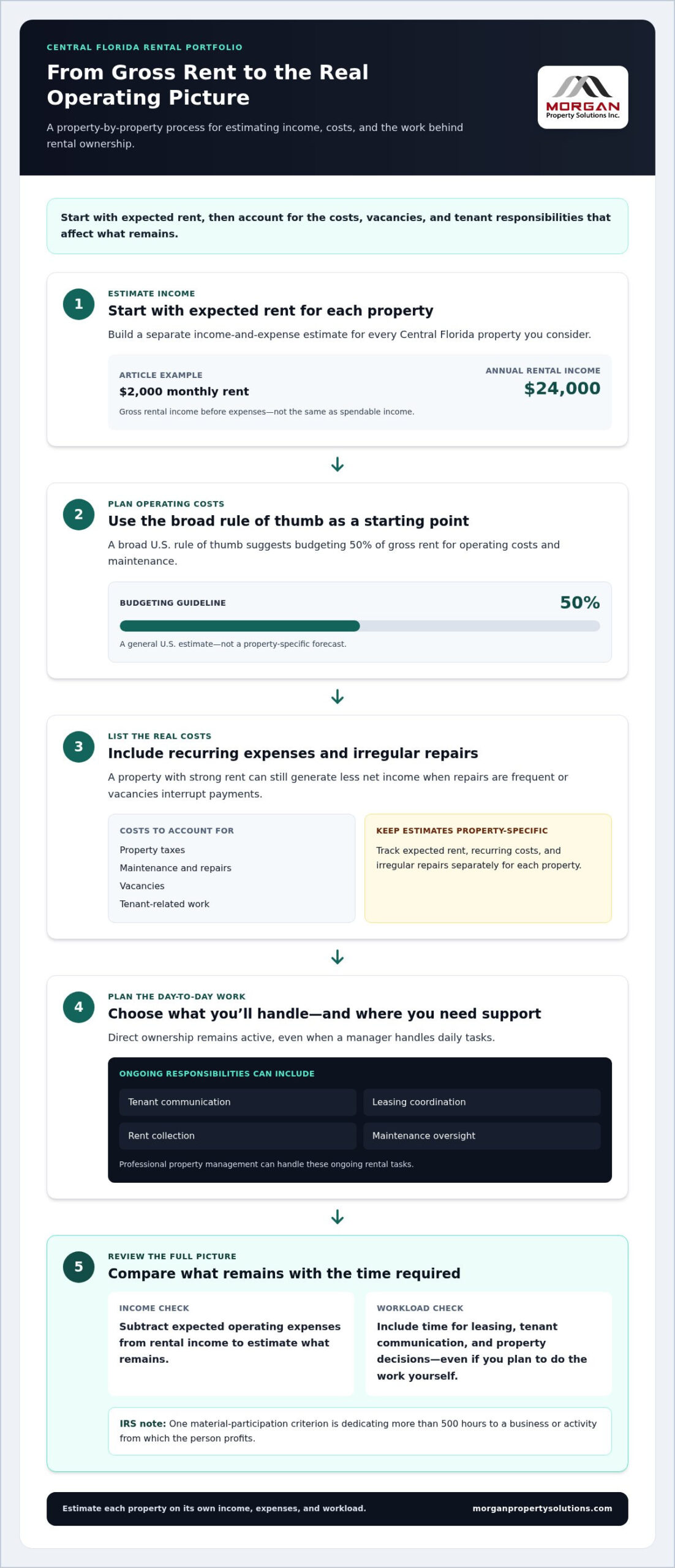
Start by estimating rent for each property, then subtract expected operating expenses. A broad U.S. rule of thumb suggests budgeting 50 percent of gross rent for operating costs and maintenance. For example, a property rented for $2,000 monthly generates $24,000 in annual rental income before expenses. That total is not the same as spendable income. Property taxes, maintenance, repairs, vacancies, and tenant-related work all affect what remains.
Build a separate income-and-expense estimate for every Central Florida property you consider. List expected rent, then account for recurring costs and irregular repairs. Include the time needed to coordinate maintenance and respond to tenants, even if you plan to handle those tasks yourself. This helps you compare the potential benefits of ownership with the work involved. A property with strong rent can still generate less net income if repairs are frequent or vacancies interrupt payments.
Tenant retention can support steadier occupancy and reduce the disruption of repeated move-outs. Set a clear process for responding to maintenance requests, scheduling routine upkeep, and communicating with residents. Promptly addressing a small repair may help prevent a larger problem, while organized follow-up gives tenants a clear point of contact. Review recurring issues across the property, too. If the same repair keeps appearing, investigate its cause instead of treating each request as an isolated expense.
Directly owning rental property remains an active investment, even when a manager handles daily tasks. For IRS material-participation purposes, one criterion is dedicating more than 500 hours to a business or activity from which the person profits, according to the Internal Revenue Service. Track the time you spend on leasing, tenant communication, and property decisions. This gives you a clearer view of your actual workload. Publicly traded real estate investments differ from owning a rental directly, since direct ownership involves property-level operating decisions.
Professional property management, such as the services provided by Morgan Property Solutions Inc., can handle ongoing rental tasks, including tenant communication, leasing coordination, rent collection, and maintenance oversight. Before choosing an approach, write down which responsibilities you’ll manage and where you need support. Compare the workload with your available time, experience, and number of properties. Property management and tenant retention work together: consistent communication and planned upkeep can support occupancy, while organized records make it easier to review income and expenses across your portfolio.
2. What Are the Key Benefits of Investing in Multifamily Properties?
Multifamily properties spread rental income across separate units. If one unit is vacant, rent from occupied units may still help cover operating costs. That can make income steadier than relying on one renter in a single-family home. It doesn’t remove vacancy risk, but it can reduce the effect of one empty unit on the property’s total income.
Multiple units also create opportunities to improve operations across a property. A planned maintenance schedule, consistent leasing process, and careful expense tracking can support stronger returns. Before committing capital, assess the building’s condition, existing leases, expected repairs, and local demand. Review nearby employment, household incomes, and planned development, since these factors can influence renters’ ability and interest in living there.
Florida landlord-tenant law and applicable local rules govern lease terms, notices, and security-deposit handling. Review current requirements and any community or zoning restrictions before buying, then include lease records, deposit procedures, and compliance tasks in your operating plan.
Home prices, rents, property taxes, insurance costs, and HOA fees vary across Central Florida. Compare properties by neighborhood, condition, unit mix, assessed value, insurance needs, and association rules, since each factor affects purchase costs and ongoing income.
Analyze rental income alongside operating expenses, rather than judging a property by gross rent alone. Include property taxes, insurance, maintenance, repairs, vacancy, and any association costs in the calculation. One example records $7,800 in annual net cash flow after $15,000 in annual expenses. Use that example to see why expense estimates matter, not as a forecast for another property. Keep a separate cash-flow projection for each building you evaluate.
For Central Florida, calculate cash-on-cash return by dividing annual cash flow by the cash invested, and cap rate by dividing net operating income by property value. A broad rental-property estimate places cap rates at 2-3% after property taxes, maintenance, insurance, and vacancies; it isn’t a Central Florida-specific benchmark. Local rent, acquisition cost, financing, and operating expenses determine a property’s figures.
Before making an offer, combine financial analysis with a physical inspection and a review of local market conditions. Keep a due-diligence file with rent assumptions, repair estimates, lease details, restrictions, and projected cash flow. Use these considerations to shape your rental operating plan before choosing a property.
3. Economic growth, population trends, and rental demand
Central Florida rental demand varies by neighborhood, property type, and renter needs. Compare local employment, household incomes, household formation, and planned development instead of assuming regional growth guarantees occupancy. Check whether nearby employers, schools, healthcare facilities, and transportation routes suit the residents you hope to attract. These factors help determine whether a location fits your unit sizes and rental strategy. A practical plan for how to build a passive income real estate portfolio in Central Florida starts with that local fit.
Use vacancy as a planning factor. The U.S. national rental vacancy rate was 7.2% in the fourth quarter of 2025, but that is not a local forecast. Compare similar rentals in the neighborhood and consider how long a unit could sit empty between tenants. Then test whether projected income can cover expenses during a slower lease-up. Revisit the estimate when new housing supply or nearby development changes the competition for renters.
Central Florida rental properties can face hurricane, flooding, insurance, and vacancy risks. Review each property’s location and condition, account for insurance and repair needs, and model how an extended vacancy could affect cash flow. For example, compare a property near employment centers with one farther away, considering renter access and the costs of preparing each unit.
Rental property may build wealth through recurring rent, but direct ownership still needs oversight. Long-term and short-term rentals differ in lease patterns, turnover, upkeep, and coordination. Before choosing a strategy, consider how often the property needs cleaning or maintenance and whether local rules or community restrictions affect its use. The right model depends on the property, its location, and the operating work you’re prepared to manage.
Rental income is reported on Schedule E, attached to Form 1040. Net rental income is taxed at the taxpayer’s ordinary income tax rate. Rental activity may qualify for the qualified business income deduction when it’s classified as a trade or business and involves regular, continuous activity. Keep organized income and expense records to support tax preparation and track property performance through the year.
Real estate investment trusts, or REITs, offer another way to invest in real estate without directly owning rental property. Investors can buy and sell publicly traded REIT shares on an exchange, while non-traded REITs have more restrictive liquidity considerations. REITs can diversify a portfolio, but they carry investment risk. When deciding how to build a passive income real estate portfolio in Central Florida, compare direct ownership with REITs by weighing control, liquidity, income approach, and the work involved.
4. Financing options and private equity partnerships
Conventional loans and private equity partnerships are two financing paths for multifamily investors. A loan lets an investor purchase a property with borrowed capital, while a partnership pools investor funds for a shared real estate investment. Compare each structure against your available capital, desired control, expected cash flow, and risk tolerance. Start with the deal’s numbers, not a promise of future dividends or income.
A private real estate fund may hold one or several properties, while a syndication typically brings investors together around a specific acquisition. In either case, understand how decisions are made, how income is distributed, and what happens if a property needs additional capital. Review the fund or sponsor’s track record, since experience and performance histories vary. Past performance alone doesn’t establish what a future investment will earn.
Due diligence should cover the investment strategy, financial assumptions, property condition, financing, management plan, and potential exit. Read the offering materials closely and identify any limits on withdrawing capital. Some non-traded REITs can lock up investors’ capital for up to eight years, and non-traded REITs are typically open only to accredited investors. Liquidity and eligibility are central to the decision, not details to leave until later.
Generally, an individual may qualify as an accredited investor by earning more than $200,000 individually in each of the prior two years, with a reasonable expectation of the same income in the current year. Another route is net worth above $1 million, excluding the primary residence. Joint income above $300,000 with a spouse or spousal equivalent in each of the prior two years, with a reasonable expectation of the same income in the current year, is also a general criterion.
Scaling a portfolio can mean reinvesting property income, using a manager to handle day-to-day rental operations, or adding REITs or syndications. These approaches can reduce hands-on tasks or provide exposure to properties without direct ownership, but each has different control, liquidity, and risk features. For direct rentals, professional Orlando property management can help coordinate tenant needs and ongoing operations as holdings grow.
Before committing, write down what you need the investment to do. An investor seeking a steadier income stream, for example, may weigh distributions and liquidity differently from someone focused on long-term property ownership. Compare the investment documents, operating plan, and risks against that goal. Diversification can spread exposure across investments, but it doesn’t guarantee a profit or protect against loss.
5. Passive income through real estate
“Passive” describes the investor’s role, not a property that runs itself. Direct ownership can generate rental income, but it still involves decisions about tenants, repairs, vacancies, and cash reserves. A management company can handle day-to-day tasks, while ownership decisions and investment risks remain. Before investing in real estate, decide how much involvement you can sustain and what kind of income stream you’re building toward.
Publicly traded real estate investment trusts, or REITs, offer a different route. They let investors gain exposure to real estate without purchasing properties directly, and shares trade through public exchanges. Many REITs pay dividends of 4-6%, though dividend-paying companies can reduce or eliminate payments. The Internal Revenue Service says REITs must distribute 90% of taxable income. That distribution rule doesn’t set an investor’s personal return or ensure a particular payment.
Compare the timing and form of income before choosing an investment structure. Public REITs often distribute income quarterly or monthly, while direct rental income depends on rent collection and property expenses. A portfolio can combine approaches, but diversification doesn’t guarantee profit or protect against loss. Review which assets each investment holds, how distributions are handled, and whether you can sell or access funds when needed.
Liquidity deserves close attention. Publicly traded REIT shares can be bought and sold on an exchange, while non-traded REITs have more restrictive liquidity considerations. Some non-traded REITs may lock up capital for up to eight years. Read the investment terms for withdrawal limits, fees, valuation methods, and selling conditions. These details affect how easily you can respond to a personal cash need or a change in your investment plan.
Tax treatment also differs across approaches. Rental income is generally reported on Schedule E attached to Form 1040, while a portion of REIT distributions may be taxed as ordinary income. Keep separate records for property income, expenses, and investment distributions. For a direct rental, compare the cash remaining after operating costs with the time required to oversee the property. For a REIT, review its distribution history and underlying holdings.
Choose a structure by matching income needs, available capital, liquidity needs, and desired involvement. Reinvesting profits can help expand a portfolio, while holding cash can support flexibility. To explore real estate investment guidance, review real estate investing resources as you shape your next steps.
Morgan Property Solutions Inc.: Residential Property Management
Morgan Property Solutions Inc. provides Residential Property Management for owners who want support with the ongoing work of rental ownership. Turn to the team when tenant communication, leasing coordination, rent collection, or maintenance oversight takes time away from other priorities. An organized management process can help keep property operations on track while you focus on portfolio decisions, such as reviewing cash flow or considering another acquisition.
If you’re preparing to rent a property, Tenant Placement and Leasing can help find and place tenants. For owners weighing a sale or new purchase, Real Estate Seller Representation and Real Estate Buyer Representation can support the next stage of their plans.
To discuss your property goals, visit Morgan Property Solutions Inc. online.
Make Your Next Move With a Clear Plan
Turn your investment goals into a decision you can act on. Write down what you want your portfolio to support, the level of involvement that suits your life, and the conditions that would make you pause before buying. These boundaries can help keep future decisions aligned with your priorities as opportunities arise.
A thoughtful plan for how to build a passive income real estate portfolio in Central Florida can start with one well-considered move. If you’re ready to discuss your real estate plans, contact Morgan Property Solutions Inc. Take the next step at a pace that feels right, and build from a foundation you understand.
Frequently Asked Questions
What Are the Key Benefits of Investing in Multifamily Properties?
Multifamily properties can spread rental income across several units and make shared operations more efficient. For example, one building may use a common maintenance schedule and leasing process. Consider the trade-off: multiple units in one location still share exposure to the same major repair, neighborhood changes, or local disruption. Compare the building’s condition and unit mix with projected income to see whether the potential benefits fit your investment goals.
Which Central Florida cities and neighborhoods have the best rental demand and investment potential?
No single city suits every rental strategy. Compare a property with the renter you hope to attract. In Orlando, Winter Park, Lake Nona, Clermont, Oviedo, Windermere, Winter Garden, Apopka, Wedgefield, and Hunters Creek, examine nearby employment, transportation, planned development, and competing rentals. Match those factors to the home’s size and expected rent. Comparing neighborhoods based on current listings and local conditions is more useful than choosing by name alone.
How do long-term rentals compare with short-term vacation rentals in Orlando and Central Florida?
Long-term rentals generally use longer leases, while short-term vacation rentals involve frequent bookings and guest turnover. That difference affects cleaning, scheduling, furnishing, and ongoing coordination. Before choosing, compare expected occupancy patterns with operating demands, then review applicable local rules and community restrictions. A short-stay model may not suit an owner seeking fewer routine tasks; a longer lease may better fit a plan built around stable tenancy.
How can investors finance a rental property with conventional loans, DSCR loans, or partnerships?
Conventional loans, DSCR loans, and partnerships use different methods to assess and fund an investment. A DSCR loan focuses on the relationship between property income and debt service, while conventional financing follows the lender’s underwriting process. Partnerships pool capital, so review decision-making authority, distributions, additional funding responsibilities, and exit terms. Compare written terms with projected property cash flow instead of judging financing only by the amount available upfront.
What steps are involved in evaluating and buying a Central Florida rental property?
Start by setting a purchase budget, target location, and rental strategy. Compare similar properties and rents, then estimate income and operating costs for each candidate. Review leases and restrictions, inspect the property’s condition, and assess local demand before making an offer. Then arrange financing and complete the purchase process. For a Central Florida comparison, consider whether Orlando, Winter Park, or another target area matches your intended renter and property type.
How can investors estimate operating expenses, vacancy, maintenance, and property management fees?
Create a property-specific worksheet with projected rent, likely vacancy periods, taxes, insurance, utilities, routine upkeep, and larger repair needs. Use inspection findings to identify near-term work, then test how cash flow changes if leasing takes longer or a repair costs more than planned. Add the proposed management fee for the property and recalculate net income before deciding whether the investment fits your goals.
What rental property cash-on-cash returns and cap rates are realistic in Central Florida?
Calculate cash-on-cash return by dividing annual cash flow by cash invested, and cap rate by dividing net operating income by property value. A broad rental-property estimate puts cap rates at 2-3%, but this is not a Central Florida benchmark; local rent, acquisition cost, financing, and expenses determine results.

Article by
Oliver Overton-Morgan
Oliver Overton-Morgan is a full-time Real Estate Broker since 2003, with years of experience helping thousands of people purchase and sell real estate throughout Central Florida. He holds a Graduate Realtor Institute designation, LCAM, and has held licenses in good standing as a Florida Mortgage Broker and a Notary Public. Oliver immigrated to central Florida in 2001, and within 5 years Oliver built a successful Real Estate brokerage in central Florida, where he recruited over 75 Sales Associates with 25+ million in sales production.