Your Clermont rental income depends on the home’s size, condition, location, and demand for similar nearby rentals, so a single citywide figure cannot predict what your investment will earn. A Clermont property manager can assess these factors and help keep operations organized through tenant screening, rent collection, maintenance coordination, and owner reporting.
It’s reasonable to want a clear picture of potential income before deciding how to manage a rental. This guide explains what influences rent in Clermont and how local demand can shape your estimate, then covers practical management tasks that help you oversee the property, track its performance, and make informed decisions.
Key Takeaways
- Estimate rental income by weighing the home’s condition, features, and nearby rental demand rather than relying on one citywide figure.
- Routine maintenance and condition checks can help you spot property needs and plan repairs before they disrupt rental operations.
- Clear financial records and regular owner reports make it easier to track income, expenses, and property performance.
- Consistent rent collection and tenant screening support a more organized rental process and informed leasing decisions.
- Professional management can bring these tasks together, giving owners a practical way to oversee a Clermont rental investment.
Property maintenance and condition inspections
Effective maintenance starts with understanding the rental’s condition. In Clermont, heat, humidity, heavy rain, and everyday use can affect roofs, drainage, air conditioning, and interior finishes. A move-in inspection establishes a useful baseline. Record each room, appliance, fixture, and visible issue with dated notes and clear photographs. This record helps distinguish existing wear from issues reported later.
According to the U.S. Census Bureau, Clermont had 43,021 people in the April 1, 2020 Census. For an owner, local demand makes a well-kept home easier to present to prospective renters. Cleanliness and working essentials also shape a tenant’s first impression. A stained carpet, dripping faucet, or poorly cooled room can distract from the property’s strengths during a showing.
Use the same practical inspection route each time to avoid missing details:
- Start outside by checking visible roof edges, gutters, walkways, gates, and signs of standing water.
- Inside, test lights, faucets, toilets, doors, windows, and appliances, then note unusual sounds or leaks.
- Check air-conditioning operation, filters, and visible moisture around equipment without attempting unsafe repairs.
- Photograph each concern and record its location, condition, and date for later comparison.
Cleaning and maintenance address different needs. Cleaning removes dirt and residue; repairs address damage or failed components. Wiping a bathroom surface, for example, won’t fix a leak beneath the sink. A documented inspection can identify both cleaning and repair needs, prioritize them, and help prevent a small maintenance issue from affecting nearby materials.
When a tenant reports a problem, gather practical details before arranging work. Ask which room is affected, when the issue began, and whether water, power, or access is involved. A running toilet is different from water spreading across a floor. Clear notes help the property manager determine next steps, coordinate repairs, and keep the tenant informed. If the cause isn’t visible, a qualified repair professional can clarify the scope of work.
Keep inspection records consistent across move-in, routine visits, and move-out. Compare current photographs with the original condition report, and record completed repairs separately from new concerns. This timeline can support a clear discussion about maintenance responsibilities and preserve factual documentation if a tenancy dispute or eviction arises. It also helps owners plan upkeep based on the property’s condition, not memory.
For a Clermont property manager, inspections are most useful when they lead to follow-through: document the issue, set its priority, arrange the appropriate repair, and confirm that the work addressed the concern. This process supports a safer, cleaner rental and helps owners make informed maintenance decisions.
Owner reporting and portal access
Useful owner reporting turns rental activity into information you can act on. A property manager maintains financial records, prepares budgets, and provides regular owner reports. For a Clermont rental, these records can show how collected income relates to property expenses, outstanding charges, and upcoming work. Clear entries help you understand performance without piecing together scattered messages and receipts.
An online portal can bring those records together in one organized view. Owners can review statements, check transaction details, and keep important documents accessible. Reports are most useful when each entry explains what happened, when it happened, and which property it concerns. For example, a repair expense should describe the work instead of appearing as an unexplained amount.
Build a straightforward review routine using the same categories each time:
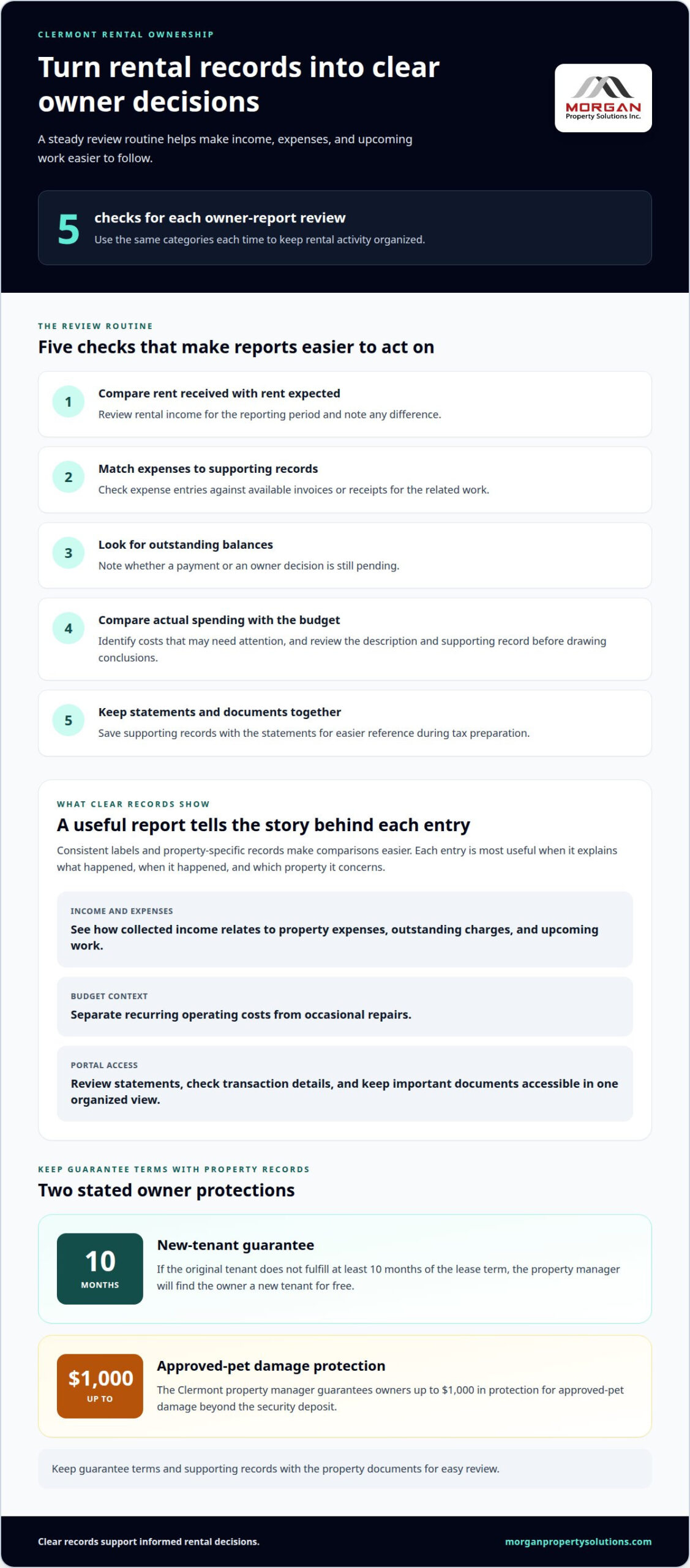
- Compare rental income received with the rent expected for the reporting period.
- Review expense entries and match available invoices or receipts to the related work.
- Check outstanding balances and note whether a payment or owner decision is pending.
- Compare actual spending with the budget, then identify costs that may need attention.
- Save statements and supporting documents together for easier reference during tax preparation.
A budget puts those reviews in context. It can separate recurring operating costs from occasional repairs, helping owners see which expenses are predictable and which need follow-up. If an expense differs from the plan, review its description and supporting record before drawing conclusions. A clear explanation may show whether the change reflects necessary work, different timing, or something that needs discussion.
Numerous small entries can make rental finances hard to follow, especially when descriptions vary. Consistent labels, property-specific records, and organized supporting documents make comparisons easier. Lake County owners with multiple rentals can keep each property’s income and expenses separate. This makes it easier to see how each home performs instead of blending results across the portfolio.
Reports support informed decisions, but they don’t increase income on their own. Use them to spot patterns, review recurring costs, and plan for upcoming needs. If a statement is unclear, identify the specific entry and question. A focused review makes follow-up more productive and keeps financial records useful for planning.
For practical guidance on rental ownership and recordkeeping, explore the landlord resources available to help organize your next steps.
Some owner protections may also be worth keeping visible alongside routine statements. Under the Clermont leasing guarantee, the property manager will find an owner a new tenant for free if the original tenant does not fulfill at least 10 months of the lease term. The Clermont property manager guarantees owners up to $1,000 in protection for approved-pet damage beyond the security deposit.
Rental laws protecting tenants and property owners exist in Florida and the other 49 U.S. states. Keep these guarantee terms and supporting records with property documents for easy review.
Rent collection and direct deposits
A consistent rent collection process gives owners a clearer view of rental income and helps tenants know what to expect. Specify the payment method, due date, and communication channel in the lease. Then follow the same process each month, recording payments against the correct property and rental period. This makes it easier to identify a missed payment before it becomes an ongoing concern.
Direct deposits can simplify how collected rent reaches an owner’s account. A clear record shows the amount collected, any authorized property expenses, and the resulting transfer. Keep the statement with related receipts and correspondence. If a deposit differs from the expected amount, compare the transactions before drawing conclusions. A property-specific ledger makes these checks easier, especially for owners managing multiple investments.
Florida rental laws protect tenants and property owners, including in matters involving security deposits, notices, and evictions. Keep deposit records, dated written notices, and payment history together so each issue has a clear paper trail.
For late payments, follow a calm, documented process. Review the ledger, then contact the tenant through the agreed channel. Record the date, amount due, payment received, and any response. If a tenant says a payment was sent, compare the transaction record with the account activity before marking it unpaid. Consistent records help distinguish a processing delay from a missed payment and support clear follow-up.
A practical monthly collection routine can include these steps:
- Match each payment to the tenant, property, and rental period.
- Record partial payments separately, with the date and remaining balance.
- Send a written reminder through the established communication channel.
- Reconcile collected rent and transfers against the owner statement.
Rent pricing also affects collection outcomes. In central Clermont, compare similar rentals by location, layout, condition, and included features. A home near Lake County’s rolling hills may appeal to a different renter than a property with other conveniences. Pricing too high can slow inquiries; pricing too low can leave potential income unrealized. Review comparable listings and showing feedback when considering an adjustment.
Keep pricing decisions separate from payment follow-up. A late payment calls for clear records and communication; a rent adjustment calls for a fresh look at comparable homes and the property’s condition. Reviewing both consistently helps you track rental income without confusing a collection issue with a market decision.
Owners organizing rent collection and rental records can use these landlord resources to plan practical next steps.
Tenant screening
A careful application review helps landlords compare prospective tenants consistently. Start with a complete application, then assess the information in a set order. For example, compare the applicant’s stated employment and rental history with the supporting details they provide. A clear process makes it easier to explain how a leasing decision was reached.
Tenant screening commonly includes background checks and credit evaluations. These checks can help owners understand an applicant’s financial history and identify details that need clarification. A credit record is one part of the picture, not a substitute for reviewing the full application. Consider it alongside income details, rental references, and the applicant’s explanation of relevant gaps.
A detailed screening workflow can keep each application organized:
- Review the application for missing fields, inconsistent dates, or unclear contact information.
- Assess income documentation against the proposed monthly rent and the applicant’s stated obligations.
- Conduct background and credit evaluations as part of the same documented process for each applicant.
- Contact rental references and ask focused questions about payment history, care of the home, and communication.
- Record the information reviewed and the reasons supporting the final decision.
Consistency matters during leasing. If one applicant is asked to explain a gap, apply the same review standard to comparable applications. Keep notes factual and tied to the information provided. For example, note that an employment date needs clarification rather than making assumptions about the applicant’s reliability.
Screening works best when the advertised rental and application process align. Describe the home accurately, explain how applicants submit information, and keep communications organized. If several applicants express interest, review each complete application using the same criteria instead of choosing solely by who responded first. This gives the landlord a clearer basis for comparing qualifications.
Credit evaluations and background checks may raise questions that need follow-up. Request clarification through the established application process, then document the response alongside the relevant record. Don’t treat one item as the entire decision. A complete review considers the application as a whole, including rental references, income information, and the applicant’s ability to meet the lease terms.
For a consistent process, keep written screening standards and application records together. Owners can review the tenant screening criteria to understand the factors used during applicant evaluation. Organized records help connect screening to leasing, making it easier to move from application review to a clear rental decision.
Property management demand in Clermont, Florida
Clermont’s rental demand depends on the home, its condition, and the renters it suits. The city’s “Choice of Champions” identity, Lake Minneola’s Waterfront Park, and the Citrus Tower give the area distinct local draws. These features can shape how renters view a neighborhood, but don’t replace comparisons with similar homes and current listings.
Orlando rents offer regional context, not a Clermont estimate. Use those figures as broad comparisons, then assess Clermont homes by location, layout, condition, and included features.
For a rental property, demand comes down to how well the home matches what prospective tenants seek. Compare nearby properties with similar bedroom counts and features. Note how presentation, access to everyday destinations, and maintenance needs affect showings and inquiries. A Clermont investment property with different features may attract a different renter than a comparable Orlando home.
How do I choose a property manager for a rental home in Clermont? Compare the manager’s approach to leasing, rent collection, maintenance coordination, and owner reporting. Ask how updates are documented and how decisions that need owner input are handled.
What licenses and legal requirements apply to property managers in Florida? Requirements depend on the activities performed and the manager’s role in leasing or other real estate transactions. Define those duties clearly and align them with applicable Florida requirements before entering an agreement.
What should a Clermont property management agreement include? It should describe services, responsibilities, payment terms, reporting, maintenance approval procedures, agreement duration, and termination steps. Clear terms help everyone understand who handles each task and when an owner’s decision is needed.
Demand also affects how owners should assess a management company’s approach. Look for a process that connects local rental comparisons with leasing feedback. If showings attract interest but applications don’t progress, review the home’s presentation and application process. If inquiries are limited, compare the asking rent, property condition, and listing details with nearby options.
For owners deciding whether professional management fits their Clermont rental, consider the time needed to coordinate leasing, payments, and property decisions. A structured approach can help keep those responsibilities organized while you assess your investment goals. Explore property management options for your rental home.
Morgan Property Solutions: Residential Property Management
Morgan Property Solutions Inc. provides Residential Property Management for owners who want help coordinating the ongoing work of a rental. Services include online payments, detailed inspections, financial reporting, tenant screening, and maintenance coordination. For a property that needs a renter, Tenant Placement and Leasing can help take it from preparation to occupancy.
This support may suit owners who live outside Clermont, have limited time for day-to-day coordination, or want a more organized process for their investment. You remain involved in decisions while management helps keep key responsibilities moving. If you’re considering a different direction for the property, Real Estate Buyer Representation and Real Estate Seller Representation can support a purchase or sale.
To discuss your property and management needs, contact Morgan Property Solutions Inc.
Take the Next Step With Your Clermont Rental
Your next step is to decide how involved you want to be in day-to-day operations. Consider what you’d like handled, which decisions you want to make yourself, and what information helps you feel in control. These priorities can guide a useful conversation with a Clermont property manager and help you define an approach that fits your investment.
Morgan Property Solutions Inc. provides Residential Property Management, Real Estate Buyer Representation, and Real Estate Seller Representation. Whether you’re preparing to manage a rental, considering a purchase, or planning a sale, the right support can help you move forward with a clearer plan.
Take the next step at Contact Morgan Property Solutions Inc. to discuss your property goals. A thoughtful plan starts with understanding what matters most to you, and you can take that step at your own pace.
Frequently Asked Questions
How much rent can you get for your investment?
Expected rent depends on a property’s size, layout, condition, and appeal to local renters. A Clermont property manager can assess comparable homes and account for features such as a garage, updated kitchen, or convenient access to daily destinations. Also distinguish gross rent from income after expenses. Mortgage payments, maintenance, vacancy, and management costs affect what remains.
What property management companies serve Clermont, Florida?
Morgan Property Solutions Inc. serves Clermont and Central Florida communities, including Orlando, Winter Park, Lake Nona, Oviedo, Windermere, Winter Garden, Apopka, Wedgefield, and Hunters Creek. For a Clermont home, consider whether the company’s services match your needs, such as ongoing oversight or leasing support. A clear discussion of responsibilities can help you decide whether management suits your ownership plans.
What services do Clermont property managers provide?
Property management can support the rental through its operating cycle, from preparing it for tenants to assisting the owner during an active lease. Services include marketing the home, coordinating applications, managing tenant communication, and organizing property-related tasks. An owner handling leasing personally may need help only with ongoing management, while an out-of-area owner may prefer broader support.
How do Clermont property managers charge for tenant placement and leasing?
Tenant placement charges and leasing terms vary by management agreement. Review whether placement is billed separately from ongoing management, what the charge covers, and when it becomes payable. The agreement should also explain how renewals are handled and whether additional leasing-related charges apply. Compare the written terms and included services rather than judging an arrangement by one fee alone.
How can I compare reviews and ratings of Clermont property management companies?
Look beyond a company’s overall rating and read reviews for details that matter to you. Notice whether owners describe clear communication, organized leasing, accurate records, or helpful follow-through when an issue arises. Compare several recent comments, then consider whether the company’s stated process addresses those concerns. Specific context about how a question was handled is more useful than broad praise alone.
What local rental market trends and average rents affect Clermont property owners?
Orlando averages provide regional context, but Clermont rents depend on each home’s features and nearby competition. Compare similar rentals by bedrooms, condition, layout, and included amenities, then monitor renter interest after listing. Clermont’s population and local attractions can inform broader demand considerations, but they don’t set an individual property’s rent. Use showing feedback and qualified inquiries to refine your estimate.

Article by
Oliver Overton-Morgan
Oliver Overton-Morgan is a full-time Real Estate Broker since 2003, with years of experience helping thousands of people purchase and sell real estate throughout Central Florida. He holds a Graduate Realtor Institute designation, LCAM, and has held licenses in good standing as a Florida Mortgage Broker and a Notary Public. Oliver immigrated to central Florida in 2001, and within 5 years Oliver built a successful Real Estate brokerage in central Florida, where he recruited over 75 Sales Associates with 25+ million in sales production.