Choosing a Bay Hill property manager involves more than finding a tenant. The right manager can set rent using local market conditions, screen applicants, coordinate leasing, and oversee maintenance to help protect your property. Bay Hill is an upscale community in Orange County, so management should reflect the home’s features and the neighborhood’s rental market.
Reliable rental income without handling every task yourself can be a practical goal. This guide covers what residential property management typically includes, how rent and tenant decisions are approached, what can affect management costs, and how to assess whether professional support suits your needs. It also explains how leasing and ongoing management fit together, so you can plan the next steps for your property.
Key Takeaways
- Set rent with Bay Hill’s local market and the property’s features in mind, and treat timely maintenance as part of protecting its long-term value.
- Use a consistent rent-collection process and keep clear records of payments, balances, and follow-up.
- Review prospective tenants’ credit, background, and rental history using consistent screening criteria.
- Organized accounting and regular investor reports make it easier to track income, expenses, and property performance.
- Professional residential management can bring leasing and ongoing property oversight together under one process.
Maintenance, rent setting, and tenant screening
Managing a Bay Hill rental means balancing upkeep, a market-informed rent, and careful tenant selection. A Bay Hill property manager can coordinate these responsibilities, while you stay informed about the process and what to review.
Property Inspections
Inspections can reveal maintenance needs before they become more significant. Review whether the manager documents the property’s condition, records repair needs, and follows up after work is completed. For example, a report noting a leak should show whether it was assigned, addressed, and checked afterward. Ask how inspection findings are shared and how urgent repairs are handled.
Maintenance coordination involves communicating with vendors, arranging access, and tracking work through completion. Clear records help you understand what was reported and what action followed. Ask how the manager handles routine upkeep, repair requests, and vendor coordination, and what information you’ll receive about each job.
Rent Setting
Rent should reflect local market conditions, the home’s features and condition, and its location. Bay Hill’s upscale character alone doesn’t establish a suitable rental price. Compare relevant properties and account for differences in layout, amenities, and maintenance condition. A proposed rent should be supported by current market research, not based only on a preferred return.
Ask how a manager researches comparable rentals and when they would review the asking rent if the property remains vacant. The explanation should connect the proposed price to identifiable market evidence and the home itself.
Tenant Screening
Consistent screening helps owners assess applicants using the same relevant criteria. A process may review rental history, income information, references, and other application details. Ask what information is collected, how decisions are documented, and how applicants are evaluated consistently. You can also review the manager’s tenant screening criteria to understand the approach.
For a residential rental, ask how credit, background, and eviction-related information are considered alongside the full application. The manager should explain the screening process rather than treating any single item as the only measure of an applicant’s suitability.
How can I choose and hire a property manager in Bay Hill? Compare Bay Hill coverage, maintenance processes, rent research, screening, communication, and the written management agreement before deciding.
What Florida licensing and legal requirements apply? Requirements depend on the activities performed. Clarify the manager’s role and responsibilities, along with applicable licensing and rental requirements, in the agreement.
What HOA or community rules affect rentals? Review the property’s governing documents for rental restrictions, approval steps, and tenant conduct rules. Requirements can differ by community.
What companies serve Bay Hill, and which are best-rated? Look for Orlando-area firms that include Bay Hill residential management in their coverage. Compare documented ratings with the services offered and management practices rather than relying on a rating alone.
Which managers specialize in residential, luxury, or vacation rentals? Match the manager’s stated focus to your property. Residential and higher-end homes need relevant leasing and oversight experience, while vacation rentals are a separate service category.
What services do Bay Hill property managers provide? Residential management commonly includes leasing coordination, rent setting, tenant screening, maintenance oversight, and owner communication.
What should I ask before signing, and what risks should I consider? Ask how repairs, vendors, rent reviews, screening, and reporting work, and read the agreement for responsibilities and fees. Unclear communication, inconsistent records, or vague maintenance procedures can make oversight harder.
Rent collection
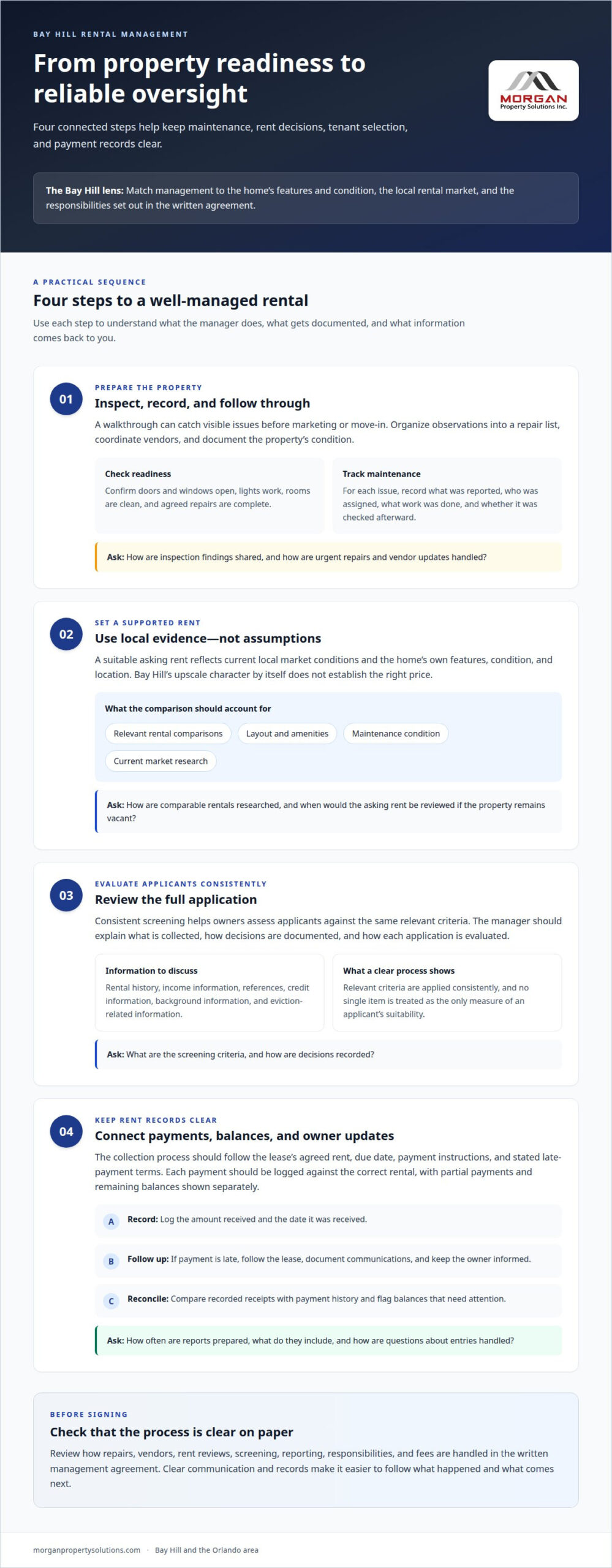
A clear rent-collection process connects the lease, payment records, and owner updates. For a Bay Hill rental, review the lease for the agreed rent, due date, payment instructions, and any stated late-payment terms. The manager’s process should follow those written terms and record each payment. That gives you a reliable way to see what has been paid and what remains outstanding.
Ask how payments are recorded and how owners receive updates. A sound process logs each payment against the correct rental, tracks partial payments separately, and records the date received. If a payment is late, the manager should follow the lease, document communications, and keep you informed. Clear records can distinguish a missed payment from a processing delay or accounting error.
Reconciliation matters, too. The manager should compare recorded receipts with the property’s payment history and flag balances that need attention. If a tenant pays only part of the rent, for example, the ledger should show both the amount received and the remaining balance. Ask how often reports are prepared, what they include, and how questions about entries are handled.
Rent readiness starts before marketing. A walkthrough can identify visible issues that may affect a prospective tenant’s first impression, such as a dripping faucet, damaged screen, or appliance that needs attention. The manager can organize observations into a repair list, coordinate work, and document the property’s condition. This creates a clearer record before a new resident takes possession.
For a family home, the walkthrough should consider how each space functions in daily use. Check that doors and windows open, lights work, and rooms are clean and presentable. Confirm agreed repairs are complete, then record the results in notes or photographs. A consistent inspection record can also help distinguish existing wear from concerns reported after move-in.
Before signing an agreement, ask who handles rent questions, how payment records are shared, and how walkthrough findings reach you. Also clarify how the manager coordinates vendors and communicates repair status. These practical details show whether rent collection and property readiness are treated as connected parts of managing a rental, rather than separate tasks. For an overview of Orlando property management, review how ongoing oversight can support owners through leasing and management.
Local context can help owners frame rent conversations without substituting market figures for the lease amount. In the Bay Hill market, a rent-ready property listing may go live quickly. That timing makes it useful to have the payment process, property condition notes, and owner reporting arrangements ready before marketing begins; the listing timeline is not a promise about when a tenant will pay or what rent a property will earn.
For broader context, Florida median gross rent figures offer a state-to-national comparison, not a rent recommendation for an individual home. Keep the agreed lease amount and actual receipts distinct from market context when reviewing reports through Morgan Property Solutions Inc.
Tenant credit, background, and eviction screening
Screening helps an owner assess whether an applicant meets the rental’s written criteria. A consistent process reviews credit information, background details, rental history, and eviction-related records. Each provides different context, so decisions should consider the full application rather than a single result. For example, documented rental history may help clarify a question raised by a credit report.
Set the criteria before reviewing applications. Identify the information required, how it will be evaluated, and how decisions will be recorded. Applying the same approach to each applicant supports consistent decisions and clear communication. A manager should explain what each screening category contributes without treating a single score or record as the whole story.
Credit information can help assess an applicant’s financial history, but it needs context. Review relevant patterns, such as unpaid obligations, alongside the income and rental information in the application. If a report contains a discrepancy, understand it before reaching a decision. Keep a record of the information reviewed and the reasons for the outcome.
Background screening should also follow the stated rental criteria. Confirm that information belongs to the applicant, then consider its relevance to the tenancy. Don’t treat an unexplained entry as a final answer. A clear process lets applicants address questions and helps owners apply decisions consistently.
Eviction screening calls for careful interpretation. A filing and a final outcome are not interchangeable, so review the record’s status and related details. Consider the information alongside the applicant’s broader rental history instead of assuming every record tells the same story. Screening can inform a decision, but it cannot guarantee that a tenancy will be free of disputes or missed payments.
Ask a prospective manager how credit, background, rental, and eviction information is gathered and reviewed. Find out how inconsistencies are handled, how decisions are documented, and how the process stays consistent from applicant to applicant. A written explanation of the criteria can make these steps easier to understand. The tenant screening criteria provide a practical starting point for reviewing the approach.
Good screening also sets expectations before move-in. Once an applicant is approved, communicate the lease, payment instructions, and property rules clearly. This connects the screening decision to the day-to-day tenancy. Keep organized records of the application and decision, and handle sensitive applicant information with care.
Milwaukee property managers should implement meticulous tenant screening to support sustained property value and consistent rental income. Milwaukee property managers should familiarize themselves with eviction norms. Careful review should preserve the distinction between a filing and a final outcome, while giving applicants a clear chance to explain relevant information.
South Shore Park is a Bay View park where residents enjoy outdoor activities and farmers markets. In a neighborhood context, screening remains one part of responsible rental management; clear criteria and thoughtful communication help keep the process understandable. Keep expectations consistent from the application stage through move-in, and explain questions promptly so applicants know what information is being considered.
Accounting and investor reporting
Accurate accounting helps you understand how a Bay Hill rental is performing. A useful report connects rental income, property expenses, and account activity to the same property and reporting period. Before management begins, agree on which records you’ll receive, how often they’ll arrive, and how to ask about an entry that needs clarification.
Start with a property-level ledger. Record rent as income and describe maintenance invoices, vendor payments, and other property expenses clearly. For example, a plumbing invoice should identify the property, vendor, work performed, and payment status. These details make it easier to trace a transaction from the original charge to the report.
A practical reporting package can include:
- Income received and any unpaid rent balance.
- Expenses grouped by purpose, such as repairs or vendor services.
- Copies or summaries of invoices and payment records.
- A reconciliation showing how reported activity matches account transactions.
Reconciliation is a useful review step. Compare the ledger with bank activity and supporting documents, then investigate differences before relying on the totals. If a report lists a vendor payment that doesn’t appear in the account activity, ask whether it is pending or was recorded incorrectly. An explanation tied to a specific transaction is more useful than an unexplained adjustment.
Investor reporting should support decisions, not just present figures. A clear summary can show whether rental income covered recorded expenses and highlight maintenance spending that needs attention. For instance, repeated service calls for the same system may prompt a review of its repair history and next maintenance steps. Reports should separate recorded activity from forecasts or estimates.
Agree on how records will be organized for each property, especially if you own more than one. Separate ledgers make it easier to compare performance without mixing one home’s costs with another’s. Ask how documents are stored, how corrections are explained, and whether you can trace each summary figure to its underlying transaction.
Before signing an agreement, clarify which accounting tasks the manager handles and what remains your responsibility. Discuss how rent receipts, invoices, owner payments, and reporting questions move through the process. Ask what happens when a vendor invoice is disputed or a transaction needs correction. A defined workflow gives both parties a practical way to resolve discrepancies and maintain complete property records.
Review a sample report before choosing a manager. Check that it identifies the property and reporting period, separates income from expenses, and provides enough detail to understand each entry. Clear accounting helps you track financial activity and make informed decisions about ongoing management.
Financial reporting and management
Financial management turns property activity into useful decisions for a Bay Hill owner. A clear report should show how rental income, operating expenses, and upcoming obligations affect cash flow. It should also separate actual transactions from projections, helping you understand what has happened and what may need attention next.
Start by reviewing the reporting period and account categories. Confirm that income and expenses belong to the correct property, then compare entries with supporting records. For example, a repair charge should connect to an invoice and a description of the work. If a transaction looks unfamiliar, ask for its supporting detail and a clear explanation.
A financial review can also help with planning. Look for recurring expenses, upcoming maintenance needs, and periods when rental income may change, such as a vacancy between tenants. These details can inform decisions about reserves, improvements, or future investment priorities. They don’t replace the underlying records, but they make the figures more useful.
- Compare actual income and expenses with the prior reporting period.
- Review recurring costs and identify unusual changes.
- Separate completed work from planned or estimated expenses.
- Note upcoming property needs that may affect cash flow.
A management portal can make records easier to access when it provides organized statements, transaction details, and relevant property documents. Check how information is grouped and whether you can trace a summary entry to its supporting record. If you prefer reports by email or another agreed method, clarify that process before management begins.
If you own multiple properties, keep each property’s activity distinct. Separate records help you compare performance without confusing one home’s expenses with another’s, and make property-specific patterns easier to spot. Repeated costs tied to the same system, for instance, may prompt a closer review of its maintenance history.
Good financial oversight includes reviewing reports, not just receiving them. Set aside time to read each statement, note questions, and follow up on entries that need context. Ask how corrections are recorded and how changes to planned work appear in later reports. A consistent review routine connects decisions to current property activity.
Before choosing a manager, discuss the reporting format, access to records, and how financial questions are handled. Clear expectations help you understand both the numbers and the decisions behind them. Explore residential property management to see how professional oversight can support your property’s ongoing financial management.
Morgan Property Solutions Inc.: Residential Property Management
Morgan Property Solutions Inc. provides residential property management for Bay Hill owners who want help coordinating a rental home. Its service can support ongoing oversight or preparation for a tenant. Tenant Placement and Leasing can also help manage the transition from marketing a home to welcoming a resident.
If you’re weighing your next move, Morgan Property Solutions Inc. also offers Real Estate Buyer Representation and Real Estate Seller Representation. These services suit different needs, whether you’re considering a purchase or preparing to sell. The right next step depends on your property goals and the support you need.
Explore your options or contact Morgan Property Solutions Inc. through morganpropertysolutions.com.
Choose a Clear Next Step for Your Bay Hill Property
Start by deciding how hands-on you want to be. If managing a rental takes time away from other priorities, a Bay Hill property manager can help move you from handling every detail yourself to having professional support. Choose an arrangement that matches your goals and the level of involvement you want to retain.
Morgan Property Solutions Inc. offers Residential Property Management, along with Real Estate Buyer Representation and Real Estate Seller Representation. Whether you’re planning to hold a rental, buy a property, or prepare to sell, consider which kind of support best fits your plans. A conversation can help you explore the next step without turning it into a rushed decision.
Contact Morgan Property Solutions Inc. today to discuss your property goals. A thoughtful plan can make the road ahead feel more manageable.
Frequently Asked Questions
Which Bay Hill property managers specialize in residential, luxury, or vacation rentals?
Match the manager’s stated focus to your property. Residential and higher-end homes call for relevant leasing and oversight experience; vacation rentals are a separate service category.
What are the best-rated property management companies near Bay Hill?
Look for firms that include Bay Hill residential management in their coverage. Compare documented ratings with the services offered and management practices.

Article by
Oliver Overton-Morgan
Oliver Overton-Morgan is a full-time Real Estate Broker since 2003, with years of experience helping thousands of people purchase and sell real estate throughout Central Florida. He holds a Graduate Realtor Institute designation, LCAM, and has held licenses in good standing as a Florida Mortgage Broker and a Notary Public. Oliver immigrated to central Florida in 2001, and within 5 years Oliver built a successful Real Estate brokerage in central Florida, where he recruited over 75 Sales Associates with 25+ million in sales production.