A rental property inspection checklist for Orlando landlords should cover the home’s interior, appliances, safety devices, and exterior condition. Routine inspections are recommended every three to six months during a tenancy, and clear photos and written notes help document what you find. A thorough walkthrough can catch issues such as leaks, pest concerns, or damaged roof shingles before they go unnoticed.
A useful inspection looks beyond visible wear: check whether appliances work, detectors respond to tests, and gutters are clear. This guide covers what to inspect inside and outside an Orlando rental, how to document observations, and how move-in, routine, and move-out inspections fit into property oversight. Use the checklist to keep each walkthrough organized and records easy to compare.
Key Takeaways
- Inspect the home’s interior and appliances for visible wear, damage, and signs that something isn’t working properly.
- Look over the roof, gutters, foundation, and outdoor areas to spot maintenance concerns before they worsen.
- Include smoke and carbon monoxide detectors and fire extinguishers in your safety review.
- Plan inspections around key tenancy stages, and give at least 24 hours’ notice before entering for an inspection.
- Consistent, documented inspections can make it easier to track property condition and plan maintenance over time.
Interior walls, floors, and appliances
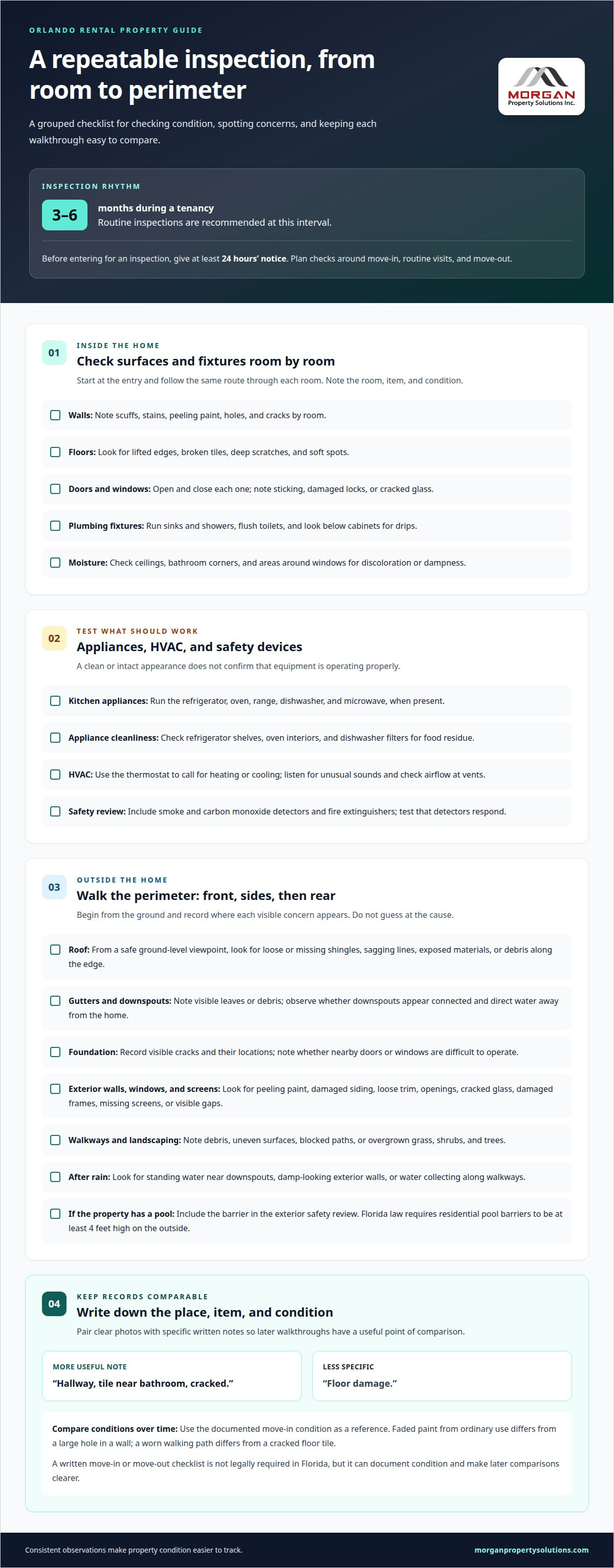
Start at the entry and move through each room in the same order. A consistent route helps you compare rooms, catch overlooked damage, and keep notes uniform. For an Orlando rental, check walls, floors, built-in appliances, plumbing fixtures, and HVAC equipment. Record each concern with its location and a clear photo.
Are Orlando landlords required to provide a written inspection checklist? Florida does not legally require landlords and tenants to complete move-in or move-out inspection checklists. A written checklist can still document the property’s condition and make later comparisons clearer.
How do Florida landlords distinguish normal wear and tear from damage? Compare the current condition with the documented move-in condition, then consider the type and extent of the change. Faded paint from ordinary use differs from a large hole in a wall; a worn walking path differs from a cracked floor tile.
- Walls: Note scuffs, stains, peeling paint, holes, and cracks by room, because their location and size help distinguish surface wear from damage.
- Floors: Look for lifted edges, broken tiles, deep scratches, and soft spots, because these can point to damage or an issue needing attention.
- Doors and windows: Open and close each one, then note sticking, damaged locks, or cracked glass, because a simple test can reveal problems not visible from across the room.
- Kitchen appliances: Run the refrigerator, oven, range, dishwasher, and microwave, when present, because an appliance that looks clean may still fail to operate.
- Appliance cleanliness: Check refrigerator shelves, oven interiors, and dishwasher filters for food residue, because cleanliness affects the home’s condition and the next tenant’s experience.
- Plumbing fixtures: Run each sink and shower, flush toilets, and look below cabinets for drips, because active leaks can leave stains or damage nearby flooring.
- HVAC: Use the thermostat to call for heating or cooling, then listen for unusual sounds and check for airflow at vents, because these steps help reveal operating concerns.
- Moisture: Inspect ceilings, bathroom corners, and areas around windows for discoloration or dampness, because a stain can signal a leak that needs follow-up.
For a property with a pool, include the barrier in the exterior safety review. The Florida Legislature says Florida law requires residential pool barriers to be at least 4 feet high on the outside. The Florida Legislature also states that a residential swimming pool barrier must be at least 4 feet high on the outside.
Record the room, item, and observed condition. For example, write “hallway, tile near bathroom, cracked” rather than “floor damage.” Pairing that specific note with a photo gives future inspections a clear point of comparison.
Roof, gutters, foundation, and exterior checks
Walk the property perimeter from the ground before reviewing individual features. In Orlando, note visible roof damage, drainage concerns, cracks, and neglected outdoor areas. Record where each concern appears and take a clear photo. Following the same route, such as front, sides, then rear, helps keep observations consistent between visits.
- Roof surface: Look for loose or missing shingles from a safe ground-level viewpoint, because damaged areas may allow water intrusion.
- Roof edges: Scan for sagging lines, exposed materials, or debris along the edge, because these details can signal a condition needing closer attention.
- Gutters: Note leaves, branches, or other visible debris, because clogged gutters can prevent rainwater from draining properly.
- Downspouts: Observe whether each downspout appears connected and directs water away from the home, because poor drainage can leave water near the structure.
- Foundation: Record visible cracks, their locations, and whether nearby doors or windows appear difficult to operate, because those details help track changes over time.
- Exterior walls: Check for peeling paint, damaged siding, loose trim, or openings around doors, because gaps and deterioration can expose the building to moisture.
- Windows and screens: Look for cracked glass, damaged frames, missing screens, and visible gaps, because each condition affects the window’s function and the home’s exterior condition.
- Walkways and common areas: Note debris, uneven surfaces, or blocked paths, because clear, orderly shared spaces are easier for residents to use.
- Landscaping: Check whether grass, shrubs, and trees appear maintained, because overgrowth can obscure the home or obstruct paths.
Be specific: “missing shingle above the rear bedroom” is more useful than “roof issue.” For gutters, note which side has debris; for foundation cracks, describe the wall and nearby feature. These details help you compare records and identify changes that need follow-up.
After rain, look for standing water near downspouts, damp-looking exterior walls, or water collecting along walkways. These signs do not establish the cause, but they show where drainage or exterior conditions may need attention. When possible, photograph the area from the same angle at later inspections to make visible changes easier to compare.
For a practical way to organize ownership tasks alongside property observations, explore these landlord resources.
Record gutters and downspouts separately: note where debris is visible and whether water appears to move away from the home. Orlando rental property inspections should check that gutters and downspouts are clear and functioning. If you see a concern, keep a photo and a brief location note for comparison at a later visit. Describe what is visible rather than guessing at the cause.
Apply the same approach to cracks: record each location and note whether nearby doors or windows are difficult to operate. Orlando rental property inspections should identify visible foundation cracks so they can be tracked over time. Describe each crack by wall and nearby feature, then compare later records. A clear comparison can show a change that merits follow-up without attempting to diagnose its cause.
Smoke and carbon monoxide detectors and fire extinguishers
Make safety equipment a deliberate stop on every walkthrough. Test smoke and carbon monoxide detectors with their test buttons, and record whether each alarm sounds. Check that units are present, accessible, and visibly intact. Since a detector can look undamaged yet fail to respond, note the test result, not just its appearance.
Orlando rental inspections should cover working smoke and carbon monoxide detectors, accessible fire extinguishers, visible exits, and clear exit signage. For short-term rental fire-safety audits in Orange, Osceola, and Polk counties, NFPA 101 Life Safety Code is identified as a basis.
- Smoke detectors: Test each unit and record its room, because a room-by-room record helps pinpoint a silent or missing alarm.
- Carbon monoxide detectors: Test each unit and record its location, because a clear location note makes follow-up easier if one fails.
- Detector age: Note the age shown on each device; inspections recommend checking that smoke and carbon monoxide detectors are less than ten years old.
- Fire extinguishers: Confirm each extinguisher is accessible and functional, because an obstructed or unusable unit cannot serve its intended purpose.
- Expiration dates: Read the date on each extinguisher and record it, because an expired unit needs attention even when it appears clean.
- Exit routes: Walk the path from occupied rooms to exterior exits, because stored items or furniture can obstruct a clear route.
- Exit signage: Confirm signs are visible along the route, because a blocked or obscured sign can make an exit harder to identify.
- Locks and security: Test each exterior door lock and accessible window latch, because a loose latch or sticking lock can affect access and security.
Identify the room or doorway for every concern. “Carbon monoxide detector, upstairs hall, no alarm on test” gives a clear follow-up record; “safety issue” does not identify the device or location. Add a photo when it helps show a missing unit, obstructed exit, or other visible concern.
Record only what the inspection establishes: the device’s location, visible condition, test response, and any date shown. If a detector does not sound, an extinguisher is expired, or an exit sign is obscured, document that specific finding for follow-up. This distinguishes a completed check from an unresolved safety concern.
Move-in, routine, and move-out inspections
Use the same written checklist at move-in, during the tenancy, and at move-out. Matching categories make it easier to compare the home’s condition over time. Florida does not legally require landlords and tenants to complete move-in or move-out inspection checklists, but consistent records can clarify what changed.
To document rental property damage, keep clear photos and detailed notes that identify the room, item, and observed condition. Compare those records with the move-in condition before documenting a change. An inspection checklist does not replace compliance with Florida’s separate security deposit requirements.
You can make a printable Florida rental inspection checklist from this guide’s categories. Copy the items into a room-by-room form, leaving space for observations, photos, and follow-up notes.
- At move-in: Record the condition of each room and included feature before the tenancy begins, noting existing marks, appliance condition, and any visible maintenance concern.
- During the tenancy: Florida landlords must give tenants at least 24 hours’ notice before entering for an inspection. Keep routine inspections on a consistent schedule, and note new concerns separately from previously documented conditions.
- At move-out: Use the move-in record as a comparison point, then document each difference with a specific location and clear photo.
- After each walkthrough: Add detailed written notes and label photos by room or feature, so an image of a stain or broken fixture has useful context.
Routine inspections help track when a condition changes instead of leaving the first observation until a final walkthrough. Florida inspection guidance recommends routine inspections every three to six months during a tenancy. It also recommends quarterly inspections during a tenant’s lease to identify potential damage, safety concerns, and lease violations. Record the date and use the same categories at each visit.
Keep observations factual. “Water stain on the living-room ceiling, photographed” describes what you can see; “tenant caused leak” assigns a cause the inspection may not establish. If a concern needs follow-up, record the next step and keep related notes with the property’s inspection history.
In an emergency, Florida landlords can enter without notice to protect or preserve the property. For a routine inspection, provide the required notice and document when it was given. Keeping emergency access separate from scheduled walkthroughs makes the records clearer.
Reliable comparisons depend on following the same room order and describing changes precisely. Note, for example, whether a mark was present at move-in or first appeared in a later inspection. That timeline, together with photos and written observations, gives you a clearer record when reviewing the property’s condition and discussing damage.
Benefits of professional property inspections
A professional inspection adds a consistent process to property oversight. Rather than relying on memory, the inspector follows repeatable steps, records observations, and organizes findings for review. For an Orlando rental, this can help owners understand the property’s condition and prioritize maintenance concerns.
- Consistent coverage: A written procedure helps keep every room and exterior area in scope, so recurring concerns aren’t overlooked between visits.
- Clearer records: Dated notes and labeled photos show what an inspector observed, giving owners a practical reference for later comparisons.
- Earlier maintenance planning: A documented drip beneath a sink, for example, gives the owner a specific issue to investigate before visible water damage spreads.
- More organized follow-up: Grouping observations by urgency and location helps owners coordinate repairs and keep track of unresolved items.
- Useful tenancy documentation: Matching inspection records across move-in, routine visits, and move-out can make changes in condition easier to review.
- Better communication: Specific findings such as “loose kitchen cabinet hinge” give owners, tenants, and maintenance teams a clear starting point.
Professional oversight can also clarify when a routine walkthrough is not the right assessment. A 4-point inspection covers a property’s roof, electrical, plumbing, and HVAC systems. That defined scope differs from a general rental walkthrough, which may record visible conditions across rooms, appliances, and outdoor areas. Knowing the purpose of the inspection helps owners choose the appropriate next step.
What does a rental property inspection cost in Orlando? The cost depends on the property, inspection scope, and reporting needs. A case-specific amount is provided after a quote request.
Before arranging an inspection, decide what question it should answer. A routine condition review may help organize maintenance; a move-out review focuses on comparing the home with its earlier documented condition. A clear purpose keeps the walkthrough focused and makes the notes more useful.
Inspection findings still require owner decisions. A report can describe a visible concern, such as a ceiling stain or damaged exterior trim, but follow-up may involve a separate assessment or repair. Clear documentation helps owners track next steps without treating every observation as a confirmed cause.
For help organizing the wider responsibilities of an Orlando rental, explore Orlando property management. A structured management approach can help keep inspections and property follow-up connected.
Morgan Property Solutions Inc.
Morgan Property Solutions Inc. helps Orlando property owners connect inspection findings with the broader work of owning and managing a rental. If a checklist flags maintenance concerns or you want help organizing property oversight, the company’s residential property management service may be a practical next step. Morgan Property Solutions Inc. also supports tenant placement and leasing, as well as buyer and seller representation when your property plans change.
Inspection notes are most useful when they guide practical decisions, such as prioritizing maintenance or preparing for a tenancy transition. Morgan Property Solutions Inc. can help you consider how those decisions fit your rental property goals. Contact the team to discuss your property and the support you need.
Turn inspection notes into a practical plan
A completed walkthrough is most useful when its findings guide your next decisions. Set a manageable process for reviewing observations, prioritizing maintenance, and keeping property records together. Future inspections can then build on an organized history. A rental property inspection checklist for Orlando landlords supports that process, but its value comes from using the record to make informed choices about the property.
If you’re deciding how inspection findings fit into your plans for a rental, Morgan Property Solutions Inc. can help you consider the next steps. Start a conversation with Morgan Property Solutions Inc. about your property and goals. A clear plan can make ownership decisions feel more manageable, one step at a time.
Frequently Asked Questions
What is a Rental Property Inspection?
A rental property inspection documents a home’s condition and features. It helps owners identify maintenance needs and track changes between visits. For a rental property inspection checklist, Orlando landlords should tailor the items to the specific home rather than assume every property has the same features. Later walkthroughs can show whether a recorded concern has changed. An inspection records observations; it does not automatically establish the cause of damage.
What should a rental property inspection checklist include?
An Orlando rental property inspection checklist should match the home and the items included with the rental. Alongside room-by-room observations, note provided keys, garage remotes, mailbox access, and shared amenities. Add space for the inspection date, the person completing it, follow-up actions, and tenant comments. These details connect a recorded condition with the right feature and make later record reviews easier.
What are Florida landlord requirements for move-in and move-out inspections?
Florida does not legally require landlords and tenants to complete move-in or move-out inspection checklists. For an inspection requiring entry, landlords must give tenants at least 24 hours’ notice; emergency entry to protect or preserve the property is an exception. Keep inspection records separate from security deposit procedures, and use dated observations to show the property’s documented condition at each stage.
How often should Orlando rental properties be inspected?
Routine rental inspections are recommended every three to six months during a tenancy. Quarterly inspections are also recommended to help identify potential damage, safety concerns, and lease violations. A consistent schedule makes records easier to compare. Owners can also arrange walkthroughs at tenancy transitions and use the property’s condition and outstanding maintenance items to plan the next routine visit.
What should tenants document during a rental walkthrough?
Tenants should record the walkthrough date and describe concerns with a precise location, such as “bedroom closet door sticks near the handle.” Photos add context, particularly when they show both the wider area and a closer view. Keep copies of notes and messages about reported issues, including dates and follow-up, to maintain a personal record of observations and communication during the tenancy.
What are Florida security deposit rules for documenting rental property damage?
Florida does not legally require move-in or move-out inspection checklists. To document damage, keep clear photos and detailed notes, then compare the condition with the move-in record.

Article by
Oliver Overton-Morgan
Oliver Overton-Morgan is a full-time Real Estate Broker since 2003, with years of experience helping thousands of people purchase and sell real estate throughout Central Florida. He holds a Graduate Realtor Institute designation, LCAM, and has held licenses in good standing as a Florida Mortgage Broker and a Notary Public. Oliver immigrated to central Florida in 2001, and within 5 years Oliver built a successful Real Estate brokerage in central Florida, where he recruited over 75 Sales Associates with 25+ million in sales production.