Do all the heirs have to travel to Orlando to sell an inherited home? Not necessarily. Selling an inherited house in Orlando with tenants may be possible without every heir attending in person, depending on who is authorized to sign and how the closing is arranged. Tenants can remain in the property during a sale, but the lease and the estate’s authority can affect timing and how the home is presented to buyers.
When probate, tenants, and family decisions overlap, a clear plan helps. A sale during probate may be possible if the personal representative has authority to sell. The property’s condition and local market also shape its value. This article explains how tenant occupancy, probate, pricing, and remote closing fit together, and when real estate support can help.
Key Takeaways
- A tenant-occupied inherited home can be sold, but the lease affects how the sale is marketed and what happens to the tenancy at closing.
- Who can authorize a sale depends on how the property was held and the personal representative’s or trustee’s authority.
- Probate and ownership details shape the sale timeline, including whether a court must authorize or confirm the transaction.
- A comparative market analysis uses recent sales of similar nearby homes to help estimate a competitive price.
- When heirs live elsewhere, signing and closing arrangements depend on who owns the property and who has authority to act for the estate.
Can I sell the property while the tenants are still living there?
Yes. An inherited home with tenants can be sold, but the estate’s authority and existing lease shape the process. The personal representative or trustee must have authority to act for the legal owner.
Authority During Probate or Trust Administration
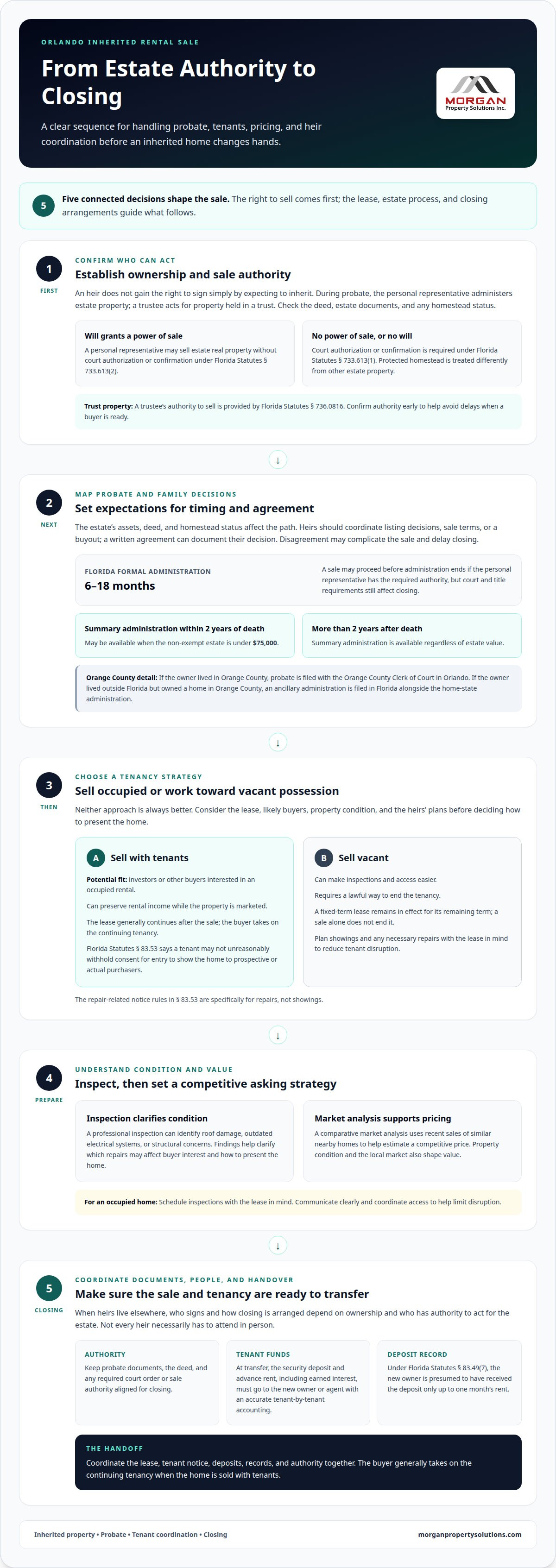
During probate, the court-appointed personal representative administers estate property, while a trustee acts for property held in trust. That distinction matters because the person managing the home may not automatically have authority to sell it. Under Florida Statutes section 733.613(2), a personal representative may sell estate real property without court authorization or confirmation when the will grants a power of sale.
If the will does not grant that power, or there is no will, section 733.613(1) requires court authorization or confirmation for the sale. Protected homestead is treated differently from other estate property. A trustee’s authority to sell trust property is provided by section 736.0816. Confirming the ownership and authority early helps prevent delays when a buyer is ready.
Landlord Duties and Tenant Risks
Until the tenancy ends or the property transfers, the person responsible for the rental must continue meeting landlord obligations. Florida landlords must maintain a safe, habitable home and address necessary repairs. Showings and unresolved maintenance can disrupt tenants, so communicate clearly and schedule access with the lease in mind.
A property manager can coordinate rent collection, maintenance, and tenant communication while the home is marketed. Insurance also deserves attention: a standard homeowner’s policy will not apply if the inherited home is not the owner’s primary residence. Rental-property coverage should account for property damage, liability, and lost rental income.
Selling With Tenants or Vacant
Selling with tenants can preserve rental income and appeal to buyers seeking an occupied investment property. Selling vacant may make inspections and access easier, but requires a lawful way to end the tenancy. Is it better to sell an inherited Orlando rental with tenants or vacant? Neither option is always better. Consider the lease, buyer pool, property condition, and heirs’ plans.
A real estate professional can market the occupied home to investors or other buyers, disclose the tenancy, and coordinate access. Florida Statutes section 83.53 says a tenant may not unreasonably withhold consent for entry to show the home to prospective or actual purchasers. The repair-related notice rules in that section are specifically for repairs, not showings.
Leases, Deposits, and Sale Options
A tenant’s lease generally continues after the landlord dies, and a fixed-term lease remains in effect for its remaining term. Does an Orlando tenant’s lease remain in effect after the inherited home is sold? Generally, yes. The sale alone does not end the lease, so the buyer takes on the continuing tenancy.
At transfer, the security deposit and advance rent, including earned interest, must go to the new owner or agent with an accurate tenant-by-tenant accounting. Under Florida Statutes section 83.49(7), the new owner is presumed to have received the deposit only up to one month’s rent. A real estate professional can coordinate the funds, records, and tenant notice. The tenant may also be considered as a buyer, alongside investors, while any sale still follows the estate’s authority and lease terms.
Before setting a sale strategy, a professional inspection can identify roof damage, outdated electrical systems, or structural concerns. The findings help clarify which repairs may affect buyer interest and how to present the home. For an occupied inherited rental, schedule the inspection with the lease in mind to reduce tenant disruption.
Establishing legal ownership and completing probate
Before an inherited home can close, the estate’s authority and the property’s ownership must be clear. In Orange County, the probate process depends on the estate, the deed, and whether the home qualifies as protected homestead.
Probate Delays and Heir Coordination
Probate is the court process for validating a will and distributing a deceased person’s assets. Heirs may not sign for a property simply because they expect to inherit it. The court-appointed personal representative administers the estate, while a trustee handles property held in a trust.
When several heirs inherit a home, they need to coordinate decisions about listing, sale terms, or a buyout. One heir, for example, may want to sell while another wants to keep the property. A written agreement can document the decision. If the heirs cannot agree, the dispute may complicate the sale and delay closing.
Probate and Sale Timelines
Florida formal administration commonly takes 6 to 18 months, so probate can shape the expected sale timeline. A sale may proceed before administration ends when the personal representative has the required authority, but the court process and title requirements still affect when closing can occur.
Summary administration may be available within two years of death when the non-exempt estate is under $75,000. If the owner died more than two years ago, summary administration is available regardless of estate value. These paths can involve different steps, so the estate’s timing and assets matter.
If the owner lived in Orange County, probate is filed with the Orange County Clerk of Court in Orlando. If the owner lived outside Florida but owned a home in Orange County, an ancillary administration is filed in Florida alongside the home-state administration. This additional proceeding can affect how ownership is established before the buyer receives title.
Homestead status also matters. Florida’s homestead devise rules appear in Florida Statutes §§ 732.401 and 732.4015. A personal representative generally does not hold protected homestead as an estate asset. Florida generally restricts a homestead devise when the deceased owner leaves a spouse or minor child, with an exception for a devise to the spouse when there is no minor child. The property’s status can therefore affect who inherits and who must participate in a sale.
For a smoother closing, the sale team needs the probate documents, deed, and any court order or authority supporting the transfer. A real estate agent can coordinate with the personal representative and heirs on marketing and buyer timelines, while the estate’s authorized signer handles the legal transfer. Real estate seller representation can help coordinate the home sale once authority and ownership are clear.
Local sale prices, rental rates, and market conditions
When selling an inherited house in Orlando with tenants, value depends on nearby comparable sales, the property’s condition, and whether it is occupied. Selling costs affect the amount left for heirs, while rental income depends on local rents, demand, and ongoing expenses.
In Orange County, sellers customarily pay deed documentary stamps and the owner’s title policy, though title-policy payment is negotiable. Documentary stamps are charged at $0.70 per $100 of sale price, and deed recording costs $10 for the first page and $8.50 for each additional page.
Local Prices and Rental Rates
A comparative market analysis estimates fair market value by comparing recent sales of similar homes. For an inherited Orlando property, relevant comparisons include the neighborhood, size, condition, and occupancy.
Rental value calls for a different comparison: similar local rentals, occupancy rates, and demand. Florida homes average 71 days on the market before an offer is accepted, but that statewide figure isn’t a promise for an individual Orange County property. A real estate agent can weigh current local conditions when setting a pricing strategy.
Closing costs explain why the gross sale price differs from the proceeds. Recording costs, title insurance, any mortgage payoff, and other transaction expenses affect the amount left after closing.
Sale Proceeds Compared With Rental Income
Selling can give heirs access to funds without ongoing landlord responsibilities. Renting may provide ongoing income and potential appreciation, but weigh rent against repairs, maintenance, utilities, management expenses, and periods without a tenant.
Heirs comparing the options can assess expected rent alongside the property’s condition and likely upkeep. They should also consider whether they want to share ownership and decisions over time. Selling turns the property into proceeds to distribute; renting keeps it as a jointly managed asset.
Tax treatment can also affect the comparison. An inherited property’s federal tax basis is generally its fair market value on the decedent’s date of death under IRC §1014. If the home has appreciated since then, the sale may have capital-gains tax implications. The basis and ownership records help explain the financial picture.
Tenants should receive clear communication about the sale and any planned showings. Florida law allows a tenant not to unreasonably withhold consent for entry to show the home to prospective or actual buyers. Coordinated access can help preserve the tenant’s possession while giving buyers a chance to evaluate the property.
Before listing or continuing the rental, an inspection can identify roof damage, outdated electrical systems, or structural problems. The findings help clarify which repairs may affect buyer interest or rental readiness. For families selling an inherited house in Orlando with tenants, consider the home’s condition and tenancy when choosing a strategy and estimating proceeds.
Do the heirs have to come to Florida to close?
Not necessarily. Heirs may be able to sign closing documents remotely, so each beneficiary does not automatically need to travel to Florida. The key questions are who holds title, who has authority to sign, and how the closing is arranged.
Start by distinguishing estate authority from ownership among heirs. During probate, an executor or personal representative may act for the estate only within their authority. Once property passes to multiple heirs, they generally need to make decisions jointly or use an agreement, such as a buyout or ownership entity. Florida generally treats property held by two or more people as tenancy in common without survivorship rights, unless the deed provides otherwise, under section 689.15.
Remote signing can help when heirs live outside Central Florida, but each signer still needs to complete the required closing documents. The closing agent coordinates signatures, verifies the authority of anyone signing for the estate, and arranges document delivery. The executor’s role and recorded ownership determine who signs. A real estate agent can coordinate the listing and sale timeline with the authorized signers.
A buyout may suit beneficiaries who want to keep the Orlando home while others prefer to sell. The heirs can agree on a value and document the ownership change. Any mortgage, property taxes, liens, and rental obligations can affect the terms. A written agreement clarifies who receives proceeds or takes on ongoing ownership responsibilities.
Tenants add another timing consideration. A valid lease may require the seller to wait until it expires, though the parties may negotiate a buyout or move-out date. Any agreement should address the tenant’s departure and the timing of possession. Until then, the sale plan must account for the continuing tenancy.
If the co-heirs cannot agree on selling, keeping, or buying out the property, a partition action may become relevant. Florida’s Uniform Partition of Heirs Property Act is codified at Fla. Stat. §§ 64.201 to 64.214. Partition is a legal process for resolving shared-property disputes, not simply another listing option. The heirs’ ownership interests and the home’s circumstances shape what happens next.
For a remote sale, first establish who can sign, agree on sale terms, and coordinate documents and possession. A Florida attorney can address estate or ownership disputes, while the real estate agent manages the listing and buyer discussions. This division helps align legal authority, decisions among heirs, tenant timing, and closing logistics.
What Makes Selling Inherited Property in Florida Different?
Selling an inherited Florida home requires a defensible estimate of market value and a clear plan for its use. A comparative market analysis can help estimate value, while occupancy and family goals inform whether selling makes sense.
Comparative Market Analysis for Inherited Homes
A comparative market analysis estimates value by comparing the home with recent sales of similar nearby properties. For an Orlando home, consider the neighborhood, size, condition, and features that distinguish it from nearby sales.
The analysis helps heirs set a listing strategy based on local evidence rather than an online estimate alone. Occupancy or needed repairs may affect buyer interest, so include those details in the pricing discussion. The result is an estimate, not a guaranteed sale price.
Inherited-home taxes also matter. Florida has no inheritance tax or state estate tax. For federal tax purposes, the inherited property’s basis is generally its fair market value on the decedent’s date of death under IRC §1014. If the home’s value has risen since then, selling may create capital gains tax consequences. The difference between basis and sale proceeds, along with eligible costs, informs that calculation.
Deciding Whether to Sell
Deciding whether to sell means comparing likely proceeds with the work and costs of continued ownership. Selling may suit heirs who want access to funds or do not want to manage a rental. Keeping the home may suit beneficiaries seeking rental income or potential appreciation.
Heirs can weigh the home’s condition, likely repairs, tenant arrangements, and their shared plans. A local rental comparison can help estimate income, while a comparative market analysis supports an estimate of sale value. Considering both makes the decision more practical.
A relative living in the home without a written lease adds another factor. Occupancy alone does not establish ownership or the terms of possession. The deed and estate documents establish ownership; communications, payments, and any agreement can help clarify the occupant’s arrangement. Before setting a sale date or promising vacant possession, the authorized owner should resolve these details with appropriate legal guidance.
Florida’s rules for ending some tenancies depend on the rental period. For example, a monthly tenancy without a specific duration requires written notice at least 30 days before the end of a monthly period. That rule should not automatically be applied to a relative whose occupancy may not be a tenancy. Correctly understanding the arrangement helps heirs avoid planning a listing around an unsupported move-out assumption.
Once ownership, value, and occupancy are understood, the heirs can choose a sale or rental plan with fewer surprises. Explore real estate seller representation to plan the home’s market positioning and sale.
Morgan Property Solutions Inc.: Tenant Placement and Leasing
Morgan Property Solutions Inc. can help you decide whether to sell an inherited Orlando home or continue renting it. If you keep the property, Tenant Placement and Leasing can support a transition to a new tenant, while Residential Property Management can help with ongoing rental responsibilities. If selling better fits your plans, Real Estate Seller Representation can guide the sale.
The next step depends on the estate’s authority, the current lease, the home’s condition, and the heirs’ goals. Heirs who want to keep the property may need rental support; those ready to sell may benefit from representation through listing and buyer discussions.
Contact Morgan Property Solutions Inc. to discuss which path fits your inherited property.
Choose the Next Step That Fits Your Plans
The next decision is what you want the property to do for your family. If you’re selling an inherited house in Orlando with tenants, Morgan Property Solutions Inc. offers Real Estate Seller Representation to support the sale. If the heirs decide to keep the home as a rental, Residential Property Management can help with ongoing ownership. Real Estate Buyer Representation may also help if a beneficiary is considering buying the property or another heir’s interest.
You don’t need to work out every detail before starting a conversation. Bring your current priorities to discuss which direction fits the property and the heirs’ plans. A clear next step can make a complicated transition feel more manageable.
Contact Morgan Property Solutions Inc. to talk through your options. Your family can move forward with a plan that reflects what matters most.
Frequently Asked Questions
Should You Rent or Sell an Inherited House?
Renting may suit heirs who want to keep the property and manage a continuing rental, while selling can provide funds and end shared ownership. Compare likely rent with repairs, vacancies, management, and other carrying costs. Heirs who live far apart, for example, may prefer selling to coordinating ongoing decisions. If the home needs substantial work, its condition can also influence which option fits the family’s plans.
Who Controls an Inherited House Before It’s Sold?
Who controls the home depends on how it was owned and whether probate or a trust applies. A court-appointed personal representative administers probate estate property, while a trustee acts for property held in trust. The deed and estate documents help identify the ownership arrangement. Someone named in a will, for example, does not necessarily have authority to sign a deed before the estate’s legal process grants it.
Can an heir avoid capital gains tax on an inherited house?
Not automatically, though the inherited-home basis rule may reduce taxable gain. Under IRC §1014, basis is generally the property’s fair market value on the date of death. If the home sells for more than its adjusted basis, the gain may have tax consequences. The IRS principal-residence exclusion has ownership and use requirements, including living in the home for at least two years within the five-year period ending on the sale date.
Can you just give them notice to leave?
No, not without understanding the occupant’s legal arrangement and the notice rules that apply. A fixed-term lease generally remains in effect for its stated term, and a sale alone does not end it. For a month-to-month tenancy without a specific duration, Florida requires written notice at least 30 days before the end of a monthly period. A relative’s occupancy may not be a tenancy, so the agreement and facts matter.
What Florida laws apply when selling an inherited rental house with tenants?
Several Florida statutes may matter at different points. Section 733.613 addresses an estate representative’s authority to sell real property. Section 83.53 covers landlord entry, including access to show a home to prospective buyers. Section 83.49 addresses security deposits and advance rent when a rental transfers, while section 83.67 restricts certain landlord actions involving tenants and their belongings. Which provisions apply depends on the estate, lease, and sale circumstances.
How much notice must a landlord give tenants in Florida before ending a tenancy or showing the property?
For a periodic tenancy without a specific duration, notice depends on the rental period: 60 days for a year-to-year tenancy, 30 days for a quarterly or monthly tenancy, and 7 days for a weekly tenancy. Those periods apply to ending the relevant tenancy, not automatically to showings. Florida law says tenants may not unreasonably withhold consent for entry to show the home to prospective or actual buyers.
How can a real estate professional help establish ownership and authority to sell an inherited house in Orange County, Florida?
A real estate professional can coordinate the sale around the ownership and authority documents, but does not decide who legally owns estate property. If the owner lived in Orange County, probate is filed with the Orange County Clerk of Court in Orlando. The sale team can coordinate with the authorized personal representative, gather transaction records, and align listing and buyer timelines with the estate process.
Does the inherited property need to go through probate before it can be sold in Florida?
Not every inherited property must pass through probate. A Lady Bird deed or a properly funded trust can allow property to pass without probate. If probate applies, a sale may still occur before administration ends when the personal representative has the required authority. A will granting a power of sale can affect that authority; without one, or without a will, court authorization or confirmation is required under section 733.613.

Article by
Oliver Overton-Morgan
Oliver Overton-Morgan is a full-time Real Estate Broker since 2003, with years of experience helping thousands of people purchase and sell real estate throughout Central Florida. He holds a Graduate Realtor Institute designation, LCAM, and has held licenses in good standing as a Florida Mortgage Broker and a Notary Public. Oliver immigrated to central Florida in 2001, and within 5 years Oliver built a successful Real Estate brokerage in central Florida, where he recruited over 75 Sales Associates with 25+ million in sales production.