
A family relationship doesn’t replace a written rental agreement. If you’re deciding how to tell family they need to sign a lease, explain that everyone should agree to the terms in writing before rent is paid. A clear agreement helps prevent misunderstandings about payment, responsibilities, and how long someone may stay.
It can feel awkward to bring up paperwork with someone you care about. Still, setting expectations early can protect both the relationship and the home. Keep the conversation warm and direct: written terms give everyone the same understanding, rather than signaling a lack of trust.
This guide explains how to raise the subject, document an existing verbal agreement, and record changes. It also covers when a family member may need to be added to a lease, how a temporary guest differs, and what to consider before signing as a co-signer. These steps can make a family rental arrangement clearer from the start.
Key Takeaways
- Set the expectation that rent and responsibilities belong in a written agreement before money changes hands.
- Record verbal agreements and later changes in an addendum, amendment, or updated rental agreement.
- Consider whether a family member is a temporary guest or a longer-term adult occupant who should be listed on the lease.
- Keep the conversation calm and practical by explaining that written terms help everyone understand the arrangement.
- Review key terms, including payment responsibilities, deposits, and any co-signer obligations, before signing.
1. Avoiding payment without a written lease
Before accepting rent or a security deposit from a relative, put the rental terms in writing. A signed agreement gives everyone a shared record of the rent, payment dates, occupancy, and responsibilities. If you’re deciding how to tell family they need to sign a lease, explain that the document protects the arrangement, not just the property owner. It also lets your relative understand the terms before paying.
Are written leases legally required when renting to family in the United States? There isn’t one answer for every rental: the applicable state and local rules and the arrangement matter. Don’t assume that being related makes a verbal agreement sufficient or changes the rules that apply to the property.
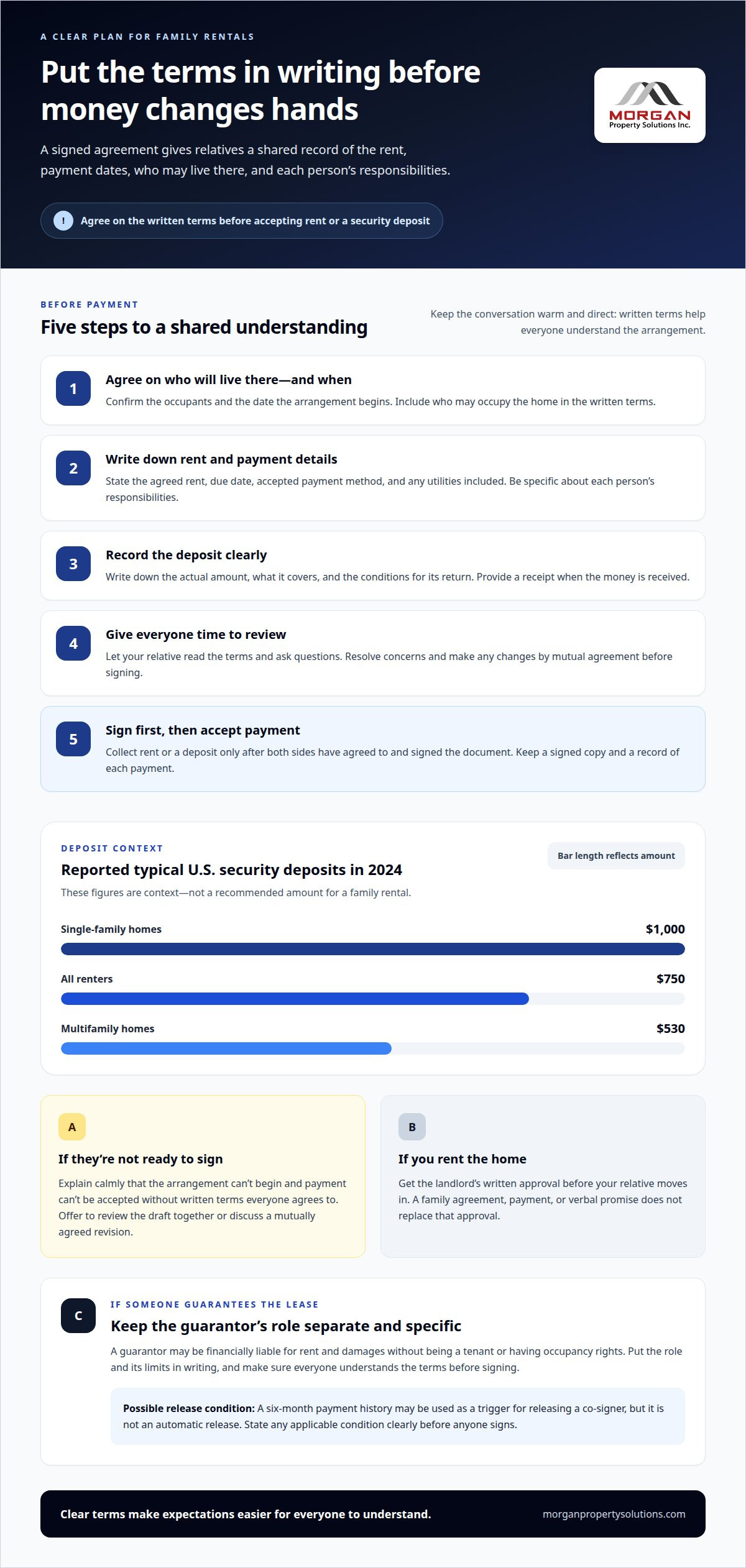
Use a simple sequence before accepting payment. First, agree on who will live in the home and when the arrangement starts. Next, write down the rent, due date, accepted payment method, and any included utilities. Then record the security deposit and the conditions for its return. Give your relative time to review the terms and ask questions. Collect payment only after both sides have agreed to and signed the document.
A deposit is a substantial commitment, so record its amount and purpose clearly. The typical security deposit renters in the United States reported paying in 2024 was $750. For single-family homes, the typical deposit was $1,000; for multifamily homes, it was $530. These figures are context, not a recommended amount for your family rental. State the actual deposit in the agreement, explain what it covers, and provide a receipt when money is received.
What if your family member refuses to sign? Calmly explain that you can’t accept rent or begin the arrangement without written terms everyone accepts. Offer to review the draft together, clarify a concern, or revise a term by mutual agreement. If you rent the home rather than own it, get the landlord’s written approval before your relative moves in. Don’t treat payment or a verbal promise as approval.
For example, if a cousin offers rent before moving in, pause the payment and complete the agreement first. Include the move-in date, agreed rent, utility responsibilities, and who may occupy the home. Keep a signed copy and a record of each payment. This creates a practical paper trail if someone later remembers the arrangement differently. Clear written terms help keep money, housing, and family expectations aligned.
If another relative guarantees the lease, put that role in writing and make sure everyone understands its limits. A lease guarantor may be financially liable for rent and damages without having tenant status or occupancy rights. Agreeing to guarantee payment does not, by itself, make the guarantor a tenant or give them the right to occupy the home. Keep the guarantor’s responsibilities separate from the resident’s terms, and have everyone review the document before signing.
The agreement can also state how a co-signer might seek release. A six-month payment history may be a trigger for releasing a co-signer, but it should not be treated as an automatic release. Set out any applicable condition clearly before anyone signs, so the guarantor understands the commitment and possible release terms.
2. Putting verbal agreements and lease changes in writing
A conversation can settle the basics, but a written document helps everyone remember the same terms. After discussing a rental arrangement with a relative, put the agreed details into a lease agreement or written addendum. Include the people involved, the home, the start date, rent, payment schedule, and any agreed responsibilities. Ask everyone covered by the document to review it before signing.
If the family member has already moved in under a verbal agreement, write down the current arrangement rather than relying on memory. State what both sides understand today, including any agreed rent or household duties. Give each person a copy. A written record can clarify expectations even when the conversation happened earlier.
For a change to an existing lease, use a lease addendum, lease amendment, or updated rental agreement. Choose a document that identifies the original lease and describes the change clearly. For example, if a relative will begin paying part of the rent, specify the new amount, who pays it, and when the change takes effect. Avoid vague phrases such as “help with bills.”
- Identify the change: State whether it concerns rent, occupants, utilities, or another agreed term.
- Set the effective date: Make clear when the new arrangement begins.
- Keep unchanged terms clear: Note that the rest of the agreement remains as written, if that is what everyone intends.
- Collect signatures and copies: Give each party a signed version for their records.
Suppose a family member initially agreed to contribute toward utilities, but everyone later decides to divide those costs differently. Record the new method and start date in writing. Keep the earlier document with the update so the household can see which terms apply. Don’t rely on text messages alone for a significant lease change. Use them to discuss details, then put the final agreement in the lease paperwork.
If the family member is being added to a lease for a rental you don’t own, get the landlord’s written approval before making the change. A verbal agreement between relatives doesn’t replace that approval. Once it’s received, document the addition in an addendum, amendment, or updated rental agreement, and keep the signed copy with the original lease.
Clear records can make ongoing rental responsibilities easier to manage. Owners organizing lease documents and updates can explore rental property guidance as they decide how to keep agreements consistent.
3. When family members should be added to a lease
A family relationship doesn’t automatically make someone a temporary guest. Adult relatives staying for several months are often added to a lease, while short visits generally fall under guest policies. The key distinction is whether the person is visiting briefly or becoming part of the household. Review the lease’s occupancy terms and get written landlord approval before adding anyone to a rental you don’t own.
What landlord-tenant laws apply when renting to relatives? The same state and local landlord-tenant rules that govern other rentals may apply; being related doesn’t automatically create an exception. The property’s location, the agreement, and the person’s living arrangement all matter, so don’t assume a family arrangement falls outside rental rules.
Consider adding a relative when they’ll live in the home regularly, share household responsibilities, or stay beyond a temporary visit. For example, an adult sibling moving in for several months may need to be listed, while a relative visiting briefly may fall under the lease’s guest policy. If you rent the home, request the landlord’s written approval before the move-in date. Then document the addition in an addendum, amendment, or updated rental agreement.
Can a landlord evict a family member who lives in the home without a lease? A person may have rights based on the living arrangement and local law, even without a signed lease. Don’t assume you can remove them immediately or change the locks; follow the process that applies where the property is located.
To set fair rent and a security deposit, consider the home’s rental terms, the relative’s share of space, included utilities, and household expenses. Decide whether rent will be fixed or divided among occupants, then put the amount, due date, deposit, and responsibilities in writing. A consistent method helps everyone understand the arrangement without surprising family members with different expectations.
How can you explain lease rules without damaging the relationship? Choose a calm time, explain the practical reason for written terms, and discuss each responsibility together. For instance, recording payment dates and guest expectations can prevent conflicting memories later. Invite questions, but keep the same boundaries you would use for any household member.
A month-to-month lease for a family member should identify the parties, property, rent, payment date, deposit, utilities, occupancy, and how either side may end the arrangement. State that the term renews monthly and record any required local notice terms. Have everyone review and sign before the arrangement begins, then keep a copy with any later written changes.
4. Telling Family to Sign a Lease for Your Home
Choose a calm time to talk before your relative moves in or pays rent. Explain that a signed lease sets the same expectations for everyone and helps protect the relationship. Keep the reason practical, not personal: “I’m glad you’ll be staying here. Before we start, I want us to write down the rent, household responsibilities, and move-in details.”
Bring a draft agreement so you can discuss actual terms, not vague possibilities. Walk through the rent, due date, utilities, shared spaces, guests, and expected length of stay. For example, if your sister plans to use the spare room and share utility costs, write down how those costs will be handled. Don’t assume you both mean the same thing by “help out.”
Give your relative room to raise concerns. They may be uneasy about the rent amount, a deposit, or a rule that feels unfamiliar. Listen, clarify what the term means, and consider reasonable changes that work for both of you. If you agree to revise a term, update the draft before signing so the final document reflects the conversation.
- Start with the relationship: Say you value having your relative at home.
- Explain the purpose: Describe the lease as a shared record of expectations.
- Discuss each term: Review rent, utilities, household duties, and the planned stay.
- Agree before signing: Give everyone time to read the final version and ask questions.
If your relative says, “We’re family, so we don’t need paperwork,” respond without turning it into an argument. You might say, “I trust you. Writing this down helps us avoid confusion about money and responsibilities later.” Keep the focus on consistency: written expectations help both people remember what they agreed to.
Set a clear point for completing the discussion. For example, agree to review the lease together before move-in, rather than leaving it unsigned after your relative has settled in. If they need time to consider a specific term, set another time to talk and keep the proposed start date separate from a final agreement.
If you can’t agree, don’t treat silence as acceptance or start the arrangement based on assumptions. Pause, identify the exact term causing concern, and discuss whether a change would work. If you can’t reach an agreement, explain your decision clearly and respectfully. A calm conversation, complete draft, and time for review give family members a fair chance to understand the arrangement before signing.
5. What should a family rental lease include in the United States
A family rental lease should make each person’s role clear. Identify the property, owner, every tenant, and lease start date. Many landlords require all adult occupants to be listed, even when they’re related to the owner. Listing each adult clarifies who lives there and whose obligations appear in the agreement.
Spell out the rent amount, due date, payment method, and any late-payment terms. Add who pays utilities and how shared costs are divided. For example, if a relative pays the electric bill directly, say so instead of writing “shares utilities.” Include the security deposit amount, its purpose, and how it will be handled under applicable state and local rules.
Set out household expectations in clear, practical language. Describe which rooms are private, how shared spaces are used, and how guests or pets are addressed. State who handles routine household tasks if everyone has agreed to share them. Specific terms, such as “take out the bins on collection day,” are easier to follow than broad instructions like “help around the house.”
Think carefully before asking a family member to co-sign. A co-signer may be financially responsible for lease obligations despite having limited control over decisions. If a tenant defaults, a landlord may pursue a co-signer for unpaid rent, property damage, and legal costs. Explain the commitment before anyone signs, and clearly document the co-signer’s responsibilities.
A security deposit and a co-signer’s promise create different kinds of financial exposure. A deposit can limit a family member’s exposure to a specific amount, rather than adding ongoing monthly obligations. Prepaid rent can provide security for the prepaid period without creating an ongoing guarantee beyond that period. State and local rules may limit deposit amounts or set requirements for returning them. The lease should reflect the rules that apply where the home is located.
Before signing, have everyone review the same final document. Check that names, payment terms, occupants, responsibilities, and any co-signer terms match what the family agreed. Keep a signed copy with any later written changes. A clear lease gives relatives a shared reference if their memories or expectations differ.
For a rental property, explore practical landlord resources to support clear, organized property decisions.
Before handing over money for a rental, make sure there is a lease or rental agreement. A renter should not pay for a rental without one. When planning a student’s housing budget, The Apartment Store advises families to include utility costs and check which utilities are included and which the student must pay. Confirming those costs helps the household understand the full housing budget and clarify payment terms.
Landlords may consider an applicant’s employment and income, rental history, credit history, legally permitted criminal background information, occupancy limits, and ability to comply with lease terms. Some rental applications set a typical income requirement of 3x the rent, so clarify how income is evaluated before relying on approval. If a rental costs $1,000 when comparable homes in the area average $2,000 per month, treat that low rent with caution and verify the terms before committing.
Morgan Property Solutions
Morgan Property Solutions Inc. helps residential property owners in Orlando and Central Florida manage rental homes and leasing decisions. If a family member will live in a property you rent out, professional support can help organize the rental process. The right next step may depend on whether you need ongoing Residential Property Management or Tenant Placement and Leasing.
For a family rental, handle occupancy and lease terms consistently while keeping communication respectful. Morgan Property Solutions Inc. supports residential property owners with ongoing property management and tenant leasing, including in Orlando, Winter Park, Lake Nona, Clermont, Oviedo, Windermere, Winter Garden, Apopka, Wedgefield, and Hunters Creek.
If you’d like to discuss your property needs, contact Morgan Property Solutions Inc.
Make the Next Conversation Easier
A lease discussion can be a chance to set a healthier pattern for future decisions. Focus on the arrangement you can support, rather than debating what a relative should consider fair. Knowing how to tell family they need to sign a lease starts with being clear about your boundary and calm about your reasons. You can care about someone and still need clear terms for sharing your home or property.
If the conversation gets tense, pause instead of making a decision under pressure. Give your family member time to consider the proposal, then return to the specific point that needs agreement. A thoughtful pause can keep the discussion respectful and make room for a practical next step.
If you’re weighing a family rental alongside broader property decisions, Morgan Property Solutions Inc. can help you explore the next step.
Start a conversation with Morgan Property Solutions Inc. when you’re ready to discuss your needs.
Frequently Asked Questions
What are the risks of renting to family without a signed lease?
Without a signed lease, family members may remember key terms differently, making disagreements harder to resolve. A relative might believe their stay has no set end date, while the owner expects them to leave by a particular date. Unclear records can also complicate discussions about property damage, shared bills, or unpaid rent. Keep written payment records and messages, but remember that living without a signed lease doesn’t automatically remove legal rights or responsibilities.

Article by
Oliver Overton-Morgan
Oliver Overton-Morgan is a full-time Real Estate Broker since 2003, with years of experience helping thousands of people purchase and sell real estate throughout Central Florida. He holds a Graduate Realtor Institute designation, LCAM, and has held licenses in good standing as a Florida Mortgage Broker and a Notary Public. Oliver immigrated to central Florida in 2001, and within 5 years Oliver built a successful Real Estate brokerage in central Florida, where he recruited over 75 Sales Associates with 25+ million in sales production.