
Choosing a tenant for your Florida rental property can feel like a high-stakes gamble. Will they pay rent on time? Will they care for your investment? The uncertainty and fear of making the wrong choice are enough to keep any landlord up at night. The key to turning that gamble into a confident investment lies in a solid screening process. But knowing exactly how to screen tenants for a rental property in Florida can be overwhelming, with complex laws and potential legal pitfalls that could put you at risk.
We believe managing your property should be stress-free. That’s why we’ve created this comprehensive guide to help you navigate the entire process with confidence. In the steps below, you will learn a proven, legally-compliant method to identify reliable, long-term renters. We’ll show you how to protect your investment, avoid costly legal mistakes, and build a system that saves you time and brings you peace of mind, every step of the way.
Key Takeaways
- Establish clear, written rental criteria before you advertise your property to ensure Fair Housing Act compliance and consistent decision-making.
- The complete process for how to screen tenants for a rental property in Florida includes a detailed application, thorough background checks, and careful review of credit and eviction histories.
- Learn the specific legal requirements for accepting or denying an applicant, including how to properly issue an adverse action notice to protect yourself from disputes.
- A well-executed screening strategy is your best tool for protecting your investment, reducing vacancies, and securing responsible tenants for your property.
The Foundation: Establish Your Rental Criteria Before You List
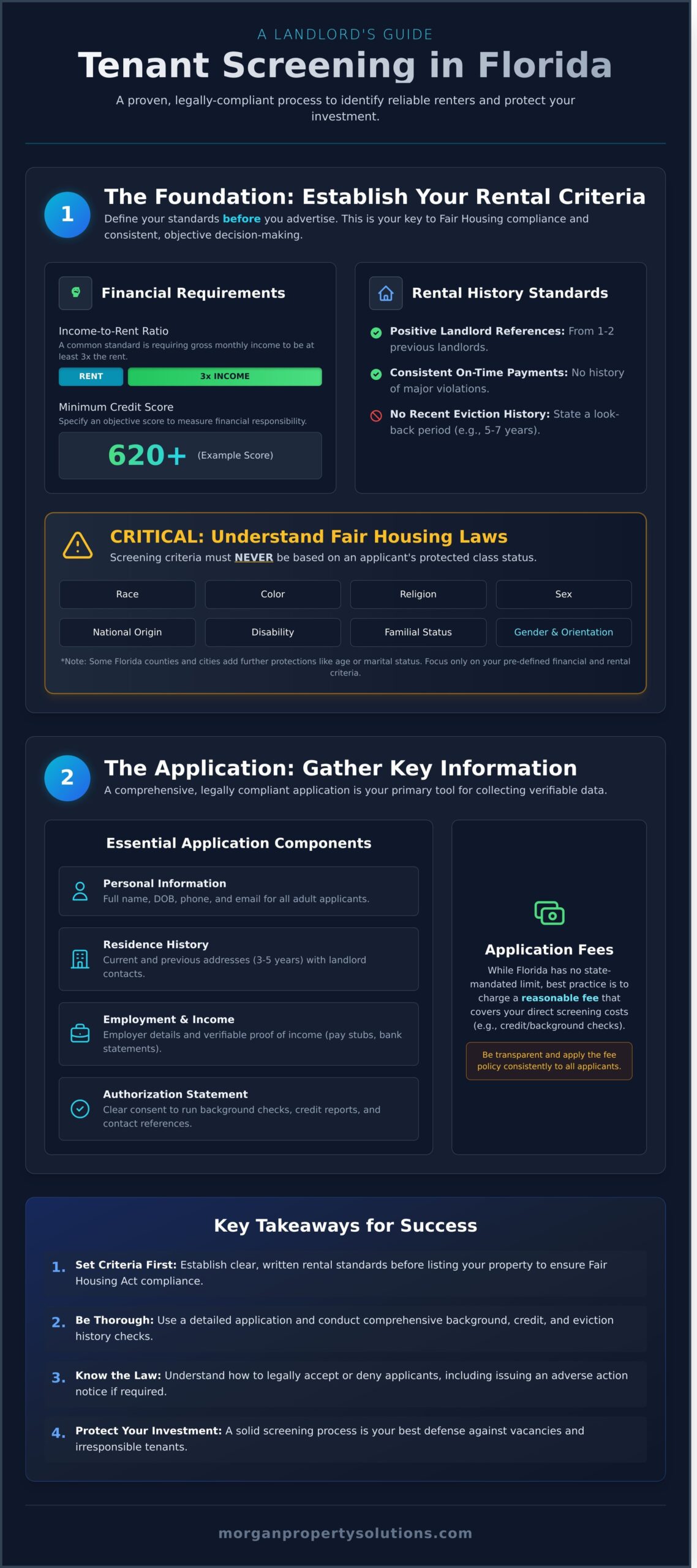
Before you even post your rental listing, the most critical step is to establish clear, written rental criteria. This proactive approach is the cornerstone of a fair and legal screening process. By defining your standards upfront, you create an objective framework that protects you from potential Fair Housing Act violations and simplifies your decision-making. The entire tenant screening process becomes more efficient and defensible when every applicant is measured against the same yardstick. This is the professional’s secret to finding a great tenant while staying compliant.
Defining Your Financial Requirements
Your criteria should clearly state the financial qualifications an applicant must meet. This isn’t about personal judgment; it’s about ensuring the tenant can comfortably afford the rent. To protect yourself and be fair to all, these standards must be applied consistently to every single applicant.
- Income-to-Rent Ratio: A common industry standard is requiring an applicant’s gross monthly income to be at least three times the monthly rent.
- Minimum Credit Score: Specify a minimum score you will accept, such as 620 or higher. This provides an objective measure of financial responsibility.
Outlining Your Rental History Standards
A tenant’s past behavior is often the best predictor of their future performance. Your criteria should detail what you’re looking for in a rental history, helping you find a reliable and responsible resident who will care for your property.
- Positive Landlord References: Require positive references from at least one or two previous landlords.
- Eviction History: State that you will not accept applicants with an eviction on their record within the last 5-7 years.
- Payment History: Look for a consistent record of on-time rent payments and no history of significant lease violations.
Understanding Protected Classes in Florida
The most important part of learning how to screen tenants for a rental property in Florida is understanding anti-discrimination laws. Your criteria must never be based on an applicant’s status as a member of a protected class. Under federal law, these include:
- Race
- Color
- Religion
- Sex (including gender identity and sexual orientation)
- Disability
- National Origin
- Familial Status (having children under 18)
Be aware that some Florida counties and cities add further protections, such as age or marital status. By focusing solely on your pre-defined financial and rental history criteria, you ensure a fair, legal, and stress-free process for everyone involved.
Step 2: The Application Process and Gathering Information
Once you’ve established your screening criteria, the next step is to create a thorough and legally compliant application process. A well-designed application is the cornerstone of your tenant screening, providing the essential, verifiable information you need to make a confident decision. This structured approach is fundamental to learning how to screen tenants for a rental property in Florida effectively and fairly, setting a professional tone from the very beginning.
We’re here to guide you through creating a process that is simple, transparent, and designed to protect both you and your potential tenants.
What to Include on Your Florida Rental Application
Your rental application should be a comprehensive tool for gathering factual information. To ensure you have everything you need while complying with fair housing laws, we recommend including the following sections:
- Personal Information: Full legal name, date of birth, phone number, and email address for every adult applicant.
- Residence History: Current and previous addresses for the last 3-5 years, along with contact information for previous landlords. This helps you verify their rental payment history and conduct.
- Employment and Income Details: Current employer, job title, supervisor’s contact information, and monthly gross income. Always ask for proof of income, such as recent pay stubs or bank statements.
- Authorization Statement: A clear and unmistakable statement authorizing you to perform background checks, credit reports, and contact references.
Handling Application Fees Legally
In Florida, there is no state-mandated limit on how much a landlord can charge for an application fee. However, this doesn’t mean you should charge an excessive amount. The best practice is to charge a reasonable fee that accurately covers your out-of-pocket costs for screening services, such as credit and background checks. It’s crucial to be transparent; while specific fee regulations aren’t detailed in the primary Florida Landlord/Tenant Law, maintaining fairness is key. Always state in writing, ideally on the application itself, that the fee is non-refundable once the screening process has begun.
The Importance of Written Consent
This is a non-negotiable step. Federal law, specifically the Fair Credit Reporting Act (FCRA), requires you to obtain an applicant’s written permission before you can run a credit report or a criminal background check. Simply accepting an application is not enough. Your form must include a separate, clearly labeled section with a signature line specifically granting you this authorization. Without this explicit, signed consent, you cannot legally proceed with these critical checks. This requirement protects the applicant’s privacy and protects you from potential legal issues.
Step 3: Conducting Thorough Background and Credit Checks
This is the heart of the tenant screening process, where you verify the information provided on the application. A consistent and fair approach is key to finding a reliable tenant and staying compliant with housing laws. A crucial part of knowing how to screen tenants for a rental property in Florida involves understanding that every step must align with the guidelines set forth in the Florida Residential Landlord and Tenant Act. Let’s break down what to look for.
Analyzing the Credit Report
A credit score offers a quick snapshot, but the full report tells the real story of financial responsibility. Look beyond the three-digit number to find patterns. We recommend focusing on:
- Payment History: Are there consistent late payments, accounts in collections, or charge-offs? A history of failing to pay debts is a significant concern.
- Debt Levels: High balances on credit cards or large loan payments could strain their budget, making it difficult to consistently pay rent on time.
- Major Financial Events: Bankruptcies or civil judgments for unpaid debts can indicate past financial hardship.
- Identity Verification: Ensure the name, social security number, and previous addresses on the report match the application.
Reviewing Criminal and Eviction History
A thorough background check provides critical insight into an applicant’s history. When reviewing criminal records, it’s important to follow HUD guidance and avoid blanket bans. Instead, assess convictions for relevance. Offenses related to property damage, financial crimes, or violence pose a greater risk to the property and community. Separately, an eviction history check is non-negotiable. A past eviction filing is one of the biggest red flags, as it demonstrates a prior failure to meet lease obligations.
Verifying Employment and Rental History
Never skip the reference checks. This is your opportunity to get direct, honest feedback from the people who know the applicant’s history best. When you call their previous landlords and employers, you complete the final piece of the puzzle.
- For Previous Landlords: Ask direct questions. Did they pay rent on time? Did they take care of the property? Were there any complaints? And most importantly, would you rent to them again?
- For Employers: Your goal is simple verification. Confirm their employment status, job title, start date, and that their stated income is accurate. This confirms they have a stable source of income to afford the rent.
Step 4: Making the Decision and Communicating with Applicants
You’ve gathered all the necessary information, and now it’s time to make a final, informed decision. This final phase of how to screen tenants for a rental property in Florida is critical for protecting your investment and ensuring a positive landlord-tenant relationship. The key is to evaluate each applicant against your pre-set criteria consistently and communicate your decision professionally, whether it’s an approval or a denial.
Approving a Tenant
Once you’ve chosen the best-qualified applicant, contact them promptly. A phone call followed by a written confirmation via email is a great way to maintain a professional record. In your communication, clearly outline the next steps, including the deadline for signing the lease (typically 48-72 hours), and the process for paying the security deposit and first month’s rent. This clarity helps set expectations and secures the tenancy without unnecessary delays.
Legally Denying an Applicant
Denying an applicant requires careful handling to avoid legal complications. Your decision must be based solely on legitimate business reasons that align with your screening criteria, such as poor credit, insufficient income, or a relevant criminal history. If your denial is based, in whole or in part, on information from a credit report or background check, the Fair Credit Reporting Act (FCRA) requires you to send an adverse action notice.
- The notice must state the reason for the denial (e.g., “based on information in your credit report”).
- It must include the name, address, and phone number of the consumer reporting agency that provided the information.
- It must inform the applicant of their right to obtain a free copy of their report and to dispute its accuracy with the agency.
Always keep detailed records of why each applicant was denied. This documentation is your best defense against potential discrimination claims. Feeling overwhelmed by the legal risks? Our experts handle tenant screening for you, ensuring every step is compliant and stress-free.
Simplify Screening with a Professional Property Manager
As this guide has shown, learning how to screen tenants for a rental property in Florida involves navigating a complex web of legal requirements and detailed background checks. It’s a significant investment of your time and energy, and a single misstep can lead to costly consequences. This is where a trusted partner can make all the difference.
At Morgan Property Solutions Inc., we simplify the entire process. We leverage our expertise and proven systems to handle every aspect of tenant screening, allowing you to enjoy the benefits of your investment property without the associated stress and risk.
Expertise in Florida Landlord-Tenant Law
We are experts in the ever-changing landscape of federal, state, and local housing laws, including the Fair Housing Act and the Fair Credit Reporting Act (FCRA). Our legally-vetted application and screening process ensures full compliance, significantly reducing your liability. We manage all tenant communications professionally, from initial inquiries to the proper delivery of sensitive adverse action notices, protecting you every step of the way.
Access to Professional Screening Tools
We go beyond basic online checks by utilizing comprehensive, professional-grade screening software. This gives us a detailed and accurate picture of each applicant, including their credit history, nationwide criminal records, and past eviction filings. More importantly, our years of experience allow us to expertly interpret these reports, identifying potential red flags and recognizing the qualities of a reliable, long-term tenant.
Saving You Time and Maximizing Your Profit
A rigorous screening process is the single most effective way to protect your return on investment. By placing high-quality tenants from the start, we help you avoid the most significant drains on a landlord’s profit:
- Costly and time-consuming evictions
- Lost income from high tenant turnover and prolonged vacancies
- Property damage from irresponsible renters
Let us handle the entire leasing journey, from marketing and showings to background checks and lease signing. Our goal is to secure a great tenant quickly so you can focus on what matters most-enjoying a truly passive income from your investment. To learn how our expert property management can help, visit us at morganpropertysolutions.com.
Partner with an Expert for Stress-Free Tenant Placement
Finding the right tenant is the most critical step in protecting your investment property. The key is to move beyond gut feelings and implement a consistent, legally compliant system. By establishing clear rental criteria before you even list and conducting thorough background and credit checks for every applicant, you create a fair process that safeguards your asset. Mastering how to screen tenants for a rental property in florida is a skill, but you don’t have to navigate it alone.
At Morgan Property Solutions, we simplify the complexities of property management. With over 20 years of combined experience serving Central Florida and an A+ rating from the Better Business Bureau, our team uses a proven process to reduce vacancies and boost your profits. We handle every detail with the care and expertise your investment deserves, giving you complete peace of mind.
Take the stress out of tenant placement. Let us find your next great tenant. Learn more about our property management services. With the right partner by your side, you can look forward to a successful and profitable rental experience.
Frequently Asked Questions About Tenant Screening in Florida
What is the minimum credit score a tenant should have in Florida?
While Florida law doesn’t set a minimum credit score, a common standard for many landlords is a score of 650 or higher, as this often indicates responsible financial management. It is crucial to establish your own clear, consistent criteria for all applicants. This not only helps you find reliable tenants but also ensures you are complying with fair housing laws by treating everyone equally. We can help you establish fair and effective screening criteria to protect your investment.
Can I deny a rental applicant in Florida because they have children?
No, you cannot deny an applicant because they have children. Familial status is a protected class under both federal and Florida Fair Housing laws. Denying a family based on the presence of children under 18 is illegal discrimination and can lead to severe legal penalties. Your screening process must focus on objective criteria like credit history, income, and rental history, applied equally to all applicants to ensure you remain compliant and protected from legal risk.
How long does the tenant screening process typically take in Florida?
The process of how to screen tenants for a rental property in Florida typically takes between 24 to 72 hours. This timeframe allows for a thorough review of the credit check, criminal background report, and eviction history. The most common delays occur when waiting for previous landlords or current employers to respond to verification requests. A clear and organized application process helps streamline this and provides a faster, stress-free experience for you and the applicant.
Can I charge a holding deposit to take the property off the market?
Yes, you can charge a holding deposit in Florida to temporarily take a rental property off the market for a promising applicant. However, it is essential to have a clear, written “holding deposit agreement.” This document should outline all the terms, including how long the property will be held, what happens if the applicant backs out, and whether the deposit will be applied toward the security deposit or first month’s rent upon signing the official lease.
What should I do if I suspect an applicant has provided false information?
If you suspect an applicant has provided false information, the first step is to diligently verify all details. Cross-reference pay stubs with employer verifications and contact all provided references to confirm their validity. If you can objectively prove that information was falsified, this is a legitimate, non-discriminatory reason to deny the application. Be sure to document your findings clearly and apply this standard consistently to all applicants to protect yourself from potential disputes.
Is it legal to screen for pets or service animals in Florida?
Understanding how to screen tenants for a rental property in Florida involves knowing the rules for animals. You can legally screen for pets, set limits on size or breed, and charge pet fees. However, you cannot deny a qualified applicant because they have a certified service animal or a properly documented emotional support animal (ESA). These are not considered pets under fair housing laws, and you cannot charge pet-specific fees or deposits for them.

Article by
Oliver Overton-Morgan
Oliver Overton-Morgan is a full-time Real Estate Broker since 2003, with years of experience helping thousands of people purchase and sell real estate throughout Central Florida. He holds a Graduate Realtor Institute designation, LCAM, and has held licenses in good standing as a Florida Mortgage Broker and a Notary Public. Oliver immigrated to central Florida in 2001, and within 5 years Oliver built a successful Real Estate brokerage in central Florida, where he recruited over 75 Sales Associates with 25+ million in sales production.