What if your rental property could run on autopilot, generating steady income without a single 2 AM maintenance call? For many Florida landlords, that sounds more like a dream than a reality. The constant worry about finding good tenants, keeping up with repairs, and navigating ever-changing rental laws can feel completely overwhelming, turning a smart investment into a source of daily stress.
But it doesn’t have to be that way. We’re here to help you understand how partnering with the right team can turn that dream into your new standard, making your passive income truly passive. In this guide, we’ll explore what to expect from top-tier property management companies by 2026, covering everything from proactive tenant placement and legal protection to the detailed financial reporting that gives you complete peace of mind.
Key Takeaways
- Discover how modern property managers act as asset managers, using advanced tech to protect and grow your investment.
- Learn to accurately weigh management fees against the hidden costs and stress of DIY to make a confident financial decision.
- Get a simple, 5-point checklist to help you properly vet local property management companies and choose a trusted partner for your rental.
- Understand why hyper-local market knowledge is your greatest advantage for setting competitive rental rates and avoiding costly vacancies.
What Do Property Management Companies Actually Do in 2026?
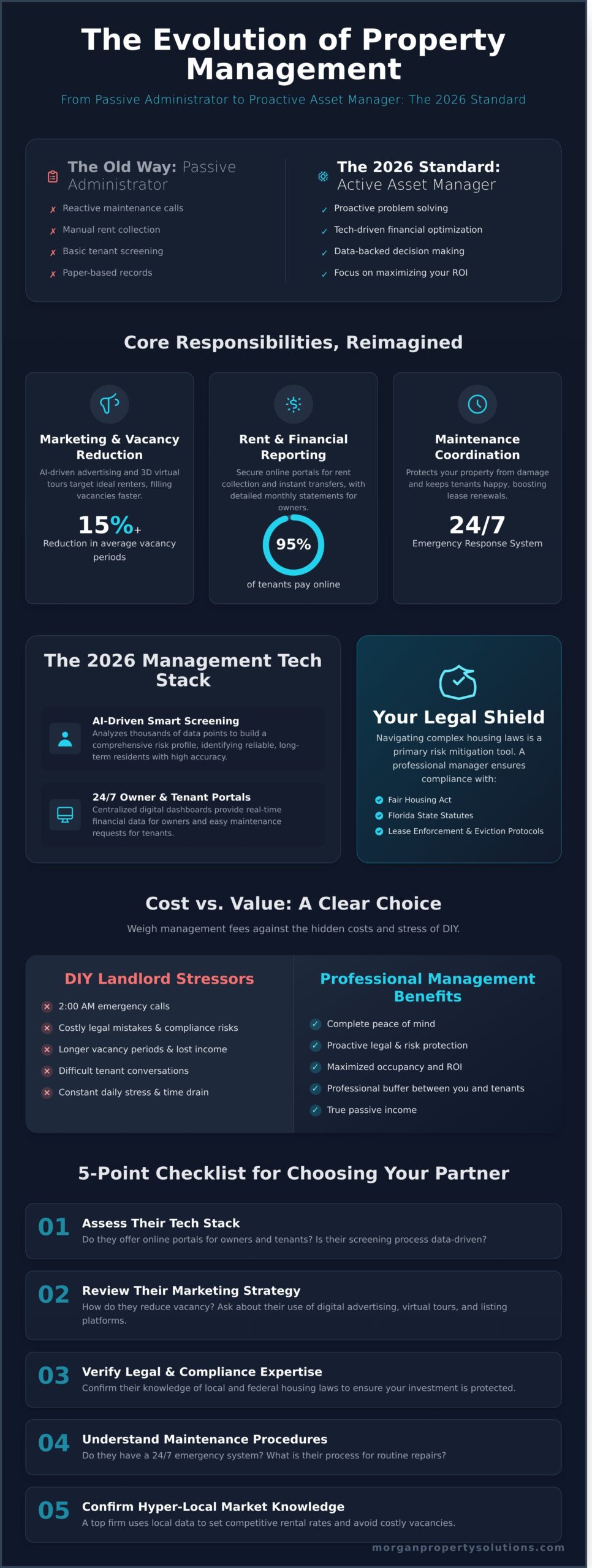
If you’re a property owner, you might think of property management as simply collecting rent and fixing leaky faucets. That was true a decade ago, but the role has evolved dramatically. Today, a professional firm handles the entire lifecycle of your rental property, from marketing an empty unit to managing the final security deposit return. It’s a comprehensive service designed to protect and grow your investment. To understand the full scope, it helps to ask the basic question, what is property management? In 2026, the answer is clear: it’s asset management.
The best property management companies have shifted from being passive administrators to active asset managers who focus on maximizing your return on investment. They don’t just solve problems; they anticipate them. This proactive approach provides the single most valuable benefit for a landlord: peace of mind. Having an experienced, professional buffer between you and your tenants removes the late-night emergency calls, the difficult conversations about late rent, and the stress of keeping up with ever-changing regulations. Staying informed is key, and using quality landlord resources helps you understand the value an expert partner brings to the table.
The Core Responsibilities of a Modern Firm
A modern property manager’s duties are powered by technology and a deep understanding of the market. Their goal isn’t just to maintain your property, but to enhance its performance. Key responsibilities now include:
- Marketing and Vacancy Reduction: In 2026, finding qualified tenants happens faster than ever. We use AI-driven advertising on platforms like Zillow and Apartments.com to target ideal renters, and 3D virtual tours are now a standard offering. This tech-forward approach has helped reduce average vacancy periods by over 15% compared to just a few years ago.
- Rent Collection and Financial Reporting: The days of waiting for a check in the mail are over. With over 95% of tenants paying online, rent collection is now streamlined through secure digital portals. You get your funds via instant transfer and receive detailed monthly financial statements, making tax time simple and stress-free.
- Maintenance Coordination: A dripping pipe at 2 a.m. can’t wait until morning. A non-negotiable standard for professional management is a 24/7 emergency response system. This protects your property from damage and keeps tenants happy, which is crucial for lease renewals.
Effective maintenance coordination relies on a robust supply chain for materials and parts. While residential management focuses on smaller-scale repairs, the principle scales up to larger construction and development projects. For instance, specialized firms such as Mobel Suministros manage the integral supply needs for large-scale modular construction, demonstrating how critical streamlined supply management is to protecting and enhancing property assets at any level.
The Legal Shield: Staying Compliant
Navigating the complex web of federal, state, and local housing laws is one of the biggest challenges for independent landlords. Making an unintentional mistake when screening a tenant or handling a dispute can lead to costly legal battles. A professional manager understands the nuances of the Fair Housing Act and specific Florida statutes, ensuring every action taken is fully compliant.
This expertise becomes critical when dealing with difficult situations like lease enforcement or, in a worst-case scenario, an eviction. A manager handles these processes professionally and humanely, following strict legal protocols to protect your interests. Ultimately, legal compliance is the primary risk-mitigation tool for a modern landlord.
The 2026 Tech Stack: How Management Has Evolved
Forget the old days of paper ledgers and endless phone tag. The property management landscape has undergone a radical transformation, driven by powerful and intuitive technology. What was once a reactive job of fixing problems is now a proactive strategy of preventing them. Modern property management companies now operate more like tech firms, using a sophisticated suite of tools to boost profits, improve communication, and deliver a seamless experience for owners and tenants alike.
This isn’t science fiction; it’s the new standard. Today’s systems leverage data to make smarter decisions at every turn, from finding the perfect resident to anticipating a maintenance issue before it happens.
Smart Screening and Placement
Placing a high-quality tenant is the single most important factor for a successful rental investment. That’s why leading firms have moved beyond a simple credit check. AI-driven screening platforms analyze thousands of data points to build a comprehensive risk profile, helping identify reliable, long-term residents with incredible accuracy. This data-first approach includes a deep dive into our strict screening criteria to ensure every applicant meets a proven standard for stability. It’s a paperless, instant process that respects everyone’s time while protecting your asset. Even welcoming pets is simpler and safer with integrated services like PetScreening, which help manage risk without sacrificing a pet-friendly policy.
Owner and Tenant Portals
The “lost email” and the “check is in the mail” are relics of the past. Centralized digital portals now provide 24/7 transparency and control. For property owners, this means a real-time dashboard showing financial performance, from rent collection to maintenance expenses. You can see your ROI at a glance, anytime. For tenants, these portals are a game-changer. They can pay rent online, submit maintenance requests with photos, and access important documents, all from their phone. This level of self-service isn’t just convenient; a 2023 Zillow survey found that 78% of renters expect to be able to pay their rent online.
Developing these integrated digital platforms is a specialized field, handled by performance-focused digital agencies that create communication systems to optimize business revenue. For readers interested in seeing how this is applied across different sectors, you can visit The Palm Group to see examples of their work.
Technology also plays a massive role in preserving the value of your property. Instead of waiting for a call about a broken water heater, predictive maintenance systems use data to flag potential issues before they become expensive disasters. By analyzing an HVAC unit’s energy usage and performance history, for example, the system can predict a potential failure weeks in advance. According to a study by Deloitte, this proactive approach can reduce overall maintenance costs by up to 30% and extend the life of major appliances significantly.
When a vacancy does occur, time is money. Automated marketing technology gets your listing in front of millions of qualified eyes in minutes, not days. With one click, your property is syndicated across more than 100 high-traffic rental sites like Zillow, Trulia, and Realtor.com. This massive exposure, combined with professional photography and compelling descriptions, dramatically reduces the time your property sits empty. The goal is simple: find the best possible tenant in the shortest amount of time. This commitment to technology is what simplifies the entire process, and you can see how we put these tools to work for our clients every day.
Cost vs. Value: Is Professional Management Worth the Fee?
One of the first questions every property owner asks is about the cost. It’s a valid concern. You look at the numbers and think, “I could save 8% to 10% of my rental income by doing this myself.” On the surface, that logic seems sound. But a closer look reveals that top-tier property management isn’t just an expense; it’s an investment designed to increase your net income and give you back your most valuable asset: your time.
Before we dive into the return on investment, let’s clarify what you’re paying for. Most fee structures are straightforward and typically include:
- Management Fee: A percentage of the monthly collected rent, usually between 8% and 12%, for day-to-day operations.
- Leasing Fee: A one-time fee for finding, screening, and placing a new tenant. This often equals 50% to 100% of the first month’s rent.
- Lease Renewal Fee: A smaller, flat fee (e.g., $250) for negotiating and executing a lease renewal with an existing tenant.
Seeing these fees can feel like a direct hit to your profit. However, the real calculation isn’t about what you spend, but what you gain and what you avoid losing. For a complete breakdown of what each charge covers and how to identify hidden costs, our transparent guide to property management fees in 2026 walks you through every line item in detail.
Calculating the Real ROI
Let’s run a simple scenario. Imagine your rental property brings in $2,200 per month. If you manage it yourself and it sits vacant for two months due to ineffective marketing or slow tenant screening, you’ve lost $4,400. An experienced management firm, with its proven marketing systems and dedicated leasing agents, can often fill a vacancy in under 30 days. The annual management fee at 10% would be $2,640. In this case, you would have saved $1,760 by hiring a professional, not to mention avoiding the hassle. The right property management companies don’t cost you money; they find you money.
Consider the “professional discount” as well. We’ve built relationships with trusted local vendors over the last 20 years. Our clients regularly save 15% to 20% on maintenance and repair calls compared to standard public rates. A single $1,000 plumbing repair could cost you only $800 through us, instantly offsetting a significant portion of the management fee for several months. In the end, professional management often pays for itself through improved tenant retention. If you want to go deeper on strategies to maximize rental income on your Florida property in 2026, our dedicated guide walks through proven local pricing strategies and cash flow optimization in detail.
Eliminating the “Stress Tax”
What is your peace of mind worth? That’s the question at the heart of the “stress tax” you pay as a DIY landlord. Think about that 2:00 AM call about a burst pipe. Handling it doesn’t just disrupt your sleep; it costs you hours of coordination and follow-up. If you value your personal time at $50 an hour, a three-hour emergency just cost you $150. We handle those calls so you don’t have to.
Beyond emergencies, there are the difficult conversations about late rent, lease violations, or even eviction proceedings. These interactions are emotionally draining and legally complex. Having a professional, objective third party manage these situations protects you from stress and potential legal missteps. Our ultimate goal is to make your investment experience simple and stress-free, allowing you to focus on what matters most to you.
How to Vet Property Management Companies: A 5-Point Checklist
Choosing a partner to manage your property is one of the most important decisions you’ll make as a real estate investor. The right firm can boost your profits and eliminate stress, while the wrong one can become a significant liability. To help you make a confident choice, we’ve developed a straightforward, 5-point checklist to guide your vetting process.
Use these steps to cut through the sales pitches and find a team you can truly trust.
- Step 1: Verify Local Expertise and Physical Presence. A company managing your Florida property from an office in another state won’t work. True management requires a deep understanding of local Florida ordinances and state landlord-tenant laws, and a physical presence for showings, inspections, and emergencies. They need established relationships with local, reliable vendors, not just a national 1-800 number.
- Step 2: Review Their Tenant Screening and Eviction Rates. A rigorous screening process is the single best way to prevent future problems. Ask for specifics. Do they require a credit score over 650? Do they verify that income is at least 3x the monthly rent? A proven company should be proud of its track record and have a historical eviction rate below 1%. If they can’t provide that number, it’s a major red flag.
- Step 3: Analyze Their Fee Transparency. The monthly management fee is only part of the story. Watch out for hidden “junk” fees that can eat into your returns. Ask directly about charges for lease renewals, maintenance coordination (some add a 10-20% markup on vendor invoices), and administrative tasks. The best property management companies offer a clear, simple fee structure without unpleasant surprises. Understanding exactly what you’ll be charged is easier when you review a detailed breakdown of property management fees before signing any agreement.
- Step 4: Evaluate Their Communication Style. You need a responsive partner. Do they offer an online owner portal for 24/7 access to financial statements? Will you have a dedicated property manager? A great test is their responsiveness during the sales process. If it takes them 48 hours to return your initial call, don’t expect faster service once you’re a client.
- Step 5: Check Their Reputation and Local Testimonials. Look beyond their website. Check for an A+ rating with the Better Business Bureau (BBB), which reflects a commitment to resolving client issues. More importantly, read reviews from local property owners on platforms like Google and Yelp. What do people in your city say about their service?
Questions to Ask During the Interview
To dig deeper, have these questions ready. Their answers will reveal a lot about their operational capabilities and philosophy.
- “How do you handle maintenance emergencies on weekends or holidays?”
- “What is your average days-on-market for a vacant property in this neighborhood?”
- “Can you explain your process for deposit-free renting and how it benefits owners?”
Warning Signs to Avoid
If you spot any of these red flags, it’s wise to walk away. The initial appeal of a low price is never worth the long-term headache.
- Poor Communication: A company that’s hard to reach before you sign a contract won’t get better after you’ve signed.
- Complex Agreements: A management agreement should be straightforward. If it’s filled with confusing legal jargon or clauses that heavily favor the manager, be cautious.
- Lack of Specialization: A firm that “dabbles” in residential management alongside commercial or sales is unlikely to have the focused expertise you need.
Finding the right property manager doesn’t have to be complicated. By following this checklist, you can confidently select a professional partner dedicated to protecting your investment. See how our transparent management process answers all these questions and more.
The Central Florida Advantage: Why Local Expertise Matters
Choosing a property manager isn’t just about finding someone to collect rent. It’s about entrusting your valuable asset to a partner who understands the unique pulse of your local market. In a region as dynamic and complex as Central Florida, having a team on the ground isn’t just a benefit; it’s a necessity for protecting your investment and maximizing your returns.
The Orlando and Tampa rental markets are projected to face a unique set of challenges by 2026. With Florida’s population expected to grow by nearly 300,000 new residents each year and insurance premiums continuing to climb by as much as 40% annually, landlords need a proactive strategy. A national company using a generic algorithm simply can’t account for these hyper-local pressures. They don’t see how a new transit project in Orange County will affect commute times and rental demand, or how a zoning change in Hillsborough County could impact your property’s long-term value.
Local knowledge directly translates to better rental pricing. A three-bedroom home in Oviedo, prized for its A-rated Seminole County schools, can easily command $300 more per month than a nearly identical property just 15 minutes away. In Lake Nona, proximity to the Medical City and tech campuses is the driving factor, not just square footage. Effective property management companies understand these nuances and price your property for maximum income without sitting vacant for weeks. For a comprehensive look at how to calculate your true profitability and grow your cash flow, our guide on maximizing rental income profits on your Florida property covers local pricing strategies in depth.
For investors interested in the pinnacle of property development and what defines luxury on a global scale, it can be insightful to see examples from other markets; you can learn more about how these principles are applied in premier international projects.
Beyond pricing, there’s the physical reality of maintaining a home in Florida. Our climate demands specialized care that out-of-state managers often overlook. Successful property ownership here depends on:
- Proactive HVAC Care: Florida air conditioners run nearly nine months a year. We schedule semi-annual service to prevent costly emergency breakdowns in the 95-degree August heat.
- Humidity and Mold Prevention: Our teams know the early signs of moisture intrusion and ensure proper ventilation, saving you from thousands in potential remediation costs. When remediation is necessary, using a dedicated service is key, and the professional standards set by companies such as ABC Mould Cleaning Solutions provide a good benchmark for what to look for.
- Year-Round Pest Control: From termites to palmetto bugs, Florida pests are a constant threat. A reliable, local pest control contract is non-negotiable.
- Hurricane Preparedness: We have trusted vendor relationships in place for everything from shutter installation to post-storm cleanup, ensuring your property is secured and repaired quickly.
- Expert Arborist Services: Trees can be a beautiful asset or a major liability, especially in hurricane-prone areas. Proactive tree maintenance from certified professionals is a key part of risk management. For landlords looking for examples of top-tier service, We Love Trees provides a model of the expertise required to keep a property safe and looking its best.
Deep Roots in Orlando and Beyond
With over 20 years of dedicated experience, Morgan Property Solutions offers more than just management; we provide peace of mind rooted in deep local expertise. Our long-standing relationships with Central Florida’s most reliable and cost-effective vendors mean your property gets prompt, quality service. We handle the complexities of local municipal regulations so you don’t have to. This is the personalized, human touch you just won’t find with a national aggregator’s 1-800 number. If you own a rental in the area and want to understand exactly what to look for in a local expert, our detailed guide on how to hire the best Winter Park property manager walks through the key questions to ask and the processes to evaluate before you decide.
Simplifying Your Investment Journey
Our mission has always been about “Making Real Estate Simple” for landlords like you. We believe that owning a rental property in Florida should be a rewarding experience, not a source of constant stress. We invite you to build your knowledge by exploring our library of real estate articles, written by our team of local experts.
Ready to see how a dedicated local partner can transform your rental property experience? Let our experts take the stress out of your rental property today.
Partner with the Right Experts for a Simpler 2026
Navigating the rental market in 2026 is all about leveraging new technology and understanding that the right partner does more than just collect rent. They provide real value that boosts your bottom line and eliminates your stress. As this guide shows, choosing from the many property management companies available comes down to finding a team with proven local expertise and a forward-thinking approach. You don’t have to figure it all out alone.
With over 20 years of dedicated experience in Central Florida, Morgan Property Solutions is committed to making your life simpler. Our A+ BBB rating and transparent, no-hassle fee structure are testaments to our promise. Ready to see what your investment is truly worth and how easy management can be? Get a Free Rental Analysis and Simplify Your Management Today.
Your peace of mind is just a click away.
Frequently Asked Questions
What is the standard fee for property management companies in 2026?
The standard management fee is projected to be between 8% and 12% of the collected monthly rent in 2026. This percentage typically covers ongoing services like rent collection, tenant relations, and routine coordination. Many companies also have a separate leasing fee, usually 50% to 100% of the first month’s rent, for the work involved in marketing your property and placing a new, qualified tenant.
Can I still be involved in major decisions if I hire a property manager?
Yes, you absolutely maintain control over major decisions. Your management agreement will specify a repair threshold, for example, $500. For any expense that exceeds this amount, such as replacing an HVAC system or a major appliance, we are required to get your direct approval first. This structure ensures you’re a partner in significant financial choices while we handle all the daily operational details for you.
How long does it typically take to find a tenant for my Orlando rental?
In the current Orlando market, it typically takes between 21 and 30 days to secure a well-qualified tenant. This can vary based on the property’s price, condition, and specific neighborhood. A home priced competitively in a high-demand area like Lake Nona might rent in under 14 days. Our 15-point marketing plan is designed to minimize your vacancy time and find the best possible renter for your home.
What happens if a tenant doesn’t pay rent on time?
If a tenant doesn’t pay on time, we initiate a firm and legally compliant collections process immediately. This starts with formal communication and late fee notices. If rent isn’t paid within the grace period set by Florida law, we then serve the official “Three-Day Notice to Pay Rent or Vacate.” Should the tenant fail to comply, we are prepared to manage the entire eviction process on your behalf, keeping you informed every step of the way.
Do property management companies handle repairs and maintenance?
Yes, coordinating all repairs and maintenance is a core responsibility of professional property management companies. We take care of everything from late-night emergency calls for a burst pipe to routine seasonal upkeep. We use a trusted network of licensed and insured vendors to ensure all work is high-quality and competitively priced. This protects your investment’s value and keeps your tenants safe and satisfied.
Is it better to hire a local company or a large national firm?
Hiring a local company is often the better choice due to their deep, specific market expertise. A local manager understands Orlando’s distinct neighborhood trends, has established relationships with reliable local repair services, and knows the specific rental laws in Orange County. This on-the-ground knowledge is invaluable and often leads to shorter vacancy periods and more effective management than a one-size-fits-all national approach. For owners with properties in the area, understanding what separates a great Winter Park property manager from the rest is a practical starting point for making that local hiring decision.
What is the difference between a leasing agent and a property manager?
A leasing agent’s job is singular: to find a tenant for your property. Their work is done once the lease is signed. A property manager, however, handles the entire long-term lifecycle of your investment. This includes marketing, screening, rent collection, maintenance, tenant communication, inspections, and eventually, the move-out process. A leasing agent fills a vacancy; a property manager is your ongoing partner in protecting your asset.
How do property managers determine the best rental price for my home?
We determine the best rental price by performing a comprehensive Comparative Market Analysis (CMA). This isn’t a guess. We analyze hard data from at least 5-7 similar homes in your immediate area that have rented within the last 90 days. We compare location, square footage, amenities, and condition to set a price that is competitive enough to attract great applicants quickly while maximizing your annual return.

Article by
Oliver Overton-Morgan
Oliver Overton-Morgan is a full-time Real Estate Broker since 2003, with years of experience helping thousands of people purchase and sell real estate throughout Central Florida. He holds a Graduate Realtor Institute designation, LCAM, and has held licenses in good standing as a Florida Mortgage Broker and a Notary Public. Oliver immigrated to central Florida in 2001, and within 5 years Oliver built a successful Real Estate brokerage in central Florida, where he recruited over 75 Sales Associates with 25+ million in sales production.