
What if one small misunderstanding of security deposit rules could cost you three times the amount in a lawsuit? It’s a scenario that keeps many Florida property owners up at night. The legal landscape can feel like a minefield, where one wrong step with a repair notice or an eviction filing leads to costly penalties and overwhelming stress. You’re not alone in feeling that the rules are complex and the stakes are incredibly high.
That’s exactly why we created this guide. We’re here to help you master the complexities of florida landlord tenant law with confidence. Our promise is simple: by the end of this article, you’ll have a clear, plain-English roadmap to Florida Statutes Chapter 83, empowering you to stay compliant, protect your investment, and manage your properties profitability in 2026. We’ll walk you through everything from lease agreements to the eviction process, giving you the expert support you need every step of the way.
Key Takeaways
- Understand the three legal ways to hold a tenant’s security deposit and master the strict timelines for its return to avoid costly financial penalties.
- Discover your exact maintenance obligations under Florida’s “Warranty of Habitability” to ensure your property remains compliant and your tenants are safe.
- Learn how to properly serve a 3-Day Notice for non-payment of rent so it holds up in court, a crucial step in navigating the florida landlord tenant law eviction process.
- Weigh the true cost of a simple legal mistake against the benefits of professional management to protect your investment and simplify your role as a landlord.
What is Florida Landlord Tenant Law? An Overview of Chapter 83
For property owners in the Sunshine State, understanding your legal rights and responsibilities isn’t just good practice; it’s essential for a successful and stress-free rental business. The foundation of these rules is found in a specific section of the state’s legal code: Part II of Chapter 83 of the Florida Statutes. This is the official rulebook that governs nearly all residential tenancies. Its main purpose is to create a fair balance, protecting a tenant’s right to a safe home while upholding a landlord’s property rights. The general principles of what is landlord-tenant law are standardized in many places, but Florida has its own unique requirements you must follow.
One of the first things to understand is the massive difference between oral and written leases. While an oral agreement can be legally binding for short-term rentals (less than one year), it’s a risky approach. Proving the terms without a written document can turn a simple disagreement into a costly court battle. A clear, written lease is your best protection. Looking ahead, the legal landscape is also constantly evolving. By 2026, Central Florida property owners will be operating under new local ordinances passed in Orange and Osceola counties in 2024, which mandate a “Tenant’s Bill of Rights.” These changes require a 60-day notice for rent increases over 5% and add new procedural steps for lease terminations, making professional guidance more critical than ever.
The Scope of the Florida Residential Landlord and Tenant Act
This act applies to the rental of most residential properties, including single-family homes, apartments, and condominiums. However, it’s important to know what isn’t covered. The specific rules in Chapter 83 generally do not apply to mobile home park tenancies or residents in medical or geriatric facilities. As defined by Florida law, a “residential tenancy” is the right granted to a tenant to occupy a dwelling unit for living or housing purposes in exchange for rent.
Why “Simple” is Better When It Comes to Lease Agreements
Using a generic lease template you found online is one of the biggest mistakes a landlord can make. These documents often lack Florida-specific clauses required for enforceability, such as proper security deposit disclosures or radon gas notices. A strong lease should be clear and straightforward, not filled with confusing legal jargon. This aligns with our core philosophy of Making Real Estate Simple through transparent and compliant contracts that protect everyone involved.
Security Deposits and Advance Rent: Handling the Money Legally
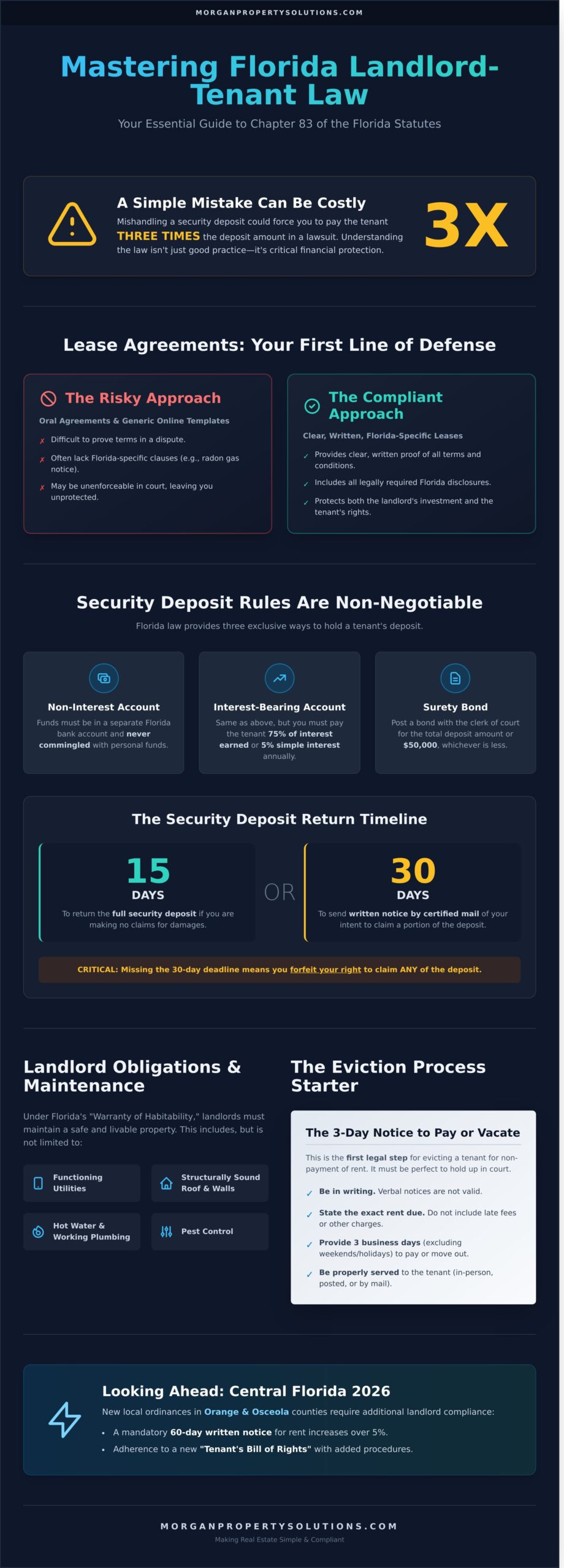
Handling a tenant’s security deposit is one of the most regulated aspects of florida landlord tenant law, and it’s a common source of disputes. Getting it wrong can lead to financial penalties, so it’s critical to follow the rules precisely. You can’t just put the money in your personal checking account. Florida law provides landlords with three specific, legal ways to hold a tenant’s security deposit or advance rent:
- A separate non-interest-bearing account: The funds must be kept in a Florida banking institution and cannot be commingled with any of your other funds.
- A separate interest-bearing account: Similar to the first option, but you must pay the tenant either 75% of the interest earned or a flat 5% simple interest per year.
- A surety bond: You can post a surety bond with the clerk of the circuit court in the county where the property is located. The bond must be for the total amount of deposits you hold or $50,000, whichever is less.
Whichever method you choose, you must notify your tenant in writing within 30 days of receiving the deposit, stating the name and address of the bank where the money is held. Documenting everything, from a detailed move-in inspection report to your formal notices, is your best defense against potential conflicts.
The Security Deposit Timeline: A Landlord’s Checklist
The clock starts ticking the moment your tenant vacates the property. Florida law is unforgiving about these deadlines. If you intend to return the full security deposit, you have 15 days to do so. If you plan to make a claim for damages beyond normal wear and tear, you have 30 days to send the tenant a written notice by certified mail. Missing this 30-day window means you forfeit your right to claim any portion of the deposit. The notice must include specific language, directly from Chapter 83, Florida Statutes, stating: “This is a notice of my intention to impose a claim for damages in the amount of [dollar amount] upon your security deposit, due to [reason]. It is sent to you as required by s. 83.49(3), Florida Statutes…”
Modern Alternatives: Deposit-Free Renting
The rental market is evolving, and traditional security deposits are no longer the only option. An increasingly popular choice is deposit-free renting. Instead of a large upfront payment, tenants pay a small, non-refundable monthly fee or a one-time premium to an insurance provider. This policy protects you against unpaid rent and damages, often providing coverage up to $5,000, which can be significantly more than a typical one-month deposit. For landlords, this means a larger applicant pool, reduced vacancy rates, and simplified move-outs. This modern approach also applies to pets, where tools like PetScreening help you create a standardized process for assessing risk and managing pet fees separately from security deposits. Managing these financial details correctly is non-negotiable. If you’re looking for a partner to simplify these complexities, our experienced property management team can help ensure you’re always in compliance.
Landlord Obligations: Maintenance, Repairs, and Access
As a landlord, your primary responsibility is to provide a safe, healthy, and habitable home for your tenants. This isn’t just good practice; it’s a legal requirement in Florida known as the “implied warranty of habitability.” Think of it as the foundational promise of your lease agreement. You agree to maintain the property, and in return, your tenant agrees to pay rent. Understanding your specific duties is a critical part of complying with florida landlord tenant law and building a positive relationship with your residents.
Florida law is very clear about what “habitable” means. Under Florida Statute 83.51, landlords must ensure the property meets all applicable building, housing, and health codes. At a minimum, this includes providing:
- Functioning plumbing with both hot and cold running water.
- Working locks and keys for all exterior doors.
- A roof, windows, and walls that are in good repair and protect against the elements.
- Clean and safe common areas.
- Garbage removal services.
- Functioning heat during the winter months.
- Extermination of rats, mice, roaches, ants, termites, and bedbugs.
Many tenants ask about their right to “repair and deduct,” a common practice in other states where they can fix an issue themselves and subtract the cost from their rent. It’s crucial to understand that this right does not exist in Florida. Instead, if a repair is needed, the tenant must provide you with a formal written notice giving you seven days to address the issue. If you fail to make the necessary repairs within that window, the tenant may have the right to withhold rent or terminate the lease, but they must follow a very strict legal process. The procedure is precise, and as detailed in The Florida Bar’s Landlord/Tenant Guide, any misstep can put the tenant in default of their lease.
Maintaining a Safe and Healthy Property
Your duty goes beyond basic amenities. In Central Florida, municipalities like Orlando and Kissimmee have their own local housing codes that can be more stringent than state law. You are responsible for ensuring your property complies with all of them. This also includes managing environmental hazards. For any property built before 1978, federal law requires you to provide tenants with a lead paint disclosure. While Florida doesn’t have a specific mold statute, your general duty to maintain the premises means you are responsible for addressing the source of any water intrusion that leads to mold growth.
The Right to Access: Respecting Tenant Privacy
While the property is yours, the tenant has the right to “quiet enjoyment,” which means you can’t enter whenever you please. The florida landlord tenant law creates a balance, allowing you access for specific, valid reasons. You can legally enter a tenant’s unit to conduct inspections, make necessary repairs, or show the property to prospective buyers or renters. However, you must provide “reasonable notice,” which the law defines as at least 24 hours prior to entry. The entry must also occur at a “reasonable time,” generally considered to be between 7:30 a.m. and 8:00 p.m. The only exception to this notice rule is in an emergency, such as a fire, a burst pipe, or if you have a reasonable belief that the tenant has abandoned the property. In these urgent situations, you can enter immediately to protect your property and ensure safety.
The Florida Eviction Process: Navigating Non-Compliance
No landlord looks forward to an eviction. It’s a stressful, time-consuming, and often costly process that serves as a last resort. However, when a tenancy goes wrong, a formal eviction is the only legal way to regain possession of your property. Understanding the strict procedures is essential, because a single misstep can send you right back to square one.
The grounds for eviction typically fall into two categories: non-payment of rent and lease violations. While non-payment is straightforward, other violations—like having an unauthorized pet or causing property damage—can lead to contentious disputes. Proving these claims can be difficult, and in more complex legal or personal conflicts where establishing the truth is paramount, specialized services such as Morgan Polygraph are sometimes utilized. For any eviction, however, serving the correct legal notice is the critical first step.
A crucial rule in florida landlord tenant law is the absolute prohibition of “self-help” evictions. It might seem faster to change the locks or shut off the utilities, but these actions are illegal under Florida Statutes § 83.67. Doing so can expose you to a lawsuit where you could owe the tenant up to three times the monthly rent in damages. Always follow the legal path; it’s designed to protect both parties.
The process starts with a formal written notice. Here’s what you need to know:
- The 3-Day Notice to Pay Rent or Quit: This is used when a tenant fails to pay rent. The notice must state the exact amount of rent due (excluding late fees) and the date it must be paid by. It’s vital to calculate the three days correctly: you cannot count the day of service, weekends, or legal holidays. For this notice to hold up in court, it must be delivered personally, left with an adult at the residence, or posted in a conspicuous place like the front door.
- The 7-Day Notice of Non-Compliance: This notice addresses lease violations. It comes in two forms. The 7-Day Notice with Opportunity to Cure gives the tenant a week to fix a correctable problem, like an unkempt lawn. If they resolve the issue, the matter is closed. The 7-Day Notice to Terminate is for serious or repeated violations, such as intentional property destruction. It gives the tenant seven days to vacate without an option to fix the problem.
Step-by-Step Guide to a Legal Eviction
Once you’ve served the correct notice and the tenant hasn’t complied, you can proceed with the formal eviction lawsuit. You’ll file a Complaint for Eviction with the county court. The tenant then has five business days to file a response. If they don’t, or if the judge rules in your favor, the court issues a Writ of Possession. This document is given to the Sheriff, who will post it on the property, giving the tenant 24 hours to leave before being physically removed.
Avoiding the Courtroom Through Better Screening
The best way to win an eviction is to never have one. Implementing rigorous screening criteria from the start is your strongest defense against future legal headaches. This process must always comply with the Fair Housing Act to prevent discrimination claims. Staying informed about local court rules by using reliable landlord resources also ensures your practices are always up-to-date and compliant with the latest aspects of florida landlord tenant law.
Navigating the eviction process requires precision and a deep understanding of legal requirements. If you’re feeling overwhelmed, let our experienced property management team handle the complexities for you.
Simplifying Your Investment with Professional Management
Understanding the rules is one thing; applying them perfectly every single day is another. After exploring the complexities of leases, security deposits, and evictions, it becomes clear that being a landlord is a hands-on, high-stakes job. A single misstep can jeopardize your entire investment. This is where professional property management transforms from a simple service into an essential shield for your asset.
Consider the real-world costs. A DIY landlord in Orange County who files an eviction notice with a minor procedural error could face a legal challenge. If the tenant hires an attorney, the landlord could be responsible for their legal fees, a cost that often exceeds $3,500. Compare that to a typical management fee of 8-10% on a $2,200/month rental. The annual cost of management is far less than the cost of one single, preventable mistake. It’s not an expense; it’s insurance against financial loss and stress. If you’re also evaluating the broader opportunity, our 2026 guide to investing in rental properties in Central Florida outlines proven strategies for identifying and acquiring high-performing assets in this market.
Beyond procedural mistakes, landlords also face risks from property damage, liability claims, and loss of rental income. Securing the right landlord insurance is another crucial layer of protection. A local Florida provider like SI Insurance can help you find a policy that covers these specific risks, ensuring your investment is protected from unforeseen events.
This protection extends to the digital realm as well. Modern landlords and management companies handle sensitive tenant data, from applications to payment information. Ensuring this data is secure is a critical, though often overlooked, aspect of professional management. For businesses that rely on robust digital infrastructure, utilizing a premier data center like 3EX Hosting can be a foundational part of their risk management strategy, safeguarding their operations and client information.
A great property manager also acts as a vital buffer between you and your tenants. They handle the late-night emergency calls, the difficult rent collection conversations, and the objective enforcement of the lease. This professional barrier prevents small disagreements from escalating into personal disputes, ensuring that every interaction is handled according to the letter of the florida landlord tenant law and with a calm, business-like approach.
Florida’s statutes aren’t set in stone. Legislative sessions can bring changes to notice periods, tenant rights, or maintenance requirements. A dedicated property manager’s job is to provide real-time compliance monitoring. We track legislative updates and immediately integrate changes into our procedures. This proactive approach keeps your investment compliant, so you don’t have to worry about being caught off guard by a new rule you didn’t know existed.
Ultimately, this is about transforming your role. You can stop being a landlord, with all the daily tasks and headaches that entails, and become a true real estate investor. Your focus can shift from fixing leaky faucets to finding your next property, all while enjoying the passive income your investment was meant to provide.
This broader investment mindset might even lead to exploring opportunities beyond local rentals. For instance, some investors diversify their portfolios by looking at premium development projects in growing international markets. A notable example of this approach is the work being done by Master Capital, showcasing how real estate investment can take many forms.
Why Central Florida Owners Trust Morgan Property Solutions
With over 20 years of dedicated experience in the Orlando and Tampa markets, we’ve built a reputation for dependable, expert management. We handle the “messy” parts of the florida landlord tenant law, from rigorous tenant screening to lawful eviction processes, so you can enjoy the benefits of ownership without the burdens. We invite you to explore more of our insights in our library of real estate articles on local laws and strategies.
Ready to Protect Your Investment?
Our Orlando property management services are designed to reduce vacancies, secure high-quality tenants, and maximize your return on investment. It all starts with understanding your property’s true market potential. Get a free, no-obligation rental analysis to see what your investment could be earning. When you’re ready for peace of mind, contact us today to simplify your property management.
Protect Your Investment and Simplify Your Process
Being a successful landlord in the Sunshine State means more than just collecting rent. It requires a solid grasp of everything from security deposit rules to the strict, step-by-step eviction process. Getting these details right is crucial for protecting your property and avoiding costly legal disputes.
You don’t have to navigate the complexities of florida landlord tenant law alone. We make real estate simple. With over 20 years of Central Florida experience, an A+ BBB Rating, and a proven screening process designed to minimize evictions, we provide the professional support you can trust to manage your investment effectively.
Ready to turn legal complexities into a hands-off, profitable experience? Let us handle the legal headaches. Explore Orlando Property Management and discover the peace of mind that comes with an expert partnership.
Frequently Asked Questions
Does a landlord have to provide air conditioning in Florida?
Can a tenant withhold rent in Florida if repairs aren’t made?
Yes, but only after following a strict legal process. The tenant must first send you a 7-day written notice via certified mail, detailing the necessary repairs. If you fail to make the repairs within those seven days, the tenant may then legally withhold rent or terminate the lease, as outlined in Florida Statute 83.60. A tenant can’t just stop paying rent without this formal notice, as that would be grounds for eviction.
How much can a landlord increase rent in Florida in 2026?
As of late 2023, Florida has no statewide laws capping rent increases, and none are anticipated for 2026. This means you can raise the rent to the current market rate once a lease term ends. You must, however, provide proper notice. For a month-to-month tenancy, you are required to give at least 15 days’ notice. For an annual lease, you would typically address any rent increase during the renewal process before the current term expires.
What happens if there is no written lease agreement?
An oral agreement with no written lease defaults to a month-to-month tenancy in Florida. The terms are governed by state law, which means rent is due monthly and either you or the tenant can terminate the agreement with at least 15 days’ written notice before the end of a monthly period. We always recommend a written lease to clearly outline all responsibilities and prevent future misunderstandings, making the entire process simpler for everyone involved.
How many days notice does a landlord have to give a tenant to move out in Florida?
The required notice period depends on the tenancy’s term. For a month-to-month agreement, you must provide at least 15 days’ written notice to terminate the tenancy. For a week-to-week tenancy, the requirement is 7 days’ notice. If you have a fixed-term lease, such as for one year, no notice is required to end the tenancy, because the end date is already set in the lease agreement itself.
Can a landlord enter a property without notice in Florida?
You can only enter a tenant’s unit without notice in an emergency, such as a fire, flood, or if you reasonably believe the tenant has abandoned the property. For any non-emergency entry, like inspections, repairs, or showings, Florida Statute 83.53 requires you to provide at least 12 hours of reasonable notice. It’s always a good practice to coordinate with your tenant to schedule a convenient time to maintain a positive relationship.
What is the “3-day notice” for rent in Florida?
A “3-Day Notice” is the formal, written demand you must give a tenant who has failed to pay rent. This notice is the first legal step in the eviction process. It must clearly state the exact amount of rent owed and inform the tenant they have three business days, not including weekends or legal holidays, to either pay the full amount or vacate the property. Any error in this notice can cause your eviction case to be dismissed.
Are Florida landlords responsible for pest control?
Yes, landlords are typically responsible for pest control. Under Florida Statute 83.51, you must ensure the property is free from pests like roaches, ants, termites, and rodents at the beginning of the tenancy and handle extermination as needed. While a lease for a single-family home or duplex can legally shift this responsibility to the tenant, the landlord is the default responsible party for ensuring a pest-free living environment.

Article by
Oliver Overton-Morgan
Oliver Overton-Morgan is a full-time Real Estate Broker since 2003, with years of experience helping thousands of people purchase and sell real estate throughout Central Florida. He holds a Graduate Realtor Institute designation, LCAM, and has held licenses in good standing as a Florida Mortgage Broker and a Notary Public. Oliver immigrated to central Florida in 2001, and within 5 years Oliver built a successful Real Estate brokerage in central Florida, where he recruited over 75 Sales Associates with 25+ million in sales production.
16 Responses