
Last Tuesday, an Orlando property owner named Sarah realized that a simple “no pets” policy could lead to a federal investigation after she denied a tenant with an emotional support animal. It’s a nightmare scenario that happens more often than you’d think. You likely started your rental business to build wealth, not to spend your weekends decoding the florida fair housing act for landlords or the latest 2024 Florida statutes. We know it’s frustrating when the rules feel like a moving target, especially when you’re just trying to protect your investment from damage.
We’re here to make things simple and stress-free. This 2026 guide will give you the confidence to screen tenants legally, handle ESA requests without the headache, and keep your business safe from costly litigation. You’ll get a clear screening checklist and learn exactly when you can and cannot say no to animals on your property so you can get back to growing your portfolio with peace of mind.
Key Takeaways
- Learn the essentials of Florida Statutes Chapter 760 so you can manage your rentals with total confidence and legal clarity.
- Get a clear breakdown of the seven protected classes, including how to properly welcome families with children without accidentally breaking the law.
- Discover if your property qualifies for specific exemptions, like the single-family home rule, to help simplify your management strategy.
- Master the tricky differences between service animals and ESAs to ensure you’re following the florida fair housing act for landlords every step of the way.
- See how creating simple daily habits and keeping the right records can protect your business and make compliance feel completely stress-free.
What is the Florida Fair Housing Act? Making the Basics Simple
If you’re managing property in the Sunshine State, you need to understand the ground rules for interacting with tenants and applicants. The Florida Fair Housing Act (FFHA) is the state-level legislation that mirrors the Federal Fair Housing Act of 1968. You can find these specific regulations within Florida Statutes Chapter 760. While legal documents can often feel overwhelming, the core objective is quite straightforward. It’s designed to ensure every person has an equal opportunity to live where they choose without facing discrimination.
The goal isn’t just to have a list of things you can’t do. Instead, it’s about creating a transparent, professional environment where housing decisions are based on objective criteria like credit scores and rental history rather than personal characteristics. The Florida Commission on Human Relations (FCHR) serves as the primary enforcement body. They’re the group responsible for investigating any claims of discrimination that arise within state borders. If a tenant feels they’ve been treated unfairly, the FCHR is the agency that steps in to mediate or investigate the situation.
Why Landlords Can’t Afford to Ignore These Rules
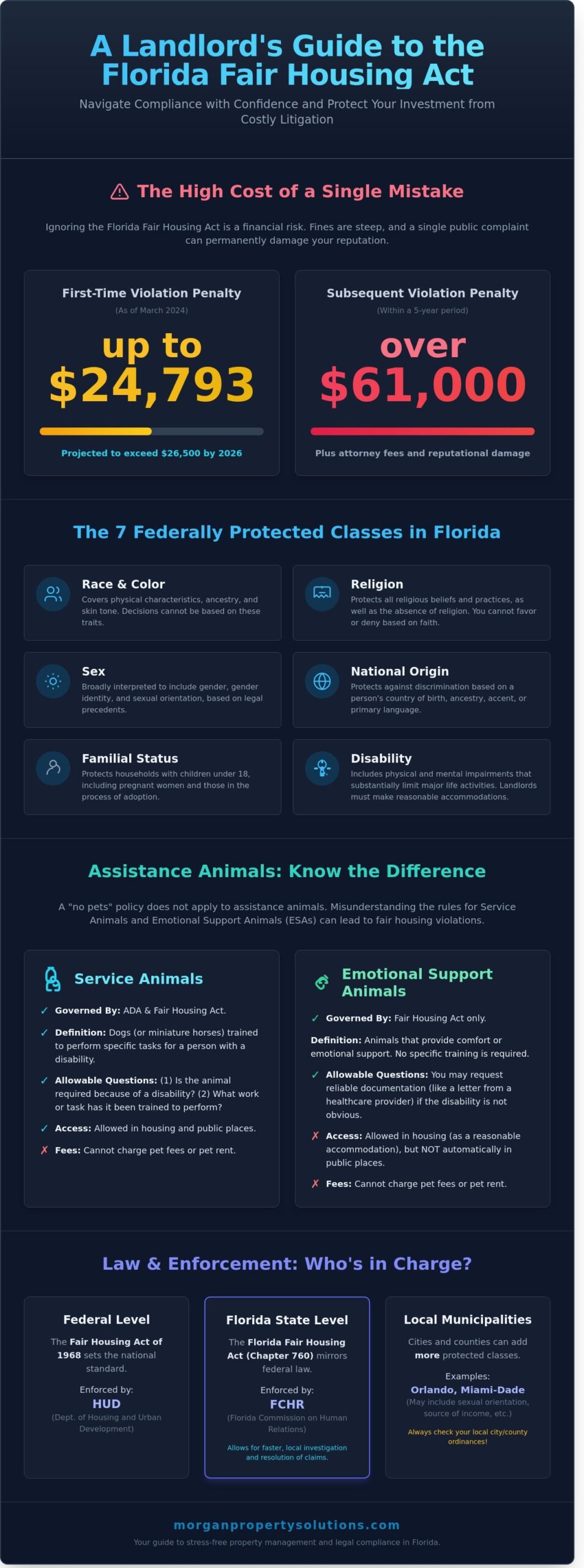
Understanding the florida fair housing act for landlords is a financial necessity, not just a moral one. The costs of a mistake are steep. As of March 2024, the Department of Housing and Urban Development (HUD) increased civil penalty amounts to keep pace with inflation. For a first-time violation, a landlord could face a fine of up to $24,793. If another violation occurs within a five-year period, that number can jump to over $61,000. By 2026, these figures are projected to exceed $26,500 for a single first-time offense based on current inflation trends.
Money isn’t the only thing at stake. In our current digital age, one public complaint can damage your reputation permanently. Online reviews and social media groups move fast. A single accusation of unfair treatment can make it much harder to attract high-quality tenants in the future. We’ve seen that professional management is one of the most effective ways to reduce this risk. Having a clear, documented process for every applicant ensures that you’re treating everyone equally and keeping your business safe from avoidable legal headaches.
Federal vs. Florida Law: What’s the Difference?
When you look at the florida fair housing act for landlords, you’ll notice it looks very similar to federal law. Florida has chosen to adopt the same protected classes found at the national level, including race, color, religion, sex, disability, familial status, and national origin. However, the state law allows local authorities to handle issues more directly through the FCHR rather than requiring everything to go through federal courts in Washington, D.C. This often means local cases move faster and involve local investigators who understand the Florida market.
It’s also vital to remember that local municipalities can add their own layers of protection. Cities like Orlando and Miami, or counties like Miami-Dade, have passed ordinances that protect additional groups, such as those based on sexual orientation or source of income. Because these rules can change depending on which street your rental property is on, we recommend checking our landlord resources to stay updated on specific regional requirements. Staying informed helps you stay confident and keeps your rental business running smoothly without any unexpected legal surprises.
The Protected Classes: Who the Law Covers in Florida
Understanding the florida fair housing act for landlords starts with knowing exactly who the law protects. These rules aren’t just suggestions; they’re legal requirements that keep the rental market fair for everyone. In Florida, you must provide equal opportunity to every applicant regardless of their background or lifestyle. Federal and state laws specifically identify seven protected classes that you cannot use as a basis for denying housing or providing different lease terms.
- Race and Color: This covers physical characteristics, hair texture, and ancestry.
- Religion: You cannot favor one faith over another or exclude someone for having no religious beliefs.
- Sex: This category has evolved significantly. Following legal precedents set in June 2020, it now broadly includes gender identity and sexual orientation.
- Disability: This includes both physical and mental impairments that limit major life activities.
- Familial Status: This protects families with children under 18, including pregnant women and those in the process of adopting.
- National Origin: You cannot discriminate based on where someone was born, their accent, or their primary language.
Familial status is often misunderstood by new property owners. It simply means you can’t turn someone away just because they have kids. Unless your property is a legally registered 55+ community, you can’t limit the number of children or segregate families to specific floors. Another trap is “steering.” This happens when a landlord pushes a tenant toward or away from certain neighborhoods or buildings based on a protected trait. Even if you think you’re being helpful by suggesting a “quieter” building to an older tenant, it’s a violation of the law.
Common “Accidental” Violations in Advertising
Many landlords get into trouble without meaning to. Using phrases like “perfect for a quiet couple” or “ideal for a single professional” might seem harmless, but they imply a preference against families or children. Your goal is to market the unit, not the person. Focus on the 1,200 square feet of living space or the updated kitchen appliances. In 2026, the best rental ads describe the amenities of the property, not the characteristics of the ideal tenant.
Navigating the Application and Interview Process
Consistency is your best defense against a discrimination claim. You should ask the exact same questions to every single person who calls or tours the home. Never ask about a person’s country of origin or the nature of a visible disability. If an applicant mentions a need for a service animal, Disability Rights Florida provides excellent resources on how to handle reasonable accommodations fairly without overstepping legal boundaries.
To keep things simple and legal, we recommend using a standardized set of requirements. You can view our screening criteria to see a gold standard for how to evaluate tenants based on facts like credit scores and rental history rather than personal traits. If you feel overwhelmed by these regulations, our team is here to help you manage your rental with total confidence. Using a professional approach ensures you stay compliant with the florida fair housing act for landlords while finding great tenants for your investment.
Are You Exempt? The “Mrs. Murphy” and Single-Family Rules
Most property owners in the Sunshine State assume the law applies to everyone equally. While the florida fair housing act for landlords is indeed broad, the 1968 federal version and state statutes do carve out a few narrow paths where you might not have to follow every single rule. These aren’t loopholes for bad behavior. They are specific scenarios meant for very small-scale operations where the owner is intimately involved in the day-to-day management of the property.
The first major exemption involves single-family homes. If you own 3 or fewer single-family houses, you might be exempt from certain portions of the law. However, the requirements are strict. You cannot use a real estate broker, an agent, or a professional management firm to find tenants. Additionally, you can’t have sold more than 1 house that wasn’t your primary residence within a 24-month window. If you’re a growing investor with a portfolio of 5 or 10 homes, this rule won’t help you at all.
The second common exception is known as the “Mrs. Murphy” rule. This applies to owner-occupied buildings with 4 units or fewer. If you live in one unit of a triplex or quadplex and rent out the others, the law recognizes that you have a unique interest in who your neighbors are. In these 1 to 4 unit properties, you have more flexibility in your screening process. This is common for “house hackers” in cities like Orlando who live in one half of a duplex while renting the other half to a tenant.
There is one huge caveat that every owner must understand. You can never use discriminatory advertising, even if you are technically exempt from other parts of the Act. You can’t post a listing that states a preference for a specific race, religion, or family status. The Florida Commission on Human Relations oversees these complaints, and they don’t give passes for “accidental” discrimination in a rental ad. One wrong sentence in a Facebook Marketplace post can trigger a legal headache that lasts for months.
The Risk of Claiming an Exemption
Trying to use an exemption is a legal tightrope for most DIY landlords. The moment you hire a licensed professional to help you find a tenant or manage the lease, your exempt status usually disappears. Florida law is very clear that professionals must follow the Act 100% of the time. We always recommend a “safety first” strategy. It’s much easier to follow the florida fair housing act for landlords than it is to defend your “exempt” status in a courtroom. Treating everyone with the same level of respect and fairness is simply the best way to do business.
Religious Organizations and Private Clubs
Some non-commercial housing run by religious groups or private clubs has different rules. These organizations can sometimes limit occupancy to their own members. This rarely applies to the average residential investor in Florida’s many communities. If you’re buying a property to build wealth, you’re running a commercial business. Getting professional advice is always cheaper than a court date. Most legal consultations for small landlords cost between $250 and $500, which is a small price for peace of mind.
Just as getting professional advice protects your business assets, it’s also wise to plan for your personal financial future. For many property owners building wealth for retirement, understanding healthcare costs is a major part of that plan. When the time comes to explore your options, working with an independent brokerage like The Modern Medicare Agency can help clarify the complexities of Medicare.
For international investors, such as those from Italy, navigating these regulations alongside immigration and business law can be even more complex. Legal firms like Tosolini, Toniutti & Partners specialize in providing this kind of cross-border guidance.
For international investors, such as those from Italy, navigating these regulations alongside immigration and business law can be even more complex. Legal firms like Tosolini, Toniutti & Partners specialize in providing this kind of cross-border guidance.
Navigating Emotional Support Animals (ESAs) and Service Dogs
Emotional Support Animals (ESAs) are currently the single biggest source of friction between landlords and tenants in Florida. It’s a topic that brings up a lot of questions, mostly because the rules feel different than standard lease terms. When you’re trying to stay in line with the florida fair housing act for landlords, you have to shift your perspective. You aren’t looking at a pet; you’re looking at a “reasonable accommodation.” Under the Fair Housing Act (FHA), an ESA is considered a tool that helps a person with a disability live comfortably, much like a walker or specialized kitchen equipment.
There is a major difference between a service animal and an ESA that you need to know. Service animals are covered by the Americans with Disabilities Act (ADA). These are almost always dogs that have been specifically trained to perform tasks, like alerting a person to a seizure or guiding someone who is blind. Emotional Support Animals don’t need any formal training. Their mere presence provides relief for conditions like anxiety or PTSD; you can read more about the mental health conditions they can support.
Florida landlords used to struggle with “certification” scams where tenants would buy a PDF online for $50 to bypass pet fees. To fix this, the state passed SB 1084 on July 1, 2020. This law added some teeth to the florida fair housing act for landlords by making it a second-degree misdemeanor to provide fraudulent ESA documentation. It also clarified that a landlord can request reliable information from a healthcare provider to verify the need for the animal if the disability isn’t obvious.
Understanding the role of legitimate mental health providers is key. For instance, practices like Balanced Minds Psychology & Wellness in Florida are the types of licensed professionals who can properly assess a patient’s need for an accommodation, distinguishing their work from online certificate mills.
Verifying documentation is just one area where clarity is crucial. In more complex disputes that can arise during a tenancy, such as accusations of serious lease violations or conflicting accounts of property damage, establishing the facts is key to a fair resolution. While it’s an unconventional step in property management, some parties in high-stakes civil matters seek out objective methods to determine the truth, including professional services like a polygraph test Boise Idaho, to help settle disagreements before they escalate into costly legal battles.
Verifying documentation is just one area where clarity is crucial. In more complex disputes that can arise during a tenancy, such as accusations of serious lease violations or conflicting accounts of property damage, establishing the facts is key to a fair resolution. While it’s an unconventional step in property management, some parties in high-stakes civil matters seek out objective methods to determine the truth, including professional services like a polygraph test Boise Idaho, to help settle disagreements before they escalate into costly legal battles.
What You Can (and Cannot) Ask for Documentation
If your tenant asks for an ESA accommodation and their disability isn’t visible, you can ask for a supporting letter. This letter should come from a licensed professional, such as a doctor or therapist, who has personal knowledge of the tenant’s condition. You cannot ask for specific medical records or demand to see the person’s private health history. You also can’t ask for a demonstration. To keep your process professional and avoid any accidental bias, we recommend using petscreening.com. It’s a reliable way to vet these requests without putting yourself at legal risk.
Can You Charge Pet Rent for an ESA?
The short answer is no. Since the law doesn’t view these animals as pets, you cannot charge pet deposits, monthly pet rent, or any other pet-related fees. However, the tenant is still responsible for the animal’s behavior. If the ESA causes physical damage to the unit, like scratching up the baseboards or ruining the carpet, you can still charge the tenant for those repairs at the end of the lease. Treating an ESA as a pet rather than an accommodation is one of the fastest ways to trigger a Fair Housing complaint in Florida.
To mitigate risks of property damage from an unattended animal, some landlords find it helpful to provide tenants with a list of local resources. While not in Florida, facilities like Noah’s Pet Hotel & Spa serve as a great example of the professional boarding and care options that responsible tenants can use when traveling, ensuring animals are not left alone to become anxious or destructive.
Dealing with these requests can feel like walking through a minefield, but you don’t have to do it alone. We’ve spent over 20 years helping owners stay compliant while protecting their property values. If you want to make your rental business stress-free, let us show you how our expert property management services can handle the heavy lifting for you.
How to Stay Compliant Without the Stress
Staying on the right side of the law shouldn’t keep you up at night. The secret to managing the florida fair housing act for landlords is consistency. Most legal trouble starts when a landlord treats one person differently than another, even if it’s accidental. To prevent this, you need Standard Operating Procedures (SOPs). Think of an SOP as a recipe for your business. Whether you’re showing a home or processing an application, you follow the same steps every single time. This creates a “paper trail of fairness” that protects you if a complaint ever arises.
Documentation is your best friend. If you deny an applicant, don’t just say “no.” Keep a record of the specific, non-discriminatory reason. Maybe their credit score was 580 when your requirement is 620; perhaps their verifiable income was only 2 times the rent instead of the required 3 times. According to 2023 industry data, landlords who maintain detailed records of every interaction reduce their risk of successful legal claims by over 40%. We recommend keeping these records for at least 3 years to stay safe. It’s about being prepared before a question is even asked.
Professional management acts as a vital buffer. When you hire an expert, you put a licensed professional between yourself and potential liability. We handle the difficult conversations and the technical details so you don’t have to. At Morgan Property Solutions Inc., we specialize in taking the complex parts of landlording and making them simple for you. You deserve to enjoy your investment without the constant fear of a lawsuit. We’ve spent over 20 years refining these processes so you can focus on your life while we focus on the rules.
A professional manager doesn’t just collect rent; they provide a layer of legal insulation. If a tenant has a grievance, they deal with our office, not your personal phone. We apply the florida fair housing act for landlords with clinical precision, ensuring that every interaction follows the letter of the law. This distance protects your privacy and your peace of mind. It turns a high-stakes legal environment into a predictable business model.
The Power of Professional Screening
Using a third-party firm ensures every applicant is measured against the same objective yardstick. This removes personal bias from the equation entirely. Our team stays ahead of the curve, including the upcoming 2026 legislative updates regarding rental history disclosures and criminal background checks. By trusting our Orlando property management experts, you ensure your screening process is always legally sound. We’ve helped over 500 local owners avoid costly mistakes by providing standardized, criteria-based results.
Final Checklist for Florida Landlords
Before you post your next listing, run through this quick list to ensure you’re fully prepared. Small tweaks to your process can prevent massive headaches later on.
- Review your ads: Check for “people-focused” language; avoid phrases like “perfect for a young couple” or “ideal for students” which can be interpreted as discriminatory.
- Update your pet policy: Include a clear, written process for Emotional Support Animal (ESA) accommodations, ensuring you follow the 2020 Florida ESA law specifically.
- Standardize your math: Verify that your income-to-rent ratio is applied identically to every single applicant, regardless of their source of income.
- Keep a log: Note the date, time, and reason for every application denial to maintain a solid defense.
Ready to stop worrying about the fine print? Let Morgan Property Solutions Inc. simplify your rental business today! We take care of the compliance so you can enjoy the rewards of being a property owner.
Protect Your Investment and Stay Compliant
Navigating the florida fair housing act for landlords doesn’t have to feel like walking through a minefield. You’ve now got the tools to identify the seven federal protected classes plus Florida’s specific additions. You also know that even if you think you’re exempt under the Mrs. Murphy rule, local ordinances might still apply to your 2026 rental strategy. Handling emotional support animals is often the trickiest part of the job; however, following a standardized screening process keeps you on the right side of the law every time.
Managing these details alone is a lot of pressure. We’ve spent over 20 years helping Central Florida owners protect their portfolios while maintaining an A+ rating from the BBB. Our team uses professional pet and ESA screening to take the guesswork out of applications. This ensures you won’t have to worry about accidental discrimination claims or legal headaches. We’re here to make your life as a property owner a whole lot easier and more profitable.
Simplify your rental business and stay compliant-Contact Morgan Property Solutions today!
We’re excited to help you manage your properties with total peace of mind!
Common Questions About the Florida Fair Housing Act
Is the Florida Fair Housing Act different from the Federal Fair Housing Act?
The Florida Fair Housing Act is essentially the same as the federal version, but it’s enforced at the state level through Chapter 760 of the Florida Statutes. While the federal law provides the foundation, Florida’s state commission handles local complaints to ensure landlords follow the same seven protected classes. We help you stay compliant with both so your rental business remains stress-free and professional.
Can I refuse to rent to someone with a criminal record in Florida?
You can’t have a blanket policy that rejects every applicant with a criminal record, as the 2016 HUD guidance states this can lead to discrimination. Instead, you should look at the specific type of crime and how long ago it happened. For example, a 7 year old misdemeanor is different from a recent violent felony. We’re here to help you create a fair screening process that protects your property while staying within the law.
Do I have to allow an Emotional Support Animal if I have a “No Pets” policy?
Yes, you must allow an Emotional Support Animal because these animals are legally considered assistive devices rather than pets. Under the florida fair housing act for landlords, you aren’t allowed to charge pet deposits or monthly pet rent for an ESA. Just follow the FHEO Notice 2020-01 guidelines to request proper documentation for disabilities that aren’t clearly visible. It makes the process simple and keeps you in the clear.
What are the penalties for violating fair housing laws in Florida?
Penalties for violations are expensive, with first-time civil fines reaching up to $21,410 as of 2023. If a landlord has two or more violations within a 7 year period, those fines can jump to over $100,000. You’ll also likely be responsible for the applicant’s legal fees and any emotional distress damages. We focus on getting your compliance right the first time so you never have to deal with these costly setbacks.
Can I say “No Kids” in my Florida rental advertisement?
No, you cannot use “No Kids” or similar language in your ads because familial status is protected under the 1988 Fair Housing Amendments Act. Even phrases like “perfect for a single professional” can be flagged as discriminatory against families with children. The only exception is for 55 plus communities where at least 80 percent of the units have one person over that age. Keeping your ads neutral helps you find great tenants without the legal risk.
Am I exempt from Fair Housing if I only own one rental house in Orlando?
It’s very unlikely you’re exempt, even with a small portfolio, because the “Mrs. Murphy” exemption under Section 3603(b) has very strict limits. To qualify, you can’t use a real estate agent or any professional advertising, which most modern landlords find impossible. Since the florida fair housing act for landlords applies to almost everyone, we recommend following all rules to stay safe. Our team provides the guidance you need to manage your Orlando property with confidence.
How do I legally deny a rental applicant without getting sued?
The safest way to deny an applicant is to use consistent, written screening criteria like a 3 to 1 income-to-rent ratio or a 600 minimum credit score. If you deny someone based on their credit report, you must send a formal Adverse Action Notice as required by the Fair Credit Reporting Act. This document gives the applicant a clear reason for the decision and shows you’re following a professional, objective process. Having a documented trail is the best way to protect your reputation and your investment.

Article by
Oliver Overton-Morgan
Oliver Overton-Morgan is a full-time Real Estate Broker since 2003, with years of experience helping thousands of people purchase and sell real estate throughout Central Florida. He holds a Graduate Realtor Institute designation, LCAM, and has held licenses in good standing as a Florida Mortgage Broker and a Notary Public. Oliver immigrated to central Florida in 2001, and within 5 years Oliver built a successful Real Estate brokerage in central Florida, where he recruited over 75 Sales Associates with 25+ million in sales production.