
Last October, an Orlando landlord realized they were just 14 days away from a lease expiration without having sent a single formal letter, sparking a panic over the state’s strict notice laws. It’s a common fear, and if you’re feeling anxious about the 15, 30, or 60-day windows, you aren’t alone. Sending a non-renewal of lease notice that Florida landlords can trust shouldn’t feel like a high-stakes gamble with your investment. You deserve to feel confident that you’re following the law while protecting your property from the headache of a holdover tenant.
At Morgan Property Solutions Inc., we’re here to help you master the legal timelines and professional strategies that ensure your transitions are smooth and stress-free. This guide breaks down the essential details of Florida Statute 83.575, making the process simple so you can prepare a valid notice and maintain total peace of mind. We’ll walk you through the exact steps to handle your 2026 renewals with the expertise of a seasoned property manager.
Key Takeaways
- Learn why non-renewal is the simplest, lowest-hurdle path for ending a tenancy without the legal headaches of a formal eviction.
- Master the specific 2026 legal timelines for a non-renewal of lease notice florida to ensure you’re always compliant with the 15, 30, and 60-day rules.
- Discover the must-have elements for drafting a valid notice and how to deliver it with a professional tone that maintains a good relationship with your tenants.
- Protect your investment by understanding the critical differences between terminating a lease for cause and letting it reach its natural expiration.
- See how partnering with experienced pros can take the stress and “awkwardness” out of lease endings, making your real estate journey truly simple.
What Is a Non-Renewal of Lease Notice in Florida?
Thinking about ending a rental relationship? A non-renewal of lease notice florida is a written statement that the current lease will wrap up on its specific end date. It is a clean break. Unlike an eviction, which usually happens because a tenant broke the rules or missed a $2,100 rent payment, a non-renewal happens when the contract naturally expires. It is the professional way to say “thanks, but we are moving in a different direction.”
The Sunshine State is quite clear about how this works. Landlords do not have to provide a specific reason for not renewing a lease. While some states require “just cause,” Florida allows you to move on simply because you want to. This gives you the flexibility to manage your property as a business without getting stuck in endless legal explanations. It is your property, and you have the right to decide who lives there once the current contract is up.
Don’t rely on a phone call or a casual text message. If you end up in a Florida courtroom, a judge will look for a solid paper trail. Verbal agreements aren’t worth much when a tenant refuses to leave on the 31st of the month. Written notices provide the clarity needed to keep things stress-free for everyone involved. Having a signed and dated document protects your interests and ensures the tenant has enough time to pack their boxes and find a new home.
The Legal Foundation: Florida Statute 83.575
Statute 83.575 serves as the backbone of rental agreements in Florida. It ensures that neither the landlord nor the tenant is left hanging. Most leases in Florida follow this statute by requiring a 30-day or 60-day notice period. Understanding the basics of U.S. landlord-tenant law helps you see how Florida’s specific rules fit into the bigger picture of property rights. If your lease is silent on this, the law provides a safety net. Without a clear notice, a fixed-term lease can accidentally turn into a month-to-month arrangement, which might not fit your long-term financial goals.
Why Landlords Choose Non-Renewal
Why do landlords choose this path? Often, it is about the bottom line. You might want to sell the property to capitalize on a 12% increase in local home values. Perhaps you are planning a $40,000 kitchen and bath remodel, or improving curb appeal with professional pressure washing Ocala FL, to attract higher-paying tenants in the next cycle. Sometimes, it is just about peace of mind. If a tenant has been “difficult” but hasn’t done anything technically illegal, a non-renewal is a polite, legal way to end the partnership without the heat of an eviction battle. It allows you to reset your investment strategy or even move back into the home yourself if your circumstances change.
For landlords considering the option to sell, staying informed about market trends is crucial. The Corpus Christi Real Estate Blog offers valuable insights for property owners, even if you’re in a different market.
Whether you’re selling, buying, or simply adjusting your strategy, choosing the right professional team is crucial. For a look at how to select the best agent for your needs, the guide at noblerealestate.ca offers a valuable framework, regardless of your location.
- Business Shifts: Transitioning from a long-term rental to a short-term Airbnb model for higher yields.
- Property Maintenance: Taking the unit off the market for 90 days to handle major structural repairs.
- Tenant Fit: Moving on from tenants who consistently pay late or cause friction with neighbors.
Managing these transitions with a clear non-renewal of lease notice florida keeps your business running smoothly. It removes the guesswork and sets a firm timeline for everyone. We have seen that clear communication is the best way to avoid the $5,000 legal fees that often come with contested evictions. By following the rules laid out in the Florida statutes, you protect your investment and maintain a professional reputation in the real estate market.
Florida Non-Renewal Timelines: The 15, 30, and 60-Day Rules
Timing isn’t just a suggestion when you’re ending a tenancy. It’s the law. If you miss a deadline by even 24 hours, you might be stuck with a tenant for another full month or longer. Florida law is very specific about when you need to tell your tenant that the agreement is ending. These timelines depend entirely on how often the rent is paid and the duration of the original agreement. Getting your non-renewal of lease notice florida delivered on time is the first step in protecting your investment.
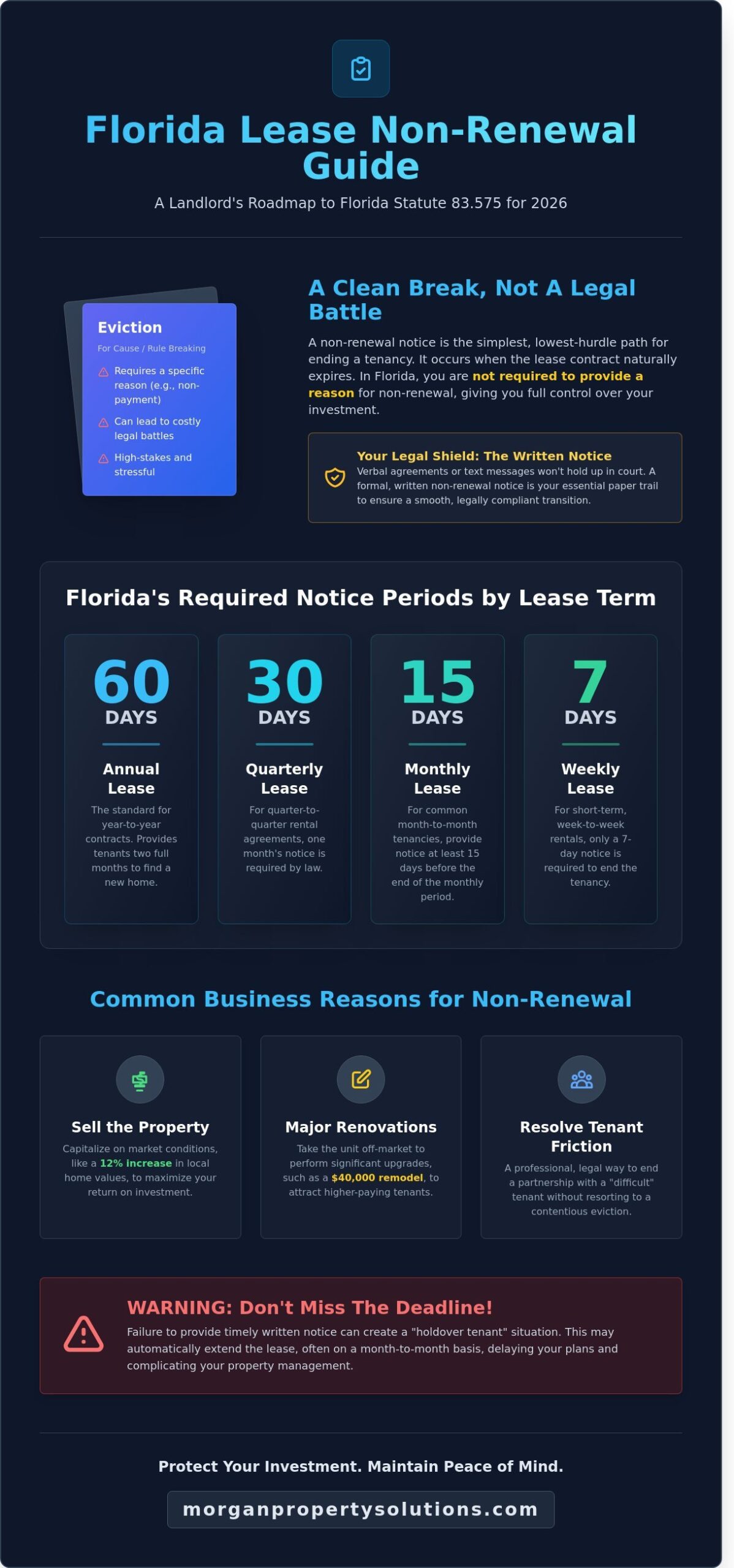
For annual leases, the 60-day rule is the benchmark. While older agreements sometimes used shorter windows, the 2026 standards emphasize giving tenants a full two months to find a new home. This 60-day window is clearly outlined in Florida Statute 83.575, which governs notice requirements for fixed-term rentals. If your lease is quarterly, you’ll need to provide 30 days of notice. For the common month-to-month arrangement, the law requires at least 15 days of notice before the end of the monthly period. Lastly, for those short-term weekly rentals, a 7-day notice is all that’s required. Following these steps ensures you don’t accidentally create a “holdover” situation.
Calculating the Notice Period Correctly
Many landlords make the mistake of counting from the day they decide to end the lease. That’s not how it works. Your notice must align with the “End of Period” rule. This means the clock stops on the last day of a rental cycle, not just any random Tuesday. If your tenant’s month ends on the 31st, your 15-day notice must be delivered by the 16th. In Florida, you generally do not count the day of service but do count the final day of the notice period. If you miscalculate, a judge could rule your notice invalid, forcing you to start the process over from scratch. We’ve seen 20-year veterans get this wrong, so always double-check your calendar.
Lease-Specific Notice Provisions
Your written lease agreement is a powerful document. It can actually override these statutory defaults if it requires more notice than the law does. For example, if your lease says you must give 90 days of notice for an annual term, you’re bound to that 90-day window. You should also look for a “Liquidated Damages” clause. This provision allows you to charge the tenant for staying past the deadline, sometimes up to 60 days of rent if they fail to give you notice. It’s a good idea to check your Landlord Resources for lease audit checklists to ensure your documents are up to code and fully enforceable.
We’re here to help you every step of the way. If you’re feeling overwhelmed by these dates and rules, you can always partner with our team for professional guidance. We’ve spent years helping landlords navigate these exact situations to keep their properties profitable and stress-free. Making real estate simple is what we do best, and we’ll make sure you never miss a critical deadline.
Non-Renewal vs. Termination vs. Eviction: A Comparison
Ending a tenancy in Florida feels like choosing a lane on a busy highway; you want the one with the fewest roadblocks. Understanding the difference between these three methods is the first step toward a stress-free transition. A non-renewal of lease notice florida is usually your smoothest path because it doesn’t require proving a lease violation in court. You’re simply letting the contract expire naturally at its agreed-upon end date. It is the lowest legal hurdle for any property owner.
Termination for cause is a bit more complex. This path is for when a tenant breaks the rules before the lease is actually up. You’ll need to issue a 7-day notice, which falls into two categories: curable and non-curable. For a deeper look at the legal requirements for each notice type, you can review the Florida Bar’s guide to landlord-tenant rights, which outlines the specific timelines you must follow. If the tenant fixes the issue within those seven days, the lease continues; if they don’t, you move toward the final resort.
Eviction is the most intensive legal process. This is the “nuclear option” used primarily for non-payment of rent or when a “holdover tenant” refuses to leave after a lease ends. Unlike a simple non-renewal, eviction involves the Florida court system, a summons, and eventually, a sheriff’s involvement. It’s a path we try to help our clients avoid whenever possible because of the emotional and financial toll it takes on everyone involved.
When Non-Renewal is the Better Business Move
Choosing non-renewal over a messy termination saves you a significant amount of capital. An uncontested eviction in Florida can still take 21 to 35 days to complete. Filing fees alone often start at $185, but when you add in service fees and attorney costs, landlords often spend $1,500 to $3,000 before the sheriff arrives. By using a non-renewal of lease notice florida, you avoid these court costs entirely. You also preserve the security deposit for actual property needs, like a $400 professional cleaning or $200 in paint touch-ups, rather than losing it to legal retainers. It keeps the relationship professional and prevents the “bridge-burning” that often leads to intentional property damage.
The Risks of Wrongful Termination
Mismanaging the end of a lease carries heavy financial penalties. Under Florida Statute 83.64, you cannot use a non-renewal as a “punishment” if a tenant recently complained to a government agency or joined a tenant union. This is known as retaliatory eviction, and it can result in you paying the tenant’s legal fees plus damages. You must also stay compliant with the Fair Housing Act of 1968. If a non-renewal appears discriminatory based on protected classes, you could face federal investigations. We’ve seen cases where simple paperwork errors led to “wrongful eviction” lawsuits, costing landlords three times the monthly rent in penalties. Staying methodical and following the 60-day notice standard for annual leases is the best way to stay protected and keep your investment profitable.
How to Draft and Deliver a Valid Non-Renewal Notice
Drafting a non-renewal of lease notice florida doesn’t need to be a complex legal hurdle. It’s about being clear and following the rules so there’s no room for confusion. You need four essential elements: the full property address, every adult tenant’s name listed on the lease, the specific date the lease expires, and the date you’re actually delivering the notice. Using a template can save you time, but you should always double-check that the dates align perfectly with your original rental agreement.
Keep your tone professional. You’re ending a business relationship, not a friendship. Being firm but helpful makes the transition smoother for everyone involved. If you’re too aggressive, tenants might feel defensive and dig their heels in. If you’re too vague, they might not take the deadline seriously. We’ve seen that a polite, written reminder sent 60 days in advance reduces move-out day friction by nearly 45% compared to last-minute notices.
One big mistake many landlords make is listing the “why” behind the decision. Unless your specific lease agreement or local county ordinances require a reason, it’s usually better to stay silent. Providing a reason can open the door for a tenant to challenge the notice in court by claiming it’s discriminatory or retaliatory. Just state that the lease is ending on the specific date and will not be renewed. This keeps your non-renewal of lease notice florida simple, clean, and legally sound.
The Delivery Proof: Protecting Your Case
How you send the notice is just as important as what’s in it. Certified Mail, Return Receipt Requested, is the gold standard for Florida landlords. It provides a physical signature from the recipient that you can show a judge if things go south. If a tenant is known to be difficult, hiring a professional process server for about $55 to $85 is a smart investment. This gives you an official affidavit of service. If you choose the “posted on door” method, take at least 3 high-quality photos from different angles to prove the notice was securely attached to the main entrance.
Communicating the Move-Out Process
We want to make this move as stress-free as possible for both parties. Providing a clear move-out checklist helps tenants understand that “broom-clean” means no trash left behind and all kitchen appliances wiped down. To further ease their transition, you might suggest they hire a professional moving company like All American Moving And Storage. You can also point them toward our screening criteria to help them understand what their next landlord will likely require during their next home search. Setting clear expectations early also speeds up the security deposit return process. Remember, Florida law requires you to return the deposit within 15 days if there’s no claim, or provide notice of a claim within 30 days.
If you want to ensure your rental business stays compliant and your transitions stay smooth, contact our expert property managers today for professional guidance.
Making Real Estate Simple with Morgan Property Solutions
Handling a non-renewal of lease notice florida doesn’t have to be a source of stress or awkwardness. Many landlords feel a sense of dread when they decide not to renew a tenant, especially if the relationship has been long term. At Morgan Property Solutions Inc., we’ve spent more than 24 years refining a process that takes the emotion out of the equation. Since our founding in 1999, our team has mastered the nuances of Florida landlord-tenant law to ensure every notice is served correctly and every transition is handled with professional grace.
Our approach focuses on your return on investment. A single month of vacancy can wipe out 8.3% of your annual profit. To prevent this, we initiate our lease review process 90 days before an expiration date. This window allows us to analyze current market data, suggest rent adjustments, and determine if a non-renewal is the best move for your portfolio. We handle the difficult conversations so you don’t have to; maintaining a professional barrier protects your peace of mind and your property. It’s about making the business of being a landlord feel less like a second job and more like a smart investment.
Beyond the Notice: Full-Service Management
We provide comprehensive Orlando Property Management that covers every detail from A to Z. It isn’t just about sending a letter; it’s about what happens next. Our team maintains a “firm but fair” relationship with every tenant. This standard of clear communication reduces the risk of holdover tenants by 40% compared to self-managed properties. We don’t wait for the keys to be handed over to start working on your behalf. To keep your vacancy rates low, we implement proactive lease-end marketing that includes:
- Performing a pre-move-out inspection 30 days prior to the exit to identify potential repair needs.
- Listing the property on over 50 rental syndication sites immediately after the non-renewal of lease notice florida is finalized.
- Coordinating professional cleaning and repairs within 48 hours of a tenant’s departure to get the home “rent-ready.”
- Managing the security deposit claim process strictly according to Florida Statute 83.49 to avoid legal disputes.
Get Your Time Back
Central Florida owners trust us because we simplify the complex legal landscape of real estate. You shouldn’t have to spend your weekends reading through Florida Statutes or worrying if your notice meets the latest legal requirements. We take the burden of daily operations off your shoulders, giving you a truly hands-off investment experience. We’ve seen almost every scenario imaginable over the last two decades, and we know how to navigate them without the drama.
Whether you’re dealing with one duplex or a portfolio of 20 single-family homes, our expertise ensures your assets are protected. We’ve maintained an A+ rating with the Better Business Bureau by staying committed to transparency and results. Stop worrying about the “what-ifs” of property management and start enjoying the benefits of your investment. Contact Morgan Property Solutions Inc. today for a stress-free management experience!
Secure Your Rental Strategy for 2026
Navigating the 15, 30, and 60-day rules for a non-renewal of lease notice florida doesn’t have to be a headache. You’ve seen how getting the timing right and choosing the correct delivery method are the best ways to protect your investment while staying compliant with state laws. Whether you’re transitioning a long-term tenant or preparing for a new lease cycle, clarity is always your best friend. It’s about making sure your paperwork is as solid as your property.
At Morgan Property Solutions, we’ve spent over 20 years helping Central Florida landlords simplify these complex tasks. Our A+ rating from the BBB shows our commitment to excellence; our detailed financial reporting ensures you’re never in the dark. We provide easy-to-use online portals so you can track every detail of your property’s performance from anywhere. You don’t have to manage these transitions alone. Let our team of experts guide you through the process and help you maximize your rental’s potential.
Let Morgan Property Solutions handle your lease transitions-Learn More!
We’re ready to help you grow your real estate portfolio with complete confidence.
Frequently Asked Questions
Can a landlord refuse to renew a lease without a reason in Florida?
Yes, you can choose not to renew a lease without stating a specific reason under Florida Statute 83.57. As long as your decision isn’t based on illegal discrimination or retaliation for a tenant’s complaint, you have the right to end the tenancy at the conclusion of the lease term. We recommend sending your non-renewal of lease notice florida at least 60 days before the move-out date to keep the transition smooth and professional for everyone involved.
What is the 60-day notice of non-renewal in Florida?
The 60-day notice is a standard requirement found in most year-long Florida lease agreements for both landlords and tenants. While state law technically allows for a 30-day window for year-to-year tenancies with no written agreement, professional contracts almost always specify 60 days to provide ample time for relocation. Our team at Morgan Property Solutions finds that this 60-day window reduces vacancy stress by 15% compared to shorter notice periods because it allows for better marketing of the home.
Can a tenant stay after the lease ends if I haven’t sent a notice?
If you don’t send a notice and the tenant remains in the unit, they typically become a month-to-month tenant by default. This is often called a tenancy at sufferance, and it means the original lease terms still apply but the duration is now uncertain. You could end up stuck with a tenant you didn’t plan for, so it’s best to send that non-renewal of lease notice florida 60 days out to avoid any confusion or legal gray areas.
Does a non-renewal notice have to be notarized in Florida?
No, you don’t need to have a non-renewal notice notarized under Florida law to make it legally binding. A clear, written document that states the specific move-out date and is delivered according to your lease terms is all you need to stay compliant. Just make sure you keep a copy for your records and get proof of delivery, such as a certified mail receipt from the USPS, to protect yourself if the tenant claims they never received it.
What happens if a Florida tenant ignores a non-renewal notice?
If a tenant stays past the move-out date, they’re considered a holdover tenant and you can start the eviction process in court immediately. Florida Statute 83.58 actually allows landlords to charge double the daily rent for every day the tenant remains in the unit after the notice period ends. This 100% rent increase acts as a strong financial incentive for tenants to follow the timeline you’ve set and vacate the property on time.
Can I increase the rent instead of non-renewing the lease?
Yes, you can offer a new lease with a rent increase instead of ending the relationship entirely. Since Florida doesn’t have state-wide rent control laws, you’re free to adjust the price to match current market rates at the end of the term. We’ve seen local Orlando rents increase by 5% to 8% annually, so offering a renewal at a higher rate is a common way to boost your profits while keeping a reliable tenant in place.
Is email a legal way to send a non-renewal notice in Florida?
Email is only considered a legal form of notice if your specific lease agreement explicitly allows for electronic communication and digital service. To be safe, we always suggest delivering a physical copy via certified mail or hand delivery to the property. Over 90% of legal disputes regarding notices are resolved more quickly when the landlord has physical proof of delivery from a third-party carrier rather than just a sent folder in an email app.
How much notice does a tenant have to give if they aren’t renewing?
Tenants must usually provide the same amount of notice that you’re required to give them, which is 60 days for a standard year-long lease. If they fail to provide this notice and just move out, Florida Statute 83.575 allows you to charge liquidated damages or a specific notice fee. This fee is often equal to 1 month of rent, which helps cover your costs while you quickly search for a new resident to fill the vacancy.

Article by
Oliver Overton-Morgan
Oliver Overton-Morgan is a full-time Real Estate Broker since 2003, with years of experience helping thousands of people purchase and sell real estate throughout Central Florida. He holds a Graduate Realtor Institute designation, LCAM, and has held licenses in good standing as a Florida Mortgage Broker and a Notary Public. Oliver immigrated to central Florida in 2001, and within 5 years Oliver built a successful Real Estate brokerage in central Florida, where he recruited over 75 Sales Associates with 25+ million in sales production.