
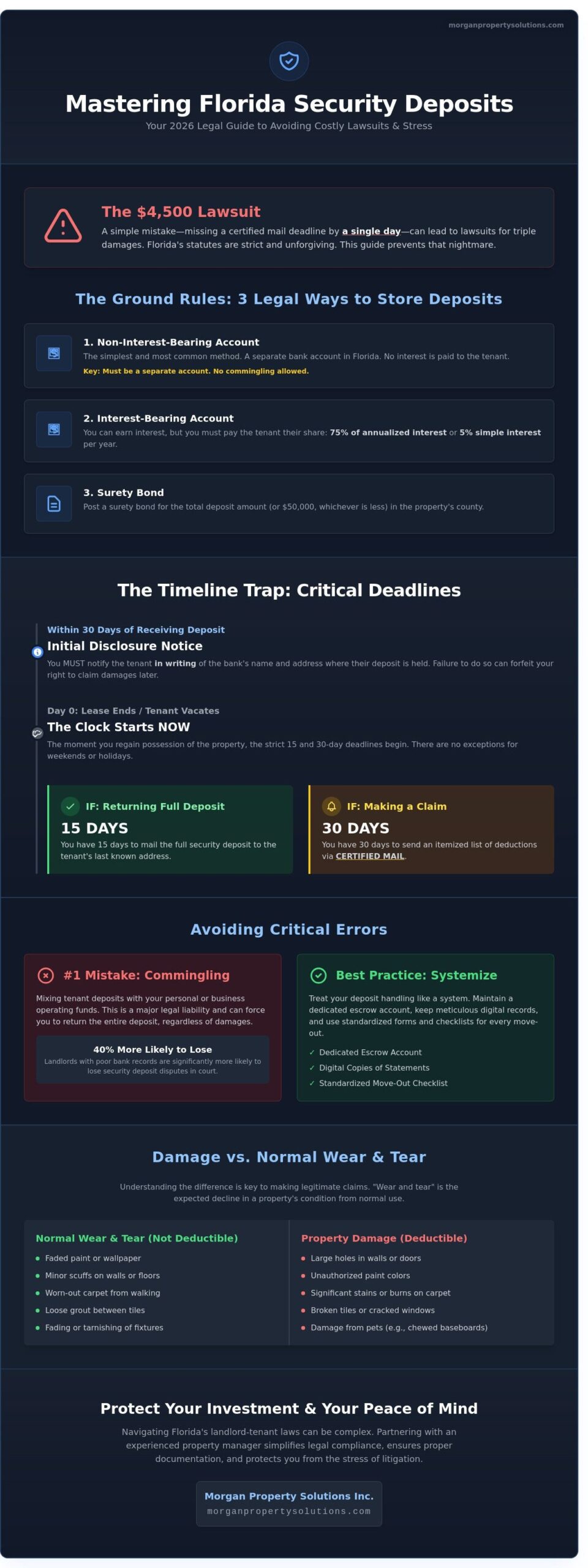
On October 12, 2025, a landlord in Orlando found themselves facing a lawsuit for $4,500 just because they missed a certified mail deadline by a single day. It’s a nightmare scenario that highlights why so many owners feel constant anxiety during the move-out process. You probably already know that Florida’s statutes are incredibly strict; the fear of being sued for triple damages over a simple technicality is enough to keep anyone up at night. We agree that it’s frustrating to guess what counts as normal wear and tear while racing against a 30 day clock. Learning how to handle security deposits in florida shouldn’t be this stressful for you.
At Morgan Property Solutions Inc., we’ve spent 21 years helping property owners turn these complex legal hurdles into simple, repeatable systems. Our goal is to give you total confidence in your documentation and ensure a peaceful transition every time a tenant leaves. This guide provides the exact 2026 legal steps and timelines you need to manage your deposits without the threat of legal disputes. We’ll walk through the specific actions required from the moment a lease ends to the final distribution of funds so you can protect your investment with ease.
Key Takeaways
- Understand the strict storage rules under Florida Statute 83.49 to ensure you aren’t accidentally commingling funds in your personal accounts.
- Master the critical 15-day and 30-day deadlines so you never lose your right to claim damages due to a simple timing error.
- Learn exactly how to handle security deposits in florida by distinguishing between legitimate property damage and standard wear and tear.
- Implement a proactive 60-day move-out workflow and cleaning checklist that sets clear expectations and helps avoid heated disputes.
- Discover how partnering with an experienced property manager can simplify legal compliance and protect your investment from the stress of litigation.
The Ground Rules: Storing Security Deposits in Florida
Managing a rental property involves more than just collecting rent; it requires a deep understanding of U.S. landlord-tenant law as it applies to your specific state. In the Sunshine State, Florida Statute 83.49 dictates exactly how every residential security deposit must be handled. You can’t just toss that money into your personal savings or checking account. It’s the tenant’s money until you have a legal claim to it, and the law treats it as such. Knowing how to handle security deposits in florida starts with choosing one of three legal storage methods. Each option has its own set of rules, but they all share one goal: keeping the tenant’s funds safe and reachable.
- Non-interest-bearing account: This is a separate account in a Florida-based banking institution. The money sits there, and neither you nor the tenant earns interest on it.
- Interest-bearing account: You can place the funds in an interest-earning account. However, you must pay the tenant at least 75% of the annualized interest or 5% simple interest per year.
- Surety bond: You can post a surety bond for the amount of the deposit, or $50,000 (whichever is less), in the county where the property is located.
Most independent landlords choose the non-interest-bearing account because it simplifies the bookkeeping. Regardless of the path you choose, the account must be separate from your personal finances. This isn’t just a best practice; it is a statutory requirement that protects you from claims of mishandling funds.
The 30-Day Initial Disclosure Requirement
Once you receive the funds, the clock starts. Florida law gives you exactly 30 days to notify your tenant in writing about where their money is sitting. This notice isn’t optional. It must include the name and address of the banking institution and the interest rate if the account earns interest. If you miss this 30-day deadline, you could lose your right to claim any of that deposit for damages when the lease ends. We find that consistency is key here. Just as we use strict screening criteria to find the best tenants, we use a standardized notice process to protect our owners’ legal standing from day one. It’s a simple step that prevents massive headaches during the move-out process.
Commingling: The #1 Mistake Florida Landlords Make
Commingling happens when you mix your personal funds with your tenant’s security deposit. It’s a major legal liability that can lead to lawsuits or the forced return of the deposit regardless of property damage. To stay safe, set up a dedicated escrow account specifically for your Florida rentals. Don’t use this account to pay for repairs or property taxes. Keep digital copies of every deposit slip and monthly statement. In a 2023 review of local court cases, landlords who couldn’t produce clear bank records were 40% more likely to lose security deposit disputes. Good record-keeping proves the funds remained untouched and separate from your business operating capital. Learning how to handle security deposits in florida correctly means treating that escrow account as sacred ground. We’re here to help you set up these systems so your investment remains stress-free and profitable.
The Timeline Trap: 15-Day and 30-Day Deadlines
The clock starts ticking the exact second your tenant hands over the keys or vacates the premises. There’s no grace period for busy schedules or holiday weekends. If you’re learning how to handle security deposits in florida, you must treat these deadlines as absolute. Missing a cutoff by even 24 hours often results in a 100% forfeiture of your right to withhold any funds, regardless of how much damage the tenant left behind.
According to the strict guidelines in Florida Statute 83.49, your responsibilities depend entirely on whether you intend to keep a portion of the money. We’ve spent over 20 years helping landlords stay compliant, and we’ve seen how easily a simple oversight can lead to an expensive legal headache. Our goal is to make this process stress-free by keeping your timeline organized and your documentation bulletproof.
Returning the Deposit in Full
If the tenant left the home in pristine condition, you have exactly 15 days to mail the full deposit back to them. Don’t wait until day 14 to head to the post office. While the law requires you to mail it within 15 days, unexpected mail delays can create friction with former tenants. We recommend sending the check via trackable mail so you have a receipt showing exactly when it left your hands.
A common hurdle is the lack of a forwarding address. Florida law requires the tenant to provide a written forwarding address, but if they fail to do so, you aren’t off the hook. You should still mail the check or notice to the tenant’s last known address, which is usually the property they just vacated. If you’re feeling overwhelmed by these moving parts, a trusted property management partner can handle the logistics for you.
Imposing a Claim on the Deposit
When damages exceed normal wear and tear, the timeline shifts. You have 30 days to notify the tenant of your intention to keep a portion of the deposit. This isn’t a casual phone call or a quick text message. You must send a “Notice of Intention to Impose Claim on Security Deposit” via Certified Mail. If you fail to use Certified Mail, the court may rule that you didn’t provide proper legal notice, even if the tenant actually received the letter.
The notice must include specific statutory language. It should clearly state your intent to claim a specific dollar amount and list the reasons why, such as $450 for carpet replacement or $200 for professional cleaning. Once the tenant receives this notice, they have 15 days to file a written objection. If they don’t object within that 15-day window, you can deduct the amount you claimed and return the remaining balance. If they do object, the situation becomes a legal dispute that may require mediation or a court ruling. Knowing how to handle security deposits in florida means being prepared for these objections with receipts, photos, and clear communication.
Damage vs. Normal Wear and Tear: The Florida Standard
Florida law doesn’t provide a dictionary definition for “normal wear and tear,” which often makes it the biggest point of contention between landlords and tenants. Generally, you can’t charge a tenant for the natural deterioration of a property that happens through ordinary, everyday use. Understanding how to handle security deposits in florida requires a clear grasp of the “useful life” rule. Florida courts typically look at the length of the tenancy and the expected lifespan of items like paint or flooring. If a tenant moves out after five years, you can’t charge them for a full interior repaint because that paint has likely reached the end of its three to five year functional life.
According to The Florida Bar’s guide, tenants are responsible for damages that result from negligence, misuse, or accidents. In our unique tropical climate, this distinction gets even more specific. For instance, if an AC unit fails because it’s 15 years old, that’s your responsibility. However, if the tenant fails to change the filters every 30 days and the system freezes up, you might have a case for a deduction. Humidity is another factor. Mold growth caused by a tenant turning off the AC while they’re on vacation for two weeks is damage, not wear and tear.
What Qualifies as Normal Wear and Tear?
Distinguishing between a lived-in home and a damaged one is easier when you look at these common categories:
- Paint and Walls: Fading from the intense Florida sun or small nail holes from hanging pictures are wear and tear. Large holes from a wall-mounted TV, deep gouges, or unauthorized neon green paint in the bedroom are definitely damages.
- Flooring: Light traffic patterns on a 10 year old carpet are expected. Pet urine stains, cigarette burns, or large permanent ink spills are clear examples of damage that can be deducted.
- Fixtures and Hardware: Worn cabinet hinges or a loose faucet handle happen over time. Broken cabinet doors, missing drawer pulls, or a cracked bathroom mirror are tenant responsibilities.
- Lanai Screens: If a screen becomes brittle and tears due to age and UV exposure, that’s wear. If a tenant’s cat shreds the bottom panel, the tenant should pay for the repair.
Documenting Property Condition Like a Pro
You can’t prove damage if you don’t know what the property looked like on day one. We recommend the “Photo-First” rule. You should take at least 50+ high-resolution photos of the home before a tenant ever touches the keys. Don’t just take wide shots of the rooms. Get close-ups of the inside of the oven, the bottom of the sinks, and the condition of the baseboards. This creates a baseline that’s hard to argue with in a small claims court.
Video walkthroughs are even better. Walk through the home and narrate what you see. Turn on the faucets to show they don’t leak and run the AC to prove it’s cooling to 72 degrees. This level of detail protects you and the tenant. When you know how to handle security deposits in florida with this kind of precision, disputes disappear. We’ve found that our landlord resources help owners standardize these inspections so nothing gets missed. Having a signed move-in inspection report alongside your digital evidence is your best defense against deposit disputes.
The Move-Out Process: A Step-by-Step Practical Workflow
Success starts early. We recommend starting the move-out conversation at least 60 days before the lease expires. This isn’t just about the paperwork; it’s about setting clear expectations so there are no surprises on move-out day. When you send the renewal or non-renewal notice, include a detailed “Cleaning Checklist.” We’ve seen that providing this list around day 45 reduces disputes by 40 percent because it defines exactly what a “full refund” requires. When people know what we’re looking for, they’re much more likely to meet those standards.
A helpful checklist should include specific tasks like:
- Wiping down the inside of all kitchen appliances and cabinets
- Cleaning the baseboards and window tracks in every room
- Removing all personal trash, including items left at the curb
- Replacing any burnt-out lightbulbs with matching sets
This proactive approach is a core part of how to handle security deposits in florida effectively while keeping the relationship with your tenant positive. It transforms the process from a confrontation into a shared goal.
The Pre-Move-Out Consultation
We suggest offering a friendly pre-inspection about 14 days before the tenant hands over the keys. This isn’t a formal legal walkthrough, but a chance to identify potential issues early. You can point out a scuffed wall or a dusty ceiling fan that might lead to a deduction. It empowers tenants to fix minor issues themselves, like patching a small nail hole. This transparency builds trust and saves you the hassle of hiring contractors for tiny repairs.
When the final day arrives, you have to decide if the tenant should be present for the walkthrough. While some landlords prefer to work alone, having them there can stop arguments before they start. If you find a broken tile or a stained carpet, you can show them the damage in person. Always take high-resolution photos of every room. These photos serve as your primary evidence if a claim ever reaches a local Orlando court.
Processing the Deductions Legally
Florida law is very specific about how you calculate costs. You should never rely on “guesstimates” for repairs. If a hole needs patching, get a written quote from a licensed contractor or use the actual receipt for materials. In the Orlando market, judges use a “Reasonableness Test” to evaluate claims. Charging a tenant $150 to replace a standard $10 air filter won’t hold up in court. Always ensure your deductions reflect real-world market rates for labor and supplies.
Cleaning fees are another common sticking point. While “broom clean” is a common phrase, your lease can set a higher standard if it’s clearly defined. If you must hire a professional crew because the tenant left the kitchen greasy, you must keep that invoice. You’re required to provide copies of these receipts if the tenant challenges the claim within their 15-day window. Handling these details with precision is how to handle security deposits in florida without running into legal headaches or expensive penalties.
Simplifying Success: Professional Management and Deposit-Free Options
Security deposit disputes are the single most common reason for landlord-tenant litigation in the Sunshine State. These conflicts often hinge on credibility, a complex issue that specialists like Morgan Polygraph are dedicated to resolving. It is a high-stakes environment where a single missed deadline or a missing piece of paperwork can lead to a judge awarding your tenant their full deposit back, plus their attorney fees. Learning how to handle security deposits in florida requires more than just a basic understanding of the rules; it requires a systematic approach that leaves no room for error. When you consider that nearly 35% of all small claims cases in some Florida counties involve deposit disputes, the risk of self-management becomes clear.
At Morgan Property Solutions, we have spent over 20 years refining our processes to keep owners out of the courtroom. Our Orlando property management services provide a professional buffer between you and the legal complexities of Florida Statute 83.49. We handle the certified mailings, the itemized lists, and the strict 15 to 30 day timelines so you can focus on your next investment instead of stressing over move-out inspections. Our team ensures that every deduction is backed by photographic evidence and detailed receipts, which significantly reduces the likelihood of a tenant contesting the claim.
The “Deposit-Free” Advantage
Modern renters often struggle to come up with three months’ rent upfront. Data shows that an estimated 40% of qualified renters have less than $1,000 in liquid savings, making a traditional security deposit a major barrier to entry. By offering Deposit-Free Renting, you instantly make your home more attractive to a wider pool of applicants. This system replaces the large cash deposit with a small monthly fee paid by the tenant. It offers several key benefits for landlords:
- Reduced Vacancy: Properties with deposit-free options often lease 20% faster than those requiring traditional cash deposits.
- Higher Protection: These systems often provide 1.5 to 2 times the coverage of a standard one-month cash deposit.
- Less Friction: Since there is no cash held in escrow, the biggest source of tension at move-out is completely eliminated.
This modern approach protects your investment while keeping your cash flow consistent. It is a win for everyone involved, as the tenant keeps their savings and you get a higher level of financial security against damage or unpaid rent.
Why Partner with Morgan Property Solutions?
Our “Making Real Estate Simple” philosophy is built into every service we offer. We don’t just react to problems; we use technology to prevent them from happening in the first place. For example, we use specialized pet screening tools to evaluate every animal before a lease is signed. This data-driven approach identifies high-risk pets, helping you avoid an average of $2,300 in “deposit-eating” damage to your floors and drywall. It is this level of detail that has earned us an A+ rating with the Better Business Bureau and the trust of hundreds of local property owners.
Managing a rental property shouldn’t feel like a second job. When you understand how to handle security deposits in florida, you realize that professional oversight is an investment in your own peace of mind. We take care of the documentation, the legal notices, and the tenant communication from start to finish. Let us handle the details so you can enjoy the profits while we ensure your property remains a source of steady income rather than a source of legal headaches.
Protect Your Investment and Stay Compliant in 2026
Navigating the 15-day and 30-day notice windows doesn’t have to feel like a legal minefield. When you accurately distinguish between normal wear and tear and legitimate damage, you protect your property and your reputation. Mastering how to handle security deposits in florida is the best way to avoid costly disputes. It’s about having a clear workflow that keeps you compliant from the moment a tenant moves in until the day they hand back the keys. This level of organization ensures your rental business stays profitable and professional.
You don’t have to manage these complex timelines alone. With over 20 years of Central Florida experience and a rock-solid A+ BBB rating, our team has built proven systems that take the weight off your shoulders. We focus on the details so you can focus on growing your portfolio. If you’re ready to stop worrying about legal traps and start enjoying your passive income, we’re here to help you every step of the way. Our goal is to make your life easier while protecting your assets.
Simplify your rental business with our Orlando property management experts and let us handle the heavy lifting for you. You’ve worked hard for your investment, and it’s time it started working for you!
Frequently Asked Questions
How long does a landlord have to return a security deposit in Florida?
In Florida, you have 15 days to return the full deposit if you aren’t making any claims against it. If you intend to keep part of the money for repairs, you must send a written notice via certified mail within 30 days. We’ve seen many landlords miss this 30 day window, which often leads to legal headaches. Keeping track of these specific dates is vital to stay compliant with state laws and keep your business running smoothly.
Can a Florida landlord charge for cleaning the carpet?
You can only charge for carpet cleaning if the damage goes beyond normal wear and tear. If a tenant leaves a 5 inch wine stain or multiple cigarette burns, you can deduct the professional cleaning cost. However, you can’t charge for a standard steam clean between tenants just because the carpet looks slightly lived in. Florida courts usually rule against landlords who try to pass routine $150 maintenance costs onto the tenant without proof of damage.
What happens if a landlord misses the 30-day notice deadline in Florida?
If you miss the 30 day deadline, you give up your right to keep any portion of the security deposit. You’re legally required to return the full amount to the tenant immediately. Even if the tenant caused $1,200 in damages, you can’t use the deposit to pay for it once that window closes. You’d have to file a separate lawsuit in court to recover those specific repair costs, which is often a more difficult path to take.
Does a landlord have to pay interest on a security deposit in Florida?
You only have to pay interest if you choose to hold the funds in an interest-bearing account. In this case, you must pay the tenant at least 75% of the annual interest rate or 1% straight interest per year. Most landlords we work with prefer non-interest-bearing accounts to keep things simple and easy. If you do use an interest-bearing account, you must provide the tenant with written notice within 30 days of receiving their funds.
Can I use the security deposit for unpaid rent in Florida?
Yes, you can use the funds to cover unpaid rent as long as your lease agreement includes this provision. Learning how to handle security deposits in florida properly means ensuring your lease language is clear from day one. If a tenant leaves owing $950 for the final month, you can deduct that from the deposit. Just remember to follow the standard 30 day notification process to document the deduction for the tenant so there’s no confusion.
What should I do if my tenant doesn’t provide a forwarding address?
You should send the required notice to the tenant’s last known address, which is usually the rental property they just vacated. Florida law requires tenants to provide a forwarding address 7 days before moving out, but many people forget this step. By mailing the notice to the rental unit via certified mail, you fulfill your legal obligation. The post office will either forward it to their new home or return it to you as proof of your attempt.
Is a move-in/move-out inspection form required by Florida law?
Florida law doesn’t strictly require a written inspection form, but skipping it is a huge risk for any landlord. We recommend using a detailed 5 page checklist with photos to document the property’s condition at both move-in and move-out. Without this 2 part evidence, it’s very difficult to prove in court that a tenant caused specific damage. Having a signed form makes the entire process stress free and protects your investment from unfair claims or disputes.
Can a tenant sue for a security deposit in Florida small claims court?
Yes, tenants can file a lawsuit in small claims court for disputes involving amounts up to $8,000. If a judge finds that you wrongfully withheld a $1,500 deposit, you might have to pay the tenant’s attorney fees and court costs too. This is why knowing how to handle security deposits in florida is so important. Being thorough and following the timelines helps you avoid these expensive and time consuming legal battles that can hurt your profits.

Article by
Oliver Overton-Morgan
Oliver Overton-Morgan is a full-time Real Estate Broker since 2003, with years of experience helping thousands of people purchase and sell real estate throughout Central Florida. He holds a Graduate Realtor Institute designation, LCAM, and has held licenses in good standing as a Florida Mortgage Broker and a Notary Public. Oliver immigrated to central Florida in 2001, and within 5 years Oliver built a successful Real Estate brokerage in central Florida, where he recruited over 75 Sales Associates with 25+ million in sales production.