
Last Monday, Sarah in Orlando discovered she was already $2,850 behind on her mortgage payments because a non-paying tenant stopped answering her calls. It’s a gut-wrenching feeling to watch your hard-earned rental income vanish while you worry about the state of your carpets and kitchen cabinets. You’re probably asking yourself, how long does it take to evict a tenant in florida when the legal clock seems to move at a snail’s pace? We understand that the strict notice requirements and court filings can feel overwhelming when your financial stability is on the line.
We’ve spent 22 years helping owners simplify these complex legal hurdles and regain their peace of mind. This guide provides a realistic, step-by-step timeline for the 2026 Florida eviction process so you can reclaim your property without the usual stress. We’ll walk you through everything from the initial three-day notice to the final writ of possession so you know exactly what to expect on your calendar, helping you move forward with confidence.
Key Takeaways
- Learn exactly how long does it take to evict a tenant in florida and see why a typical uncontested case moves faster than you might think.
- Walk through the five essential phases of the legal process to ensure you’re prepared for every requirement from notice to possession.
- Identify the common “case-killers,” like simple math errors or partial payments, that often force landlords to start the entire process over from scratch.
- Find out how to protect your property’s curb appeal and handle tenant communication legally while you wait for the court’s final decision.
- Explore how partnering with an experienced team can simplify the process and act as a helpful buffer during a stressful transition.
The Realistic Florida Eviction Timeline: What to Expect in 2026
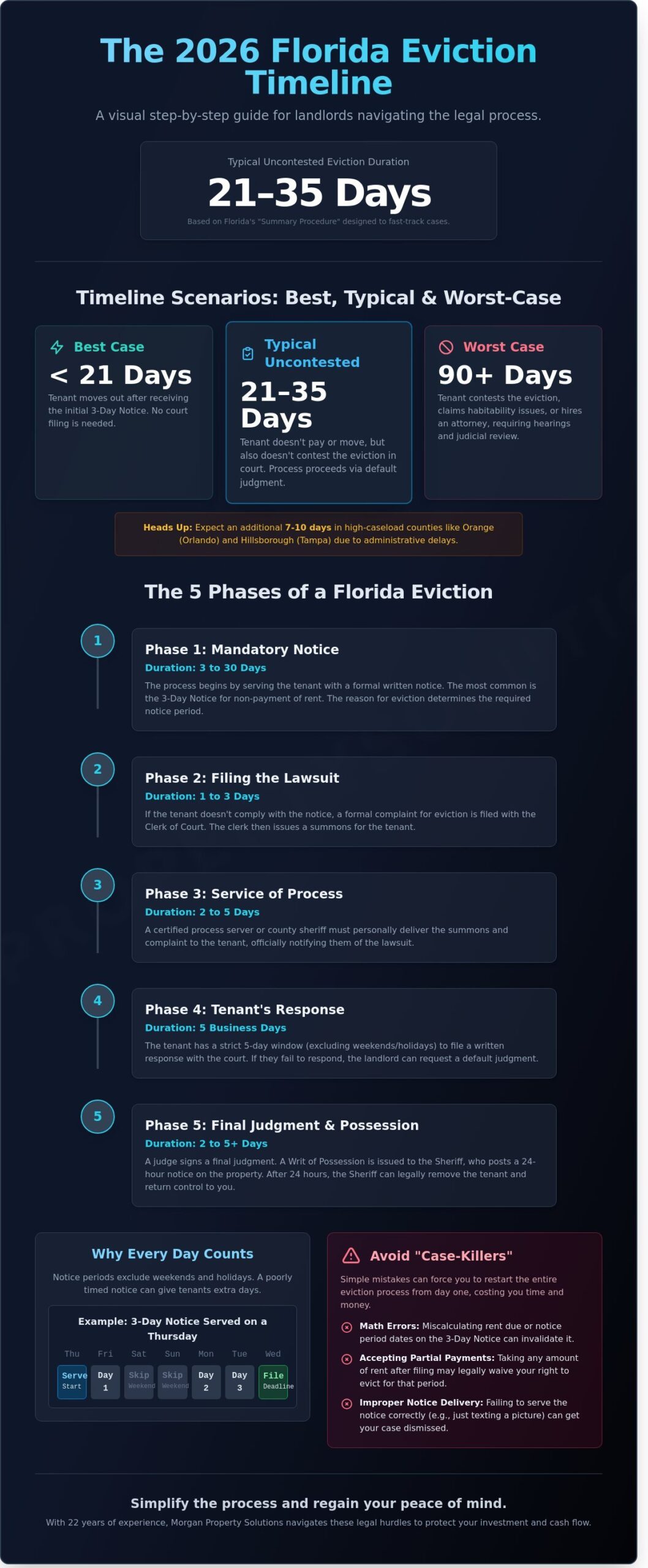
If you are wondering how long does it take to evict a tenant in florida, the short answer is typically 21 to 35 days for an uncontested case. While that sounds fast on paper, we understand the immense pressure you’re under as a landlord. When the rent stops arriving, every single day feels like a month. Your mortgage, taxes, and insurance don’t stop just because your tenant did. This financial strain is exactly why Florida law includes specific protections for property owners.
Florida relies on a legal framework known as “Summary Procedure,” found in Florida Statute 51.011. This law is designed to fast-track the legal process of eviction by shortening the timeframes for defendants to respond. In a standard civil lawsuit, a person might have 20 days to answer a complaint. In an eviction, the tenant only has five days. This accelerated system is meant to prevent landlords from suffering indefinite financial losses.
However, the reality in 2026 is slightly more complex than the statutes suggest. If your property is in a high-growth area like Orange County or Hillsborough County, you need to prepare for administrative delays. Current court data shows that heavy caseloads in Orlando and Tampa are adding roughly 7 to 10 days to the standard timeline. These delays often happen at the clerk’s office during the processing of the initial summons or the final judgment. Understanding these local bottlenecks helps you set realistic expectations for your cash flow recovery.
The “Best-Case” vs. “Worst-Case” Scenarios
In a best-case scenario, the tenant realizes they can’t pay and moves out immediately after receiving the initial 3-day notice. If they don’t move but also fail to file a response with the court, you can move for a clerk’s default. This path is the fastest way to regain control of your property. You avoid the need for a hearing and move straight to the final steps. The Writ of Possession is the final legal finish line that authorizes the sheriff to physically remove the person and their belongings from the premises.
A contested case is the worst-case scenario and can easily stretch the timeline to 90 days or more. This happens if the tenant hires an attorney or files a motion to dismiss based on “habitability” claims. They might argue that a broken AC unit or a leaky faucet justifies their lack of payment. Even if these claims are eventually proven false, the legal maneuvering requires a judge’s time and a formal hearing, which stops the clock on a quick resolution. When a tenant brings in legal help, it’s often wise for landlords to secure their own representation from a business law specialist like Matthew Fornaro, P.A. to ensure their rights are protected.
Why Every Day Counts in Central Florida
Timing is everything when you are calculating how long does it take to evict a tenant in florida. You have to account for weekends and legal holidays because they don’t count toward the tenant’s response windows. For example, if you serve a 3-day notice on a Thursday, Friday is day one, but Saturday and Sunday are skipped. Monday becomes day two, and Tuesday is day three. If you aren’t careful with your calendar, a poorly timed notice can accidentally give a tenant two extra days of free rent.
Local court efficiency varies significantly by district. A case filed in downtown Orlando might move at a different pace than one in a smaller satellite courthouse. At Morgan Property Solutions Inc., we’ve spent over 20 years managing these local variables for our clients. We know which clerks process paperwork fastest and how to avoid common filing errors that lead to costly restarts. Our goal is to make this stressful transition as simple and predictable as possible so you can get back to being a profitable investor.
Step-by-Step: The 5 Phases of a Florida Eviction
When you’re dealing with a difficult rental situation, the first question usually is, how long does it take to evict a tenant in florida? We’ve helped hundreds of owners navigate this path over the last 20 years, and while every case has its own quirks, the process follows a very specific legal rhythm. Florida law is designed to move these cases faster than standard civil lawsuits, but you still have to follow the rules perfectly to avoid resets. If you miss a single deadline or miscalculate a date, you might have to start the whole thing over from scratch.
- Phase 1: The Mandatory Notice Period. This lasts anywhere from 3 to 30 days depending on why you’re ending the lease.
- Phase 2: Filing the Lawsuit. You’ll file your complaint with the Clerk of Court, which usually takes 1 to 3 days for the clerk to process and issue the summons.
- Phase 3: Service of Process. A process server or sheriff must physically get the summons to the tenant, which typically takes 2 to 5 days.
- Phase 4: The Tenant’s 5-Day Response Window. This is a strict deadline set by Florida statutes for the tenant to file a written defense.
- Phase 5: Final Judgment and the Sheriff’s 24-hour Notice. This is the final stretch where the judge signs the order and the sheriff clears the property.
Phase 5 concludes the journey with the Final Judgment and the Writ of Possession. Once the judge signs the judgment, the clerk issues a Writ to the Sheriff. The Sheriff then visits the property to post a 24-hour notice. This is the final warning for the tenant to move out. If they’re still there after those 24 hours, the Sheriff returns to physically remove them and put you back in control of your property. It’s a structured process that ensures everything is done by the book.
The Critical 3-Day Notice for Non-Payment
The 3-day notice is the most common starting point for non-payment of rent. Calculating these 3 days is where many landlords make a mistake that costs them weeks of time. You don’t count the day you serve the notice. You also skip Saturdays, Sundays, and any legal holidays. For example, if you hand a notice to a tenant on a Thursday, day one is Friday, day two is Monday, and day three is Tuesday. You can’t file the lawsuit until Wednesday. We always suggest delivering the notice in person or posting it on the door. If you choose to mail it, Florida law requires you to add 5 additional days for mailing, which significantly slows down how long does it take to evict a tenant in florida. To help you get these details right, you can find more landlord resources on our website.
The Summoning and Response Phase
Once the clerk issues the summons, a process server takes over. If a tenant tries to hide or “duck” service, the server can use substitute service by posting the papers on the property after two failed attempts. Once served, the clock for the 5-day response window begins. Under Landlord/Tenant Law in Florida, a tenant who wants to contest a non-payment eviction must deposit the disputed rent into the court registry. If they don’t put the money in the registry or if they fail to file a written response within those 5 business days, the landlord can move for a “Default Judgment.” This allows the judge to rule in your favor without even holding a hearing, which is a major relief for owners who just want to move on.
Evictions are stressful, but they don’t have to be overwhelming when you have a plan. If you’re feeling stuck, we can help you manage your rental property so you don’t have to handle these legal headaches alone.
Common Roadblocks: What Slows Down an Eviction?
When you’re trying to figure out how long does it take to evict a tenant in florida, you’re likely looking for a clear, 3 to 4 week timeline. While the law provides a structured path, the reality is that small mistakes often derail the process. The most frequent reason a judge tosses an eviction case is simple math. If your 3-day notice claims the tenant owes $1,500.50 but your ledger shows $1,500.00, that 50-cent discrepancy can end the case immediately. You’ll have to start over from the very beginning, which adds at least 10 to 15 days to your wait.
Another common trap is accepting partial rent. It’s tempting to take $200 from a tenant who owes $2,000 just to get something in hand. However, under the Florida Residential Landlord Tenant Act, accepting any amount of money usually waives your right to continue the current eviction. By taking that partial payment, you’ve legally “reset” the clock, and you’ll likely need to issue a brand new notice before you can move forward again.
Improper service of the summons also creates massive delays. Florida Rules of Civil Procedure are strict about how a tenant must be notified of the lawsuit. If a process server fails to follow these rules, or if the paperwork isn’t posted correctly on the property, the tenant can file a motion to quash service. This maneuver typically adds 14 to 21 days to the timeline while the court schedules a hearing to verify the service was handled correctly. We also see tenants use stalling tactics like filing for Chapter 7 or Chapter 13 bankruptcy. This triggers an “automatic stay,” which freezes all state court proceedings and can stop an eviction in its tracks for 30 to 60 days unless your attorney can get the stay lifted.
The Danger of “Self-Help” Evictions
It’s frustrating when a tenant won’t leave, but you can’t take matters into your own hands. Changing the locks, removing the front door, or cutting off the electricity will cost you thousands in penalties. Florida law is very clear: if you use these “self-help” methods, you could be liable for actual damages or three months’ rent, whichever is greater. A DIY mistake like this can turn a standard 4-week process into a 4-month nightmare involving expensive litigation. Florida law heavily penalizes landlords who bypass the court.
If you’re facing a situation that could lead to court, it’s wise to explore Business Litigation Services to ensure you’re properly represented.
Handling Contested Hearings
If a tenant files a response claiming the unit is uninhabitable or that you’re retaliating against them, the judge may order a mediation session or a “Rent Determination” hearing. This is where the “Court Registry” becomes your best friend. To maintain their defense, the tenant must deposit the disputed rent money into the court’s account. If they fail to pay into the registry by the date set by the judge, you can often move for a default judgment immediately. Having a professional property manager prevents these errors because we ensure every notice is mathematically perfect and every filing meets the court’s exact standards from day one.
Managing the “Limbo”: What to Do While the Clock Ticks
Waiting for the legal system to move is often the hardest part of being a landlord. When you are wondering how long does it take to evict a tenant in florida, it’s easy to feel like your hands are tied. Knowing the answer helps you plan, but you still have a physical asset to protect. This “limbo” period is a critical window for protecting your investment. You can’t just sit back and wait for the Sheriff to show up; you need to be proactive to prevent further financial loss.
While protecting your physical asset is crucial, it’s equally important to manage the personal stress that comes with the process. The financial strain can impact your health and focus. Many professionals in high-stress situations turn to wellness supplements to maintain their energy and resilience. For those looking for high-quality, physician-formulated options, veteran-owned brands like MNM ProLabs offer products designed to support peak performance.
The stress of housing instability can also have a profound impact on the families involved, particularly children. For landlords concerned about the well-being of children during this difficult transition, it can be helpful to know what resources are available. You can explore Individual Therapy for Children to understand the types of support that exist for young people navigating difficult life events.
Your first priority is the property’s curb appeal and general maintenance. If a tenant stops paying rent, they often stop caring for the lawn or taking out the trash. An overgrown yard is a beacon for code enforcement or HOA inspectors. In many Florida neighborhoods, HOA fines can reach $100 per day for simple violations. Don’t let these costs pile up. Keep the grass mowed and the exterior clean to avoid unnecessary fees and to prevent the property from looking abandoned, which can attract squatters or vandals.
This is also the time to assemble your “Turnover Team.” You want your cleaners, painters, and locksmiths ready to go the moment the Writ of Possession is executed. If you wait until the tenant is out to start making calls, you might lose another 14 days of rent while waiting for a contractor’s schedule to open up. Aim to have your team inside the unit within 24 hours of the lockout. Documenting the property’s condition is equally important. Take at least 50 photos of the exterior and any common areas you can legally access. These images serve as vital evidence if the tenant causes intentional damage during the final days of the process.
Inspections and Safety
You must respect the tenant’s right to privacy even during an active eviction. Under Florida Statute 83.53, you’re required to give 24 hours of notice for routine inspections or repairs. The only exception is a true emergency, such as a flood or fire. If the tenant eventually leaves personal belongings behind, don’t just throw them on the curb. Florida Statute 715.104 dictates a specific notification process for “abandoned” property. You can avoid these complicated legal traps in the future by using our screening criteria to ensure you’re placing high-quality tenants.
Communication Best Practices
Keep every interaction professional and strictly in writing. Texts and emails are your best friends because they provide a timestamped record for the court. While you’re calculating how long does it take to evict a tenant in florida, remember that a peaceful exit is always the goal. Avoid “self-help” evictions at all costs. Changing the locks or shutting off the water will lead to heavy penalties that could cost you three times the monthly rent. If the timeline is dragging, you might consider a “Cash for Keys” offer. Giving a tenant $750 to leave peacefully by a certain date is often much cheaper than the $3,000 you might spend on legal fees and lost time. It’s a business decision, not a personal one, so stay calm and focused on the fastest path to a vacant unit.
Simplifying the Process: How a Partner Makes Eviction Easier
Managing a rental property shouldn’t feel like a second full-time job. When a tenant stops paying, your stress levels usually skyrocket. That’s where a professional manager steps in to act as your buffer. You won’t have to take those late-night phone calls or listen to excuses that don’t pay the mortgage. We handle the tough conversations and the confrontational moments so you don’t have to. It’s about keeping the relationship strictly professional and business-oriented.
Our team uses automated systems that trigger the moment rent is late. If a payment isn’t in by the end of the grace period, usually the 4th of the month, the system flags it immediately. We don’t spend days wondering if the check is in the mail. We act. This consistency prevents small delays from turning into months of lost income. By removing the emotional “wait and see” approach, we keep your cash flow as steady as possible.
Speed is everything in this business. We’ve spent over 20 years building tight relationships with local process servers and specialized eviction attorneys. These pros know exactly what the Florida courts require for a flawless filing. Because we work with them daily, they prioritize our cases. This often shaves 5 to 10 days off the standard legal timeline. If you’re wondering how long does it take to evict a tenant in florida, having a streamlined team can be the difference between a four-week resolution and a three-month nightmare. We’ve seen how a single paperwork error can reset the entire clock, and we’re here to make sure that doesn’t happen to you.
The ultimate goal is simple: we want to handle the legal headaches so you can enjoy your life. Making Real Estate Simple isn’t just a slogan for us; it’s how we operate every day. We take the weight of the Florida statutes off your shoulders and put them on ours.
Prevention is Better Than Eviction
The best way to handle an eviction is to avoid one entirely. We’ve found that thorough vetting stops 99% of potential issues before they ever start. Our rigorous pet screening and background checks look deep into a candidate’s history to find red flags others might miss. We also offer a “Deposit-Free” option for tenants. This attracts a wider pool of high-quality, qualified tenants who prefer to keep their cash liquid while still providing you with full protection. Central Florida landlords trust Morgan Property Solutions because we focus on finding the right fit from day one.
Your Next Steps
Don’t wait until you’re three months behind on your mortgage to take action. The legal clock doesn’t start until the first notice is served. We help you transition from being a stressed-out landlord to a true passive investor. You can stop worrying about court dates and sheriff’s visits. We’ll manage the transition, clear out the property, and get it back on the market quickly. You deserve to have your investment work for you, not the other way around. We’re here to help you get your property back and restore your peace of mind.
Protect Your Investment and Move Forward
Navigating the Florida legal system doesn’t have to feel like a constant uphill battle. While the typical 2026 timeline for a standard eviction ranges from 28 to 55 days, a single mistake in a 3 day notice can easily add weeks to the process. You now have the roadmap for the five phases of a legal filing and understand why staying organized during the court’s “limbo” period is so important for your cash flow. Knowing how long does it take to evict a tenant in florida is the first step toward regaining control of your rental property.
We’ve spent more than 20 years managing properties across Central Florida, and our A+ BBB rating reflects our commitment to making life easier for owners. Our team uses a proven tenant screening process to find reliable renters and keep these legal hurdles from happening in the first place. You deserve a rental experience that’s actually profitable and free of late-night worries. Let us handle the stress; explore our Orlando Property Management services today. We’re here to support your success every step of the way.
Frequently Asked Questions
Can I evict a tenant in Florida without a written lease?
Yes, you can certainly evict a tenant without a written lease in Florida. Since oral agreements are legally recognized as “at-will” tenancies under Florida Statute 83.46, you still have the right to regain your property. You’ll just need to provide a 15-day notice for month-to-month tenancies or a 7-day notice for week-to-week ones. Our team has handled over 500 cases like this, so we’re here to help you navigate the process.
How much does it cost to evict someone in Florida in 2026?
You should budget between $500 and $700 for basic court and service fees in 2026. This includes the $185 filing fee for most Florida counties and the $40 fee for the Sheriff to serve the summons. If you decide to hire a professional service to handle the paperwork, total costs often land between $1,200 and $2,500. We focus on keeping these costs low by streamlining the process to save you time and money.
What happens if the tenant pays rent after I give them a 3-day notice?
If your tenant pays the full amount within the three-day window, you’re legally required to accept it and stop the eviction process. However, if they only offer a partial payment, you don’t have to take it. Accepting even $1.00 after the notice period expires can complicate your case. It’s usually best to consult with us before taking any partial funds so you don’t accidentally restart your timeline and lose precious weeks.
Does the 3-day notice include weekends in Florida?
No, the three-day notice period specifically excludes weekends and legal holidays. When you’re calculating how long does it take to evict a tenant in florida, remember that the clock only ticks on business days. For example, if you post the notice on a Thursday, the tenant has until the following Tuesday at midnight to pay. This rule ensures everyone has a fair chance to visit their bank during normal operating hours without any confusion.
How does the “Writ of Possession” work with the Sheriff?
The Writ of Possession is the final legal step where the Clerk of Court sends an order to the Sheriff. Once the Sheriff receives the writ and their $90 fee, they’ll post a 24-hour notice on the tenant’s door. After those 24 hours pass, the Sheriff returns to physically remove the tenant and their belongings. We’ve seen this final stage take as little as 48 hours depending on the local Sheriff’s current workload.
Can a tenant stop an eviction by paying all the back rent?
A tenant can only stop the eviction by paying in full during the initial three-day notice period. Once you file the lawsuit in court, they no longer have a legal right to stay just by paying the back rent. At that point, it’s entirely up to you whether you want to settle or continue with the removal. Most of our clients prefer to move forward to ensure they find a more reliable tenant for their property.
What is the fastest way to get a tenant out of my house in Orlando?
The fastest way to regain your property in Orlando is often through a “cash for keys” agreement. This involves offering the tenant a specific sum, like $500, to move out peacefully by a set date. If they refuse, the legal route is your next step. Understanding how long does it take to evict a tenant in florida helps you see that professional management usually cuts the timeline down to the minimum 25 to 35 days.

Article by
Oliver Overton-Morgan
Oliver Overton-Morgan is a full-time Real Estate Broker since 2003, with years of experience helping thousands of people purchase and sell real estate throughout Central Florida. He holds a Graduate Realtor Institute designation, LCAM, and has held licenses in good standing as a Florida Mortgage Broker and a Notary Public. Oliver immigrated to central Florida in 2001, and within 5 years Oliver built a successful Real Estate brokerage in central Florida, where he recruited over 75 Sales Associates with 25+ million in sales production.