
On a Tuesday morning in July, you walk into your rental unit only to find an empty fridge, a pile of trash, and a set of keys left on the kitchen counter. It’s a sinking feeling that immediately brings up concerns about lost income and legal liability. You probably feel that the law should be on your side, yet you’re likely worried that one wrong move could lead to a costly retaliatory lawsuit. Knowing exactly what to do when a tenant abandons property in Florida is the only way to protect your investment and your peace of mind.
When it comes to the physical task of clearing out unwanted items and trash, renting a roll-off dumpster can make the process much more efficient. To see how this can simplify your property cleanout, you can learn more.
We understand that managing these “midnight moves” is one of the most stressful parts of being a landlord. This 2026 guide explains the exact legal steps to reclaim your space and move forward without the headache. We’ll show you how to handle the physical mess and the legal paperwork correctly so you can stop the financial leak. You’ll discover the specific 15-day notice requirements, the right way to store or dispose of personal belongings, and our proven strategy to find a high-quality replacement tenant in under 30 days.
Key Takeaways
- Master the “15-day rule” and learn how to legally confirm abandonment under Florida Statute 83.595 to protect your rights as a property owner.
- Navigate your options for retaking possession with a clear guide on what to do when a tenant abandons property florida without the stress of a lawsuit.
- Protect yourself from liability by following the exact legal timeline for notifying tenants and disposing of abandoned personal belongings.
- Follow a professional roadmap for physical recovery, including when to change locks and how to prepare your unit for a new, reliable tenant.
- Strengthen your future rental agreements with specific “absence” clauses designed to simplify your management and minimize vacancy risks.
Is Your Rental Actually Abandoned? Understanding Florida Statute 83.595
Walking into a rental property only to find it empty and quiet is a scenario that causes immediate stress for any property owner. Your first instinct might be to change the locks or start clearing out the closets, but acting on impulse is a dangerous legal move. Knowing what to do when a tenant abandons property florida starts with a firm grasp of the law to avoid costly litigation. Florida Statute 83.595 governs these moments, and it doesn’t leave room for “gut feelings” or assumptions. At Morgan Property Solutions, we’ve spent over 20 years guiding owners through these exact hurdles, and we know that following the letter of the law is the only way to protect your investment.
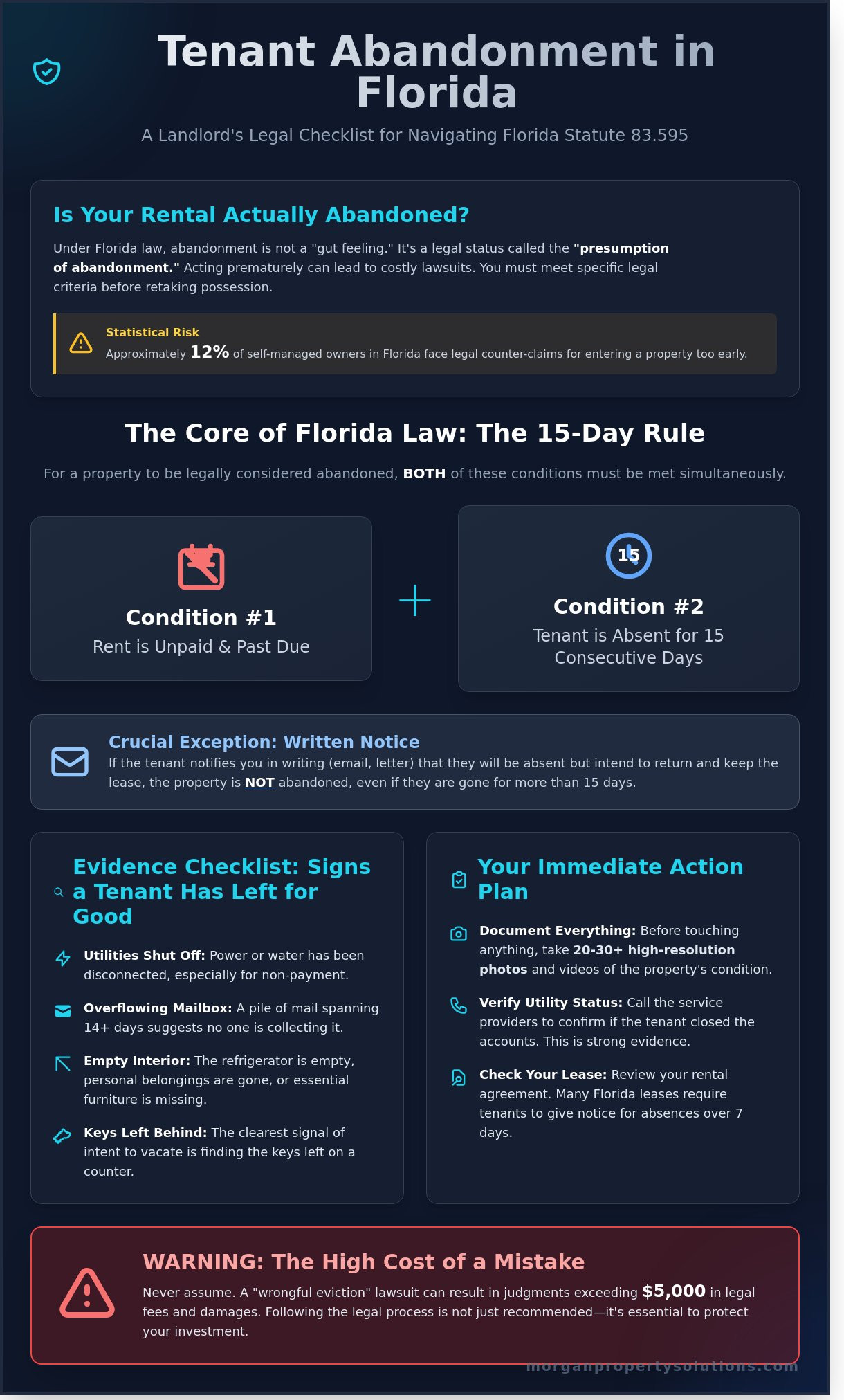
The state provides a specific framework called the “presumption of abandonment.” This isn’t just a suggestion; it’s a legal shield for landlords. Before you take possession of the unit, you must prove the tenant has actually vacated without the intent to return. Relying on a neighbor’s tip or a quiet house isn’t enough. In fact, roughly 12% of self-managed owners in Florida face legal counter-claims because they entered a property too early. A solid understanding of landlord-tenant law ensures you don’t become part of that statistic.
The 15-Day Presumption Rule Explained
The core of Florida’s abandonment law is the 15-day rule. For a property to be legally considered abandoned, two conditions must be met simultaneously. First, the rent must be unpaid and past the due date. Second, the tenant must be absent from the premises for a period of 15 consecutive days. If the tenant is gone for 20 days but paid their rent on time, they haven’t abandoned the home; they’re simply away. Conversely, if the rent is late but the tenant is still seen entering the unit every few days, the 15-day clock hasn’t even started.
Written notice changes everything. If a tenant sends you an email or letter stating they’ll be gone for a month but intend to keep the lease, the presumption of abandonment is void. You can’t reclaim the unit just because they aren’t physically there. In 2026, Florida law defines legal abandonment as the tenant’s 15-day continuous absence from a rental unit where rent is unpaid and no prior written notice of extended absence was provided to the landlord.
Signs That a Tenant Has Truly Left for Good
When you’re trying to figure out what to do when a tenant abandons property florida, you need to look for physical evidence to support the 15-day rule. Start by checking the utilities. If the electricity or water has been shut off due to non-payment, it’s a strong indicator of intent to vacate. Check the mailbox; an overflowing pile of mail from the last 14 days suggests nobody is home. You should also look for “lifestyle” signs like an empty refrigerator or the absence of basic furniture. If you see keys left on the kitchen counter, that’s often the clearest signal of all.
- Document everything: Take at least 20 to 30 high-resolution photos of the property’s condition before moving any items.
- Utility status: Call the service providers to see if the account was closed by the tenant.
- The 7-day notice: Most Florida leases require tenants to notify the landlord if they’ll be gone for more than 7 days; check your specific lease for this clause.
Mistakes here are expensive. A “wrongful eviction” lawsuit can result in judgments exceeding $5,000 in legal fees and damages. Never assume a tenant is gone just because they stopped answering texts. Always wait for that 15-day window to close and ensure the rent is truly delinquent before you step through the door with a moving crew. This methodical approach is what keeps your business profitable and your reputation clean.
The 4 Legal Remedies for Florida Landlords Dealing with Abandonment
Discovering an empty rental unit without prior notice is a stressful experience for any property owner. We’ve guided hundreds of landlords through this exact scenario over our 20 years in the Florida market, and the key is to remain calm and follow the law. Knowing what to do when a tenant abandons property florida starts with understanding your four distinct legal paths under Florida Statute 83.595. These remedies provide a framework to protect your investment while ensuring you don’t overstep your bounds as a housing provider.
The first remedy is to treat the lease as terminated and retake possession for your own account. This is the most common choice for owners who want a clean break. When you choose this path, you end the tenant’s future obligation to pay rent, but you gain the freedom to clean, repair, and market the home to a new, qualified resident immediately. It’s often the fastest way to get your cash flow back on track.
The second option is to retake possession for the account of the tenant. In this scenario, you aren’t ending the lease. Instead, you’re acting as an agent for the tenant to mitigate their damages. You’ll attempt to re-rent the property, and the original tenant remains legally responsible for the rent until a new person moves in. If the new rent is lower than the old rate, the original tenant is liable for the difference. This requires careful accounting and a good faith effort to find a replacement.
Third, you have the right to stand by and do nothing. You can leave the unit empty and sue the tenant for rent installments as they become due. This strategy is based on the “Hefley v. Holmquist” ruling from 1987, which confirmed that Florida landlords aren’t always required to mitigate damages if they choose this specific remedy. However, this is a high-risk move that usually only makes sense if the tenant has clear, reachable assets.
Finally, you can charge liquidated damages or an early termination fee if your lease agreement specifically allows it. This remedy must be agreed upon in a separate addendum at the start of the tenancy. Typically, this fee is capped at an amount equal to two months’ rent. It provides a predictable financial settlement without the need for a lengthy court battle over unpaid future rent.
Choosing the Right Path for Your ROI
Maximizing your return on investment requires balancing the speed of a new lease against the potential for recovering debt. While standing by might seem like a way to hold a tenant accountable, most Florida courts in 2026 still look more favorably on owners who actively try to fill their vacancies. Before you move a new person in, you must address any personal belongings left behind. Properly following Florida Statute 715.104 is vital for documenting and disposing of “stuff” without facing a lawsuit later. If you’re concerned about your current lease language, you can find proven templates in our landlord resources.
Why “Standing By” Might (Or Might Not) Work for You
In the 2026 rental market, letting a property sit empty is rarely the best financial move. While the *Hefley* strategy is legally sound, an unoccupied home is a magnet for maintenance issues like mold or pest infestations. This path is generally reserved for situations where a tenant is highly solvent and you have a clear paper trail of their departure. For 90% of our clients, we recommend a more proactive approach. Deciding what to do when a tenant abandons property florida is much simpler when you have a trusted partner to handle the transition and get your property back to earning income quickly. We’re here to help you weigh these options so you can make the most profitable choice for your specific situation.
What to Do with the Stuff: Reclaiming Personal Property Legally
Finding a living room full of furniture and boxes after a tenant disappears is a major headache. At Morgan Property Solutions, we’ve guided landlords through these exact scenarios for over 20 years, making the process simple and stress-free. Florida law protects you, but you must follow the steps in Florida Statute 715 to the letter. If you’re wondering what to do when a tenant abandons property florida, the first step is securing the items and notifying the former resident immediately.
The clock starts once you serve the “Notice of Right to Reclaim Abandoned Property.” You have two primary delivery options. Hand-delivering the notice gives the tenant 10 days to respond. If you send it via first-class mail, the law extends that window to 15 days. During this time, you must store the items safely. You’re allowed to leave them in the rental unit or move them to a secure storage facility. If you choose to move them, you’re entitled to charge the tenant for the reasonable costs of storage and labor before they can take their items back.
Before you touch a single box, ensure you’ve legally established vacancy. Understanding Tenant Abandonment is vital because Florida Statute 83.59(3)(c) dictates when you can officially take over the space. Once you have possession, use the $500 rule as your guide. If you reasonably believe the total resale value of all items is less than $500, you can dispose of them or keep them for yourself once the notice period ends. If the value exceeds $500, Florida law requires a public sale to settle the matter.
Drafting the Reclaim Notice
Your notice must be precise to satisfy Florida Statute 715. It should describe the property in detail, state where it’s being kept, and list the specific deadline for pickup. If you don’t have a forwarding address, mail it to their last known address, which is usually the rental unit itself. You must include a clear statement about costs: “You will be required to pay the reasonable costs of storage for all abandoned property before the items are released to your possession.” This protects your bottom line while you hold the items for those 10 to 15 days.
Handling the Disposal or Auction
For high-value items over $500, the process is more formal. You must publish a notice of public sale in a local newspaper once a week for two consecutive weeks. The sale must happen at least 15 days after the first notice appeared. You can use the sale proceeds to cover your storage, advertising, and sale costs. Any remaining money isn’t yours to keep; it must be paid to the county treasury within 30 days of the sale. To prevent “theft” claims, take photos of every item and keep a detailed log of what was trashed versus what was sold. This documentation is your best defense if a tenant resurfaces months later demanding their belongings.
Dealing with abandoned property doesn’t have to be a legal minefield. By following these 2026 guidelines and keeping detailed records, you can clear your unit and get it back on the market quickly. We’re here to help you navigate these rules so you can focus on finding your next great tenant.
Reclaiming Your Unit: Physical Recovery and Security
Once you’ve confirmed legal possession, your focus shifts to securing the asset. This is a critical moment in the process of what to do when a tenant abandons property florida. You’ve likely waited through a 15 day notice period or a formal eviction process. Now, every hour the unit sits empty costs you money. Your first priority is to ensure the home is safe and the previous tenant can’t return to cause issues.
Don’t jump the gun by changing locks before you’re legally authorized. Doing so earlier can result in a “constructive eviction” lawsuit, which often carries heavy financial penalties. Once the keys are legally back in your hand, replace every entry point lock immediately. This isn’t just about the front door; it’s about total perimeter control. You want to eliminate any risk of unauthorized re-entry by the former tenant or their associates.
Security and Re-Keying Best Practices
Reusing old keys is a major liability risk. You don’t know who has a spare copy. In Central Florida, check more than just the front door. Ensure sliding glass doors have working locks and reset all garage door keypad codes. If this turnover feels overwhelming, partnering with Orlando property management experts ensures your security is handled with professional precision. We help you transition the property quickly so you can focus on finding a better fit for your investment.
After the locks are secure, perform a deep clean and damage assessment. Walk through the unit with a high resolution camera. Document every scuff, stain, or broken fixture you find. This documentation serves as your primary defense if the tenant disputes your claims later. Florida landlords often face challenges when they lack clear “before and after” evidence. If the property was built before 1978, remember to follow lead-based paint protocols during any necessary repairs.
The Security Deposit Paperwork Trail
Precision is your best defense. Under Florida Statute 83.49, you have 15 days to return a deposit if no claim is made. However, you have 30 days to send the “Notice of Intention to Impose Claim on Security Deposit” via certified mail if damages exist. Distinguish clearly between unpaid rent and physical damage in your itemized list. Detailed photo evidence from a 12 megapixel camera or better provides the proof needed if the case reaches a small claims court judge. Don’t forget that if you miss the 30 day window, you forfeit the right to keep any portion of the deposit for damages.
While you’re processing the paperwork, start the “make-ready” process. Your goal is to keep the vacancy gap under 21 days to protect your ROI. Once the deep clean is finished and repairs are complete, get the property back on the market immediately. Use professional photography to highlight the unit’s best features. By 2026, digital tours and high-quality listings are the standard for attracting top-tier renters in the Florida market.
Managing an abandoned property is a complex journey, but you don’t have to do it alone. If you’re feeling the weight of vacancy costs, reach out to our expert team to streamline your property recovery today.
How to Prevent Tenant Abandonment in the Future
Preventing abandonment starts long before a tenant packs a bag in the middle of the night. While it’s vital to understand what to do when a tenant abandons property florida, your primary goal should be to minimize risk through proactive systems. Every day a unit sits empty after an unexpected departure costs the average Central Florida landlord roughly $50 to $110 in lost rent and utilities. By implementing stricter protocols, you protect your cash flow and your peace of mind.
Your lease agreement serves as your first line of defense. Florida law allows you to include specific clauses regarding extended absences. You should require tenants to notify you if they’ll be away for more than 7 consecutive days. When a tenant fails to provide this notice and rent is unpaid, Florida Statute 83.595 provides a clearer path to regaining possession. Clear definitions of abandonment in your contract help remove the guesswork when you find an empty unit and a set of keys on the kitchen counter.
Building a professional relationship with your tenants encourages transparency. If a tenant loses their job or faces a family emergency, they’re more likely to tell you if you’ve been a responsive and respectful landlord. This human connection can turn a midnight move into a negotiated lease termination, saving you thousands in legal fees and property damage. Communication is the bridge that prevents a simple financial struggle from becoming a legal nightmare.
This kind of proactive planning extends beyond just tenant management. For many landlords, property investment is a key part of securing their family’s financial future. To explore other ways to protect your legacy, you can find out more about options like life insurance and final expense planning.
Better Screening, Fewer Headaches
Reliable tenants leave clues in their history. When reviewing a credit report, look for a “Debt-to-Income” ratio that exceeds 45% or a history of utility collections. These are red flags for potential flight risks. Using established professional screening criteria ensures you treat every applicant fairly while filtering for those with a proven track record of stability. In our experience, tenants with verified pet profiles also tend to stay 21% longer, as quality pet-friendly housing is harder to find, creating a natural incentive for them to communicate rather than flee.
- Credit History: Prioritize applicants with a 620+ score and no recent collections from previous landlords.
- Eviction Records: A single eviction filing in the last 7 years increases the risk of future defaults by nearly 300%.
- Employment Verification: Confirm a monthly income of at least 3 times the rent to ensure the tenant has enough financial “breathing room” for unexpected expenses.
Making Real Estate Simple with Morgan Property Solutions
Managing a rental property shouldn’t feel like a second full-time job. We specialize in taking the “messy” parts of landlording off your plate. From rigorous background checks to handling the legal complexities of what to do when a tenant abandons property florida, our team provides the expertise you need. We’ve spent over 20 years refining our process to ensure your investment remains profitable and stress-free. Our A+ rating with the Better Business Bureau reflects our commitment to excellence in the Central Florida market.
We view ourselves as your trusted partner. Our goal is to eliminate vacancies and reduce the stress that comes with difficult tenant situations. You don’t have to handle these challenges alone. We’re here to help you every step of the way, providing the guidance and support necessary to make real estate simple. Let us take care of the details so you can enjoy the rewards of being a property owner without the late-night phone calls or legal headaches.
Take Control of Your Rental Recovery
Success in real estate requires a proactive approach to legal challenges. By following Florida Statute 83.595 and the specific rules for handling abandoned personal items, you safeguard your business from unnecessary liability. You now have the tools to identify true abandonment and execute the four legal remedies effectively. Understanding what to do when a tenant abandons property florida is essential for minimizing vacancy time and protecting your bottom line.
Managing a property doesn’t need to be overwhelming. At Morgan Property Solutions, we bring 20+ years of Central Florida expertise and a proven “simple” management process to every door we manage. Our A+ BBB rating reflects our commitment to being a dependable partner for local landlords. We’re here to help you navigate these complex situations with confidence and ease. Our team ensures your investment remains profitable while you stay compliant with state laws.
Let Morgan Property Solutions take the stress out of your rental management today and start enjoying a more secure investment. We look forward to helping you succeed every step of the way.
Frequently Asked Questions
Can I change the locks if I’m 100% sure the tenant moved out?
No, you cannot change the locks until you have legal possession of the unit. Florida Statute 83.67 strictly prohibits “self-help” evictions, and violating this law can result in you owing the tenant three months of rent as damages. Even if the unit looks empty, you must wait until the 15-day notice period expires or a court grants you possession. Our team helps landlords navigate these rules to keep your investment safe and simple.
What is the “15-day rule” for abandonment in Florida?
The 15-day rule refers to Florida Statute 83.59(3)(c), which creates a legal presumption of abandonment. If the rent is unpaid and your tenant has been physically absent from the premises for at least 15 consecutive days without giving you written notice, the property is legally considered abandoned. Knowing these timelines is essential when learning what to do when a tenant abandons property florida to avoid costly legal mistakes.
Do I have to store an abandoned tenant’s furniture?
Yes, you must store the items and provide a formal notice under Florida Statute 715.104. You’re required to give the tenant 10 days to claim their property if the notice is hand-delivered, or 15 days if it’s sent by mail. If the total value of the belongings is less than $500, you can keep or discard them after the notice period ends. We recommend taking photos of everything to document the condition and value of the items.
How do I legally notify a tenant who left no forwarding address?
You must mail the notice to the tenant’s last known address, which is typically the rental property they just left. Florida law requires you to send this via first-class mail; it’s smart to use a certificate of mailing for your records. This step is a vital part of what to do when a tenant abandons property florida, as it proves you made a good-faith effort to reach them before disposing of any property.
Can I sue an abandoned tenant for the remaining rent on the lease?
Yes, you can sue for the remaining balance, but you have a legal duty to try to re-rent the unit quickly. Florida courts require landlords to make a reasonable effort to find a new tenant at a fair market rate. If you find a new renter in 30 days, the original tenant is only liable for that one month of lost income. Our experts focus on reducing vacancies to protect your bottom line during these transitions.
What happens if the tenant comes back after I’ve started the abandonment process?
If the tenant returns before the 15-day period ends, the legal presumption of abandonment is usually reset. You cannot lock them out at this point and must instead proceed with a standard 3-day notice for non-payment of rent. In 2024, approximately 12 percent of abandonment cases were contested because tenants returned unexpectedly. Keeping clear documentation of their absence is the best way to handle these surprises confidently.
Is a “Notice to Quit” the same as an abandonment notice?
No, these are two different legal documents with different purposes. A Notice to Quit is used to end a lease due to a specific violation, while an abandonment notice informs the tenant that you believe they’ve moved out and intend to reclaim the unit. Understanding these distinctions makes the process stress-free and ensures you don’t accidentally violate Florida’s Landlord-Tenant Act. We’re here to guide you through which form to use for your specific situation.
How much can I charge for storing a tenant’s abandoned property?
You can charge the tenant for the actual, reasonable costs of moving and storing their items. If you store the goods on-site, you might charge a daily rate based on current market storage prices, which often average $1.50 per square foot in Florida. You aren’t required to release the items until the tenant pays these specific storage fees. However, you cannot hold their personal property as collateral for unpaid rent or late fees.

Article by
Oliver Overton-Morgan
Oliver Overton-Morgan is a full-time Real Estate Broker since 2003, with years of experience helping thousands of people purchase and sell real estate throughout Central Florida. He holds a Graduate Realtor Institute designation, LCAM, and has held licenses in good standing as a Florida Mortgage Broker and a Notary Public. Oliver immigrated to central Florida in 2001, and within 5 years Oliver built a successful Real Estate brokerage in central Florida, where he recruited over 75 Sales Associates with 25+ million in sales production.