Last August, a landlord in Orlando discovered that a tiny AC leak had spiraled into a $7,400 mold remediation project because it went unnoticed for only three days. It’s a painful scenario, but with Florida’s humidity often hovering above 85% throughout the summer, these structural threats move quickly. To truly protect your investment, you need a proactive rental property maintenance checklist florida landlords can use to stop small issues from becoming budget-breaking disasters in 2026.
We know that managing property in the Sunshine State can feel like a constant battle against the elements and rising repair costs. It’s stressful to worry about hurricane season or wonder if your HVAC will survive a 98-degree July heatwave. We’re here to help you simplify the process and show you how a consistent plan can reduce your long-term repair spending by as much as 22%. This guide offers a seasonal breakdown of essential tasks, from clearing condensate lines to securing windows, so you can keep your tenants happy and your mind at ease.
Key Takeaways
- Learn how to handle the “Florida Tax”-that tricky mix of humidity and salt air-so your investment stays in great shape year-round.
- Get clear guidance on Florida Statute 83.51 to make sure your property always meets legal standards and keeps your tenants happy.
- Save yourself from expensive repairs by following our rental property maintenance checklist florida to protect your HVAC and roof from the intense sun.
- Discover how to prep for hurricane season and manage seasonal upkeep with a simple calendar that takes the guesswork out of property care.
- Find out how to build a reliable vendor network so you can stop stressing over 2 AM emergency calls and keep your business running smoothly.
Why Your Florida Rental Needs a Different Kind of Maintenance
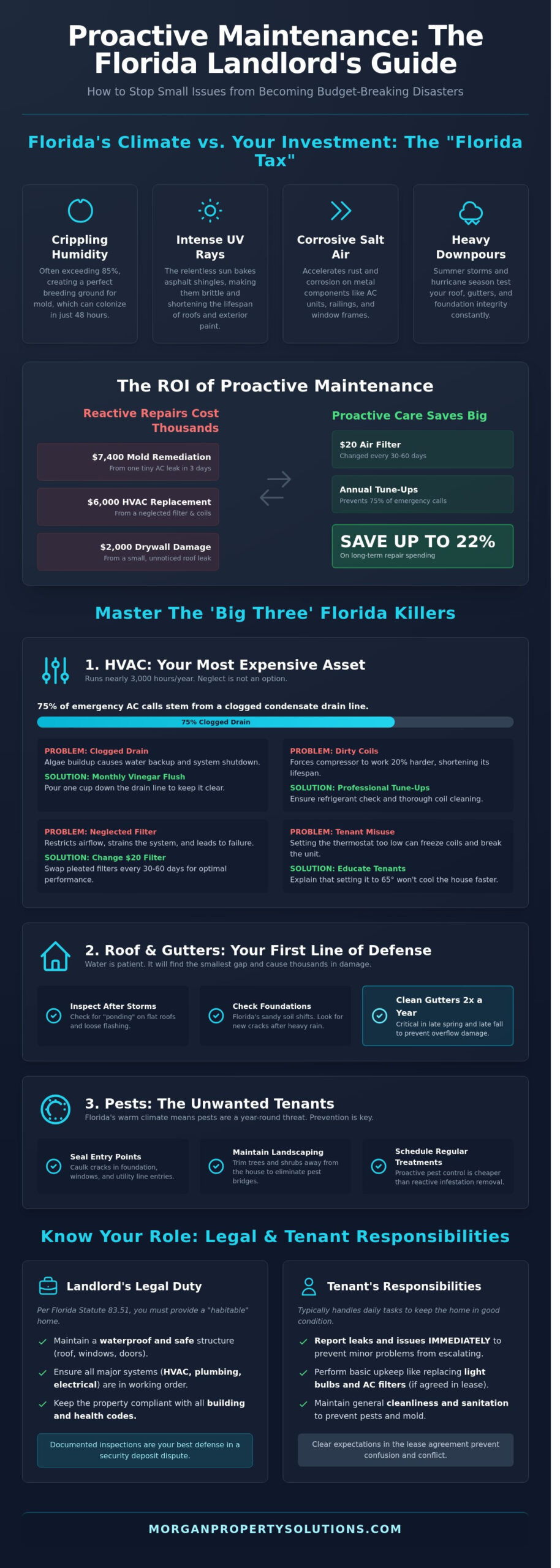
Owning a rental in the Sunshine State is a fantastic investment, but it comes with a unique set of challenges we often call the “Florida Tax.” This isn’t a fee you pay to the government; it’s the physical toll that 90% humidity, intense UV rays, and corrosive salt air take on your property. If you aren’t using a specific rental property maintenance checklist florida landlords trust, you’re likely going to overspend on avoidable repairs. We’ve spent over 20 years helping owners navigate these exact issues, and we know that a proactive approach is the only way to protect your bottom line.
The return on investment for being proactive is massive. Consider your HVAC system. In Central Florida, these units run for nearly 3,000 hours every year to combat the heat. A simple $20 pleated air filter, swapped out every 30 to 60 days, keeps the airflow steady and the coils clean. If you neglect this small task, you’ll eventually face a $6,000 bill for a new compressor or a full system replacement. At Morgan Property Solutions Inc., we believe in making real estate simple by stopping these big expenses before they start. It’s much easier to guide a tenant through basic care than it is to manage a total system failure in the middle of a July heatwave.
Setting clear expectations with your tenants is another vital part of the process. You need to define what’s their job versus your job right from the start. Generally, tenants handle daily tasks like replacing light bulbs, keeping the home clean, and reporting leaks immediately. As the owner, your role is to maintain the structural integrity and major systems of the home. Many states base their local codes on the Uniform Residential Landlord and Tenant Act, and Florida law specifically requires you to keep the unit in a condition that meets all building and health codes. When everyone knows their role, the relationship stays professional and stress-free.
Florida Climate vs. Your Investment
Orlando rentals face a tough environment where humidity is the primary enemy. When moisture levels stay high, mold can begin to colonize drywall and wood trim in as little as 48 hours. This “invisible killer” is far more expensive to remediate than it is to prevent with proper ventilation. You also have to consider the ground beneath the home. Central Florida’s sandy soil shifts differently than the heavy clay found up north. This means you should check your foundation for new cracks after our heavy 3:00 PM summer downpours to ensure water isn’t pooling where it shouldn’t.
The Legal Side of Keeping Things Fixed
Florida Statute 83.51 outlines your legal obligations regarding “habitability.” Essentially, you’re required to provide a home that is waterproof, safe, and structurally sound. Regular inspections aren’t just about maintenance; they’re your best defense during a security deposit dispute. Having a documented trail of the home’s condition protects you if a tenant claims a pre-existing issue. We provide several landlord resources to help you stay compliant with these state-specific rules. Staying on top of these repairs doesn’t just keep you legal; it keeps your tenants happy and encourages them to renew their lease year after year.
The ‘Big Three’ Florida Killers: HVAC, Roof, and Pests
Florida’s climate is relentless. Between the 95 degree summer days and the humidity that sits at 80% for months, your property faces unique stressors. If you want to keep your investment profitable, your rental property maintenance checklist florida must prioritize the three systems that fail most often. These aren’t just minor repairs. They are the “Big Three” that can cost you thousands of dollars if you look the other way for even a few months.
HVAC Maintenance: Your Most Expensive Asset
In Florida, the air conditioner is the lungs of the home. It doesn’t just cool the air; it removes moisture to prevent mold growth. We’ve seen that 75% of emergency AC calls stem from a clogged condensate drain line. This happens when algae builds up in the pipe, causing water to back up and shut the system down. You should have your tenants pour a cup of vinegar down the drain line every 30 days to keep it clear.
A professional tune-up in 2026 should be more than just a quick look. It needs to include a refrigerant level check and a thorough cleaning of the evaporator coils. A dirty coil can force the compressor to work 20% harder, shortening its lifespan by years. You also need to teach tenants that setting the thermostat to 65 degrees on a 98 degree day won’t cool the house faster. It only leads to frozen coils and a broken unit. If you need help managing these vendor schedules, our team can coordinate everything for you.
Roofing and Gutters: Keeping the Water Out
The Florida sun is a silent destroyer. UV rays bake asphalt shingles until they become brittle and lose their granules. After any major afternoon thunderhead, you need to check for “ponding” on flat roofs or loose flashing around chimneys; for a professional assessment, resources like floridarooftopexperts.com can be invaluable. Water is patient; it will find the smallest gap in a seal and cause $2,000 in drywall damage before you even see a spot on the ceiling.
Central Florida is famous for its majestic live oaks, but those trees are a nightmare for gutters. We recommend cleaning gutters at least twice a year, specifically in late spring and late fall. When gutters clog, rain overflows and rots the wood fascia boards. This creates a perfect entry point for squirrels and rats. A simple $150 gutter cleaning can save you from a $4,000 fascia and soffit repair project later.
Pest Control: Termites, Roaches, and Ants
Living in the Sunshine State means accepting that bugs are everywhere. However, there is a big difference between a stray palmetto bug and an infestation. According to Florida Statute 83.51, landlords are generally responsible for pest control in multi-unit dwellings, though lease terms can vary for single-family homes.
We suggest a “perimeter-first” strategy. By applying professional grade barriers around the exterior every 90 days, you stop pests before they cross the threshold. This is much cheaper than doing interior “bombing” after a tenant complains. Most importantly, never skip the termite bond. Subterranean termites cause over $5 billion in property damage annually in the U.S., and Florida is a high-risk zone. A bond is essentially an insurance policy that ensures the home is inspected and treated every year.
While strategies may vary by region, understanding the fundamentals of pest management is crucial for any property owner. For a detailed guide on handling common issues like rodents, you can visit Jones Bros Pest Control, Inc.. Their insights can help you develop a proactive plan, no matter where your property is located.
The 2026 Approach: Smart Sensors
Technology is changing how we handle a rental property maintenance checklist florida. By 2026, smart leak sensors should be in every laundry room and under every AC air handler. These devices cost about $35 and alert your phone the second they detect moisture. Catching a slow leak in a water heater on a Tuesday morning is the difference between a simple part replacement and a $12,000 flood insurance claim on a Saturday night.
The Seasonal Florida Maintenance Calendar
Florida weather doesn’t follow the traditional four seasons you’ll find up north. Instead, we manage a cycle of intense humidity, tropical storms, and brief, dry cold snaps. Keeping a consistent rental property maintenance checklist florida helps you stay ahead of the environment before it causes expensive damage. We’ve seen how the salt air and heat can wear down a home, so staying proactive is the best way to protect your equity and keep your tenants happy.
Spring, from March to May, is your window of opportunity. This is the “calm before the storm” where you should focus on deep cleaning and HVAC prep. Florida’s pollen count usually peaks in April, which can clog up AC filters and coat exterior surfaces. We recommend scheduling a professional AC tune-up during these months. A technician can clear the condensate drain line to prevent the dreaded “float switch” shutoff that happens to 30% of homeowners during the first heatwave of June. It’s also the right time to pressure wash the siding and walkways to prevent mold growth before the daily summer rains begin, and professional services from companies like Warrens Power Washing can ensure it’s done correctly.
Summer brings the heat and the start of the Atlantic hurricane season on June 1st. From June through August, your primary focus is keeping the cooling system running and ensuring the building envelope is tight. Since the 2023 season saw record-breaking temperatures, AC units are working harder than ever. You should remind your tenants to keep the thermostat at a steady 78 degrees to avoid freezing the coils. It’s much easier to handle a small repair in July than an emergency replacement in August when every HVAC company in town has a three-day waitlist.
Hurricane Season Readiness (The June 1st Ritual)
In Orlando and surrounding areas, wind damage is often caused by debris rather than just the gusts themselves. You need to hire a licensed arborist to trim any branches hanging within 10 feet of the roofline or power lines. Check the seals on your impact glass or ensure that your storm shutters move freely in their tracks. We also suggest reviewing the Florida Bar landlord-tenant rights to ensure you’re meeting your legal obligations for providing a safe, habitable dwelling during storm emergencies. Finally, update your tenant emergency contact list so you can reach everyone quickly if a tropical warning is issued.
Fall, spanning September to November, is about recovery and exterior prep. Once the peak of hurricane season passes in October, walk the property to look for loose shingles or damaged soffits. The heavy rains of September can also wash away mulch and expose foundations, so adding a fresh layer of ground cover helps with drainage. This is also the time to check your exterior lighting as the days get shorter, ensuring your tenants feel safe coming home after dark.
The Winter ‘Off-Season’ Check
Winter in Florida is short but requires specific attention to your rental property maintenance checklist florida. December through February is our “dry season,” and many municipalities move to one-day-a-week watering schedules. You’ll need to adjust the irrigation timers to comply with these local restrictions to avoid fines. Don’t forget to test the “heat” side of the heat pump in early December. Most Florida rentals use electric heat strips that haven’t been turned on in ten months; testing them early prevents that burning smell from alarming tenants on the first 40-degree night of the year. Sealing small gaps around doors and windows now will also keep out those rare winter drafts and lower the utility bills.
By following this calendar, you’re not just reacting to problems; you’re managing your investment like a professional. Keeping these tasks organized ensures the home remains in top shape regardless of what the Florida sky throws at it.
The Room-by-Room Interior Maintenance Checklist
Florida rentals face unique challenges that landlords in other states don’t have to worry about as much. The high humidity can turn a tiny drip into a massive mold problem in less than 48 hours. When you’re walking through your unit, a solid rental property maintenance checklist florida owners can rely on starts with a room-by-room inspection. We’ve seen how a few minutes of prevention saves thousands of dollars in the long run. It’s all about catching the small stuff before it becomes a weekend emergency call.
Wet Rooms: Preventing the $10,000 Leak
Kitchens and bathrooms are the most expensive rooms to repair. Start in the kitchen by looking under the sink with a flashlight. If you see warped wood or water stains, you have a slow leak that’s rotting your cabinets. Check the refrigerator door seals too. A loose seal makes the compressor work 30% harder to keep food cold, which leads to an early appliance replacement. Don’t forget the “Flush Test” in every bathroom. If a toilet takes more than 4 seconds to clear or if the drain is sluggish, you’re looking at a future backup. Check the floor around the base of the toilet for “softness.” If the floor gives even a little, the wax ring has likely failed, and water is soaking into the subfloor.
We’ve found that water heaters are often neglected until they burst. Inspect the pressure relief valve for any crusty buildup and make sure the drip pan is dry. If you find standing water, it’s a sign of a slow leak that could flood the unit. To help manage these risks, we recommend using Pet Screening to identify high-risk pets. Pets often cause hidden damage in wet areas by splashing water or scratching at baseboards, which can lead to wood rot if you don’t catch it early. Our 20 years of experience has shown that documented pet profiles make these inspections much easier to manage.
Safety and Tech Updates
Safety devices require more than just a quick glance. You should replace batteries in smoke detectors annually, but we prefer upgrading to sealed 10-year lithium battery units. This removes the temptation for tenants to “borrow” batteries for their TV remote. Check the manufacturing date on your fire extinguishers. Most units expire after 6 to 12 years; if yours is older, it might not work when your tenant needs it most. In multi-family properties, these must be tagged and inspected by a professional every year to stay within Florida code.
Looking toward 2026, smart home tech is becoming a standard part of a rental property maintenance checklist florida managers use to stay competitive. Test your smart locks to ensure the batteries are above 20% and the firmware is current. Wi-Fi thermostats should be checked to ensure they’re communicating with the HVAC system properly. We also suggest installing leak sensors near water heaters and under sinks. These $40 devices send an alert to your phone the second they get wet, stopping that $10,000 flood before it starts. Keeping your smart home hubs updated ensures your tenant’s data stays secure and the home remains easy to manage.
Keeping up with interior maintenance doesn’t have to be a headache. We’re here to help you protect your investment and keep your tenants happy. Learn how our expert team simplifies property management for you.
How to Manage It All Without Losing Your Mind
Owning a rental in the Sunshine State is a smart investment, but it shouldn’t feel like a second full-time job. Many owners fall into the DIY trap, thinking they’ll save a few hundred dollars by fixing a leaky faucet or patching a roof themselves. In reality, a 2023 industry survey found that DIY repairs often cost 1.5 times more than professional fixes. This happens because non-experts often miss the root cause of a problem, leading to a second, more expensive emergency visit later. Your time has a specific dollar value. If you spend your entire Saturday driving to hardware stores, you aren’t growing your portfolio or enjoying the Florida lifestyle.
Part of that lifestyle, for many, includes getting out on the water to de-stress. Even if your properties are in Central Florida, taking a trip to the coast for a day of fishing is a great way to recharge. Services like Blue Barracuda Charters in Southwest Florida offer that perfect escape, reminding you why you invested in the state in the first place.
Part of that lifestyle, for many, includes getting out on the water to de-stress. Even if your properties are in Central Florida, taking a trip to the coast for a day of fishing is a great way to recharge. Services like Blue Barracuda Charters in Southwest Florida offer that perfect escape, reminding you why you invested in the state in the first place.
Maximizing your time is key to growing your portfolio. This often means relying on a network of trusted professionals for everything from repairs to your own travel logistics. For investors who need to move efficiently around Orlando, local services like PDA Limo can handle airport transfers and executive transport, freeing you up to focus on what matters.
You need a reliable “Vendor Rolodex” for those inevitable 2 AM emergencies. Florida’s humidity doesn’t wait for business hours; it’s relentless. When an AC unit fails in the middle of a July heatwave, your tenant won’t be happy waiting until Monday morning. Having a pre-vetted list of experts means you aren’t scrambling to find a random contractor who might not show up. It’s about building relationships before the crisis hits so you’re a priority on their schedule.
Keeping a detailed maintenance log is your best defense if a dispute ever reaches a Florida courtroom. Judges look for concrete proof of habitability and effort. If a tenant claims you ignored a leak that led to mold, a dated log showing you serviced the plumbing on October 14, 2023, can save you an average of $3,500 in potential litigation costs. This documentation turns your rental property maintenance checklist florida from a simple to-do list into a powerful legal shield that protects your assets.
Building Your Maintenance Team
You need four core professionals on speed dial: a licensed HVAC technician, a master plumber, a versatile handyman, and a reliable electrician like Sanford Electric, LLC. In Florida, you must verify that contractors hold active licenses through the Department of Business and Professional Regulation. Hiring an unlicensed worker can lead to fines up to $5,000 and may even void your property insurance policy. Morgan Property Solutions maintains a vetted network of insured vendors so you never have to worry about the quality of work on your property.
The Power of Professional Management
We simplify the entire process by using a centralized online portal to track every single repair and receipt for your property. This system ensures you have a digital paper trail for tax season and eliminates the stress of digging through shoeboxes of paper. Our 24/7 emergency maintenance lines are a major factor in tenant retention. Statistics show that 75% of tenants are more likely to renew their lease if repairs are handled within 24 hours. When you have a team managing the rental property maintenance checklist florida, you’re no longer the one getting the midnight phone call.
Ultimately, the goal is to make your investment simple. When you move away from the day-to-day grind of fixing toilets and chasing vendors, you regain the freedom to focus on your next big move. We’re here to guide you through every step, ensuring your property remains a source of income rather than a source of stress.
Protect Your Investment and Your Sanity in 2026
Florida property ownership comes with a unique set of challenges that can’t be ignored. Between the brutal 90-degree summer days and the constant threat of pests, staying organized is the only way to protect your bottom line. By following a dedicated rental property maintenance checklist florida, you can avoid those sudden $5,000 HVAC replacements or major roof leaks that catch most landlords off guard. It’s all about staying one step ahead of the humidity and the heat before they damage your property’s value.
We know how stressful it feels to keep up with every filter change and inspection. Morgan Property Solutions brings 20+ years of Central Florida experience to the table, helping owners like you navigate these local demands without the headache. We maintain an A+ BBB rating because we’re committed to doing things right the first time. Our team provides 24/7 emergency maintenance support so you aren’t the one answering the phone at 3:00 AM for a broken pipe or a failed cooling system. We’re here to make real estate simple.
Let us take the maintenance stress off your plate-see our Orlando management services. You’ve worked hard to build your portfolio, and we’re ready to help you keep it in peak condition every step of the way.
Frequently Asked Questions
How often should I inspect my Florida rental property interior?
You should aim to inspect your Florida rental property interior at least every 6 months to catch small issues before they grow. This biannual schedule helps you spot leaks under sinks or signs of mold that tenants might miss. By walking through the home twice a year, you protect your investment and show your tenants that you care. It’s a simple way to keep your rental property maintenance checklist florida up to date and manageable for the long term.
Is the landlord or tenant responsible for pest control in Florida?
Florida Statute 83.51 generally makes the landlord responsible for exterminating rats, mice, and wood-destroying organisms. If you’re renting out a single-family home or duplex, you can shift this responsibility to the tenant in the lease agreement. We usually suggest landlords handle quarterly exterior sprays to prevent infestations. It costs about $50 per visit but saves thousands in potential damage from termites or roaches. Keeping pests out is easier than getting them out.
What are the most common maintenance issues in Orlando rental homes?
Air conditioning failure and high humidity levels are the top issues we see in Orlando, accounting for 65% of our service calls. The central Florida heat puts a massive strain on HVAC systems, especially during the 90-degree days in July and August. Clogged drain lines and dirty filters cause most of these breakdowns. We also see frequent plumbing leaks from aging pipes in older neighborhoods like College Park or Delaney Park. Quick responses prevent these from becoming floods.
How do I prepare my rental property for hurricane season?
You need to complete your hurricane preparations by June 1st each year to stay ahead of the Atlantic storm season. Start by trimming tree branches within 10 feet of the roofline and checking window seals. Including these steps in your rental property maintenance checklist florida ensures you’re ready for high winds. It’s much easier to secure the property in May than it is when a tropical storm is 48 hours away. Preparation saves your roof and your peace of mind.
Do I legally have to provide air conditioning in a Florida rental?
Florida law doesn’t actually require landlords to provide air conditioning, but local building codes in cities like Orlando often have stricter rules. Even if it’s not a state requirement, 99% of Florida renters won’t even look at a home without central air. If you do provide an AC unit, you’re legally obligated to keep it in good working order. It’s a vital part of keeping your tenants happy and your property occupied in our tropical climate.
How much should I set aside for maintenance reserves each month?
We recommend setting aside 10% to 15% of your monthly rental income into a dedicated maintenance reserve account. If your home rents for $2,000, you should save at least $200 every month. This fund covers routine repairs and prepares you for big-ticket items like a $6,000 roof replacement or a $5,000 HVAC system. Having this cash ready makes the whole process stress-free when an emergency inevitably pops up. It’s about being prepared for anything.
Can a tenant withhold rent for a broken AC in Florida?
A tenant can’t just stop paying rent because the AC broke; they must first provide a formal 7-day written notice to the landlord. Under Florida law, the tenant must give you time to fix the issue before they can legally withhold a portion of the rent. If the repair isn’t made within that 7-day window, they might have grounds to reduce payment. It’s always best to respond to cooling issues within 24 hours to avoid legal headaches.
Should I offer ‘deposit-free’ renting to attract better tenants who care for the home?
Offering deposit-free renting through a surety bond can attract 3 times more applicants, but it doesn’t always guarantee better care of the home. These programs allow tenants to pay a small monthly fee instead of a large upfront sum, which helps them move in faster. However, traditional security deposits usually provide more direct protection for the landlord. We’ve found that a thorough screening process is more effective at finding respectful tenants than the specific type of deposit you choose.

Article by
Oliver Overton-Morgan
Oliver Overton-Morgan is a full-time Real Estate Broker since 2003, with years of experience helping thousands of people purchase and sell real estate throughout Central Florida. He holds a Graduate Realtor Institute designation, LCAM, and has held licenses in good standing as a Florida Mortgage Broker and a Notary Public. Oliver immigrated to central Florida in 2001, and within 5 years Oliver built a successful Real Estate brokerage in central Florida, where he recruited over 75 Sales Associates with 25+ million in sales production.