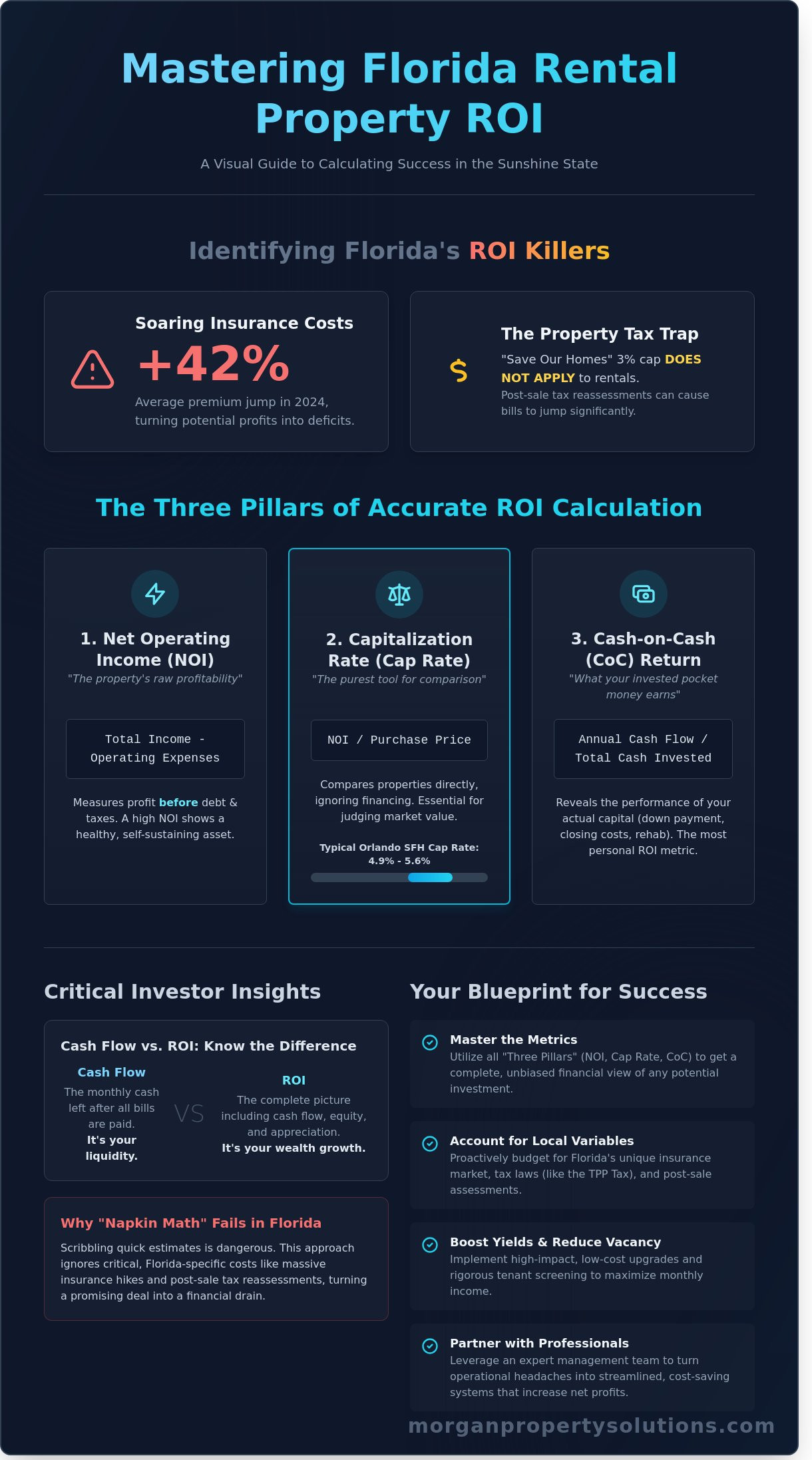
In 2024, Florida property insurance premiums jumped by an average of 42% for many owners, a reality that can quickly turn a promising deal into a monthly deficit if you aren’t prepared for the task of calculating rental property roi florida. It’s completely normal to feel a bit of hesitation when you’re looking at the numbers. You’ve likely heard about how the “Save Our Homes” 3% cap doesn’t apply to rentals, which often leads to tax bills that are significantly higher than what the previous owner paid. We know you want to grow your portfolio with confidence, but the fear of overestimating your cash flow is a real hurdle for even the most seasoned investors.
We’re here to help you simplify the process and get the clarity you need. You’ll learn the exact math behind a successful investment and discover the local variables, like the 2026 insurance trends and specific tax assessments, that truly drive your bottom line. We’ll break down a clear formula for success and highlight the Florida-specific expenses you can’t afford to miss. This guide provides everything you need to move forward with total peace of mind as you build your future in the Sunshine State.
Key Takeaways
- Get a clear handle on the “three pillars” of rental math-Cap Rate, Cash-on-Cash Return, and NOI-to understand what your investment potential really looks like.
- We’ll show you the right way to approach calculating rental property roi florida so you can account for the 2026 local variables that others might miss.
- Learn how to dodge “ROI killers” like the “Save Our Homes” tax trap and navigate the unique challenges of the current Florida property insurance market.
- Discover practical, low-cost ways to boost your rental yields and reduce vacancies through better tenant screening and high-impact property upgrades.
- See how partnering with a professional management team can actually increase your profits by turning everyday headaches into streamlined, cost-saving systems.
Why ROI is the North Star for Florida Landlords
When you look at a potential rental in Orlando, it’s easy to get distracted by the fresh paint or the proximity to the theme parks. But as a professional landlord, your most valuable tool isn’t a hammer; it’s your calculator. At its core, Return on investment (ROI) is the direct relationship between the money you put into a property and the net profit it gives back. It tells you if your cash is actually growing or just sitting idle in a bank account. In the Sunshine State, this number is the only way to know if you’re building wealth or just trading dollars.
Florida is a different beast compared to other states. You can’t just copy a strategy from the Midwest and expect it to work here. As we look at the 2026 market climate in Central Florida, the stakes are higher than they were just a few years ago. Orlando continues to grow, but the costs of doing business are changing rapidly. Property insurance rates and shifting tax assessments mean that calculating rental property roi florida requires a level of precision that many part-time investors overlook. The influx of residents moving to the state has kept demand high, but it has also led to more frequent property tax reassessments that can surprise an unprepared owner.
Understanding the broader economic currents that make Florida attractive is also key. The state’s robust economy is heavily supported by international trade, with many goods arriving via major shipping routes like the Panama Canal. For investors curious about the intricate logistics that power this growth, it can be insightful to explore Ship Agency Services that manage these complex vessel transits.
We know that staring at a spreadsheet of numbers can feel a bit scary. It’s easy to feel like you’re drowning in percentages and decimals. Our team at Morgan Property Solutions Inc. has spent over 20 years helping owners make sense of these figures. We believe in making real estate simple. This guide is here to walk you through the math, step by step, so you can move forward with confidence. You don’t need to be a math genius to succeed, but you do need a solid plan. We’ve seen every type of market cycle since 2004, and the one constant is that the numbers never lie if you know how to read them correctly. Let’s start by breaking down the fundamentals so you can see the big picture.
The Difference Between Cash Flow and ROI
Cash flow is the cash left in your pocket each month after all bills are paid. It’s what keeps your business liquid today. ROI is the full story. It includes cash flow plus equity growth and property appreciation. If you only focus on monthly cash, you might ignore a high-growth property. If you only focus on ROI, you might face a cash crunch. Balance is key.
Why “Napkin Math” Fails in the Sunshine State
Scribbling numbers on a napkin is a dangerous way to invest in Florida. Hidden costs like high insurance premiums or a 50 percent jump in property taxes after a sale can kill your profits. You need real data, not optimistic guesses. For more insights, check our real estate articles. Accurate calculating rental property roi florida prevents a deal from becoming a drain.
The Three Pillars of Rental Property Math
Understanding your numbers doesn’t have to be a headache. We’ve seen plenty of investors get overwhelmed by complex spreadsheets, but we like to keep things simple. To get a clear picture when calculating rental property roi florida, you really only need to master three specific numbers. These metrics tell different stories about your money; looking at just one is like trying to drive a car while only looking out the side window. You need the full view to stay safe and profitable.
For investors seeking to streamline this process, you can visit Multifamily Intelligence, a dedicated platform that offers the specialized tools, education, and community support needed to make confident decisions.
As we head toward 2026, the Florida market requires a more disciplined approach than it did five years ago. Prices have stabilized and insurance costs have shifted, so “guessing” isn’t a strategy anymore. By looking at Cap Rate, Cash-on-Cash Return, and NOI together, you can strip away the emotion and see if a property actually makes sense for your bank account. We’re here to help you make sense of these figures so you can invest with total confidence.
Net Operating Income (NOI)
Think of NOI as the engine under the hood of your investment. NOI is the profit generated before debt and taxes. To find it, you just subtract your operating expenses from your total income. Keeping this number high is the secret to building long term wealth because it shows the property can stand on its own feet. When you’re calculating these costs, don’t forget that Florida has specific rules, like the Florida Tangible Personal Property Tax, which applies to the furniture and appliances you provide in a rental. This is an often overlooked expense that can bite into your bottom line if you aren’t prepared for it.
Capitalization Rate (Cap Rate)
The Cap Rate is the purest way to see a property’s value because it ignores how you pay for it. The formula is simple: Net Operating Income divided by the Purchase Price. If you bought a house for $425,000 cash and it cleared $22,100 after expenses, your Cap Rate is 5.2%. In the Orlando market right now, a good cap rate for a single family home typically hovers between 4.9% and 5.6%. If you find something significantly higher, it might be a great deal, or it might be in a neighborhood that requires more hands on management. It’s a great tool for comparing two different properties side by side without getting distracted by mortgage rates.
Cash-on-Cash Return (CoC)
If you’re using a mortgage, this is the number you’ll probably care about most. It measures the actual cash you get back compared to the cash you actually pulled out of your pocket. The human speak formula is your Annual Pre-Tax Cash Flow divided by your Total Cash Invested. Remember that “Total Cash” isn’t just your down payment. You have to include the $6,200 you spent on closing costs and the $4,500 you spent on new vinyl plank flooring before the tenant moved in. This gives you the real world percentage of what your bank account is actually seeing each year. If you need help evaluating your portfolio’s performance, we can help you run these numbers accurately.
By 2026, the Florida market will likely be more competitive than ever. Relying on a single metric is a recipe for surprises you don’t want. A property might have a great Cap Rate but a terrible Cash-on-Cash return if your interest rate is too high. Or, a house might look profitable until you realize the NOI is being eaten alive by rising maintenance costs. We always tell our clients that looking at all three pillars is the only way to ensure your investment stays stress free and successful for the long haul.
The “Florida Factor”: Taxes, Insurance, and Hidden ROI Killers
Success in the Sunshine State depends on more than just finding a great house in a nice neighborhood. If you are calculating rental property roi florida, you have to account for specific local expenses that can quickly eat into your cash flow if you aren’t prepared for them. We see investors make the mistake of using national averages all the time, but Florida operates by its own set of rules. From the cost of keeping the lights on to the legal requirements outlined in Florida landlord-tenant laws, the details matter for your bottom line.
Navigating the Insurance Maze
Insurance is the most talked about hurdle for a reason. As we head into 2026, premiums in Central Florida are still a major line item in every budget. You can expect to pay anywhere from $2,800 to $5,500 annually for a standard three bedroom home. The age of your roof is the biggest deal breaker here. If a roof is older than 15 years, your options for coverage shrink and your costs skyrocket. Before you sign any contracts, always ask for a wind mitigation report. This single document can save you 15% to 30% on your annual premium by proving the home can withstand high winds. Don’t guess on this number; get a firm quote from a local agent during your due diligence period.
The Non-Homestead Tax Reality
Many new investors fall into the “Save Our Homes” trap. In Florida, primary residents enjoy a 3% cap on annual property tax assessment increases. As an investor, you don’t get that protection. Your taxes are capped at 10% annually, and your tax bill resets the year after you buy. If the current owner has lived there for 20 years, their tax bill might be $1,500. Once you buy it, the county will reassess it at the current market value, and that bill could easily jump to $4,000 or more. You should always visit the local county appraiser’s website and use their “Tax Estimator” tool to see what your actual bill will look like in year two. Budgeting for this jump is vital for calculating rental property roi florida accurately.
HOA fees are another factor that can silently kill your margins. In many Florida communities, fees range from $150 to $450 per month. These costs often cover things like lawn care or community pools, but they are mandatory and non-negotiable. If you don’t account for these, your projected 8% return can quickly drop to 4%. This is where a professional rental management company becomes an asset. We help you vet these communities to ensure the fees provide actual value. We also handle the day to day headaches of compliance, so you don’t end up with expensive fines from an overzealous board. Managing these local hurdles is how you turn a risky investment into a stable source of passive income.
5 Practical Ways to Boost Your Florida Rental Yields
Once you’ve finished calculating rental property roi florida for your current portfolio, the next logical question is how to make those numbers look even better. You don’t always need a massive renovation to see a jump in your cash flow. Often, the smallest shifts in how you manage the property yield the biggest results. We’ve found that a $500 investment in modernizing light fixtures and cabinet hardware can justify a $50 monthly rent increase, which is a 120% annual return on that specific spend.
Another major factor in your ROI is the quality of your residents. Bad debt and property damage are the fastest ways to tank your percentages. By sticking to rigorous screening criteria, you’re not just finding a tenant; you’re protecting your asset. A single eviction in the 2024 Florida market can cost a landlord upwards of $3,500 in legal fees and lost rent, making the upfront work of screening well worth the effort.
You should also consider your pet policy. Data from the 2023 Humane Society reports show that 72% of renters own pets, yet many landlords still say no to furry friends. By using tools like PetScreening, you can safely accept pets while charging a reasonable pet rent of $25 to $50 per month. This adds $300 to $600 to your bottom line every year with very little risk.
Energy efficiency is an overlooked goldmine, especially if you pay for any utilities. Swapping out old incandescent bulbs for LEDs and installing low-flow showerheads costs less than $100 but can shave 10% off monthly water and electric bills. Similarly, a $125 HVAC tune-up twice a year prevents a $7,000 system failure during a 95-degree July day. Preventative maintenance keeps your ROI from being killed by emergency repairs that always seem to happen on weekends at double the labor rate.
Reducing Turnover and Vacancy
A vacant home is an expensive home. If your property sits empty for just 30 days, you’ve lost roughly 8.3% of your annual gross income. You’re also stuck paying for lawn care and utilities out of pocket. We’ve seen that offering deposit-free renting can get a home leased 14 days faster than traditional methods. Building tenant loyalty through proactive communication and quick repair turnarounds ensures they stay for years, not just one lease term.
Strategic Rent Increases
While you’re calculating rental property roi florida for your next acquisition, remember that rent isn’t static. You can stay competitive without pricing out good tenants by implementing small, incremental increases of 3% to 5% annually rather than a massive jump every three years. Timing is everything here. We recommend timing your lease renewals to end between March and August. This is when demand in Florida peaks, giving you the most leverage to adjust rates to current market data.
Get a professional rental analysis to see how much your property could be earning today.
Simplifying Success: How Professional Management Protects Your Returns
Many investors view the monthly management fee as a direct hit to their bottom line. It’s easy to look at a 10% fee and see it as a loss, but that perspective often misses the bigger picture of your total yield. When you’re calculating rental property roi florida, you have to account for the “leakage” that happens when a property isn’t managed with expert precision. A single month of vacancy or a poorly handled repair can wipe out a whole year of management fee savings in one go. Professional management isn’t a cost; it’s a strategy to plug those leaks and keep your cash flow consistent.
Think of professional management as an insurance policy for your profitability. We’ve seen DIY landlords lose thousands because they didn’t know how to navigate Florida’s specific landlord-tenant laws. A single legal mistake or a tenant who stops paying can result in an eviction process that takes 5 to 7 weeks and costs upwards of $3,500 in legal fees and lost revenue. Our systems are designed to stop these issues before they start. We use rigorous screening to find high-quality tenants who pay on time and respect your property. If you need more help understanding these dynamics, our landlord resources offer a wealth of information to guide you through the process.
The math often favors the professional. If a management fee costs you $180 a month, that is $2,160 per year. However, if our marketing team fills your vacant unit 21 days faster than you could on your own, and your rent is $2,400, we’ve already saved you $1,680 in vacancy costs alone. When you add in our discounted contractor rates for maintenance, the service essentially pays for itself while protecting the physical condition of your asset.
The ROI of Your Own Time
What is an hour of your life worth? This is the question every investor should ask. If you’re spending 10 hours a month on a property and your time is worth $75 per hour, that’s $750 of “hidden” cost every month. If you’re spending your weekends chasing down rent checks or coordinating plumbers, you aren’t a passive investor; you’ve just bought yourself a second job. Automating rent collection is a key step towards passive income, and you can visit Merchant Solutions Corp for the kind of merchant services that help landlords streamline their financial operations. Being a stressed landlord takes a toll on your mental health and your ability to look for your next deal. We handle the 2 AM phone calls about broken water heaters so you can sleep through the night. By shifting from an active manager to a passive owner, you free up your schedule to focus on what actually grows your wealth.
And what does that freedom look like? For many, it’s about enjoying the very lifestyle that makes Florida real estate so valuable in the first place. Instead of dealing with maintenance calls, you could be exploring the state’s world-class outdoor attractions. For instance, many investors find that a successful portfolio allows them the time to hire Lake Okeechobee bass fishing guides and experience the natural beauty that draws so many residents here.
This principle of leveraging expert guidance to free up your time for growth applies in any market. For example, investors exploring opportunities in Southern California can visit County Properties to see how a regional agency handles the operational details, allowing them to focus on their next acquisition.
The same logic applies to investors diversifying into international markets. For those considering luxury properties on Spain’s Costa del Sol, for example, partnering with a regional specialist like King Estates is crucial for navigating the local landscape.
The Morgan Property Solutions Difference
With over 20 years of experience right here in Central Florida, we’ve refined a process that takes the guesswork out of property ownership. We don’t just manage properties; we optimize them for long-term growth. Our proven systems are built to eliminate vacancy and boost profits by keeping your units filled with reliable residents. We’ve seen every market shift since 2004, and we know exactly what it takes to keep your numbers in the green. Our team is here to support you and ensure your investment journey is as smooth as possible. We invite you to learn more about us and see how our local expertise makes the difference in calculating rental property roi florida for your portfolio. We’re ready to be your partner in success every step of the way.
Take Control of Your Florida Investment Future
Success in the Sunshine State isn’t just about picking a house near the coast. It’s about the math. As we look toward 2026, calculating rental property roi florida requires a sharp eye on every line item, especially with shifting insurance rates and tax assessments. Balancing the Three Pillars of math and accounting for the Florida Factor can either build your wealth or drain your reserves if you aren’t careful. Managing these details is a full-time job, but it doesn’t have to be your burden alone.
Morgan Property Solutions brings over 20 years of Central Florida expertise to your portfolio. We make ownership simple by handling everything from tenant screening to transparent financial reporting through our comprehensive online portal. Our A+ BBB rating reflects our commitment to helping landlords boost yields while reducing daily stress. We’re here to guide you through every step so you can focus on growing your wealth rather than chasing down repairs.
Let us help you maximize your Florida rental profits; get started today!
We’re excited to help you turn your 2026 investment goals into a reality. You’ve got this, and we’re ready to help you succeed!
Frequently Asked Questions
What is a good ROI for a rental property in Florida?
A good ROI for a Florida rental property is generally between 8% and 12%. While some high-growth areas might offer more, a 10% return is a solid target for most investors. We’re here to guide you toward properties that meet these goals without added stress. Keeping your expectations in this range ensures you have a safety net for repairs and vacancies.
How do I estimate property taxes for a new Florida investment?
You should estimate your property taxes at roughly 1.5% to 2% of the purchase price. Don’t rely on the current owner’s tax bill because their Save Our Homes cap disappears once you buy. Florida law requires a full reassessment at the market value whenever a property changes hands. This simple calculation prevents a nasty surprise when your first tax bill arrives.
Are property management fees tax-deductible in Florida?
Yes, you can deduct 100% of your property management fees on your federal tax return. Since these are direct operating expenses, they lower your taxable income and help your bottom line. This makes calculating rental property roi florida much easier because professional help often pays for itself through tax savings. We’ll provide the detailed annual statements you need for your accountant.
How much should I budget for maintenance on a Florida rental?
Budgeting 1% of the property value for annual maintenance is a smart move for any Florida landlord. If you own a $450,000 home in Orlando, you should set aside $4,500 every year for repairs. This covers high-wear items like AC units, which often need replacing every 12 years in our humid climate. Being prepared for these costs keeps your investment stress-free.
Is it better to calculate ROI monthly or annually?
It’s better to calculate your ROI annually to get a true picture of your investment’s performance. Monthly tracking is great for managing your daily cash flow, but yearly figures account for one-time costs like property taxes and insurance renewals. Most of our successful clients look at the trailing 12 months to see how their portfolio is growing. It’s the best way to plan for the future.
How does the current 2026 interest rate affect my Cash-on-Cash return?
If interest rates are around 6.5% in 2026, your Cash-on-Cash return will be lower than in years with cheaper debt. Every 1% increase in your mortgage rate can shave about 2% off your annual cash return. We’ll help you run the numbers to ensure your rental income still covers the higher debt service. Staying informed about these shifts helps you make smarter buying decisions.
What happens to my ROI if I allow pets in my rental?
Allowing pets typically boosts your ROI by adding $25 to $50 in monthly pet rent to your income. You also get a larger pool of applicants, which can reduce your vacancy time by about 10 days. Since 70% of renters own pets, being pet-friendly is a simple way to increase your profits. We can help you set up a solid pet policy to protect your property.
Can I calculate ROI if I am doing a BRRRR strategy in Orlando?
You can calculate ROI for a BRRRR project by focusing on the cash left in the deal after your 75% LTV refinance. When calculating rental property roi florida for these deals, we look at the equity you gained during the renovation. If you pull all your initial capital back out, your return technically becomes infinite. It’s a proven way to build a large portfolio in markets like Orlando.
The initial purchase and renovation are often funded through short-term financing. Many investors work with private money brokers like JGL Capital LLC to secure capital quickly and compete with cash offers.
Similarly, the ‘Rehab’ component requires precise execution to control costs and timelines. For investors taking on larger renovations or multiple projects, having professional oversight is invaluable. An owner’s representative like FALKE Atlantic Corporation can manage the entire construction process, ensuring the development adds maximum value before the refinancing stage.
This strategy’s success hinges on having a reliable financial partner for the refinance stage. To find the types of real estate loan programs that are essential for investors using the BRRRR method, you should check out Icon Capital LLC.

Article by
Oliver Overton-Morgan
Oliver Overton-Morgan is a full-time Real Estate Broker since 2003, with years of experience helping thousands of people purchase and sell real estate throughout Central Florida. He holds a Graduate Realtor Institute designation, LCAM, and has held licenses in good standing as a Florida Mortgage Broker and a Notary Public. Oliver immigrated to central Florida in 2001, and within 5 years Oliver built a successful Real Estate brokerage in central Florida, where he recruited over 75 Sales Associates with 25+ million in sales production.