Last Tuesday at 2:14 AM, an investor named David woke up to a frantic text about a burst pipe in his Phoenix rental while he was asleep 1,200 miles away in Chicago. It’s the exact scenario that keeps most remote owners awake at night. You likely share that same fear of your property being damaged or the frustration of trying to find a plumber who won’t overcharge you. We understand that stress because we’ve spent the last 20 years helping people manage their investments with confidence. These long distance landlord tips will show you how to transform your out-of-state house into a truly passive income stream by the end of 2026. You’ll learn how to build a reliable local team and use simple tools to stay informed without the headache. We’re going to walk through a practical plan to give you back your peace of mind while ensuring your rental maintains its value for years to come.
This is a particularly common challenge for professionals like educators, first responders, and military personnel, whose careers often require them to relocate and manage properties from afar. For these community heroes, finding support from the very beginning of their real estate journey is key, which is where initiatives like the Lead the Way Home Savings Program can make a significant difference.
Key Takeaways
- Learn why successful remote owners stop trying to do everything themselves and instead shift their focus toward high-level asset management.
- Discover how to build a reliable “Response Network” on the ground so you’re never left scrambling when a repair or emergency pops up.
- Get practical long distance landlord tips for handling Florida’s unique challenges, like managing humidity and hurricane prep from hundreds of miles away.
- Find out which essential tech tools will help you ditch paper checks and keep your rental income flowing smoothly in 2026.
- Identify the exact moment when your time becomes more valuable than a management fee, helping you turn a stressful job back into a smart investment.
The Reality of Managing a Rental Property from Out of State
Managing a rental property from 100 miles away or across the country used to feel like a high-stakes gamble. In 2026, the physical distance doesn’t define your success; your systems do. You’re moving away from being a DIY landlord who keeps a toolbox in the trunk. Instead, you’re stepping into the role of an asset manager. With modern tools like 3D virtual inspections and real-time moisture sensors, you can often see more from your smartphone than you ever could through a dusty window during a quick drive-by. The biggest hurdle isn’t the miles. It’s the emotional need to “just see it” in person. You have to trust the data and your local partners. These long distance landlord tips will help you bridge that gap without the stress.
The Mindset Shift: Systems Over Proximity
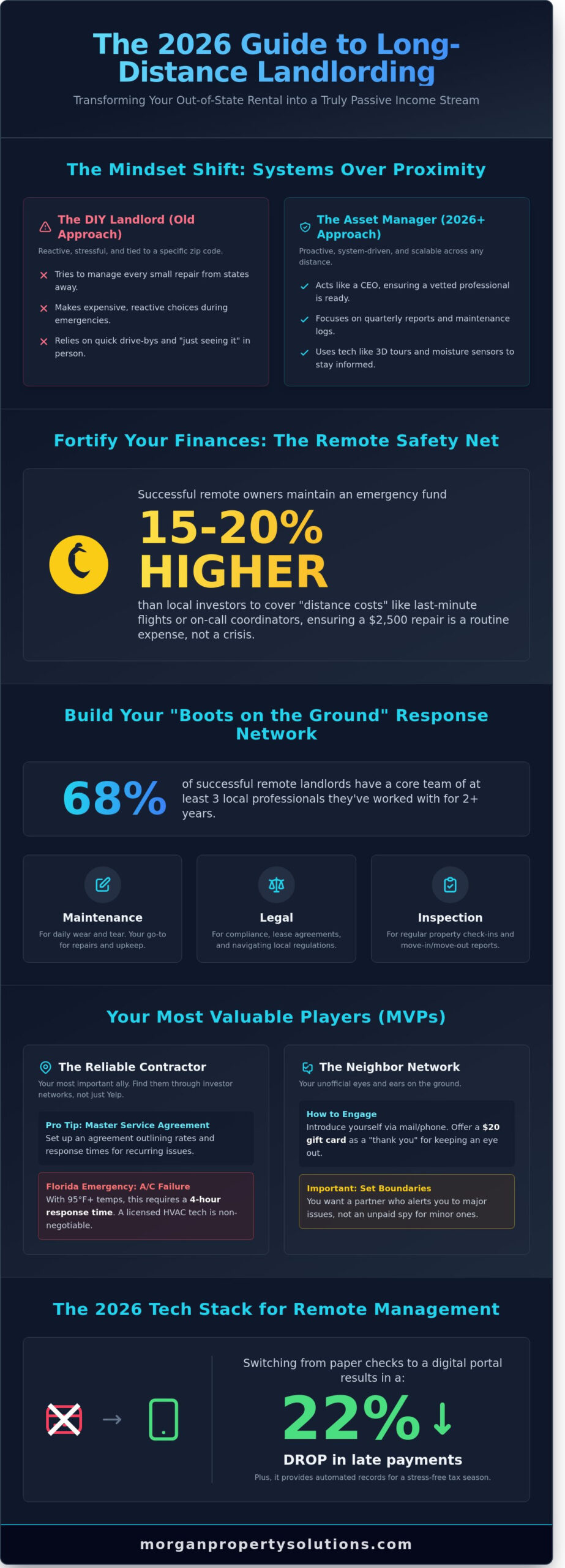
Being a “hands-on” owner from a distance is actually a liability. If you try to manage every small repair from three states away, you’ll end up making reactive, expensive choices. You aren’t the handyman anymore; you’re the CEO. A CEO doesn’t fix the sink. They ensure there’s a vetted professional ready to do it. Moving to proactive management means you’re looking at quarterly reports and maintenance logs rather than waiting for an emergency call. This shift allows you to scale your portfolio without being tied to a specific zip code.
The Financial Buffer You Need for Remote Success
Remote ownership requires a sturdier safety net than local investing. We’ve found that successful out-of-state owners maintain an emergency fund that is 15% to 20% higher than their local counterparts. You have to account for specific “distance costs,” such as a last-minute $500 flight or the premium for an on-call local coordinator. You can find more details on budgeting in our landlord resources. High liquidity is essential. It ensures that a $2,500 roof patch remains a routine business expense rather than a logistical nightmare because you couldn’t be there to shop for quotes in person.
Building Your Local “Boots on the Ground” Team
Managing a property from a different state isn’t about having a long list of phone numbers. It’s about building a “Response Network.” You need people who don’t just answer the phone; they take ownership of the problem. A 2024 study of remote investors found that 68% of successful landlords maintain a core team of at least three local professionals they’ve worked with for two years or more. This team follows a specific hierarchy: Maintenance for the daily wear and tear, Legal for compliance and lease issues, and Inspection for regular property check-ins.
For international landlords, especially those managing investments between the US and Italy, the legal component is even more complex. Beyond local tenant law, you may face cross-border tax issues or need guidance on structuring your investment. In these situations, a specialized firm like Tosolini, Toniutti & Partners can provide essential support for business operations and compliance.
Vetting these professionals from a distance requires a systematic approach. You can’t shake their hand, so you have to rely on their track record. When you’re looking for help, apply the same high standards you’d use for a new tenant. It’s helpful to review our screening criteria to see the level of detail we recommend for anyone interacting with your investment. Always verify licenses through the Florida Department of Business and Professional Regulation website and ask for photos of completed work before paying a final invoice.
The Reliable Contractor: Your Most Important Ally
Finding “The One” usually happens through local networking or referrals from other investors rather than just scrolling through Yelp. Once you find a pro you trust, set up a Master Service Agreement. This document outlines agreed-upon rates and response times for recurring issues. In Central Florida, a licensed plumber and HVAC technician are non-negotiable. With summer temperatures regularly hitting 95 degrees, an AC failure is an emergency that needs a 4-hour response time to keep your tenants safe and happy.
The Neighbor Network: Your Unofficial Eyes and Ears
Your best long distance landlord tips often come from the people living next door. Neighbors see the small things, like a car parked on the lawn or a pile of trash that’s been sitting out for three days. Introduce yourself via mail or a quick phone call. Offer a $20 gift card as a small incentive for them to “keep a friendly eye” on the place. Just be sure to set clear boundaries. You want a partner who alerts you to major issues, not an unpaid spy who calls you every time the tenant’s dog barks.
Building this team takes time, but it’s the only way to make your investment truly passive. If you’re feeling overwhelmed by the logistics, our team offers plenty of landlord resources to help you streamline your remote management process.
Leveraging Technology for Remote Property Management
Managing a rental from a different state used to involve a lot of “fingers crossed” moments. By 2026, technology has removed most of that guesswork. You don’t have to be there to see a dripping faucet because your sensors can do it for you. These long distance landlord tips focus on building a tech stack that works while you sleep, making your life stress-free and your investment secure.
Paper checks are a nightmare for remote owners. They get lost in the mail, they’re slow to process, and they offer zero automation. Moving to a digital portal is the smartest move you can make. Recent data shows that landlords who switch to automated portals see a 22% drop in late payments. It also keeps your records organized for tax season. When you can’t visit in person, video walkthroughs are your eyes. Don’t just look at the general cleanliness. Ask your tenant or a local contact to point the camera under the sinks and around the base of the toilets. You’re looking for moisture, dark spots, or bubbling paint. These are the early warning signs of a leak that could cost thousands if left alone.
Digital Rent Collection and Communication
Using a dedicated portal makes real estate simple. It keeps a clear paper trail that protects you and your tenant. We recommend setting a “Communication Rule” immediately. Tell your tenants you’ll respond to non-emergencies during business hours. This prevents midnight texts about minor issues. Keep every lease and photo in a cloud folder. You can find more helpful guides in our landlord resources.
Smart Tech for Remote Protection
Smart locks are vital. You can change the entry code from your phone the second a lease ends, which is safer than physical keys. Water leak sensors are another must-have. A $50 sensor under a sink can prevent a $50,000 insurance claim for flooring. Smart thermostats also help you monitor HVAC health from afar. If the unit runs constantly without cooling, you can call a pro before it fails. Avoid gimmicks like smart refrigerators; they’re just one more expensive thing that can break.
Florida-Specific Considerations for Remote Landlords
Managing a rental from a different time zone is one thing, but doing it in the Sunshine State adds a layer of complexity. Florida’s environment is aggressive. If you aren’t prepared, the humidity and local regulations can eat into your ROI faster than a termite through soft pine. These long distance landlord tips focus on the unique challenges of the Orlando market to keep your investment running smoothly in 2026.
Handling the Florida Climate Remotely
In Orlando, your HVAC system isn’t a luxury; it’s a life-support system for your property. When a unit fails in July, mold can begin growing within 48 hours due to the extreme moisture. We recommend scheduling bi-annual inspections every March and October. A $150 tune-up is much easier to swallow than a $7,000 full replacement because of a clogged drain line. You also need a recurring pest control contract. Florida is home to 21 species of cockroaches and subterranean termites that cause over $5 billion in property damage annually in the U.S. Paying for quarterly sprays keeps these uninvited guests out of your investment.
Don’t forget the curb appeal. Many Orlando communities, especially in Lake Nona, have strict HOAs. A brown lawn or a few weeds can trigger fines of $100 per day. Since you aren’t there to see the grass dying, hire a reliable landscaping crew that sends photo updates after every mow. This ensures you aren’t surprised by a violation notice in the mail.
Staying Legal in the Sunshine State
Florida law is generally landlord-friendly, but it’s very specific about timelines. You must understand the nuances of Florida Landlord-Tenant Law to avoid expensive court delays. For example, if you’re holding a security deposit in a Florida bank, you have exactly 30 days to notify the tenant of a claim against it or 15 days to return it in full. Missing these windows can mean losing your right to the funds entirely.
- Hurricane Prep: Decide now who installs shutters. Tenants often aren’t physically able or contractually required to do it. You need a local contact on speed dial before a storm enters the Gulf.
- Remote Inspections: Use a local partner to conduct walk-throughs twice a year. Photos don’t always catch the smell of a hidden leak or the early signs of a pest infestation.
- Lease Clauses: Ensure your lease includes a specific mold addendum and clear rules on guest stays to prevent unauthorized long-term occupants.
The legal landscape changes often. Having a local expert on your side is the best way to stay compliant with the latest Florida Statutes. It’s a small price to pay for peace of mind. If you’re feeling overwhelmed by these regional quirks, our team can help you simplify your Orlando property management today.
When to Hire a Professional Property Manager in Orlando
Managing a rental from a different state is a lot to handle. At some point, every owner hits a wall where the DIY approach stops making sense. This is the break-even point. It happens when your personal time becomes more valuable than the 8% to 10% monthly fee a manager charges. If you’re spending your weekends answering tenant emails or hunting down contractors from three time zones away, you aren’t an investor; you’re an employee of your own property.
This is a universal challenge for remote investors. The key is finding a reliable local partner who understands the specific market, whether that’s in Orlando or on the other side of the globe. For example, investors with properties in Western Australia might visit Regal Gateway Property to see how a premier local agency handles the day-to-day operations. For those looking at different investment models entirely, such as new developments in international hubs that can offer a more hands-off approach, you can learn more.
For investors whose portfolios include or are expanding into luxury properties, the management and acquisition strategy is often different. A firm that specializes in high-value investments can offer a more tailored service. To see an example of this specialized approach, you can learn more about Julius Elite.
The hidden costs of self-management are often higher than the management fees themselves. Consider the price of a last-minute flight to Orlando to handle an eviction or a major repair. Think about the cost of a property sitting empty for 45 days because you couldn’t get away from your day job to show it. These long distance landlord tips are meant to help you scale, and scaling requires delegation.
Calculating Your Time’s Worth
You can use a simple formula to see if you’re actually saving money. Take your professional hourly rate and multiply it by the hours you spend on rental tasks each month. If you earn $75 an hour and spend just five hours on property issues, that’s $375 of your time gone. A professional manager for a $2,400 rental might only cost $240. You’re losing $135 every month by doing it yourself. We believe “Making Real Estate Simple” is the only way to build long-term wealth without burning out. Having a team to handle 24/7 emergency calls means you actually get to enjoy your life. That freedom allows you to enjoy the best of the Florida lifestyle during your visits, whether that’s exploring the theme parks in Orlando or booking a fishing trip with Blue Barracuda Charters in the beautiful waters of the Southwest.
The Morgan Property Solutions Advantage
We’ve spent over 20 years mastering the Central Florida market. A manager like Morgan Property Solutions turns a stressful job into a true passive investment. We take care of the gritty details that keep remote owners up at night. Our team handles everything from pet screening to rigorous financial reporting. Because we have a deep bench of vetted vendors, we often save owners 15% to 20% on repair costs compared to what a one-time customer would pay. Transitioning from DIY is easy; we handle the tenant handoff and lease review so the process is seamless for you. Let us simplify your remote landlording journey today.
Take Control of Your Orlando Investment Today
Managing a rental from another state doesn’t have to feel like a second full-time job. By now, you’ve seen how the right mix of smart technology and a reliable local team can bridge the gap between you and your property. These long distance landlord tips are all about giving you back your time while ensuring your Florida investment continues to grow. Whether you’re coordinating repairs through an app or navigating specific Orlando regulations, having a clear strategy is what keeps your business profitable and stress-free.
Sometimes the smartest way to simplify your life is to partner with experts who know the Central Florida landscape inside and out. We bring over 20 years of local experience to the table and maintain an A+ rating with the BBB to give you total peace of mind. Our owners enjoy 24/7 visibility through a detailed online portal, so you’re always in the loop without having to pick up the phone. We’re here to guide you and make sure your property is in good hands every single day. Simplify your rental experience with our Orlando Property Management services. We look forward to helping you reach your goals and making your next move a success.
Frequently Asked Questions
How often should a long-distance landlord visit their property?
You should aim to visit your rental property at least once every 12 months. While modern tech handles daily tasks, 68% of high-performing remote landlords find that a bi-annual walkthrough prevents small issues from becoming $5,000 repairs. Plan your trips around seasonal maintenance like gutter cleaning in October or AC servicing in April. It’s a great way to maintain a face-to-face connection with your tenants and ensure the home stays in top shape.
Is it better to have a fixed-price contractor or pay as you go?
It’s usually better to use a fixed-price contractor for major projects to keep your budget predictable. Paying as you go often leads to “scope creep,” where costs can easily balloon by 22% over the initial estimate. For smaller, recurring tasks, keep a “pay as you go” handyman on a $500 monthly retainer. This balance ensures you aren’t overcharged for simple fixes while keeping your larger renovations under a strict, signed agreement.
What is the biggest mistake out-of-state landlords make?
The biggest mistake out-of-state landlords make is trying to manage every tiny detail without a local point of contact. Data shows that remote owners without local help face 40% higher vacancy rates because they can’t show the property quickly. One of the best long distance landlord tips is to build a reliable local network before you even sign a lease. You need someone who can physically be there within 30 minutes if a pipe bursts.
How do I handle an emergency repair at 2 AM from another time zone?
You should set up a pre-authorized emergency fund with a local 24-hour plumbing or HVAC company. Give them a written “limit to act” of $1,000 so they can stop a flood or restore heat without waiting for your call. This simple step prevents a 2 AM crisis from turning into a $10,000 insurance claim. It’s also smart to use a digital portal where tenants can upload photos of the damage instantly for your records.
Can I legally require my tenant to handle small repairs?
You can legally require tenants to handle minor maintenance like light bulb changes or battery replacements in smoke detectors. Most landlords set a “repair deductible” where the tenant covers the first $50 of a non-essential fix. However, 42 states have strict “warranty of habitability” laws that prevent you from shifting major responsibilities like plumbing or heating to the tenant. Always check your specific city ordinances to ensure your lease remains fully compliant.
Should I use a smart lock for my remote rental property?
You definitely should install a smart lock, as 90% of remote landlords now use them to manage access for contractors and new tenants. Models like the August Wi-Fi Smart Lock allow you to create temporary 24-hour codes from your phone. This removes the risk of lost keys and saves you from paying a locksmith $150 every time a tenant moves out. It’s a simple way to make your property management much more secure and efficient.
How do I find a trustworthy person to do inspections if I don’t have a manager?
You can hire a licensed home inspector or a real estate agent to perform a walkthrough for a flat fee of around $125. These pros provide a detailed report with 20 to 30 photos, giving you a clear view of the property’s condition. Using these long distance landlord tips helps you stay informed without the high cost of a full-time manager. It’s a reliable way to get an unbiased set of eyes on your investment twice a year.

Article by
Oliver Overton-Morgan
Oliver Overton-Morgan is a full-time Real Estate Broker since 2003, with years of experience helping thousands of people purchase and sell real estate throughout Central Florida. He holds a Graduate Realtor Institute designation, LCAM, and has held licenses in good standing as a Florida Mortgage Broker and a Notary Public. Oliver immigrated to central Florida in 2001, and within 5 years Oliver built a successful Real Estate brokerage in central Florida, where he recruited over 75 Sales Associates with 25+ million in sales production.