
Last Tuesday, a landlord in Winter Park sat staring at their phone, dreading yet another notification from a tenant who was three weeks behind on rent but still demanding a full kitchen remodel. It’s a situation that leaves you feeling trapped between protecting your investment and staying out of an expensive courtroom. You’re likely exhausted from the constant back and forth and worried that learning how to deal with difficult tenants legally might be too complicated to handle on your own. We’ve seen this happen to many property owners throughout Central Florida, and we know how heavy that burden feels.
The good news is that resolving these issues doesn’t have to be a nightmare. With over 20 years of experience helping local owners, we want to show you how to handle these disputes without breaking the law or losing your mind. We’re here to guide you through the process of setting firm boundaries and protecting your rental income. In this guide, we’ll walk you through the exact steps for documented communication, Florida’s specific notice requirements, and the right way to start a legal eviction if it becomes necessary.
Key Takeaways
- Learn how to distinguish between common tenant frustrations and actual lease violations so you know exactly when it’s time to step in.
- Discover why a solid paper trail is your best defense in Florida courts and what specific evidence a judge needs to see to rule in your favor.
- We’ll show you how to deal with difficult tenants legally using de-escalation tactics that protect your property while keeping your stress levels low.
- Get a simple, step-by-step breakdown of Florida’s eviction laws to ensure you’re using the right notices at the right time for your specific situation.
- See how a professional management team acts as a helpful buffer to handle tough conversations for you and keep problematic applicants away from your investment.
Recognizing Difficult Behaviors and Their Legal Implications
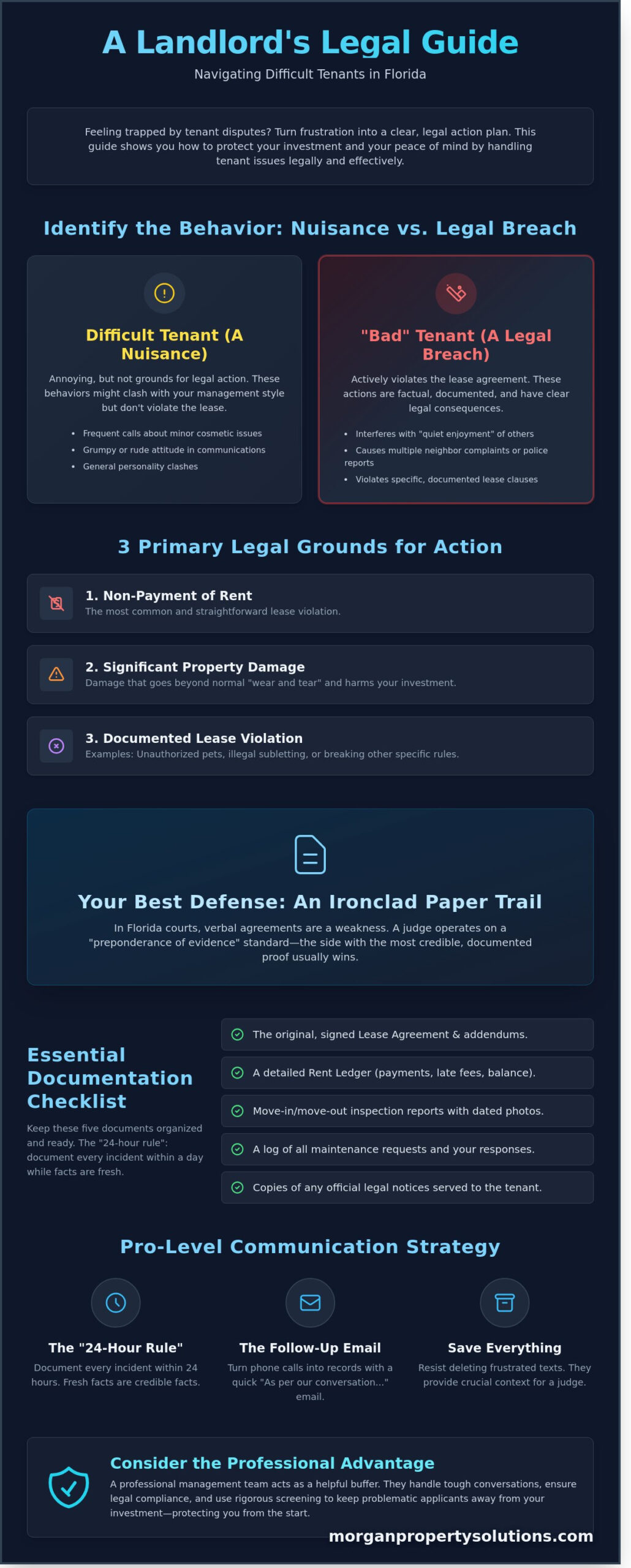
Managing rental property in Florida for over 20 years has taught our team that every tenant has a unique personality. Sometimes, those personalities clash with your management style. It is vital to distinguish between a tenant who is simply “difficult” and one who is actually “bad” in a legal sense. A difficult tenant might be someone who calls frequently to complain about minor cosmetic issues or someone who has a grumpy attitude during inspections. While these behaviors are annoying, they aren’t grounds for legal action. A bad tenant, however, is someone who actively violates the terms of the lease agreement you both signed.
To understand how to deal with difficult tenants legally, you have to look at the facts rather than your feelings. There are three primary legal grounds for intervention that stand up in court. First is the non-payment of rent. Second is significant property damage that goes beyond standard wear and tear. Third is a documented lease violation, such as keeping an unauthorized pet or subletting the unit without permission. Before you take any steps toward a formal notice, you should always review your original lease for specific conduct clauses. These sections often outline expectations for noise, trash disposal, and guest stays. If the behavior isn’t mentioned in the lease, it is much harder to enforce.
In cases of an unauthorized pet, the issue may stem from a tenant’s temporary need for pet care, such as during travel or an emergency. While this still constitutes a lease violation, offering a helpful resource can be a constructive first step before issuing a formal notice. For example, even if your property is in Florida, you could point to a high-quality service as a model for what they should look for; you might suggest they discover Noah’s Pet Hotel & Spa as an example of a professional boarding facility that can solve their problem.
The Difference Between a Nuisance and a Breach
A tenant who is rude to you in an email is a nuisance, but they aren’t necessarily in breach of their contract. A breach occurs when their actions interfere with the “quiet enjoyment” of the property for other residents. For instance, if a tenant hosts loud parties that result in multiple police reports or neighbor complaints, they are likely violating local noise ordinances and lease terms. You can often prevent these stressful situations from the start by implementing rigorous screening criteria. Setting a high bar for entry helps ensure you’re placing residents who respect both the property and their neighbors.
Fair Housing Laws: The Boundary You Can’t Cross
Even when a tenant is being incredibly challenging, they still have protected rights under Florida and federal law. You must stay calm and professional to avoid any claims of discrimination or landlord harassment. In 2026, the Fair Housing Act continues to serve as the essential legal barrier that prevents landlords from using behavioral issues as a cover for discrimination based on race, disability, or family status. Always document every interaction and stick to the specific rules outlined in your lease. If you focus on the contract rather than the person, you protect yourself from costly legal mistakes while learning how to deal with difficult tenants legally and effectively.
Building an Ironclad Paper Trail for Florida Courts
In Orlando, a handshake or a verbal “we’ll fix it later” doesn’t hold much weight in front of a judge. If you’re figuring out how to deal with difficult tenants legally, you’ve got to understand that verbal agreements are your biggest legal weakness. Florida courts operate on a “preponderance of evidence” standard. This means the side with the most credible, documented proof usually wins. Without a paper trail, a dispute quickly turns into a “he-said, she-said” scenario that rarely ends well for the property owner. For particularly complex business disputes where establishing the truth is critical, some professionals visit Morgan Polygraph to verify claims through lie detection services.
Florida judges appreciate facts that are organized and easy to follow. Using a digital portal is one of the smartest moves you can make because it creates a timestamped, unalterable record of every interaction. Whether it’s a maintenance request or a rent reminder, having a digital log removes any doubt about when a message was sent or received. It takes the guesswork out of the timeline and shows you’ve been a proactive, professional landlord.
The Essential Documentation Checklist
Keeping your files organized doesn’t mean you need to act like a private investigator. You just need to be consistent. We recommend following the “24-hour rule” for every incident: document the details within 24 hours while the facts are fresh. To stay prepared, you should always have these five documents ready to go:
- The original, signed Lease Agreement with all addendums.
- A detailed Rent Ledger showing every payment, late fee, and balance.
- Move-in and move-out inspection reports with dated photos.
- A log of all maintenance requests and your documented responses.
- Copies of any official legal notices served to the tenant.
If you’re unsure if your current forms are up to standard, you can find professional templates and landlord resources on our site to help you get started. Having the right paperwork from day one is the best way to handle how to deal with difficult tenants legally without unnecessary stress.
Communication Logs: Your Best Friend in Court
Every time you speak with a tenant on the phone, follow it up with a quick “as per our conversation” email. This simple habit turns a fleeting phone call into a permanent record that a judge can review. You should also resist the urge to delete frustrated or nasty text messages from a tenant. These messages provide crucial context regarding the tenant’s behavior and your attempts to remain professional.
If things don’t improve, formal “Notice to Cure” letters are your next step. These letters officially notify the tenant of a lease violation and give them a specific window to fix the problem. This shows the court that you gave the tenant a fair chance to resolve the issue before seeking legal action. If managing these details feels like a full-time job, our team can help you manage your Orlando rental property so you can focus on your life instead of the paperwork.
Strategic Communication: De-escalating Without Giving Up Rights
When you are figuring out how to deal with difficult tenants legally, your most effective tool is not a court order. It is actually your ability to stay calm. At Morgan Property Solutions Inc., we have seen over our 20 years of experience that a single 15 minute phone call often resolves a dispute that would otherwise cost $5,000 in legal fees and months of lost sleep. It is about being a human first. You can be incredibly kind while staying 100 percent firm on your lease terms.
Setting boundaries is the only way to stay professional. If a tenant calls your personal cell phone at 10 PM on a Tuesday, you do not have to answer. Redirecting them to a formal maintenance portal or office line the next morning reinforces that you run a business. This keeps the relationship from getting too personal, which is usually where things go wrong. If the conversation starts to circle or becomes abusive, that is your cue to stop talking. At that point, it is time to let a professional property manager or an attorney handle the paperwork.
The Art of the Neutral Conversation
Using “I” statements is a simple trick to keep the temperature low. Instead of saying “You broke the dishwasher,” try “I noticed the dishwasher needs a repair, and I want to make sure we get it fixed properly.” This shifts the focus from blame to solutions. If rent is late, a quick script like “I am reaching out because the payment hasn’t posted yet; is everything okay?” feels much more supportive than a robotic demand. Listening to their “why” before you cite the “how” of the lease builds the trust needed to find a resolution.
Mediation: The Middle Ground Before Eviction
Florida landlords have access to excellent mediation services, such as those provided by the 9th Judicial Circuit in Orlando. A neutral third party can often bridge the gap that you cannot. Mediation sessions typically cost between $150 and $300, which is a small price to pay compared to a full court battle. A mediator helps you create a written agreement that is legally binding, often solving the issue without the permanent scar of an eviction on the tenant’s record. This approach is a core part of how to deal with difficult tenants legally while maintaining your reputation as a fair landlord.
Navigating the Florida Eviction Process Step-by-Step
Florida Chapter 83 serves as the essential roadmap for every property owner in the Sunshine State. It’s the legal framework that dictates exactly how you must handle lease terminations and possession claims. When you’re figuring out how to deal with difficult tenants legally, following this “playbook” to the letter is the only way to avoid costly delays in the Orlando courts. As of 2026, judges are more focused than ever on procedural accuracy, meaning a single typo on a notice could force you to start the entire process over from scratch.
You might feel tempted to take matters into your own hands when a tenant stops paying, but “self-help” evictions are incredibly dangerous. Changing the locks, removing front doors, or shutting off the electricity are all illegal acts under Florida law. If you attempt these shortcuts, you could be liable for actual damages or three months’ rent, whichever is greater, plus the tenant’s attorney fees. It’s much safer to stick to the court-ordered path, which typically takes 35 to 50 days in Orange County from the initial filing to the final move-out.
Serving the Correct Notice
The first step is choosing the right notice for the situation. A 3-Day Notice to Pay is strictly for past-due rent. It must include specific language stating, “You are hereby notified that you are indebted to me in the sum of [amount] for the rent and use of the premises.” If the problem involves lease violations like unauthorized pets or excessive noise, you’ll need a 7-Day Notice to Cure instead. You can serve these documents by handing them directly to the tenant, but most landlords prefer “posting” the notice in a conspicuous place on the front door. Under the 2026 legal calendar rules, you cannot count the day of delivery, weekends, or court holidays toward the three-day deadline.
The Final Stages: From Filing to Writ of Possession
Once you file the eviction with the court, the tenant has 5 business days to file a formal “Answer.” This is a critical period because a savvy tenant can use this response to raise defenses that might delay your case by 10 to 14 days. If they don’t respond, the judge will likely issue a default judgment quickly. After the judgment is signed, the Clerk of Court issues a Writ of Possession. The Sheriff then posts a 24-hour notice on the property. When the Sheriff returns to execute the writ, you finally regain legal control of the home. If the tenant leaves furniture or personal items behind, Florida law allows you to move those items to the property line once the Sheriff has signed off on the possession.
Managing the legalities of a difficult rental situation can be exhausting, but you don’t have to do it alone. Explore our landlord resources to find more tools for protecting your investment property.
Why Professional Management Simplifies Difficult Tenant Situations
Managing rental property shouldn’t feel like a second full-time job where you’re always on edge. When you hire a professional management team, you create a vital buffer zone between your personal life and your rental business. This distance is crucial when you’re figuring out how to deal with difficult tenants legally. Instead of getting into a heated argument on the front porch, you have a licensed expert who follows the letter of the law every step of the way. This professional distance keeps emotions out of the equation, which is where most legal mistakes happen.
Think of it like having roadside assistance for your investment. When a car breaks down, drivers in the Rochester area know they can call a professional service like Ibrahim Road Rescue LLC to handle the stressful situation for them. A property manager, or a dedicated firm like Van Treese Management, serves the same purpose, stepping in to manage tenant issues so you don’t have to.
Professional firms also stop problems before they start. So-called “professional tenants” often target independent landlords because they know how to manipulate the system. These individuals usually stay away from managed properties because they know our screening process is built to spot red flags that an untrained eye might miss. The management fee isn’t just an expense; it’s an investment in your peace of mind. If you save just one month of lost rent or avoid a single 5,000 dollar legal fee, the service has already paid for itself. We make real estate simple by letting our experts handle the hard stuff while you enjoy the returns.
The Morgan Property Solutions Advantage
We’ve spent over 20 years managing properties and resolving disputes across Central Florida. We know the local courts and the specific regulations that apply to this market. Our Orlando property management services take the guesswork out of legal compliance. We even use PetScreening to handle service animal verifications and pet risks. This tech-driven approach helps us avoid the common lease disputes that trip up most owners, ensuring your property stays protected and profitable.
Turning Your Investment Back Into Passive Income
Real estate works best when it’s actually passive. You shouldn’t be the one answering 3:00 AM calls about a broken pipe or a noise complaint. If you’re currently stuck with a “problem” property, we can help you turn it around. Our team has a proven process for mid-lease takeovers. We step in, review the existing lease, and stabilize situations that have spiraled out of control. We take over all communication, enforce the rules firmly, and get your investment back on track. Reach out to us today to see how we can take the stress off your plate and make your life easier.
Take Control of Your Florida Rental Today
Managing a rental property doesn’t have to be a source of constant stress. By maintaining a meticulous paper trail and following Florida statutes to the letter, you’ll safeguard your investment against legal pitfalls. Most issues settle down when you use firm, strategic communication and stick to a consistent process. Mastering how to deal with difficult tenants legally is a powerful tool for any landlord, but it’s also time-consuming work that can quickly drain your energy.
You don’t need to handle these headaches on your own. We’ve spent over 20 years managing properties across Central Florida, and we’ve seen it all. With our A+ BBB rating and a comprehensive tenant screening process, we focus on placing reliable people in your homes from the start. We’re here to simplify your life and help your portfolio thrive without the late-night phone calls or legal drama.
Let us handle the difficult tenants for you-explore our Orlando property management services.
You’ve built a great foundation for your future, and we’re excited to help you protect it every step of the way.
Frequently Asked Questions
Can I legally evict a tenant for being “difficult” or rude in Florida?
You can’t legally evict a tenant in Florida just for being rude or having a difficult personality. Florida Statutes Chapter 83 requires a specific lease violation, like non-payment of rent or criminal activity, to start the process. If their behavior violates a specific “conduct” clause in your signed 12-month agreement, you might have a case, but simple personality clashes won’t hold up in court.
How long does the legal eviction process take in Orlando in 2026?
The eviction process in Orlando typically takes between 21 and 35 days in 2026. This timeline accounts for the initial 3-day notice, the 5-day window for the tenant to respond to the court summons, and the final 24-hour writ of possession from the Orange County Sheriff. While we aim for speed, local court backlogs can occasionally push the total time closer to 6 weeks during busy seasons.
What should I do if a tenant refuses to communicate with me?
If a tenant stops responding, you should move all communication to written notices sent via certified mail with a return receipt requested. This creates a solid paper trail that’s vital when learning how to deal with difficult tenants legally. We recommend avoiding repeated texts or calls, as these can be viewed as harassment; instead, stick to formal letters that provide a clear 48-hour deadline for a response.
Is it legal to offer a tenant money to leave the property (Cash for Keys)?
Yes, offering “Cash for Keys” is perfectly legal in Florida and often serves as the fastest way to regain control of your home. Many local landlords find this method is 60% cheaper than paying for a full legal eviction and the associated court filing fees. Just ensure you use a written “Agreement to Vacate” and don’t provide the funds until the tenant has fully moved out and returned the keys.
What happens if a tenant damages the property after receiving an eviction notice?
You can use the security deposit to cover any intentional damage discovered after the tenant leaves. Under Florida law, you have exactly 30 days to notify the tenant of your intent to claim the deposit for these repairs. If the repair costs exceed the deposit by more than $100, you can file a supplemental claim in small claims court to seek a judgment for the remaining balance.
Do I need a lawyer to handle a difficult tenant in Florida, or can I do it myself?
You aren’t required to hire a lawyer if you own the property in your own name, but it’s often the safest way to avoid delays. Data shows that 80% of DIY eviction filings in Florida are dismissed because of minor technical errors in the paperwork. If your rental is owned by an LLC or a corporation, Florida law actually requires you to have an attorney represent the entity in court.
How can I legally enter the property if a difficult tenant is refusing access?
You can legally enter the unit after providing a 24-hour written notice, even if the tenant doesn’t give you explicit permission. Florida Statute 83.53 gives you the right to enter for repairs or inspections between 7:30 a.m. and 8:00 p.m. Knowing how to deal with difficult tenants legally means standing your ground on these access rights while ensuring you’ve documented the 24-hour notice period to stay compliant with state law.

Article by
Oliver Overton-Morgan
Oliver Overton-Morgan is a full-time Real Estate Broker since 2003, with years of experience helping thousands of people purchase and sell real estate throughout Central Florida. He holds a Graduate Realtor Institute designation, LCAM, and has held licenses in good standing as a Florida Mortgage Broker and a Notary Public. Oliver immigrated to central Florida in 2001, and within 5 years Oliver built a successful Real Estate brokerage in central Florida, where he recruited over 75 Sales Associates with 25+ million in sales production.