
Last Tuesday, a landlord in Tampa realized that 15% of his tenants had missed the grace period, leaving him scrambling to cover his own mortgage payments. It’s a situation we see often, and it usually stems from a vague or missing late rent fee policy florida landlords can actually rely on. You likely feel that rent should be paid on time, every time, but you also don’t want to end up in a legal battle over a fee that a judge might call unconscionable.
We understand how frustrating it is when your rental income becomes unpredictable. You shouldn’t have to spend your weekends digging through conflicting online forums to figure out if a $50 or $100 fee is the right move for your property. We’re here to help you clear up that confusion. In this guide, you’ll learn exactly how Florida law handles these charges and what counts as a reasonable amount. We’ll walk through the specifics of Florida Statute Chapter 83 together to ensure your policy is legally sound and your stress levels stay low.
Key Takeaways
- Understand how Florida’s flexible laws work and how to avoid the “unconscionability” trap that could get your fees tossed out in court.
- Learn the 5% to 10% rule of thumb that experienced managers use to set fair fees that protect your bottom line.
- Discover how a well-defined late rent fee policy florida landlords trust can eliminate confusion and keep your rental income predictable.
- See why a standard 3-to-5 day grace period is the secret to maintaining a positive relationship with your tenants while still getting paid.
- Find out how professional management and online portals take the emotional stress out of rent collection by automating the entire process for you.
Understanding Florida’s Stance on Late Rent Fees
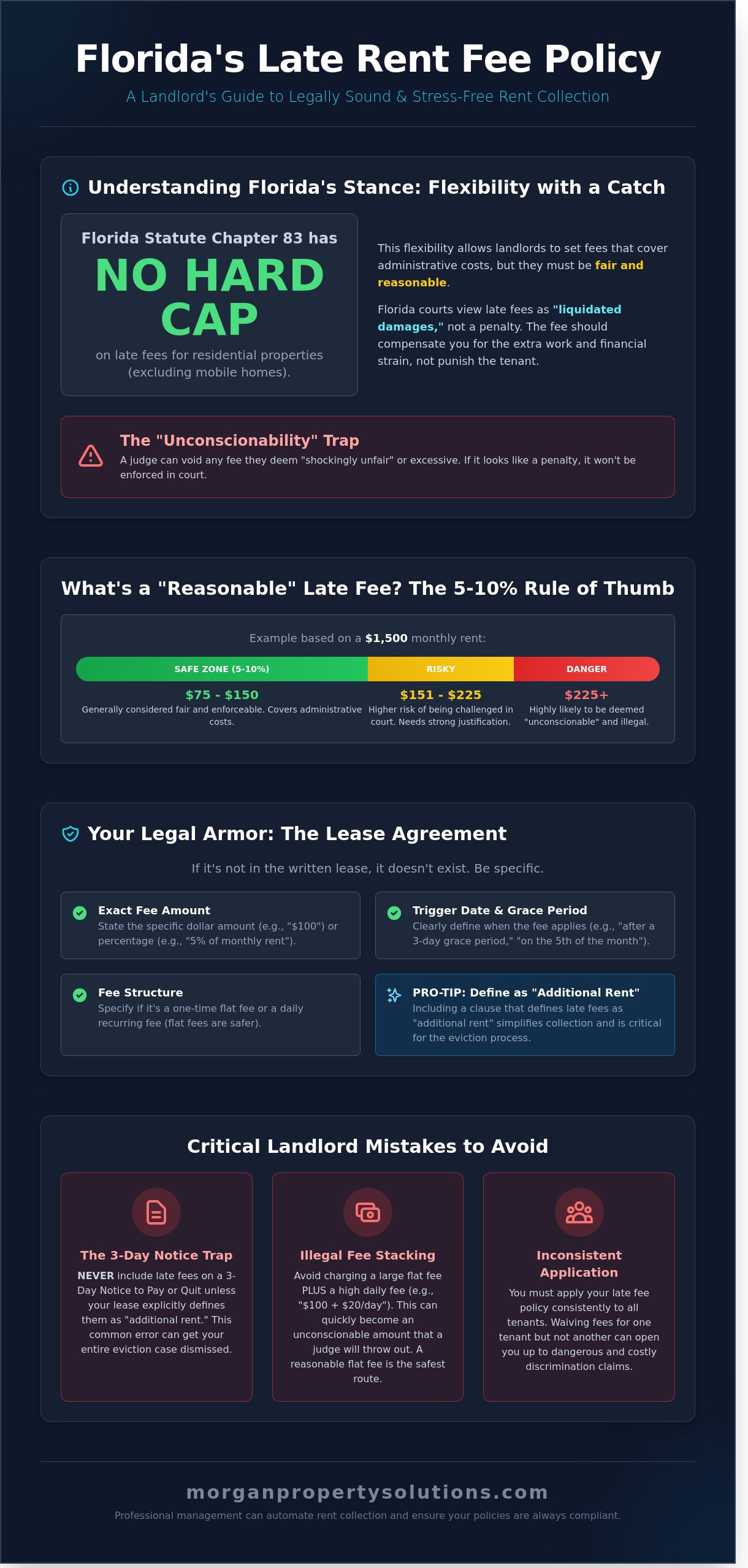
Florida remains one of the most landlord-friendly states in the country as we head into the 2026 rental season. If you’re managing property here, you’ve likely noticed that the state doesn’t micromanage your fee structures. Florida Statute Chapter 83 does not establish a maximum dollar amount or a “hard cap” for residential late fees. This flexibility allows you to set a late rent fee policy florida that actually covers your administrative costs, but it also puts the responsibility on you to be fair and transparent.
Most property owners view these fees as a way to encourage on-time payments. Legally speaking, Florida courts view late fees as “liquidated damages.” This means the fee isn’t meant to punish the tenant. Instead, it’s a pre-set amount meant to compensate you for the time, effort, and financial strain caused by a late payment. Because there’s no state-mandated limit, we always suggest looking at our landlord resources to ensure your fees align with local market standards in cities like Orlando or Tampa.
The Role of the Lease Agreement
You might think a verbal agreement or a quick text message about late fees is enough, but that won’t hold up in a Florida court. If it isn’t in the written lease, it doesn’t exist. For your 2026 contracts, you need to be incredibly specific. Your lease should clearly state the exact dollar amount of the fee, the date it kicks in, and whether it’s a one-time charge or a daily recurring fee.
One pro tip for 2026 is to look at how you define “Rent” in your contract. By defining rent to include late fees and other charges, you make the collection process much smoother. This clarity helps us keep things simple and stress-free for everyone involved. If the tenant knows exactly what to expect, you’ll see fewer disputes and more consistent cash flow.
Florida Statute Chapter 83 Basics
The Florida Residential Landlord and Tenant Act is the rulebook we all live by. While the law is broad, it prioritizes the contract that you and your tenant signed. Understanding Landlord-Tenant Law is the first step in protecting your investment; it ensures you stay on the right side of the court system if a conflict arises.
Chapter 83 emphasizes that while you have the freedom to set your late rent fee policy florida, you must apply it consistently. If you waive a fee for one tenant but charge another, you could open yourself up to discrimination claims. We’ve seen that a steady, professional approach is always the best way to maintain a positive relationship with your renters while protecting your bottom line. We’re here to help you navigate these rules so you can focus on growing your portfolio without the headache.
What Does Florida Law Actually Say About Limits?
You might hear people say Florida has no limits on what you can charge for late rent. While it’s true there isn’t a specific dollar cap written into the statutes for standard residential homes, that’s a dangerous myth to follow blindly. If you set a fee that’s clearly excessive, you’re asking for trouble in court. Florida judges rely on the concept of “unconscionability.” This means if a fee is shockingly unfair or acts as a penalty rather than a way to cover your actual costs, a judge can refuse to enforce it. In 2026, we’re seeing a much stronger push for transparency. Many modern leases now include a “fee summary” on the very first page to ensure tenants know exactly what happens if they miss a deadline.
Mobile home park rules are a different story entirely. Unlike standard apartments or houses, mobile home parks often have specific statutory caps on late fees. For most residential landlords, keeping your fee between 5% and 10% of the monthly rent is a safe bet. If you’re charging $200 on a $1,000 rent payment, you’re likely crossing into illegal territory. Citing Florida Statute 83.808 is a good way to understand how the law views the overall fairness of rental agreements and the fees contained within them.
When Late Fees Become Illegal
Fees become illegal the moment they stop being a “liquidated damage” and start being a punishment. Stacking fees is a common trap. For example, charging a $50 flat fee plus $20 every single day can quickly spiral into a mountain of debt that a court will find unconscionable. You also can’t use these fees to bypass usury laws, which limit interest rates on debts. If your late fee effectively charges 50% interest on the late rent, it won’t hold up. Staying within a reasonable, flat-fee structure is the best way to keep your late rent fee policy florida compliant and enforceable.
The 3-Day Notice Connection
The 3-Day Notice to Pay or Quit is the first step in the eviction process. A common mistake is including late fees in the “amount due” on this notice. In Florida, you generally can only include “rent” on a 3-day notice. If your lease doesn’t specifically define late fees as “additional rent,” including them can cause a judge to dismiss your entire eviction case. It’s a technicality that costs landlords thousands in legal fees. You can find compliant notice templates and other helpful tools at our landlord-resources page to make sure you’re following the right steps.
Managing these nuances can be a lot to handle on your own. If you want to ensure your lease is airtight and your collection process is handled correctly, we can help you through our Orlando property management services, where we handle the paperwork so you don’t have to.
Defining a “Reasonable” Late Fee in Florida
Florida law doesn’t provide a specific dollar amount for late fees, which often leaves landlords wondering what they can legally charge without overstepping. To keep things simple and fair, about 85% of property managers in the Orlando metro area follow a rule of thumb between 5% and 10% of the monthly rent. If you’re managing a property where rent is $2,200, a fee between $110 and $220 is generally seen as acceptable by local courts. Having a clear late rent fee policy florida tenants can easily understand helps prevent confusion and keeps your monthly cash flow steady.
Choosing between a flat fee and a percentage often depends on your portfolio size. Flat fees, typically ranging from $75 to $125, are much easier to track in accounting software and present clearly in a lease. Percentage-based fees are more common for high-end luxury rentals. For a unit renting at $4,500, a flat $50 fee wouldn’t be much of a deterrent, so a 5% fee makes more sense. If a dispute ever reaches a courtroom, you’ll need to show the judge that the fee isn’t a penalty but a way to recover actual costs. Citing the Florida Bar Landlord/Tenant Law guidelines can help you stay within legal boundaries while protecting your investment.
Industry Standards for 2026
As we move through 2026, we’re seeing more landlords move toward a hybrid model to handle late payments. This usually involves a flat initial fee of $75 followed by a daily fee of $10 or $15. If you use daily fees, you must include a maximum ceiling. For example, you might charge $10 per day, but cap it at $150 total or 10% of the rent. Without a cap, a judge might view the fee as “unconscionable” and throw it out entirely. In the Orlando market, average late fees are slightly lower than in high-density areas like Miami, where fees often start at $150 regardless of the monthly rent amount.
The Cost of Late Rent
Late rent is more than just a minor inconvenience; it creates real financial ripples for your business. When a tenant misses a deadline, you might face late payment penalties on your own mortgage or spend 45 to 60 minutes of administrative time sending notices and making phone calls. A reasonable fee should cover these specific damages rather than acting as a profit center. We always recommend using strict screening criteria to find reliable tenants who respect deadlines from the start. This proactive step is the best way to avoid the stress of late payments altogether. Our team is here to help you set up a system that is both firm and fair, ensuring your property remains a successful, stress-free investment.
Grace Periods and Notification: Best Practices
Understanding the distinction between a due date and a late date is the first step in creating a functional late rent fee policy florida landlords can rely on. Your due date is the specific day rent is legally expected, which is almost always the 1st of the month. The late date is when the financial penalty actually kicks in. While Florida Statutes don’t require you to give any extra time, offering a small window for payment helps keep the relationship positive and professional.
Setting Up the Grace Period
A 3 to 5 day grace period has become the standard benchmark for rental properties across Florida. Even though you aren’t legally obligated to provide this, it accounts for bank processing times and the occasional weekend delay. If rent is due on the 1st and you offer a 3 day grace period, the fee shouldn’t apply until the 5th. You should clearly state in your lease whether these days include weekends or holidays. Most professional agreements count calendar days but allow for payment on the next business day if the grace period ends on a Sunday or a federal holiday like July 4th.
The Psychology of Collection
Handling money is sensitive business. You want to be firm, but you also want to keep a good relationship with the person living in your home. Using automated property management software changes the dynamic completely. Instead of you calling and sounding like a bill collector, the system sends a neutral, automated reminder on the 2nd or 3rd day. This removes the personal friction and makes the fee feel like a standard business process rather than a personal confrontation. Data suggests that 85% of tenants pay faster when they receive an automated text or email reminder before the grace period ends.
If a normally reliable tenant is late for the first time in 12 months, a quick, friendly phone call often works better than a formal notice. You can listen to their situation and perhaps waive the fee as a one time gesture of goodwill. This builds incredible loyalty and trust. However, you need to stay consistent. If the lateness becomes a recurring pattern, you must stick to the written policy to avoid any confusion or claims of unfair treatment. We’re here to help you guide these conversations and keep your rental business running smoothly. You can find more helpful tools in our landlord resources section.
How Professional Management Simplifies Rent Collection
Collecting rent shouldn’t feel like a monthly confrontation. For many landlords, the hardest part of the job is the emotional weight of enforcing a late rent fee policy florida landlords must follow. When you’re dealing directly with a tenant who has a plausible excuse, it’s easy to let things slide. However, data from 2025 shows that 68% of landlords who waive fees once find that payments arrive even later the following month. Using a third-party manager shifts the dynamic from a personal struggle to a professional business process.
Our online portals remove human error and bias from the equation. These systems are programmed with your specific lease terms; if rent isn’t in by the grace period’s end, the software automatically calculates and applies the fee at 12:01 AM. This ensures your late rent fee policy florida stays consistent for every tenant, which is vital for staying compliant with fair housing standards. You don’t have to send the awkward “where is the rent?” text because the system provides clear, instant reminders for you.
We’ve found that the best way to handle late payments is to prevent them before they start. Through rigorous screening, we aim for a 98% on-time payment rate across our portfolio. By selecting tenants with a proven history of financial responsibility, we reduce the “heavy lifting” of collections. When issues do arise, Central Florida owners trust us to step in immediately with the legal expertise required to protect their investment without the landlord ever having to have a difficult conversation.
The Morgan Property Solutions Advantage
At Morgan Property Solutions, we focus on “Making Real Estate Simple” by using automated systems that take the guesswork out of management. We’ve spent 20 years refining our process to ensure you get paid on time. If a payment is missed, we handle the entire 3-day notice process from start to finish. You won’t have to spend your Saturday delivering papers or tracking down signatures. For more details on how we protect your cash flow, visit our orlando-property-management page.
Your Next Move
Trying to DIY your legal notices often leads to expensive mistakes. A single error on a 3-day notice can reset an entire eviction timeline, potentially costing you two or three months of rental income. It’s much safer to have experts handle the paperwork. If you’re unsure if your current rates are competitive, we offer a free rental analysis to see if your fees and rent match the 2026 market standards. You don’t have to manage this alone; we’re here to guide you every step of the way.
Keeping Your Rental Business Running Smoothly
Staying on top of your late rent fee policy florida doesn’t have to be a headache. The most important thing to remember is that while the state doesn’t have a specific dollar limit, your fees need to stay “reasonable” to hold up in court. You’ll also want to make sure your lease clearly spells out when a payment is late and what the grace period looks like. Since laws can shift by 2026, keeping your documentation sharp is your best defense against future disputes.
We know that chasing down payments is often the least favorite part of being a landlord. That’s why we’ve spent over 20 years helping owners in Central Florida keep their investments profitable and stress free. As licensed experts with an A+ BBB rating, we’re here to guide you through every legal hurdle and tenant interaction. We’ll make sure your rent arrives on time so you can focus on what matters most. Let us handle the stress of rent collection for you; explore our Orlando property management services today.
You’ve got this, and we’re always here to help you make your next move a success.
Frequently Asked Questions
Is there a maximum late fee for rent in Florida?
Florida law doesn’t set a specific dollar limit on late fees, but they must be reasonable. Most Florida courts consider a fee between 5% and 10% of the monthly rent to be fair. If you charge a fee exceeding 20%, you might face challenges in court since judges often view excessive charges as penalties rather than liquidated damages. We recommend staying within that 10% range to keep things simple and legal.
Can I charge a daily late fee in Florida?
You can charge a daily late fee in Florida as long as it’s clearly defined in your written lease agreement. For example, a $5 or $10 daily charge is common once the grace period ends. Just make sure the total accumulated fee doesn’t surpass a reasonable percentage of the rent, like 10%, to keep your late rent fee policy florida compliant with local court expectations. This approach helps keep your cash flow steady and predictable.
Does a landlord have to give a grace period in Florida?
Florida law doesn’t require landlords to provide a grace period, so rent is legally late on the second day of the month if it’s due on the first. However, 85% of Orlando property managers include a 3 to 5 day grace period in their leases to maintain good tenant relationships. Your specific lease terms will dictate exactly when a fee can be applied, so check your signed document first. We’re here to help you understand these nuances.
What happens if a tenant refuses to pay the late fee but pays the rent?
If a tenant pays rent but skips the late fee, you should check your lease’s order of payment clause. Many professional leases state that payments are applied to outstanding fees before rent. This means the tenant still technically owes a portion of the rent, which allows you to issue a 3-day notice for the remaining balance. We’ve seen this approach resolve 90% of fee disputes quickly and without further legal action.
Can I evict a tenant for not paying late fees in Florida?
You can evict a tenant for unpaid late fees only if your lease specifically defines those fees as additional rent. Without this specific language, Florida judges may dismiss an eviction filing based solely on non-payment of fees. It’s a small detail that makes a huge difference, so ensure your 2026 lease agreements include this wording to protect your investment. We’ve helped hundreds of owners navigate these requirements to keep their properties profitable.
Is a 10% late fee considered reasonable in Orlando?
A 10% late fee is widely considered reasonable and is the standard for about 75% of rental properties in the Orlando market. For a $2,000 apartment, a $200 fee holds up well in local courts. It’s high enough to encourage on-time payments but not so high that it looks like an illegal penalty. We always aim for this balance to keep things stress-free and fair for everyone involved in the rental process.
How should I notify my tenant that a late fee has been applied?
You should notify your tenant in writing as soon as the late fee is triggered, ideally through an automated property management portal or email. While Florida law doesn’t mandate a specific notification format for the fee itself, sending a formal notice of late rent provides a clear paper trail. Providing this notice within 24 hours of the missed deadline helps you stay organized and keeps the communication line open for a quick resolution.
Can I change my late fee policy in the middle of a lease?
You can’t change your late fee policy in the middle of a fixed-term lease without a written amendment signed by both you and the tenant. Your existing late rent fee policy florida remains binding until the current lease expires. If you’re on a month-to-month agreement, you can typically change the terms by providing a 30-day written notice before the next rent cycle begins. This ensures you’re always following the proper legal steps.

Article by
Oliver Overton-Morgan
Oliver Overton-Morgan is a full-time Real Estate Broker since 2003, with years of experience helping thousands of people purchase and sell real estate throughout Central Florida. He holds a Graduate Realtor Institute designation, LCAM, and has held licenses in good standing as a Florida Mortgage Broker and a Notary Public. Oliver immigrated to central Florida in 2001, and within 5 years Oliver built a successful Real Estate brokerage in central Florida, where he recruited over 75 Sales Associates with 25+ million in sales production.