
Last Tuesday, an Orlando property owner stood on a tenant’s porch with a plumber, only to be turned away because they hadn’t provided exactly 24 hours of written notice. It’s a situation that happens more than you’d think, especially since staying on the right side of rental property inspection laws florida requires more than just a quick text message. You want to be a great landlord, but you also need to protect your asset without the fear of a legal battle or a hostile tenant.
We know how stressful it is to feel like you’re walking on eggshells around your own investment. That’s why we’re here to help you make sense of the complex legal side of things. In this guide, you’ll learn the specific steps to legally enter your rental while keeping your tenant relationship positive and professional. We’ll walk through the current requirements of Florida Statute 83.53, clarify what qualifies as a “reasonable” time for entry under the 2026 updates, and give you a simple checklist to use for every inspection you perform.
Key Takeaways
- Understand Florida Statute 83.53 to find the perfect balance between protecting your property and respecting your tenant’s privacy.
- Master the rental property inspection laws florida by learning the four specific reasons you’re legally allowed to enter a unit.
- Learn how to avoid “abuse of access” claims so you can protect your investment without accidentally overstepping legal boundaries.
- Discover how to use professional checklists to turn stressful inspections into simple, helpful check-ins that build tenant trust.
- See how partnering with a management expert can take the legal heavy lifting off your plate and make your landlord journey much easier.
Understanding Florida Statute 83.53: The Rules of Entry
Owning a rental property in the Sunshine State is a great investment, but it comes with a specific set of legal boundaries you have to respect. The cornerstone of rental property inspection laws florida is Florida Statute 83.53. This law acts as the ultimate referee between your rights as a property owner and your tenant’s right to privacy. While you own the bricks and mortar, the tenant essentially buys the right to peaceful possession during their lease term. Striking this balance is vital for a stress-free landlord experience.
If you enter a property without following the rules, a court might view it as “unreasonable” entry. In Florida, this isn’t just a minor annoyance; it’s a legal breach of the lease agreement. We’ve helped landlords for over 20 years, and we’ve seen how a single unannounced visit can sour a relationship or lead to a costly legal dispute. These rules apply across the board in 2026, whether you’re managing a single-family home in Orlando or a commercial storefront in Tampa. Understanding the broader context of Landlord-tenant law helps you see why these protections exist to ensure fair treatment for everyone involved.
The 24-Hour Notice Rule
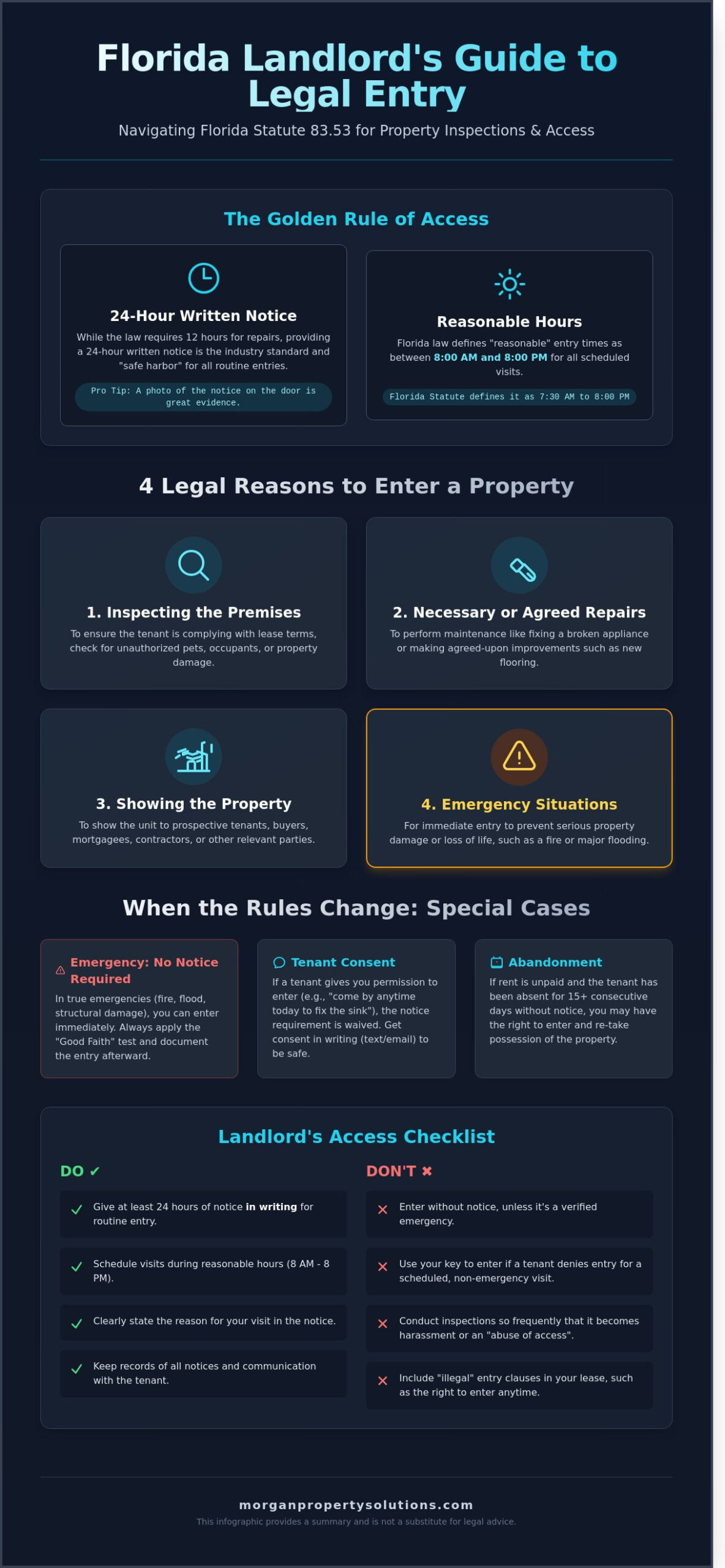
Florida law technically requires at least 12 hours of notice for repairs, but 24 hours has become the industry “safe harbor” for routine inspections. It’s a professional courtesy that prevents friction. You should schedule these visits during “reasonable” hours, which the state defines as 8 AM to 8 PM. To protect yourself, always deliver notice in writing. A quick text or email works, but a physical notice posted on the door is the gold standard if you ever need to prove your actions in a courtroom. We always recommend keeping a photo of the posted notice for your records.
When the Lease Is Silent
Sometimes a DIY lease forgets to mention inspections. If your contract is silent, don’t worry. Florida Statute 83.53 acts as your default safety net, granting you the right to enter for inspections, repairs, or showings. However, you can’t just add a clause saying you can enter “anytime without notice.” Florida courts routinely throw out “illegal” entry clauses because they violate state law. Stick to the statute to keep your business protected. For more help with your rental strategy, check out our landlord resources to keep your investments running smoothly.
When Can a Florida Landlord Legally Enter?
Understanding the boundaries of entry is a big part of keeping a healthy relationship with your tenants. While you own the property, Florida law protects the tenant’s right to privacy and quiet enjoyment. This means you can’t just drop by whenever you feel like it. According to Florida Statute 83.53, there are specific scenarios where you have the legal right to enter a dwelling. For most of these, you’re required to give at least 24 hours of notice and visit during reasonable hours, which the law defines as 7:30 a.m. to 8:00 p.m.
There are four primary legal reasons you might need to step inside the unit:
- Inspecting the premises: This allows you to ensure the tenant is following the lease terms, such as checking for unauthorized pets or verifying that the number of occupants matches the agreement.
- Necessary or agreed repairs: You have the right to enter to fix things like a broken dishwasher or to make improvements you both agreed upon, like installing new flooring.
- Showing the property: If you’re selling the home or looking for new renters, you can show the unit to prospective buyers, tenants, or contractors.
- Emergency situations: When immediate action is required to save the property from damage.
Following the rental property inspection laws florida has established helps you protect your investment without overstepping. It’s all about finding that balance between your rights as an owner and their rights as a resident.
Emergency Situations: No Notice Required
In a true emergency, the 24-hour notice rule goes out the window. Florida law defines an emergency as a situation where waiting could lead to serious property damage or loss of life. Common examples include a fire, a major pipe burst that’s flooding the unit, or structural damage after a hurricane. In these critical moments, calling in experts like First Choice Plus Plumbing & Air can help mitigate damage quickly. You should always apply the “Good Faith” test: would a reasonable person agree that entering was necessary right then? It’s a good idea to document these entries with photos and send a follow-up email to the tenant explaining the situation. This level of transparency prevents future disputes and builds trust.
Tenant Consent and Abandonment
There are times when the standard rules don’t apply because of the tenant’s actions. If a tenant calls you to fix a leaky faucet and says, “Feel free to come in whenever you’re around today,” they’ve waived their right to the 24-hour notice. Even so, it’s smart to get that consent in writing or via text just to be safe. Another scenario is abandonment. In Florida, if a tenant is gone for 15 days without notifying you and the rent is unpaid, you may have the right to enter and take possession. If a tenant is home but refuses to let you in for a legal, scheduled inspection, don’t force your way in. Instead, you can find helpful guidance on handling these conflicts through our landlord resources to ensure you stay on the right side of the law.
The Difference Between a “Nuisance” and an Inspection
Owning a rental property is a major investment, so it’s natural to want to check on its condition. However, there’s a thin line between protecting your asset and crossing into harassment. If you find yourself entering the home too frequently, you might be violating rental property inspection laws florida and risking a legal claim for “abuse of right of access.” This occurs when a landlord uses their legal right to enter for reasons that aren’t legitimate or does so in a way that feels like they’re trying to push the tenant out.
In 2024, access disputes were among the most common reasons for tension between owners and residents. To keep things professional, you should stick to a predictable schedule. We recommend checking our landlord resources for tips on how to build a positive relationship with your tenants from day one. To better understand the legal balance, you can review the Rights and Duties of Tenants and Landlords, which outlines how these statutes protect both sides and simplifies the legal jargon of the statutes.
Avoiding the “Harassment” Label
If you’re scheduling walkthroughs every two weeks, you’re likely overstepping. Most Florida experts suggest that quarterly or bi-annual inspections are the standard for “reasonable” frequency. Anything more can lead to a “constructive eviction” claim, where the landlord’s intrusive actions make the home unlivable. Under Florida law, the covenant of quiet enjoyment guarantees that a tenant can live in their rented home in peace without the landlord interfering with their privacy or possession of the property.
Handling Tenant Pushback
Sometimes a tenant might flat-out refuse to let you in, even when you’ve given the proper 24-hour notice. If this happens more than once, it’s a lease violation. Your first step should be issuing a 7-Day Notice to Cure, which gives the resident one week to fix the behavior. If the tension remains high, it’s often best to involve a professional property manager. We’ve seen that having a neutral third party handle the walkthrough can de-escalate the situation and ensure you stay within the rental property inspection laws florida without the drama. It’s all about keeping the process simple and stress-free for everyone involved.
Best Practices for Stress-Free Inspections in 2026
Managing a rental doesn’t have to feel like a constant battle between privacy and protection. By 2026, the most successful landlords have shifted their mindset from “checking up” on people to “checking in” with them. This subtle change in approach helps you stay compliant with rental property inspection laws florida while building a relationship based on mutual respect. When you treat an inspection as a proactive way to preserve the home, tenants are far more likely to cooperate and keep the place in top shape.
Using a standardized checklist is the best way to keep things professional and objective. It removes the guesswork and ensures you don’t miss the small things, like checking under the sink for slow leaks or testing smoke detector batteries. We’ve found that using digital tools makes this even easier. High-resolution photos are your best friend here. Just make sure you get tenant permission before snapping pictures of their personal belongings. This transparency prevents disputes and keeps everyone on the same page. If you’re feeling overwhelmed by the logistics, our team for Orlando property management can handle these details for you with local expertise.
Communication Strategies That Work
The way you frame the visit matters. Instead of calling it an “inspection,” try calling it a “maintenance wellness check.” This tells the tenant you’re there to help, not to judge their housekeeping. Data from 2025 shows that 92% of modern renters prefer receiving notices through automated portals rather than paper stuck to a door. It’s faster and creates a clear digital trail. Always follow up with a brief summary. Letting them know “everything looks great” or “we’ve scheduled that AC filter change” goes a long way in keeping the peace.
The Move-In/Move-Out Inspection
Your move-in inspection is the most vital legal document you’ll ever sign. It sets the baseline for the entire tenancy. Without a detailed report from day one, justifying security deposit claims becomes nearly impossible under rental property inspection laws florida. We recommend taking at least 50 to 100 photos of the property before a new tenant arrives. Focus on high-traffic areas and expensive appliances. In fact, clear documentation reduces security deposit disputes by 75% according to industry surveys. When they move out, you can compare these side-by-side to see what’s normal wear and tear versus actual damage. To make this process even smoother, you can use our screening criteria to find high-quality tenants who are more likely to care for your investment from the start.
How Professional Management Simplifies Florida Law
Owning a rental in Orlando is a great investment, but the legal side of things can get messy fast. About 85% of the property owners who reach out to us do so because they’re tired of the friction that comes with tenant interactions. They want a professional buffer. It’s much easier to have a third party deliver a 12-hour notice or conduct a move-out walkthrough than to do it yourself. When a manager handles these tasks, it removes the emotion from the situation. It turns a potentially awkward encounter into a standard business procedure, which keeps your tenant relationships professional and your property protected.
The financial impact of a mistake is also a major factor. A single legal error during an inspection or a notice period can lead to a lawsuit or a lost month of rent. By hiring professional management, you’re investing in an insurance policy against these costly mistakes. We make sure every step follows the letter of the law, so you don’t have to spend your nights reading through updated statutes or worrying about a surprise court date. Staying updated on rental property inspection laws florida is a full-time commitment, and we’re here to take that weight off your shoulders.
The Morgan Property Solutions Approach
We’ve been serving the Central Florida area since 2004. With over 20 years of experience, we’ve seen how the market and the laws have shifted. We manage hundreds of properties, which means we perform roughly 1,500 property visits every year. We don’t just rely on a clipboard and a pen. Our team uses advanced mobile technology to document every single visit.
- Digital Evidence: We capture 50 or more high-resolution photos during every inspection to create a clear timeline of the property’s condition.
- Timestamped Reports: Every report is geofenced and timestamped, giving you ironclad proof if a dispute ever arises.
- Legal Compliance: We’ve spent over 20 years learning the ins and outs of rental property inspection laws florida to ensure your investment is always protected.
This systematic approach gives our owners total peace of mind. You’ll always know exactly what’s happening with your home without having to drive across town or deal with a difficult conversation yourself.
Get Started with a Trusted Partner
Our company slogan is “Making Real Estate Simple” because we truly believe property ownership shouldn’t be a source of stress. We’ve refined our systems over two decades to make the transition to professional management as easy as possible. In most cases, we can have your property onboarded and under our care in as little as 48 hours.
If you’re ready to stop worrying about legal notices and start enjoying the passive income your property provides, we’re ready to help. You can trust us to take good care of your home and your tenants. Let us take the stress out of your rental property!
Take the Stress Out of Florida Property Entry
Staying on top of rental property inspection laws florida doesn’t have to feel like a legal balancing act. You’ve learned that following Florida Statute 83.53 is all about respect and clear communication. Keeping your 24 hour notice consistent and distinguishing between a quick repair and a full inspection protects both your rights and your tenant’s privacy. When you handle these visits correctly, you build a relationship based on trust rather than tension.
If you’d rather focus on growing your portfolio than tracking notice periods, we’re here to guide you. With over 20 years of experience across Central Florida, our team knows exactly how to navigate these local regulations while keeping your property in top shape. We hold an A+ rating from the BBB and provide detailed digital inspection reporting so you always know what’s happening at your unit without having to step foot inside yourself. We’ll handle the logistics so you don’t have to worry about a thing.
Simplify your property management today with Morgan Property Solutions!
You’ve got this, and we’re ready to help you make 2026 your most successful year yet.
Frequently Asked Questions
How much notice must a landlord give a tenant to inspect a property in Florida?
You’ve got to give your tenant at least 24 hours of notice before entering for a routine inspection. This requirement comes directly from Florida Statute 83.53, which balances your rights as an owner with the tenant’s right to privacy. We always recommend sending this notice in writing so there’s a clear paper trail for everyone involved. It’s about keeping things simple and respectful for your residents.
Can a tenant refuse a landlord entry in Florida?
A tenant can’t legally refuse you entry if you’ve provided the required 24 hour notice and are visiting during a reasonable time, typically between 7:30 a.m. and 8:00 p.m. While they might ask to reschedule, Florida law doesn’t allow them to withhold consent for repairs or inspections unreasonably. If a tenant blocks you 3 times in a row without a valid reason, you might need to seek legal guidance to resolve the access issue.
Can a landlord enter without notice in Florida for an emergency?
Yes, you can enter the property without any prior notice if there’s a genuine emergency like a burst pipe or a fire. Florida Statute 83.53(2) specifically allows this to protect the building and the safety of the people inside. For example, if a neighbor reports water leaking from under the door at 2:00 a.m., you’re legally allowed to go in immediately to stop the damage. It’s a vital rule for protecting your investment.
What happens if a landlord enters a rental property without permission in Florida?
Entering without permission or proper notice can lead to serious legal headaches, including lawsuits for invasion of privacy or breach of the lease. Under Florida law, a tenant could potentially terminate their lease early or seek damages if a landlord repeatedly violates their privacy. We’ve seen cases where unauthorized entries led to court orders or fines exceeding $1,000; so it’s always best to follow the rental property inspection laws florida to keep your business running smoothly.
Is there a limit on how many times a landlord can inspect a property in Florida?
Florida law doesn’t set a specific number of allowed inspections per year, but they must be for a reasonable purpose. Most professional managers schedule a thorough walkthrough once or twice every 12 month cycle to check for leaks or maintenance needs. If you’re showing up every week, a court might see that as harassment. Sticking to a bi-annual or quarterly schedule helps you maintain the home without overwhelming your tenants.
Does a landlord have a key to my apartment in Florida?
Landlords almost always keep a spare key to the property, and this is standard practice in nearly 95% of Florida lease agreements. Having a key is necessary for those middle of the night emergencies or scheduled maintenance when the tenant isn’t home. Just remember that having a key doesn’t give you the right to walk in whenever you want. You still have to follow the 24 hour notice rules for all non-emergencies.
Can a landlord take pictures during an inspection in Florida?
You can definitely take photos during an inspection to document the home’s condition or identify needed repairs. It’s a smart way to track the property’s state over a 12 month lease period. However, try to avoid capturing the tenant’s personal items, like family photos or sensitive documents, in your shots. Focusing on the structure and fixtures keeps the process professional and respects the tenant’s personal space while you gather necessary data.
How do I legally notify my tenant of an upcoming inspection?
The best way to notify your tenant is through a written notice delivered at least 24 hours before you plan to arrive. You can hand it to them personally, mail it, or even post it on their front door if that’s what your lease allows. Following the rental property inspection laws florida ensures you’re protected if a dispute ever comes up. Being clear about the date and time window helps everyone feel comfortable and prepared.

Article by
Oliver Overton-Morgan
Oliver Overton-Morgan is a full-time Real Estate Broker since 2003, with years of experience helping thousands of people purchase and sell real estate throughout Central Florida. He holds a Graduate Realtor Institute designation, LCAM, and has held licenses in good standing as a Florida Mortgage Broker and a Notary Public. Oliver immigrated to central Florida in 2001, and within 5 years Oliver built a successful Real Estate brokerage in central Florida, where he recruited over 75 Sales Associates with 25+ million in sales production.