
Last November, a landlord in Jacksonville faced a $3,200 flooring replacement because their pet policy for rental property florida didn’t distinguish between a security deposit and a non-refundable fee. It’s a stressful spot to be in, especially when you’re trying to be a fair housing provider while protecting your hard earned investment. You likely feel the pressure of “fake” emotional support animal requests or the fear that a high vacancy rate is the only alternative to risking pet damage. It’s a common struggle, but it doesn’t have to be your reality.
We’ve spent over 20 years helping owners simplify these complex rules. You’re about to learn how to create a profitable, legally sound framework that actually protects your ROI. We’ll show you how to confidently handle ESA requests and set up a fee structure that makes sense for your 2026 budget. This guide covers everything from the latest Florida security deposit laws to the specific screening steps that help you find the best four-legged tenants and their responsible owners.
Key Takeaways
- See why saying “yes” to pets is the smartest way to cut down on vacancies and keep your best tenants around longer in the 2026 market.
- Get a handle on Fair Housing rules so you can easily tell the difference between a family pet and a legally protected support animal.
- Find out how to set up fees and rent for your pet policy for rental property florida that covers your risks while staying fair to tenants.
- Learn why checking a pet’s actual behavior is way more effective than just looking at a breed list when you’re screening new applicants.
- Discover how a professional team can handle the tough stuff—like damage and rules—so you can enjoy a truly hands-off investment.
Why a Solid Pet Policy is Your Best Friend in Florida
Let’s be real. If you are a landlord in Central Florida in 2026, the “no pets” property owner is a dying breed. It is rare to find a successful investor who still shuts the door on four-legged tenants. The market has shifted so much that being pet-friendly is no longer a perk; it is a necessity for keeping your units full and your bank account healthy. A well-crafted pet policy for rental property florida acts as your roadmap, ensuring that you and your tenants are on the same page from day one.
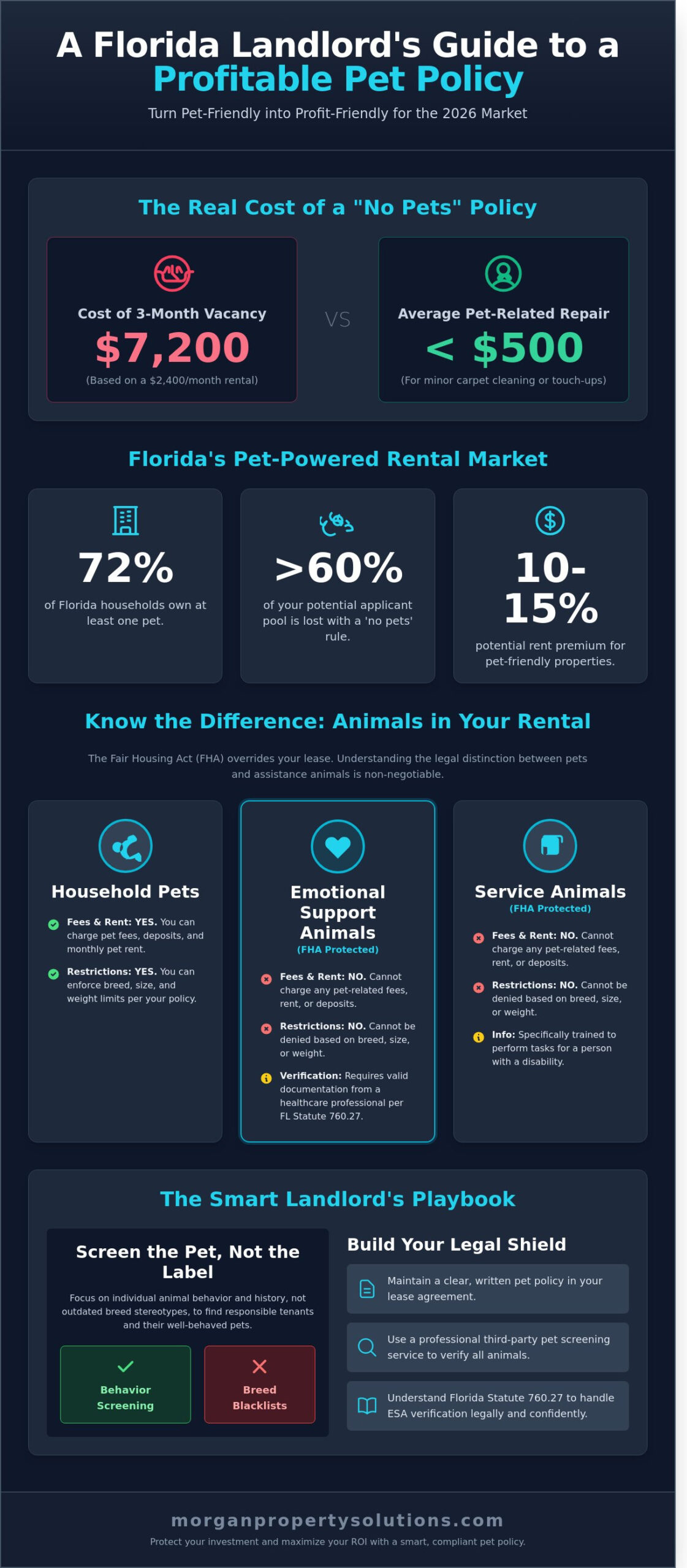
The financial risk of property damage is a common fear, but the data tells a different story. The cost of a three-month vacancy in a $2,400-a-month rental is $7,200. Compare that to the average pet-related repair, which usually stays under $500 for minor carpet cleaning or baseboard touch-ups. By opening your doors to pets, you drastically reduce the time your property sits empty. Plus, pet owners tend to stay longer because they know how difficult it is to find another quality home that welcomes their animals. This leads to higher tenant retention and less money spent on marketing and turnover.
A written policy is your only real shield. Without it, you are vulnerable to “he said, she said” disputes that can get messy quickly. Grounding your agreement in Landlord-Tenant Law Basics ensures that your rules are enforceable and fair. We often recommend using tools like our pet screening service to vet animals just as thoroughly as you vet their owners. This professional approach removes the guesswork and protects your investment.
The 2026 Florida Market: A Pet-Heavy Landscape
Recent data shows that over 72% of Florida households now include at least one furry family member. In high-demand hubs like Orlando and Tampa, tenants are actively looking for “pet-friendly” filters on every search engine. These renters are often willing to pay a premium of 10% to 15% above standard rates for the right spot. If you decide to ignore pet owners, you are effectively cutting your potential applicant pool by more than 60%.
This demand for animal-friendly spaces is a trend seen across all types of real estate. For instance, those looking to invest in larger-scale equestrian estates or acreage can learn more about Colorado Horse Property to see how specialized properties cater to animal owners’ needs.
The Risk of Saying No to Fido
Strict “no pets” policies often backfire. Instead of keeping animals out, they often lead to “hidden” pets. When a tenant sneaks a dog into a unit, they won’t report issues like a leaky water bowl or a scratched door because they are afraid of being caught. This leads to more damage than if the pet were there legally. By acknowledging pets as family members, you build trust. This transparency allows you to collect appropriate deposits and conduct regular inspections, keeping your property in top shape while making your tenants feel truly at home.
Navigating the Legal Side: ESAs and Service Animals
The Fair Housing Act (FHA) serves as the ultimate authority in this space. It essentially bypasses any “no pets” rule you might have in place. When you are drafting a pet policy for rental property florida, you have to recognize that assistance animals occupy a unique legal category. They aren’t pets; they are viewed as essential tools for daily living. This distinction is vital because it changes every rule in your standard lease agreement.
FHA vs. Your Policy: Who Wins?
Federal law always overrides local lease clauses. Even if your property has a strict “no animals” stance, the FHA mandates that you provide a reasonable accommodation for those with disabilities. This means you cannot charge pet rent, one-time pet fees, or security deposits for these animals. Since they aren’t legally pets, your standard financial protections for animal damage don’t apply in the same way. If you feel unsure about how to process these requests, looking through some landlord resources can help you stay compliant while protecting your investment.
Spotting the Difference: Service Animals vs. ESAs
Service animals are almost always dogs trained to perform specific tasks. This might include guiding someone who is blind or alerting a person to an oncoming seizure. Emotional Support Animals (ESAs) are different. They provide comfort for mental or emotional conditions and don’t require specific task training. Both groups are protected under the FHA, but your right to ask for proof depends on the situation.
If a tenant’s disability isn’t obvious, you can request documentation from a healthcare professional. You should be wary of those $50 “ESA certificates” bought from online mills. According to Florida Statute 760.27, landlords have the right to ask for information from a practitioner who has personal knowledge of the patient. If the documentation comes from a website that sells registrations without a real clinical relationship, it likely won’t meet the legal standard in Florida.
By 2026, Florida has become even more specific about these interactions. You can’t ask a tenant about the specific nature of their disability or demand to see medical records. However, you can ask if the animal is required because of a disability and what work it has been trained to do. Mismanaging these requests is risky. In 2020, Florida updated its laws to make it a second-degree misdemeanor for a person to provide fraudulent ESA documentation; but landlords can also face steep administrative fines if they wrongly deny a legitimate request. Keeping your pet policy for rental property florida updated with these 2026 standards is the best way to avoid a costly legal headache.
Dollars and Cents: Fees, Deposits, and Pet Rent
Florida law gives you a lot of room to move when deciding how to charge for four-legged residents. It is a balancing act. You want to protect your investment, but you also want to keep your unit occupied by a reliable tenant. Being upfront about these costs in your screening criteria is the best way to keep everyone on the same page from day one. When you are building a pet policy for rental property florida, you have to decide between a one-time fee, a monthly rent, or a refundable deposit. Each has its own psychological effect on the renter.
Non-Refundable Fees vs. Refundable Deposits
A non-refundable pet fee is a one-time payment that stays in your pocket. It is great for your bottom line because it covers the general wear that comes with pets, like that faint “doggy” smell or minor scratches on the door frames. However, a refundable pet deposit often works better as an incentive. If a tenant knows they might get $300 back at the end of the year, they are much more likely to keep the cat away from the window screens.
While Florida does not have a strict legal cap on security deposits, most successful landlords keep the total package under two months’ rent to stay competitive. It is also vital to remember that these charges do not apply to everyone. Under the HUD Guidelines on Assistance Animals, you cannot charge pet fees or deposits for documented service or support animals. They are not considered pets in the eyes of the law, and trying to charge for them can lead to expensive legal headaches.
Is Pet Rent Worth the Extra Paperwork?
Many owners wonder if an extra $30 or $50 a month is worth the hassle. In the 2026 market, standard pet rent in Orlando and Tampa usually ranges from $25 to $60 per pet. Over a standard 12-month lease, that is an extra $300 to $720 in your pocket. This money acts as a buffer for “extra wear and tear” like deep carpet cleanings or lawn repair, which is why some investors turn to EverTurf Inc for synthetic turf that holds up against heavy pet use.
We believe in making this process as simple as possible. You shouldn’t have to chase down separate checks or manage complex ledgers. By using an online owner portal, pet rent is automatically bundled with the monthly payment. This keeps your records clean and your cash flow steady. It turns a potential “pet policy for rental property florida” headache into a predictable stream of income that protects your property value.
Building a Paws-itive Screening Process
Screening the human is only half the battle. If you want a stress-free experience, you have to screen the pet too. Since roughly 70% of Florida households now include a furry family member, your pet policy for rental property florida shouldn’t just be about saying yes or no. It is about finding the right fit for your specific home and protecting your investment from day one. We believe in a process that is thorough but fair, ensuring that both the tenant and the property stay in great shape.
Beyond the Breed: Assessing the Individual Pet
Many landlords still rely on outdated breed lists, but in 2026, behavioral history is a much better predictor of success. We’ve found that a “scary” breed with a Canine Good Citizen (CGC) certification is often a better tenant than a tiny Yorkie with a habit of chewing through drywall. You should always ask for pet references from the last two landlords. If a previous owner says the dog was quiet and never caused damage, that is a green flag. You can also spot signs of a responsible owner during the initial showing. If the pet is well-groomed and the owner has a leash and waste bags ready, they likely take their responsibilities seriously.
The Documentation You Actually Need
Don’t leave things to chance or verbal agreements. You need a solid paper trail to keep things professional. Start with up-to-date rabies vaccinations; this is a non-negotiable safety requirement in Florida. We also recommend requiring proof that the pet is spayed or neutered. This simple step prevents territorial marking and the “surprise” of an unplanned litter in your rental unit. Finally, require a comprehensive pet profile. This should include a recent photo of the animal and emergency contact information for a local vet or pet sitter. If something happens to the tenant, you need to know exactly who to call to ensure the animal is cared for.
To take the bias out of the process, we use professional tools like PetScreening.com. This service provides a “Fido Score” based on actual risk factors, which helps keep your pet policy for rental property florida consistent and legally compliant. It moves the conversation away from gut feelings and toward data-driven decisions. By standardizing your approach, you reduce the risk of fair housing complaints and ensure every pet is judged by the same set of rules.
Want to make sure your property is fully protected? Check out our full tenant screening criteria to see how we help owners find the best residents.
Making It Simple: Professional Management Solutions
Let’s be honest: keeping track of pets is a 24/7 job that leaves many DIY landlords feeling completely burnt out. It isn’t just about collecting a deposit and moving on. It’s about the constant vigilance required to ensure your investment stays protected. A solid pet policy for rental property florida isn’t just a document you sign once; it’s a living part of your management strategy. Without professional oversight, that high-ROI asset you’ve worked so hard for can quickly turn into a source of constant stress. We’ve seen how the right policy makes the difference between a thriving rental and a total headache. Check out our landlord resources for more ways to simplify your life and protect your equity.
Why Outsourcing the Pet Headache Saves Money
Professional inspections catch pet-related issues before they turn into $5,000 renovation projects. For example, we’ve seen cases where a small, recurring leak from a heavy water bowl caused $3,200 in subfloor damage because it wasn’t spotted during a casual walkthrough. Our team knows exactly where to look. Expertise in Florida law also reduces your risk of a Fair Housing lawsuit. Since 2020, requests for emotional support animals have surged, and saying the wrong thing during a screening can lead to legal trouble that costs more than a year’s worth of rent. We also manage the tricky transition when a tenant decides to “add” a pet six months into their lease, ensuring all paperwork and fees are handled immediately without any awkward confrontations.
The Morgan Property Solutions Approach
We treat your property like our own, and that includes the four-legged tenants living there. Our team uses modern technology to track compliance and document property conditions with high-resolution photos throughout the year. This removes the “he-said, she-said” arguments during move-out. We’re the ones who step in to have those uncomfortable talks about pet damage or noise complaints so you don’t have to. By providing a clear, firm implementation of your pet policy for rental property florida, we keep the relationship with your tenant professional and your property in top shape. Ready to make your rental life simple? Let’s talk about managing your Florida property.
Take the Next Step Toward a Stress-Free Rental
Creating a solid pet policy for rental property florida is really about finding a balance that works for your wallet and your peace of mind. You now have the tools to handle ESA requests legally and the knowledge to set up a fee structure that actually covers your risks. Remember that thorough screening is your best defense against property damage, and it starts with asking the right questions from day one. You’ve got the roadmap to turn your property into a pet-friendly haven without sacrificing your investment’s safety.
We’ve spent over 20 years helping Central Florida owners navigate these exact challenges. Our team uses a comprehensive PetScreening integration to ensure every animal is vetted with data-driven precision, so you don’t have to worry about the details. With our A+ BBB rating and decades of local expertise, we make the entire process feel simple and manageable. You deserve to enjoy your investment without the constant stress of “what ifs” or legal gray areas.
Simplify your rental business with Morgan Property Solutions today. We’re ready to guide you through every step of the journey and help your property thrive in 2026 and beyond.
Frequently Asked Questions
Can I legally refuse pets in my Florida rental property?
Yes, you can legally refuse pets in your Florida rental property. Florida statutes don’t require landlords to accept animals unless they’re service or support animals. About 70% of Florida renters own pets, so while you can say no, you’ll likely be limiting your tenant pool. Our team at Morgan Property Solutions helps you weigh the pros and cons of this decision to ensure your investment stays protected and profitable.
What is the maximum pet deposit I can charge in Florida?
Florida law doesn’t set a specific dollar limit on pet deposits. Roughly 85% of landlords we work with charge between $200 and $500 per animal. Since this deposit is refundable under Florida Statute 83.49, you must return it within 15 to 60 days after the tenant moves out, minus any documented repair costs for pet damage. We recommend keeping detailed photos of the property before and after the lease to justify any deductions.
Do I have to allow emotional support animals if I have a “no pets” policy?
You must allow emotional support animals even if you have a strict “no pets” policy. Under the federal Fair Housing Act and Florida Statute 760.27, these aren’t considered pets. You can’t charge a pet deposit or monthly rent for them. However, you’re allowed to request written documentation from a healthcare provider if the disability isn’t obvious. Dealing with these requests can be tricky, but we’re here to guide you through the compliance process.
Can a landlord restrict specific dog breeds in Florida?
Yes, Florida landlords can restrict specific dog breeds in their rental agreements. While Florida Senate Bill 942, passed in 2023, prevents local governments from banning specific breeds, private landlords still have the right to set their own rules. Over 80% of owners exclude breeds like Pit Bulls or Rottweilers because 90% of standard homeowners insurance policies have “restricted breed” lists. It’s important to list these exclusions clearly in your lease to avoid any confusion later on.
Is it better to charge a pet fee or monthly pet rent?
Monthly pet rent is often better for long-term cash flow and covering wear and tear. Our data shows pet rent ranging from $25 to $50 per month in the Florida market. A one-time pet fee, typically $300, is non-refundable but only provides a single payment. Combining these options helps you create a solid pet policy for rental property florida that protects your bottom line while keeping the home accessible to great tenants.
What happens if a tenant brings in a pet without telling me?
If a tenant sneaks in a pet, they’ve committed a lease violation. You should issue a 7-Day Notice to Cure under Florida Statute 83.56. This gives the tenant exactly one week to either remove the animal or pay the required fees. If they don’t fix the issue by day 8, you have the legal right to start the eviction process. We suggest doing quarterly inspections to catch these issues before they cause at least $500 in damage to your floors.
Can I evict a tenant in Florida for a pet policy violation?
You can evict a tenant for a pet policy violation if they fail to follow your written lease terms. After you serve a 7-Day Notice to Cure, the tenant must comply or leave. If they continue to keep the unauthorized pet after those 7 days, you can file for eviction in a Florida county court to regain possession of your property. Our team handles these stressful situations for you, ensuring every legal step is followed perfectly.
Are there specific insurance requirements for pet-friendly rentals in Florida?
There aren’t specific state mandates, but we recommend requiring tenants to carry at least $100,000 in personal liability insurance. This coverage should specifically include animal liability to protect you from lawsuits if the pet bites someone. About 65% of pet-related insurance claims involve dog bites; having this requirement in your pet policy for rental property florida is a smart move for every landlord. It’s a simple step that provides you with peace of mind.

Article by
Oliver Overton-Morgan
Oliver Overton-Morgan is a full-time Real Estate Broker since 2003, with years of experience helping thousands of people purchase and sell real estate throughout Central Florida. He holds a Graduate Realtor Institute designation, LCAM, and has held licenses in good standing as a Florida Mortgage Broker and a Notary Public. Oliver immigrated to central Florida in 2001, and within 5 years Oliver built a successful Real Estate brokerage in central Florida, where he recruited over 75 Sales Associates with 25+ million in sales production.