
What if your next rent increase was the only thing standing between a profitable year and a stressful financial loss? With Florida property insurance premiums climbing by an average of 42 percent in recent cycles, many owners are feeling the squeeze. You likely already realize that keeping a great tenant is often more cost-effective than starting over with a vacancy, but you still have to keep up with the market. It’s a delicate balancing act that requires both a clear plan and a solid understanding of the law.
We’re here to make things simple by explaining exactly how much can a landlord raise rent in florida as we head into 2026. You’ll get a clear, human-friendly breakdown of the state’s “no limit” rule and the specific notice requirements you need to follow to stay protected. We’ll also walk through a strategy to help you stay profitable in competitive areas like Orlando and Tampa without risking a legal dispute or losing the people who take care of your property.
Key Takeaways
- Understand why Florida law currently prohibits local governments from setting rent caps, giving you more flexibility with your investment pricing.
- Learn how to run a comparative market analysis so you can set a competitive rate that keeps your best tenants in place.
- Get a clear breakdown of how much can a landlord raise rent in florida and the specific written notice rules you must follow to stay legal.
- Identify the common legal pitfalls, like retaliation and discrimination, that can turn a simple rent adjustment into a costly mistake.
- Discover how professional property management can handle the “awkward” conversations for you while using real-time data to simplify the process.
Understanding Florida Rent Increase Laws in 2026
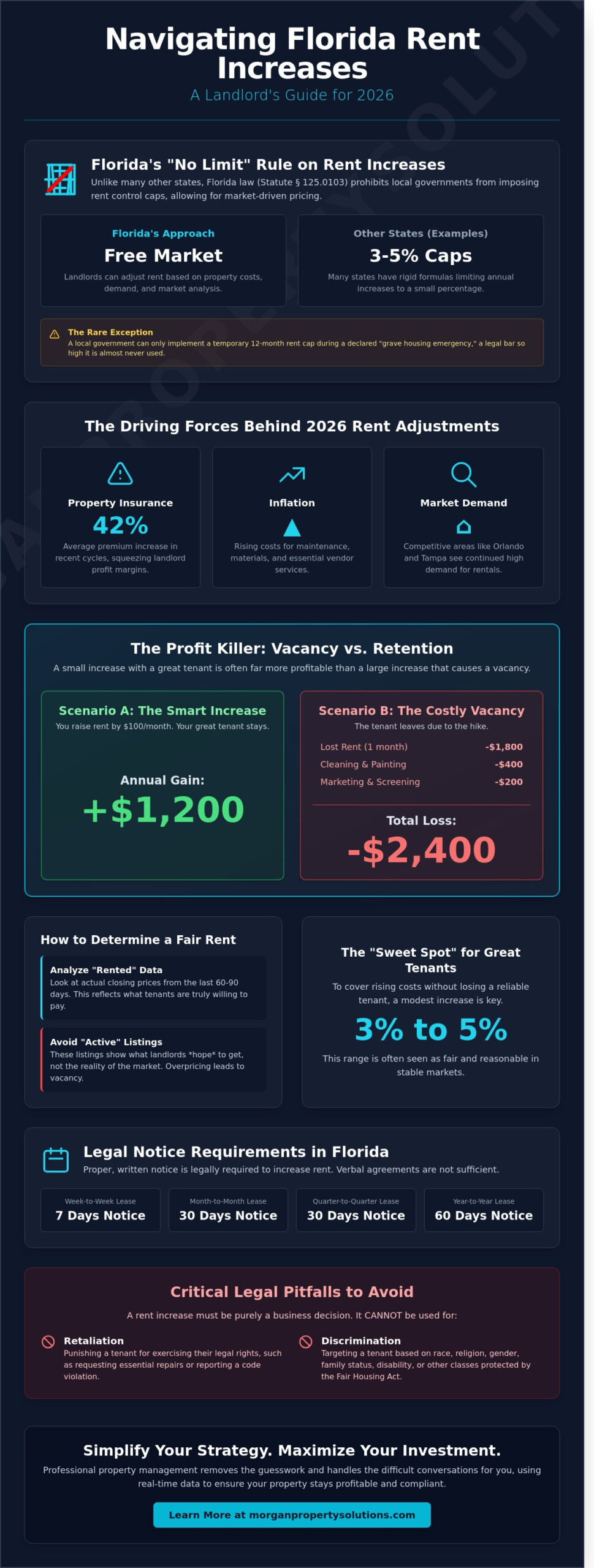
If you’re wondering how much can a landlord raise rent in florida for 2026, the answer is simpler than you might think. Let’s start with the big question: No, there is no statewide rent control in Florida. Unlike some states that set a hard percentage cap on annual increases, Florida allows the market to dictate what a fair price looks like. This means you have the flexibility to adjust your rates based on your specific property costs and the current demand in your neighborhood.
The foundation of this policy is Florida Statute § 125.0103. This law is very clear; it actually bans local governments from setting their own rent caps. Whether you own property in a small town or a bustling metro area, the state ensures that local councils can’t step in and tell you what to charge. This landlord-friendly stance is designed to encourage investment and keep the housing supply moving. For your 2026 strategy, this means you can focus on your property’s value without worrying about sudden local legislative hurdles.
There’s only one rare exception to this rule. A local government can implement a temporary 12-month rent cap only during a strictly declared housing emergency. However, the legal bar for this is incredibly high. The local government must prove that the housing shortage is so severe it constitutes a grave menace to the community. Even then, it usually requires a public vote. It’s a safety valve that is almost never used, leaving the free market as your primary guide.
The Reality of Rent Control in the Sunshine State
To understand why Florida’s approach is unique, it helps to look at Rent control in the United States as a whole. In many other states, landlords deal with complex boards and rigid formulas that limit increases to 3 or 5 percent annually. Florida prioritizes a different path, favoring a free-market approach for residential leases. Even in high-demand cities like Orlando or Miami, local officials don’t have the power to override state law to implement price ceilings. This creates a predictable environment for owners who need to balance their books.
Why Landlords Are Adjusting Rates in 2026
We know that raising rent isn’t just about maximizing profit; it’s often about keeping up with the rising costs of ownership. Florida property insurance has been a major factor lately. Many owners have seen their premiums jump by 40 percent or more over the last two years. When you combine that with inflation affecting the cost of maintenance, vendor services, and materials, adjusting your rates becomes a necessity for staying profitable.
While property insurance impacts your business bottom line, it is also wise to consider how other insurance changes might affect your personal financial planning in 2026; you can visit Safe Harbor Financial Resources to explore retirement and supplemental health options.
It’s vital to stay informed as the market shifts. We’ve developed several landlord resources to help you stay updated on legislative changes and management best practices. Understanding how much can a landlord raise rent in florida is just the first step in building a sustainable, long-term investment plan that works for both you and your tenants.
How to Determine a Fair Rent Increase for Your Property
Setting the right price for your rental is more of an art than a science. While you might be wondering exactly how much can a landlord raise rent in florida to maximize your profits, the answer usually lies in local market data rather than a random high number. If you push the rent $500 above the neighborhood average, you aren’t just testing the market; you’re often inviting a long vacancy. It’s better to have a property occupied at a fair price than sitting empty while you wait for a “unicorn” tenant who is willing to overpay.
Analyzing the Central Florida Rental Market
In 2024 and 2025, Central Florida markets like Orlando and Lake Nona have seen steady demand, while Tampa remains one of the most competitive areas in the state. To get an accurate picture of what you should charge, don’t just look at “active” listings on popular rental sites. Those figures represent the prices landlords hope to get, not necessarily what they receive. Instead, look at “rented” data from the last 60 to 90 days to see the actual closing prices. Fair Market Rent is the price a willing tenant pays in an open market. Staying grounded in this data helps you remain compliant with the Florida Residential Landlord Tenant Act while keeping your investment profitable and competitive.
The Tenant Retention vs. Profitability Scale
There’s immense value in what we call a “gold-star” tenant. If you have someone who treats the home like their own, communicates issues early, and pays on time every month, you want to keep them. In stable markets, a 3% to 5% annual increase is usually the sweet spot. This small adjustment helps cover your rising property taxes and insurance premiums without feeling like a “move-out notice” to the tenant. If you want to dive deeper into these investment strategies, you can find more tips in our real estate articles.
The hidden cost of vacancy is the biggest profit killer for Florida landlords. Let’s look at the numbers:
- The $100 Increase: You raise rent by $100, earning an extra $1,200 per year.
- The Vacancy Cost: The tenant leaves because of the hike. You spend $1,800 on one month of lost rent, $400 on professional cleaning and touch-up paint, and $200 on new marketing and screening.
- The Result: You’ve spent $2,400 to chase a $1,200 gain. It takes two full years just to break even.
Balancing your ROI with tenant happiness is how you build long-term wealth in real estate. If you’re feeling stuck on the specific numbers for your zip code, we offer a variety of landlord resources to help you make an informed, stress-free decision.
The Legal Requirements for Notifying Your Tenants
While Florida law doesn’t place a cap on the dollar amount of an increase, the procedure for implementing that change is strictly regulated. You can’t just mention a price hike during a casual phone call or send a quick text message on the first of the month. To make the increase legally binding, you must provide a formal written notice. This document serves as a clear record of your intentions and protects you if a dispute arises later. Following the rules keeps your investment profitable and your professional reputation intact.
If you’re wondering exactly how much can a landlord raise rent in florida, remember that the “how” is often more important than the “how much” in the eyes of a judge. Clear communication is the backbone of a successful rental business. We always suggest checking out the Florida Bar’s landlord-tenant guide to see how these statutes translate into real-world requirements. It’s a reliable way to ensure you’re staying on the right side of the law while managing your properties.
Notice Periods Based on Lease Type
The amount of lead time you owe your tenant depends entirely on the structure of your rental agreement. For annual leases, providing 60 days of notice is the industry gold standard in 2026. This gives your tenant two full months to decide if they’ll renew or start looking for a new home. If your lease is silent on the matter, Florida law typically defaults to the terms of the agreement, but 60 days remains the safest bet for maintaining a positive relationship.
For month-to-month tenancies, the rules are more specific. Under Florida Statute 83.57, you must provide at least 30 days of notice before the end of the monthly period. If you have a quarter-to-quarter lease, that same 30-day rule applies. Giving anything less than the required timeframe can result in the tenant legally paying the old rate for an extra month, which can eat into your projected margins. You can find more templates and tools for these situations in our landlord resources section.
Drafting a Professional Rent Increase Letter
A professional letter does more than just state a new price. It should clearly list the effective date of the increase, the new total monthly amount, and a specific deadline for the tenant to accept the terms or give notice of their intent to move. We recommend sending this via certified mail with a return receipt requested. This provides you with physical proof that the tenant received the notice, which is invaluable if they later claim they were never informed.
Don’t forget to address the security deposit in your letter. If your lease requires a deposit equal to one month’s rent, a rent hike means the deposit is now technically “short.” For example, if rent moves from $2,100 to $2,300, you should request the additional $200 to keep the deposit current. Handling this during the initial notice keeps things simple and prevents confusion when the new lease term begins. Taking these extra steps shows you’re a detail-oriented professional who values clear, honest business practices.
Avoiding Legal Pitfalls: Retaliation and Discrimination
While Florida law doesn’t set a hard cap on rent hikes, it’s a mistake to think you have total freedom. There are two major “red lines” that can turn a standard notice into a legal nightmare: retaliation and discrimination. Even if you follow all the rules for notice periods, the reason behind your decision matters just as much as the amount you choose. If a tenant feels they’re being targeted unfairly, they may seek legal counsel, which can lead to expensive settlements or court dates.
The Danger of Retaliatory Increases
Florida Statute 83.64 is very clear about what landlords can and cannot do when a tenant exercises their legal rights. You cannot raise the rent simply because a tenant complained about a safety issue to code enforcement or joined a tenant union. This is considered a retaliatory increase and it’s strictly prohibited. If a tenant has filed a formal complaint about a leak or a broken HVAC system, any rent hike within the next six months is often viewed with high suspicion by the courts. This “protected window” means you need to be extra careful with your timing.
To stay safe, you must be able to prove a non-retaliatory reason for the hike, such as documented increases in property taxes or insurance premiums. Keeping a folder of your own rising costs is a smart way to show that your decision is based on business reality, not a personal grudge. If you can’t show a clear financial reason for the change, a judge might decide you’re just trying to push a “difficult” tenant out, which is a losing battle for you.
Fair Housing Compliance for Landlords
The federal Fair Housing Act is another area where you can’t afford to slip up. When you’re deciding how much can a landlord raise rent in florida for your various properties, you have to ensure the numbers aren’t based on a tenant’s race, religion, or familial status. For example, you can’t charge a higher rate to a family because they have children, as this violates protections against discrimination based on familial status. Consistency is your best friend here. If you own three identical units in the same building, raising the rent on only one of them without a clear justification looks like a red flag to investigators.
You also need to be aware of “disparate impact.” This happens when a policy seems neutral on the surface but ends up hurting one protected group more than others. To avoid these risks, many successful owners rely on established screening criteria to ensure every tenant is treated with the same level of professionalism and fairness from day one. When your policies are uniform, it’s much harder for anyone to claim they were singled out for an unfair rent increase.
If you want to make sure your rental business stays profitable and compliant, we can help you navigate these tricky waters. Check out our Orlando property management services to see how we protect your investment.
How Professional Management Simplifies Rent Adjustments
Managing a rental property is often more personal than people realize. When you’ve had a tenant for three or four years, asking for a $200 increase feels like you’re being the “bad guy.” This emotional weight often leads DIY landlords to keep rents stagnant, which eventually hurts the property’s long-term value. Professional management takes that burden off your shoulders. We handle the numbers based on market data, not personal feelings.
By using professional property management software, we track market shifts the moment they happen. You won’t have to guess how much can a landlord raise rent in florida in 2026 because our systems analyze comparable listings in Orlando and Tampa every single day. This ensures your property stays competitive without overcharging or leaving money on the table. We also make sure every notice is legally compliant and delivered within the strict windows required by Florida law, protecting you from potential disputes.
Negotiations are another area where we provide a massive benefit. If a tenant wants to counter-offer, we handle that conversation. We know how to balance the need for a rent increase with the value of keeping a reliable tenant. Our goal is to maximize your property’s performance while you stay completely hands-off.
The Morgan Property Solutions Advantage
We’ve spent over 20 years managing homes across Central Florida. That experience means we’ve seen every market cycle since 2004. Our team focuses on “Making Real Estate Simple” for owners who want to grow their wealth without the headache of daily operations. If you need local expertise, our Orlando property management team knows the specific neighborhood trends that dictate pricing. We use two decades of localized data to set the perfect price for your rental.
Technology Meets Personal Service
Our approach blends advanced tech with a human touch. Tenants use an online portal for seamless payments and communication; this makes a rent adjustment feel like a standard business update rather than a personal confrontation. We also conduct regular inspections to justify these changes through consistent property upkeep. When a tenant sees that their home is being well-maintained, they’re much more likely to accept a fair increase.
We know exactly how much can a landlord raise rent in florida while still maintaining a high retention rate. This professional buffer protects your relationship with the tenant while ensuring your investment remains profitable. It’s about reducing your stress and giving you back your time. You can trust us to take good care of you and your property every step of the way.
Take the Next Step Toward Stress-Free Management
Navigating the rental market in 2026 doesn’t have to be a headache. While Florida still lacks statewide rent control, you’ve got to stay sharp on local notice requirements and market shifts to avoid legal trouble. Most landlords find that a 60 day notice for yearly renewals keeps things transparent and professional. It’s all about balancing your bottom line with a fair deal for your tenants. Understanding exactly how much can a landlord raise rent in florida is just the first step in protecting your investment.
We’ve spent over 20 years helping Central Florida owners manage these transitions smoothly. With our A+ BBB rating and a streamlined online portal, we make the hard parts of property management feel simple. You don’t have to guess if your increase is fair or if your paperwork is perfect. We’re here to guide you through every adjustment so you can focus on growing your portfolio. Our team is ready to provide the expert support you need to keep your properties profitable and compliant.
Let us handle the complexities of your rental—get a free consultation today!
We look forward to helping you succeed with your rental property!
Frequently Asked Questions
Can my landlord raise my rent by $500 in Florida?
Yes, your landlord can legally raise your rent by $500 or any other amount because Florida doesn’t have rent control laws. Since the Florida Legislature passed Senate Bill 102, known as the Live Local Act, in 2023, local governments are blocked from setting price caps. This means market rates dictate the increase. You’ll want to check your lease agreement to see if there are any specific local terms that might apply to your situation.
Is there a limit on how often a landlord can raise rent in Florida?
There isn’t a specific number of times a landlord can raise rent, but they can’t do it while a fixed-term lease is active. For a standard 12-month lease, the price stays the same for all 365 days. Most owners adjust rates once a year during the renewal process. If you’re on a month-to-month agreement, they could technically propose a change every 30 days as long as they give you the proper legal notice.
Do I have to sign a new lease if my rent is increased?
You’ll typically need to sign a new lease or a written addendum to stay in the home at the higher price. If you don’t sign the new agreement, you’re essentially choosing not to renew your stay. In most cases, if you stay and pay the new amount for 2 months without a signature, Florida courts might view your payment as acceptance of the new terms. We always recommend getting everything in writing to keep things simple.
Can a landlord raise rent during a lease in Florida?
A landlord cannot raise your rent in the middle of a fixed-term lease unless the contract you signed specifically allows for it. Most Florida leases lock in your rate for the full term, whether that’s 7 months or a year. If you’re wondering how much can a landlord raise rent in florida during your term, the answer is usually zero until that lease expires or you agree to a written change.
What can I do if I think my rent increase is retaliatory?
You can challenge the increase in court if you believe it’s a direct response to you exercising your legal rights. Florida Statute 83.64 protects tenants who complain about building code violations or join a tenant union. You’ll need to prove the landlord’s primary motive was to punish you. Keep detailed records of all your interactions and any maintenance requests you’ve made over the last 12 months to support your legal case.
How much notice does a landlord have to give to raise rent in Florida for 2026?
For 2026, the notice period depends entirely on your pay schedule under Florida Statute 83.57. If you have a year-to-year lease, the landlord must give you at least 60 days of notice before the end of the term. For month-to-month renters, the requirement is only 15 days of notice. We suggest checking your specific lease, as many property managers voluntarily provide 30 or 60 days to keep the whole process stress-free.
Does a rent increase mean my security deposit also goes up?
A rent hike doesn’t automatically increase your security deposit, but your landlord can ask for an additional deposit amount during renewal. Many professional leases state the deposit must equal one month of rent. If your rent goes from $1,800 to $2,000, the landlord might ask for that extra $200 to keep the deposit current. It’s a common practice used to cover potential damages at the current market value of the home.
Can Florida cities like Orlando pass their own rent control laws?
No, cities like Orlando or Miami cannot pass their own rent control laws anymore. While Orlando voters approved a rent control measure in November 2022, the Florida Legislature effectively ended those efforts with the Live Local Act in 2023. This law preempts local governments from regulating the amount of rent charged for residential improvements. This ensures that how much can a landlord raise rent in florida remains consistent across all 67 counties.

Article by
Oliver Overton-Morgan
Oliver Overton-Morgan is a full-time Real Estate Broker since 2003, with years of experience helping thousands of people purchase and sell real estate throughout Central Florida. He holds a Graduate Realtor Institute designation, LCAM, and has held licenses in good standing as a Florida Mortgage Broker and a Notary Public. Oliver immigrated to central Florida in 2001, and within 5 years Oliver built a successful Real Estate brokerage in central Florida, where he recruited over 75 Sales Associates with 25+ million in sales production.