
Last Tuesday, a landlord in Orlando realized her star tenant’s contract was set to expire in just 14 days, leaving her with zero time to legally adjust the rent or find a replacement. That sudden panic is a feeling 42% of independent property owners face when they lose track of the calendar. It’s stressful to balance the fear of a vacancy with the uncertainty of how much you can legally increase rent without losing a great resident. You’ve worked hard to find someone who takes care of your investment, and the last thing you want is a legal oversight to end that relationship.
We’re here to help you make sense of the lease renewal process florida requires so you can move forward with total confidence. This guide gives you everything you need to know about 2026 legal requirements, notice periods, and proven strategies for keeping your best tenants happy. We’ll walk through a clear 90 day timeline and the specific steps to secure a signed renewal while staying fully compliant with Florida Statute 83.57. You’ll finish this article with a simple plan to protect your profits and your peace of mind.
Key Takeaways
- Get the timing right by mastering the 60-day rule so you stay fully compliant with Florida law and avoid unnecessary stress.
- Find out how to balance fair rent increases with keeping great tenants using our latest 2026 market insights for the Orlando and Tampa areas.
- Follow our simple, step-by-step lease renewal process florida guide to ensure your property stays protected and your paperwork is always up to date.
- Learn why a quick pre-renewal inspection is the best way to catch issues early and show your tenants you truly care about their home.
- Discover how partnering with a local expert can take the entire renewal cycle off your plate, making your landlording experience smooth and worry-free.
Understanding the Florida Lease Renewal Landscape in 2026
Think of a lease renewal as a fresh start rather than a simple continuation. It’s a strategic moment to reset the clock, update your terms, and ensure your investment is still performing at its peak. In 2026, Florida’s rental market remains incredibly active. With the state’s population projected to reach 23.5 million people by the end of the year, the demand for quality housing is high. This makes a proactive approach to the lease renewal process florida landlords follow more than just a good idea; it’s a necessity for protecting your bottom line.
Many “accidental landlords” fall into the trap of doing nothing. They might have inherited a property or kept an old home as a rental and assume that if the tenant stays, everything is fine. However, letting a lease expire without a new agreement often defaults the arrangement to a month-to-month tenancy under Florida Statute 83.01. This creates a lack of certainty that can be stressful for both parties. A formal renewal allows you to:
- Adjust rent to stay competitive with 2026 market rates.
- Update community rules or pet policies.
- Verify the tenant’s current contact information and emergency details.
- Inspect the property to ensure it’s being well-maintained.
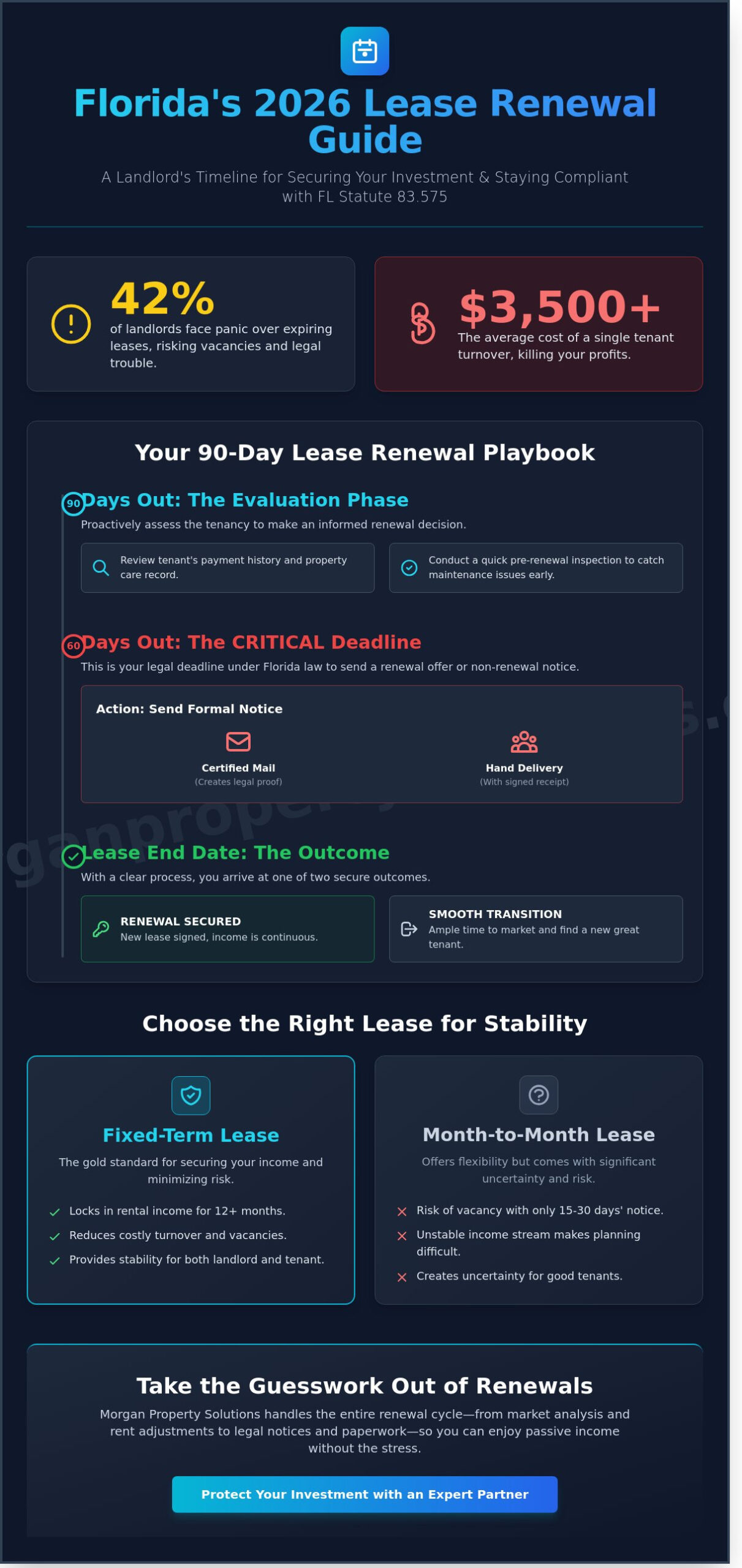
Mastering the lease renewal process florida requires requires starting at least 60 to 90 days before the current lease ends. This window gives you enough time to evaluate the tenant’s payment history and decide if you want to invite them to stay for another year. It’s all about keeping things simple and stress-free for everyone involved.
Fixed-Term vs. Month-to-Month: Which is Better for You?
Fixed-term leases are the gold standard for stability in Central Florida. When you sign a 12-month renewal, you’re securing your income and reducing the risk of a mid-season vacancy. Month-to-month arrangements offer flexibility if you plan to sell the property or move back in, but they come with high risks. Under current Florida law, either party can typically terminate a month-to-month lease with just 15 days’ notice. For most 2026 investment goals, the security of a fixed term is much more dependable.
Why a Good Renewal Strategy Saves You Thousands
Tenant turnover is the silent profit killer for Florida property owners. Between deep cleaning, repainting, marketing costs, and the loss of rent while the home sits empty, a single vacancy can easily cost $3,500 or more. Keeping “the tenant you know” is almost always the more profitable path. We’ve seen that clear communication and fair terms are the best ways to encourage good tenants to stay. If the thought of negotiating rent hikes feels overwhelming, professional property management can handle the entire process for you. We act as your trusted partner, making sure the paperwork is handled correctly while you enjoy the passive income from your investment.
Florida Notice Requirements: Timelines You Can’t Afford to Miss
Timing is everything when you’re managing a rental property. In Florida, the clock starts ticking long before the move-out date arrives. If you want a smooth lease renewal process florida landlords must stay ahead of these dates to avoid legal headaches or lost income. Florida Statute 83.575 is the primary rulebook here. It dictates how much notice you can require from a tenant and what happens if someone stays past the deadline. Most professional leases in the Sunshine State rely on the 60-day rule because it provides enough cushion to market the property if the tenant decides to leave.
Automatic renewal clauses are a common trap for the unwary. These clauses state that the lease automatically extends for another term unless one party gives notice. While they sound convenient, they can backfire. If you forget to send a notice to increase the rent or terminate the lease, you might be stuck with the same tenant at the same price for another year. If you miss the window entirely, the law usually favors the tenant. You might find yourself unable to raise the rent or regain possession of the home when you planned, which is why we always recommend keeping a detailed calendar of every expiration date.
The Legal Timeline for Fixed-Term Leases
Florida Statute 83.575 allows a lease agreement to require up to 60 days of notice from a tenant if they intend to vacate at the end of a fixed-term lease. To calculate your notice date, look at your lease end date and count exactly 60 days backward. For example, if a lease ends on December 31, 2026, you should have your renewal offer or non-renewal notice in the tenant’s hands by November 1, 2026. Don’t rely on a casual text message or a phone call for this. The proper way to deliver notice is through certified mail with a return receipt or hand delivery with a signed acknowledgment. This creates a paper trail that holds up in a Florida court if the tenant later claims they never heard from you. You can find more helpful templates and guides in our landlord resources section to help you stay organized.
Handling Month-to-Month Notice Periods
Ending or changing a monthly lease requires a different strategy. While state minimums vary, a 30-day notice is the standard requirement for terminating or changing the terms of a monthly tenancy in most modern Florida contracts. It’s a common mistake to think that 30 days means exactly 30 days from the moment you send the notice. In reality, the notice must be given at least 30 days before the end of the next rental period. If your tenant pays rent on the first of the month and you give notice on June 15, the lease doesn’t end on July 15. It actually ends on July 31. Landlords often trip up here by trying to force a mid-month move-out, which can lead to unnecessary disputes. We’re here to help you keep these dates straight so your transitions remain stress-free and profitable.
The Human Side: Balancing Rent Increases and Tenant Retention
Finding a great tenant is hard work. Keeping one is even harder, especially when your own costs are rising. In the 2026 Florida market, landlords are facing higher property taxes and insurance premiums that make a rent increase feel necessary. However, pushing for every last dollar can backfire if your best renters decide to leave. Managing the lease renewal process florida property owners handle every year is really about protecting your most valuable asset: a reliable tenant.
Think about the “Retention Discount.” If the current market rate for a three-bedroom home in Orlando or Tampa is $2,500, but your current tenant is paying $2,300, you don’t have to jump all the way to the top. Offering a renewal at $2,425 keeps you competitive while showing the tenant you value their history. A single month of vacancy often costs more than $2,500 when you factor in cleaning, marketing, and lost rent. Keeping a good person in place at a slightly lower rate is often the most profitable move you can make.
Determining the Right Rent Increase for 2026
To find the sweet spot, you need to look at the data. Florida’s rental market remains strong, but the “greedy jump” often leads to high turnover. Use our landlord resources to look at recent comps in your specific neighborhood. In 2026, renters are highly sensitive to the cost of living. If you can show that your increase is based on actual market shifts and rising utility or tax costs, they’re much more likely to accept it without resentment. It’s about being fair, not just following a trend.
The Conversation: How to Approach Your Tenant
The way you deliver the news matters as much as the number itself. A cold, formal notice taped to a door feels like a business transaction, not a relationship. Try a friendly email or a quick phone call first. You might say, “I’ve loved having you as a tenant, and I want to keep you here. Because of the rise in local taxes and insurance, I need to adjust the rent to $2,400 for the coming year.” This approach keeps the lease renewal process florida residents expect transparent and professional.
- Be ready to listen if they ask for a lower rate.
- Offer a small upgrade, like a smart thermostat, to add value to the increase.
- Explain the “why” behind the numbers to build trust.
If a tenant asks for a lower rate, don’t shut them down immediately. If they’ve been there for three years and never missed a payment, that reliability has a dollar value. You might agree to a smaller increase in exchange for a longer lease term, like 18 months. This gives you long-term stability and gives them peace of mind. It’s a win for everyone involved.
A Step-by-Step Guide to Executing the Renewal
Executing a renewal shouldn’t feel like a chore. It’s actually a great chance to reset the clock and make sure everything is on track for the coming year. We’ve found that a structured approach keeps things calm for both you and the tenant. When you follow a set routine, you don’t have to worry about missing a legal disclosure or a property maintenance issue.
The Pre-Renewal Inspection Checklist
Think of this as a “health check” for your rental. It’s a chance to catch small issues before they become expensive repairs. Instead of making it sound like a “test,” tell the tenant you’re doing a maintenance checkup to ensure the home is in top shape for another year. During your walk-through, focus on these key areas:
- Check for signs of moisture or slow leaks under every sink and around the water heater.
- Look for evidence of unapproved pets or extra people living in the home.
- Test the smoke detectors and check the expiration date on the fire extinguisher.
- Verify that the tenant is still maintaining the property according to the standards in our screening criteria.
Framing this as a service helps keep the relationship friendly. You’re there to make sure their home is safe and functional, which most tenants really appreciate. It also gives you a clear picture of how they’ve treated the property over the last twelve months.
Next, don’t skip the re-screening phase. A lot can change in a year. A tenant who was financially stable in 2025 might have hit a rough patch by 2026. Checking their current credit and criminal background again ensures your “great tenant” is still a low-risk fit for your property. This extra layer of protection is a hallmark of the professional lease renewal process florida landlords use to stay profitable.
Finally, get your paperwork ready. Whether you’re using a brand new lease or a simple addendum, make sure it includes any updated 2026 Florida legal requirements. Once the terms are set, it’s time to get those signatures and file everything away.
Using Technology to Simplify the Paperwork
By 2026, paper leases should be a thing of the past. We use digital portals because they’re faster and much safer. Digital signatures eliminate the “it’s in the mail” excuse and give you a clear timestamp of when the tenant agreed to the terms. Using a dedicated tenant portal also allows you to keep a digital paper trail of every payment and lease version in one spot. This organization is what makes the process stress-free. It’s much easier to pull up a file on your phone than to dig through a dusty filing cabinet.
If you’re feeling overwhelmed by the technical side of things, we can handle the heavy lifting for you. Our team has over 20 years of experience and an A+ BBB rating, so you can trust us to take good care of your investment.
Why Partnering with Experts Makes Florida Landlording Simple
Managing a rental property shouldn’t feel like a second full-time job that keeps you up at night. Since 2004, our team has helped landlords navigate the constant shifts in the Central Florida rental market. Whether you own a single-family home in Lake Nona or a multi-unit property in downtown Orlando, the lease renewal process florida requires a steady hand and deep local knowledge. We take over the entire cycle, from initial market analysis to the final digital signature, so you can focus on your own life instead of your leases.
Our approach is built on the idea of simplifying the complex. We know that Florida laws and local market trends change quickly, which is why we stay ahead of the curve for you. By trusting your property to a team with over 20 years of experience, you’re not just hiring a manager; you’re gaining a partner who treats your investment with the same care you do. We handle the logistical hurdles and the technical paperwork so your experience as a landlord remains entirely stress-free. Our local presence in the greater Central Florida area means we understand the specific neighborhood dynamics that drive tenant retention and rental value.
We believe that clear communication is the key to a successful landlord-tenant relationship. By acting as the primary point of contact, we eliminate the friction that often comes with lease discussions. This professional distance allows us to maintain high standards while ensuring your tenants feel heard and respected. When we manage the lease renewal process florida, we focus on creating a win-win scenario that keeps your property occupied by high-quality residents while maximizing your monthly returns.
The Morgan Property Solutions Advantage
We’ve built our reputation on a foundation of transparency. Our A+ rating with the Better Business Bureau is a reflection of our commitment to making real estate simple for every client we serve. Negotiations can often feel awkward, especially if you have a long-term tenant you’ve grown to know. We step in as the professional buffer to handle those tough conversations about rent increases or updated terms. You can meet the dedicated professionals on our about page to see the team that works behind the scenes to protect your interests.
Ready to Make Your Next Move?
Waiting until the final weeks to think about renewals is a common mistake that leads to expensive vacancies. We recommend looking at your options at least 60 to 90 days before a lease expires to ensure a smooth transition. If you’re ready to stop worrying about paperwork and start enjoying the benefits of your investment, we’re here to help. You can get started today with a free rental analysis or a personal consultation to see how we can boost your results. We look forward to being your trusted partner for years to come.
Take the Hassle Out of Your Next Renewal
Managing a rental property shouldn’t feel like a second full-time job. By staying ahead of the strict 2026 notice timelines and keeping your communication clear, you’re already ahead of most landlords. The lease renewal process florida requires is really about balancing your bottom line with keeping great tenants in place. It’s a delicate dance; getting it right means more stability and fewer empty units for your investment. Success in this market comes down to being proactive rather than reactive.
You don’t have to navigate these legal shifts or tenant negotiations on your own. At Morgan Property Solutions, we’ve spent over 20 years mastering the Central Florida market. Our team maintains an A+ rating with the Better Business Bureau because we focus on building trust and delivering results. We use proven systems designed to eliminate vacancy and help boost your profits while taking the weight off your shoulders. We’re here to guide you through every step so you can enjoy the rewards of owning property without the stress.
Let us handle your lease renewals; contact Morgan Property Solutions today!
We look forward to helping you make your landlording journey simple and successful.
Frequently Asked Questions
Is a 60-day notice required for lease renewal in Florida?
Yes, a 60-day notice is often required if your specific rental agreement includes this provision. Florida Statute 83.575 states that a lease may require up to 60 days’ notice from either the landlord or the tenant regarding renewal intentions. If your contract doesn’t specify a timeframe, the law defaults to 15 days for month-to-month tenancies. Keeping this timeline in mind helps make the lease renewal process florida landlords handle much more predictable.
Can a landlord increase rent without notice in Florida?
No, you can’t raise the rent without giving your tenant proper written notice first. For a standard month-to-month agreement, Florida law traditionally required 15 days’ notice, though many counties moved toward 60-day requirements in 2023 to give renters more breathing room. It’s best practice to provide 30 to 60 days’ notice regardless of the minimums to maintain a positive relationship and avoid sudden vacancies that hurt your bottom line.
What happens if a Florida lease expires and no new lease is signed?
The arrangement automatically converts into a month-to-month “tenancy at will” under Florida Statute 83.01. This means the tenant stays under the same general terms, but either party can end the agreement with just 15 days’ notice before the end of the monthly period. While this offers flexibility, most experts recommend signing a fresh document to keep your investment protected and the terms clear for everyone involved in the process.
Can a tenant refuse a lease renewal in Florida?
Yes, a tenant has every right to decline a renewal offer and move out at the end of their current term. You can’t force someone to sign a new contract if they’re ready to move on. In these cases, the tenant just needs to provide the notice period outlined in their original agreement, which is typically 30 or 60 days, to ensure they get their security deposit back without any legal issues.
Does Florida have rent control laws in 2026?
No, Florida does not have rent control laws because the state government passed the Live Local Act, also known as SB 102, in 2023. This legislation specifically prohibits local governments from imposing rent caps on private residential properties. Because of this state-wide preemption, landlords across all 67 counties have the freedom to set market-based rates that reflect the current value of their rental units without local government interference.
What is the maximum a landlord can raise rent in Florida?
There’s currently no legal limit on how much you can increase rent in the Sunshine State. Since the 2023 Live Local Act blocked local rent control, the market dictates the price. However, most professional managers suggest keeping increases within 5% to 10% to keep good tenants in place. Drastic jumps often lead to high turnover costs, which can cost you more than a modest increase helps you earn in the long run.
How do automatic renewal clauses work in Florida?
Automatic renewal clauses are legal and functional as long as they’re clearly written into the original lease agreement. These clauses state that the lease will renew for another term, often month-to-month or for a full year, unless one party gives notice by a specific date. This is a common part of the lease renewal process florida property owners use to ensure there’s never a gap in occupancy or legal coverage for the home.
Do I need a lawyer to renew a lease in Florida?
While not strictly required for standard renewals, consulting a professional ensures your interests are protected. If you are interested in how property law experts handle transactions in other major markets, you can visit Open Door Real Estate Lawyers to see how they help clients move forward with confidence.

Article by
Oliver Overton-Morgan
Oliver Overton-Morgan is a full-time Real Estate Broker since 2003, with years of experience helping thousands of people purchase and sell real estate throughout Central Florida. He holds a Graduate Realtor Institute designation, LCAM, and has held licenses in good standing as a Florida Mortgage Broker and a Notary Public. Oliver immigrated to central Florida in 2001, and within 5 years Oliver built a successful Real Estate brokerage in central Florida, where he recruited over 75 Sales Associates with 25+ million in sales production.