
Imagine it is 2:14 AM on a Tuesday in early 2026. You are jolted awake by a frantic call about a burst pipe, only to realize your go-to plumber hasn’t answered a text in over three months. It’s a frustrating reality for many DIY landlords who find themselves trading their peace of mind for what they think are savings. When you calculate the true cost of self-managing rental property, you have to look well beyond the monthly management fee. You must account for the dozens of hours you spend acting as a part-time repair coordinator and an amateur legal expert.
You likely invested in real estate to build a secure future for your family, not to spend your weekends stressed about Florida’s 2025 legislative changes or hunting for reliable contractors in a crowded market. This guide is designed to show you exactly where your money and time are going so you can decide if DIY is actually building your wealth or quietly killing it. We’ll look at the hidden financial leaks, the legal traps that catch even the most careful owners, and how a professional approach can actually put more profit in your pocket by the end of the year.
Key Takeaways
- Learn why the 10% you think you’re saving by DIY-ing is often offset by an “invisible salary” you’re paying yourself in lost free time.
- Identify the three biggest financial leaks—including vacancy and pricing errors—that drive up the true cost of self-managing rental property.
- Protect yourself from Florida’s legal minefield by mastering the strict timelines and rules for security deposits that most DIY landlords miss.
- Evaluate the “burnout factor” to decide if being on call 24/7 for maintenance emergencies is actually helping or hurting your long-term wealth.
- See how transitioning to a professional partner can simplify your investment strategy while keeping you firmly in the driver’s seat.
The DIY Landlord Trap: Why “Saving” on Fees Can Cost a Fortune
When you first look at your investment numbers, the math seems simple. By cutting out a professional manager, you keep that 8% to 10% monthly fee in your own pocket. It feels like an instant win for your bottom line. However, the real cost of self-managing rental property often stays hidden until you are deep into a difficult tenancy. You aren’t just saving a fee; you’re essentially hiring yourself for a high-stress job. We often see owners realize too late that their “free” management is actually the most expensive part of their investment because of the sheer volume of time it consumes—a challenge that full-service teams like TBM Property Management help owners in regions like Maryland overcome by handling every detail professionally.
Think of it as an invisible salary you pay yourself. If you value your time at $50 or $100 an hour, every afternoon spent chasing a repair or answering a tenant’s text is money out of your pocket. In the 2026 market, being a landlord isn’t a passive hobby anymore. It requires a level of efficiency that most people can’t maintain while working a full-time career or raising a family. Choosing Orlando property management experts often pays for itself simply by reclaiming those lost hours and preventing costly mistakes.
The “Part-Time Job” You Didn’t Know You Applied For
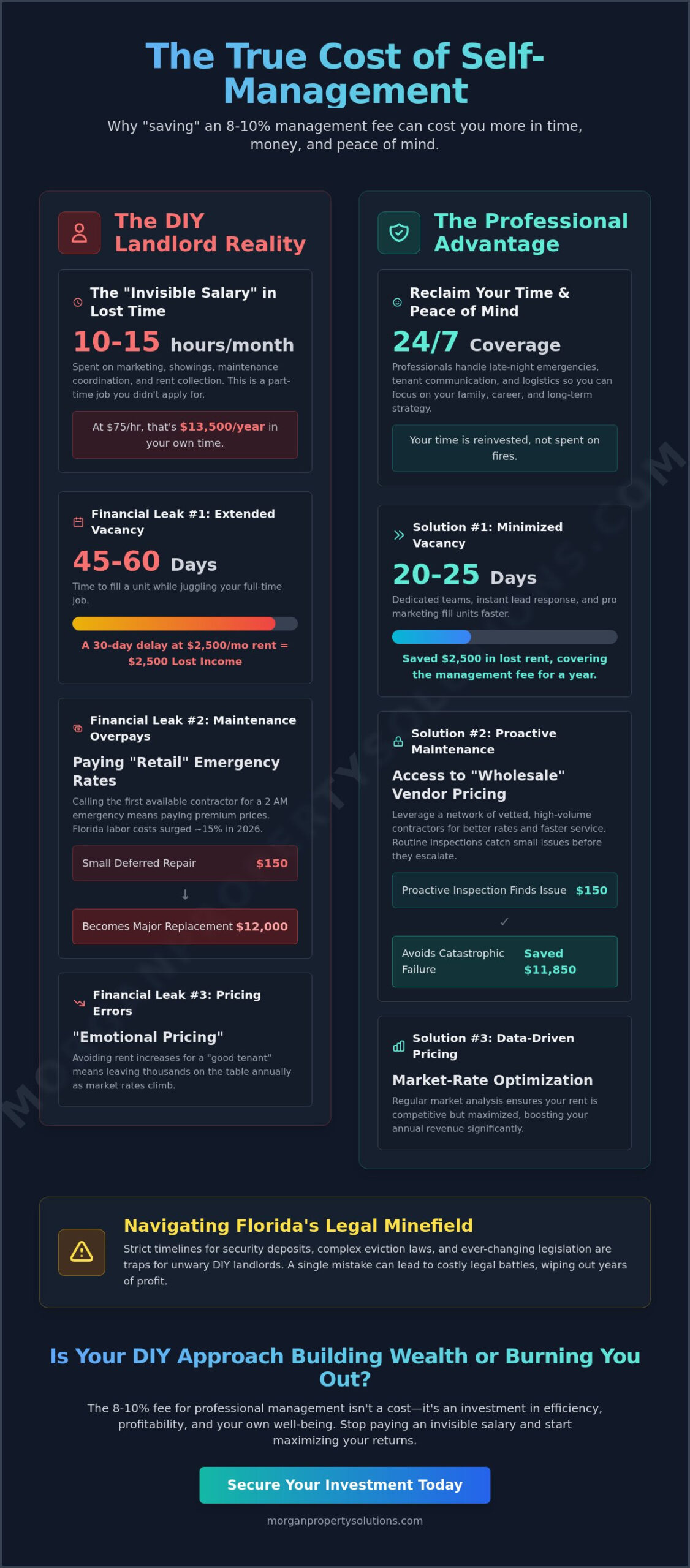
Managing a single unit can easily eat up 10 to 15 hours every month. This includes marketing the home, screening applicants, and coordinating maintenance. When a pipe bursts at 2:00 AM, you’re the one on call. Rent collection might seem easy, but it becomes a massive headache when life gets in the way and a tenant starts paying late. Beyond the logistics, you have to stay updated on Landlord-Tenant Law to ensure you aren’t accidentally violating any regulations. Ask yourself: what is your hourly rate at your actual job? If you’re spending 15 hours a month on one property, you might be “earning” less than minimum wage as a property manager.
The 2026 Central Florida Rental Landscape
The rental market in areas like Lake Nona and Belle Isle has become incredibly fast-paced. High demand means a single listing can generate 50 inquiries in 48 hours. In 2026, tenants expect instant communication. If you don’t respond to a lead within an hour, they’ve already moved on to the next house. The cost of self-managing rental property includes the risk of longer vacancies because you couldn’t get back to a prospect fast enough. Today’s market also demands professional-grade listing photos and high-tech virtual tours to stay competitive. Without these tools, your property sits on the market while your mortgage and tax bills keep coming.
Beyond technology, offering high-end amenities can also set your listing apart in a crowded market. For example, outfitting a home gym with quality equipment from Gym Pros can attract health-conscious tenants who are willing to pay a premium for a turnkey lifestyle.
Doing the Math: Quantifying the Financial Leaks of Self-Management
Many landlords choose the DIY route to save on the standard 8% to 10% management fee. On paper, it looks like a smart move. However, the true cost of self-managing rental property often shows up in “financial leaks” that are hard to spot until the end of the year. These leaks usually come from three specific areas: extended vacancy, retail maintenance pricing, and emotional rent setting. When you add these up, the DIY approach often ends up costing more than professional oversight.
To see how a professional team addresses these specific challenges, you can learn more about Parkerson Property Management and their approach to optimizing rental income.
The High Cost of an Empty House
An empty house is the most expensive thing you can own. We’ve seen that DIY landlords often take 45 to 60 days to fill a unit. This happens because they’re balancing showings around their own full-time jobs and family life. A professional firm typically fills a unit in 20 to 25 days because they have dedicated teams for marketing and tours.
Part of this efficiency comes from having reliable vendors ready to go. Professional services like Richard R. Rio, PLLC can handle the deep cleaning required between tenants, ensuring the property is presented in its best light as quickly as possible.
The math is simple but painful. If your rent is $2,500, every week the home sits empty costs you $625. If you take an extra month to find a tenant, you’ve lost $2,500 in cash flow. That single month of vacancy is equivalent to paying a management fee for an entire year. To avoid this, it’s vital to use professional tenant screening. Finding the right person the first time prevents the even higher costs of evictions or mid-lease breakups later on.
Maintenance: The “Retail vs. Wholesale” Problem
When a water heater leaks at 2:00 AM, a DIY landlord usually calls the first plumber they find on a search engine. You’ll likely pay the “retail” rate, which includes a premium for emergency service. Management firms don’t work that way. We maintain a preferred vendor list of contractors who give us “wholesale” pricing because we provide them with a high volume of work throughout the year.
This network also covers specialized exterior needs. For properties requiring significant land clearing or forestry mulching to maintain their value, Advantage Outdoors Land Services offers professional site preparation that professional managers can coordinate efficiently, saving you from the stress of vetting specialized contractors on your own.
In 2026, Florida labor costs have surged by roughly 15% due to high demand for skilled trades. Navigating these costs alone is difficult. It is also important to stay updated on your legal obligations through resources like the Florida Bar to ensure you’re handling repairs according to state law. Beyond the daily calls, “deferred maintenance” is a silent killer. Ignoring a small $150 roof patch today can easily turn into a $12,000 total replacement after a Florida summer storm. Professionals catch these small issues during routine inspections before they escalate.
Finally, many owners fall into the trap of “emotional pricing.” They don’t raise the rent for years because they like the tenant and don’t want to cause friction. If the market rent has increased by $250 but you haven’t adjusted your lease, you’re essentially giving away $3,000 of your wealth every year. If you want to stop the leaks and start treating your property like a true investment, you can check out our landlord resources to see how much more your property could be earning.
The Legal Minefield: Florida Landlord-Tenant Law in 2026
Let’s be honest: Florida’s rental laws aren’t just friendly suggestions; they’re strict requirements. In a Florida courtroom, “I didn’t know the law” isn’t a valid defense. Judges expect you to be an expert if you’re acting as a landlord. This legal pressure is a major part of the hidden cost of self-managing rental property. If you make a mistake during the tenant screening process, you could face a Fair Housing claim that drains your bank account before you even find a tenant. We act as your legal shield, staying on top of every legislative update so you don’t have to worry about expensive lawsuits.
Security Deposits and the 30-Day Rule
Florida Statute 83.49 is the rulebook for deposits, and it doesn’t offer second chances. If you intend to claim any portion of a security deposit for damages, you must notify the tenant by certified mail within 30 days. If you’re just returning the full amount, you have 15 days. Missing these deadlines by a single day means you forfeit your right to the money. A common DIY mistake is waiting for a repair quote that takes five or six weeks to arrive. By the time the landlord sends the notice, the 30-day window has closed. They’re then legally forced to return the full deposit despite the damage. As noted by Forbes, the administrative precision of a professional manager often saves more than the management fee itself by preventing these blunders.
Evictions and Documentation
Handling the Florida eviction process is another area where the true cost of self-managing rental property becomes clear. If you try to evict a tenant based on a “handshake deal” or a text message warning, you’ll likely lose in court. Judges in 2026 require specific, written notices delivered in a very particular way. You also need ironclad proof of the property’s condition.
Documentation is the only thing that holds up in front of a judge. This means having detailed move-in and move-out inspections with timestamped photos for every room. Without this evidence, it’s your word against theirs, and that’s a gamble you don’t want to take. Professional management ensures every interaction and inspection is documented, protecting your investment from expensive legal delays and lost rent.
The “Burnout” Factor: Your Quality of Life Audit
You probably didn’t buy an investment property because you wanted a second full-time job. Yet, many owners find themselves tethered to their phones, waiting for the next crisis. It’s the 3:00 AM call about a burst pipe or the constant ping of a text about a flickering light bulb. This mental weight is a massive part of the true cost of self-managing rental property that rarely shows up on a tax return. When you’re always “on call,” your personal life takes a back seat. It’s hard to enjoy a quiet dinner or a family vacation when you’re worried about a tenant lockout or an emergency repair.
Emotional Distance vs. Personal Connection
It’s natural to want to be a “nice” landlord. You start chatting with your tenants during inspections and soon you know their kids’ names and their career goals. While being friendly is great, it makes it incredibly difficult to run your property like a professional business. Enforcing a late fee feels cold when you know your tenant just had an expensive car repair. This emotional trap leads to “rent chasing,” which adds layers of stress to your daily life. A property manager serves as a necessary buffer. They handle the tough conversations and rule enforcement so you don’t have to. You get the peace of mind that comes from detailed financial reporting and consistent cash flow without the personal guilt or awkward face-to-face confrontations.
- You feel a pit in your stomach every time your phone rings.
- You’ve let a tenant slide on rent for more than two weeks because you felt bad for them.
- You haven’t raised the rent to market rates in years to avoid a “difficult” conversation.
- You’ve missed personal milestones or family events to handle a maintenance emergency.
- Your “passive” investment is taking up more than 10 hours of your personal time each month.
The Opportunity Cost of Your Time
Your time has a specific dollar value. If you spend 10 hours a month managing a single unit, that’s 120 hours a year. According to 2023 industry surveys, some self-managing owners spend up to 40 hours just handling a single tenant turnover. Ask yourself: could those hours be spent finding your next investment deal? For instance, you can explore Property Sourcing to identify high-potential opportunities while a professional team handles the management. Think about the value of a Saturday spent with family versus driving to Hunters Creek to fix a leaky toilet. Professional management fees are essentially a way to buy back your freedom. By delegating the day-to-day tasks, you can focus on high-level growth or simply enjoy the life your investments were supposed to fund in the first place.
We’re here to help you reclaim your time and protect your investment. See how our professional management can take the weight off your shoulders.
Simplifying the Complex: Transitioning to Professional Management
Deciding to hand over the keys to a professional doesn’t mean you’re giving up control of your investment. It actually means you’re gaining a dedicated partner who handles the midnight phone calls and legal paperwork while you focus on your bigger goals. Whether you are working with a local specialist or a firm like Van Treese Management in other regions, the goal is to shift from a reactive landlord to a proactive investor. When we talk about the true cost of self-managing rental property, we have to include the value of your own time and the stress of being on call 24/7. Most owners find that once they step back, they feel a huge weight lift off their shoulders.
Our onboarding process is designed to be as smooth as possible. When Morgan Property Solutions takes over, we handle the heavy lifting. This includes reviewing existing leases, performing a detailed property inspection, and introducing ourselves to your tenants as the new point of contact. We make sure the transition is seamless so there is no interruption in rent collection or property maintenance. You won’t have to worry about the awkward conversations or the legal nuances of 2026 compliance.
You’ll likely see an immediate boost to your bottom line through optimized pricing and vendor rates. We use real-time market data to ensure your rent is priced correctly. Often, self-managed owners leave money on the table by not adjusting for local demand, which adds to the hidden cost of self-managing rental property over time. Plus, our established relationships with local contractors mean you get professional work done at preferred rates that aren’t usually available to individual landlords.
What to Look for in an Orlando Property Manager
You need a team that knows the specific nuances of Central Florida neighborhoods. Managing a home in Oviedo requires a different approach than a luxury condo in Lake Nona. Look for a firm with an A+ rating from the Better Business Bureau and a history that spans at least 20 years. This kind of longevity proves they can handle market shifts and protect your assets. You can browse our real estate articles to see how we stay ahead of industry trends and local regulations.
Your First Step Toward a Stress-Free Investment
The journey starts with a comprehensive Rental Analysis. We don’t just guess what your home is worth. We look at comparable properties, current inventory levels, and seasonal trends to find the sweet spot for your monthly income. Our philosophy is built on Making Real Estate Simple. We want you to enjoy the benefits of owning property without the daily headaches that usually come with it. If you’re ready to see what your investment can really do, contact Morgan Property Solutions for a free rental evaluation today.
Take Back Your Time and Protect Your Investment
Owning a rental shouldn’t feel like a second full-time job that keeps you up at night. While it might seem like you’re saving a few dollars by handling everything yourself, the actual cost of self-managing rental property often shows up in lost personal time and the stress of navigating complex 2026 Florida landlord-tenant laws. When you factor in the 24/7 maintenance demands and the risk of a single legal oversight, the DIY approach can quickly become a financial drain rather than a benefit.
At Morgan Property Solutions, we’ve spent more than 20 years mastering the Central Florida market to ensure our clients don’t have to worry about the small details. With our A+ BBB rating and a commitment to transparency, we provide detailed financial reporting and 24/7 online portal access so you’re always in the loop without being in the weeds. We’re here to turn your property back into a passive income stream so you can focus on what really matters in your life.
Once your investment becomes truly passive, you can finally focus on the travel experiences you’ve been dreaming of; for example, you can discover KEYS property group to learn the best time to visit the beautiful city of Malaga.
Let us simplify your investment—Get your Free Rental Analysis today!
You’ve worked hard to build your portfolio, and we’re excited to help you watch it grow with total peace of mind.
Frequently Asked Questions
Is self-managing a rental property worth it for one unit?
It’s rarely worth it for one unit because the cost of self-managing rental property often exceeds the 10% average fee when you factor in your personal time. Most single-unit owners spend 10 to 15 hours monthly on tenant calls, repairs, and bookkeeping.
If you value your time at $40 per hour, you’re essentially paying $600 a month to do the work yourself. That’s a high price for a DIY project.
What is the average cost of property management in Orlando, FL?
In Orlando, property management fees typically range from 8% to 12% of the monthly gross rent collected. You should also expect a leasing fee, which is often 50% to 100% of the first month’s rent for finding a new tenant.
These rates vary based on the level of service and the total number of properties you own in Central Florida. It’s a standard investment for local peace of mind.
Can I deduct property management fees from my taxes?
You can fully deduct property management fees from your taxes as a legitimate business expense. According to IRS Publication 527, these costs are considered ordinary and necessary for managing and maintaining a rental home.
This deduction effectively lowers the net price you pay for professional help, making it much more affordable than it looks on paper. It’s a smart way to keep your profits high while reducing your workload.
How much time does it actually take to manage a rental property?
Managing a single rental takes about 60 hours per year on average, but that number jumps if you have a turnover. A single vacancy can require 20 hours for cleaning, listing, and showings.
The true cost of self-managing rental property includes these unpredictable spikes in your schedule that pull you away from your regular job or family. It’s hard to plan a vacation when a pipe might burst.
What happens if a self-managing landlord violates Florida Fair Housing laws?
Violating Florida Fair Housing laws can lead to civil penalties starting at $21,410 for a first-time offense. These fines are set by the Department of Housing and Urban Development and increase significantly for repeat violations.
Even an accidental mistake in your rental ad can trigger a costly legal battle that wipes out years of profit. Staying compliant is much easier with a licensed professional on your side.
How do property managers find better tenants than I can?
Managers find better tenants by using professional screening software that accesses national databases for evictions and criminal records. While a DIY landlord might only check a pay stub, pros verify employment with a 2-year history and talk to previous landlords.
This rigorous process helps keep the eviction rate below 1% for most professional firms. It’s about finding someone who will treat your home like their own.
Do I still have a say in maintenance decisions if I hire a manager?
You still have the final say on all major maintenance decisions and expenses when you hire a manager. Most management agreements include a maintenance limit, which is often set at $300 or $500.
Anything above that amount requires your direct approval before any work begins. You’re kept in the loop without having to handle the 2 a.m. phone calls or the stress of finding a plumber.
What is the “opportunity cost” of managing my own rental?
Opportunity cost is the financial value of the time you spend on your rental instead of more profitable activities. If your professional hourly rate is $75 and you spend 4 hours fixing a fence, that repair actually costs you $300 in lost income.
Hiring a pro allows you to focus on your career or find your next investment property. It’s about working on your business, not in it.

Article by
Oliver Overton-Morgan
Oliver Overton-Morgan is a full-time Real Estate Broker since 2003, with years of experience helping thousands of people purchase and sell real estate throughout Central Florida. He holds a Graduate Realtor Institute designation, LCAM, and has held licenses in good standing as a Florida Mortgage Broker and a Notary Public. Oliver immigrated to central Florida in 2001, and within 5 years Oliver built a successful Real Estate brokerage in central Florida, where he recruited over 75 Sales Associates with 25+ million in sales production.